

Biological Computer Market Overview and Key Insights:
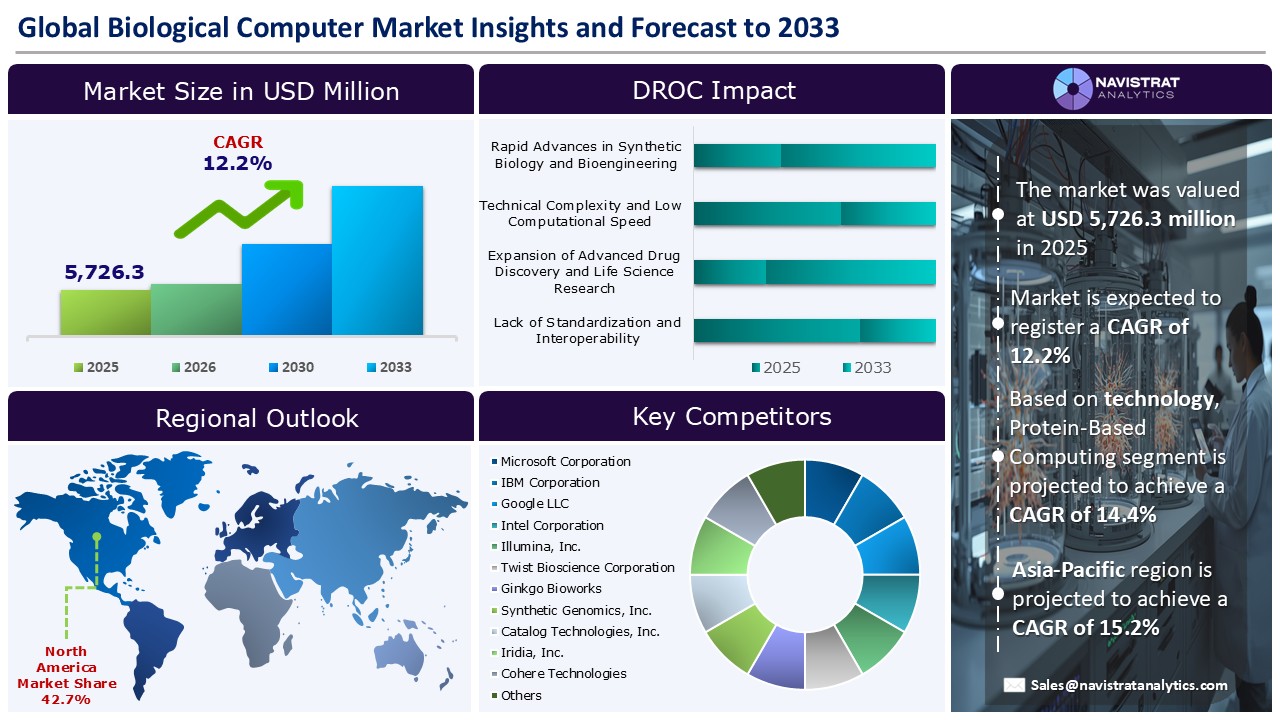
The global biological computer market reached USD 5,726.3 million in 2025 and is expected to register a revenue CAGR of 12.2% during the forecast period. Rapid advances in synthetic biology and bioengineering, growing demand for ultra-dense and long-term data storage, rising need for energy-efficient and sustainable computing and growing adoption of bio-computing in sensing and diagnostics are expected to drive revenue growth of the market.
Market Drivers:
Growing demand for ultra-dense and long-term data storage is driving strong revenue growth of the market. Global data generation is expanding rapidly due to cloud computing, AI workloads, IoT systems, and digital archiving requirements. It places pressure on conventional magnetic and solid-state storage technologies that face limits in density, lifespan, and energy efficiency. Biological computing approaches, particularly DNA-based data storage, offer exceptional advantages by storing massive volumes of data in extremely small physical space while maintaining data integrity for decades or even centuries without continuous power.
In December 2025, Atlas Data Storage, a spin-off from Twist Bioscience, is aiming to bring DNA-based data storage to the commercial market by 2026. The company’s technology is designed to encode up to 13 TB of digital information within a single drop of water. It offers extremely high storage density and long-term durability for archival applications. Although challenges such as high costs and slow read-write speeds remain, the approach provides a highly energy-efficient alternative at a time when global data volumes are growing rapidly.
Market Opportunity:
Expansion of advanced drug discovery and life science research is creating significant opportunities for the market. Pharmaceutical and biotechnology companies are shifting toward more complex research models, including cellular systems, organoids, and biologically relevant simulations, to improve the accuracy of target identification and toxicity screening. Biological computers process and respond to biochemical signals in ways that conventional digital systems cannot. It makes them valuable tools for modeling disease pathways and drug responses.
In January 2025, NVIDIA revealed new collaborations with IQVIA, Illumina, Mayo Clinic, and Arc Institute to accelerate drug discovery, strengthen genomic research, and advance next-generation healthcare services. The initiatives encompass AI agents designed to streamline clinical trials by reducing administrative workloads, AI models that learn directly from biological instruments to support drug discovery, and digital pathology. These collaborations are driving revenue growth of the biological computer market by increasing adoption of bio-integrated computing platforms across drug discovery and life science research workflows.
Recent Trends:
The integration of bio-electronic hybrid architectures has emerged as a key technological trend in the biological computer market due to the rising need to bridge biological processing systems with conventional digital infrastructure. These architectures combine living cells, neuronal networks, or molecular systems with electronic components such as sensors, microelectrodes, and semiconductor interfaces. It allows biological signals to be read, processed, and translated into digital outputs. Recent advances in microelectronics, materials science, and signal transduction are improving the stability, sensitivity, and scalability of these interfaces. It makes biological computing platforms more reliable and commercially viable.
Restraints & Challenges:
Technical complexity and low computational speed are significant factors restraining the revenue growth of the biological computer market by limiting its applicability to a narrow set of use cases. Many biological computing systems rely on biochemical reactions, cellular processes, or neuronal signaling, which operate much more slowly and with higher variability than electronic processors. Designing, maintaining, and scaling these systems requires specialized interdisciplinary expertise, increasing development time and operational costs for end users. This complexity makes integration with existing digital infrastructure challenging and discourages large enterprises from large-scale deployment.
Component Segment Insights and Analysis:
Based on the component segment, the biological computer market is segmented into hardware, consumables, software and services. Hardware segment is further sub-segmented into microelectrode arrays, specialized chips & instrumentation, lab automation & robotics, and others. Consumables segment is further sub-segmented into biochemical reagents, cell lines, DNA/RNA synthesis and others. Software segment is further sub-segmented into sequence design & encoding tools, bioinformatics, control & interfacing firmware and others. Services segment is further sub-segmented into R&D & prototyping, integration & consulting, outsourced synthesis others.
Hardware segment contributed the largest share in 2025 due to rising investment in physical infrastructure required to build, operate, and scale biological computing systems. Growing adoption of DNA-based storage, cellular computing platforms, and neuronal computing models is driving demand for specialized hardware such as bio-electronic interfaces, microelectrode arrays, sequencing and synthesis instruments, lab-on-chip devices, and high-precision sensing components. Research institutions, pharmaceutical companies, and technology firms are increasing capital expenditure on advanced instrumentation to support complex biological computation, improve signal accuracy, and enhance system stability.
In March 2025, Cortical Labs introduced the CL1, a biological computing platform that combines human brain cells with silicon-based hardware to form adaptive neural networks. Marketed as Synthetic Biological Intelligence (SBI), the system is positioned as an alternative to conventional AI by harnessing the natural learning ability and energy efficiency of biological neurons. Unlike traditional processors built on rigid logic gates, this approach supports more flexible, adaptive, and learning-oriented computational behavior. This development is driving revenue growth of the hardware segment by increasing demand for specialized physical systems that enable bio-electronic integration.
Technology Segment Insights and Analysis:
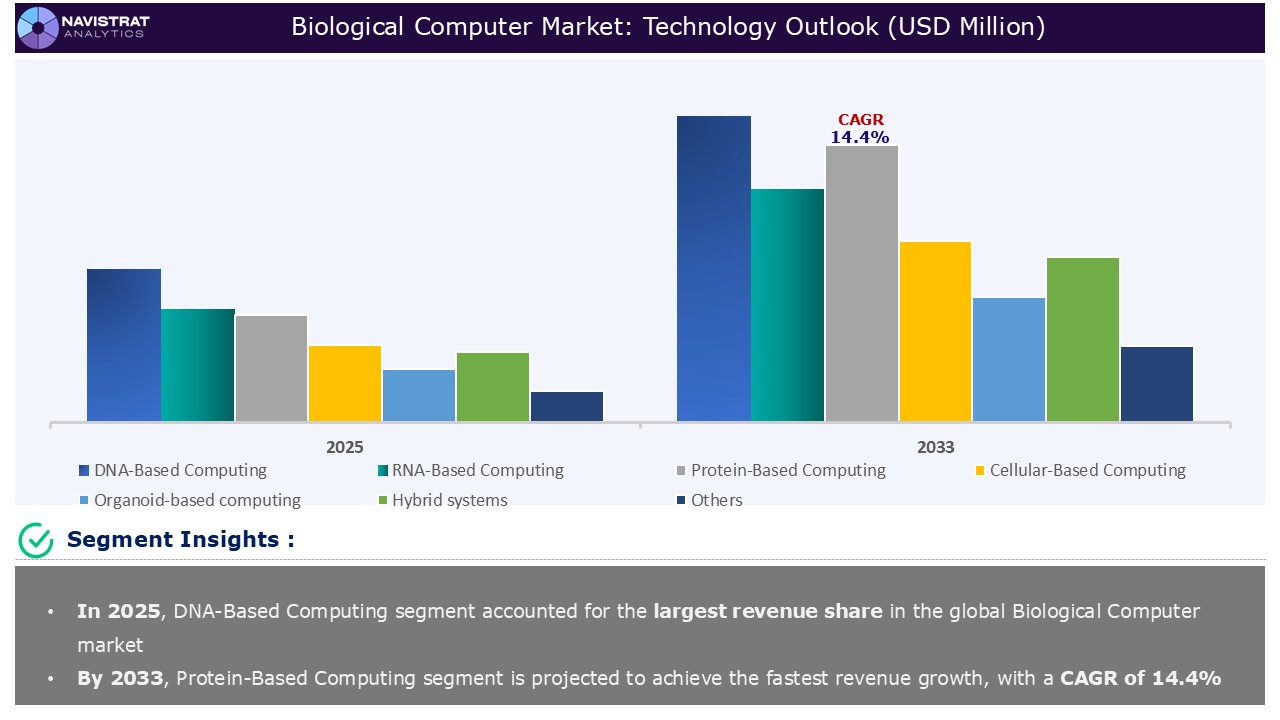
Based on technology, the biological computer market is segmented into DNA-based computing, RNA-based computing, protein-based computing, cellular-based computing, organoid-based computing, and hybrid systems.
DNA-based computing segment contributed the largest share in 2025 due to rising demand for ultra-dense, durable, and energy-efficient data processing and storage solutions. DNA offers exceptional information density and long-term stability, making it highly attractive for archival data storage, complex computation, and molecular-level data manipulation that conventional silicon technologies struggle to achieve efficiently. Rapid advances in DNA synthesis, sequencing technologies, and error-correction algorithms are improving performance and reducing costs, enabling a shift from experimental research toward early commercial deployment.
In October 2024, DNA Ascendancy, an early-stage innovator based in Cambridge, created what it describes as the world’s first practical DNA computer. The technology replaces conventional silicon with DNA as the core computational medium. As performance gains from Moore’s Law taper off, the company aims to unlock a new path for computing by significantly boosting processing capability while sharply lowering energy requirements. by moving the technology beyond theoretical research toward real-world applications. As DNA-based systems demonstrate the ability to deliver high computational density with significantly lower energy consumption than silicon-based processors, interest from technology firms, research institutions, and government agencies is increasing. These developments are encouraging greater investment in DNA synthesis, sequencing hardware, encoding software, and system integration tools required to support DNA computing platforms.
Application Segment Insights and Analysis:
Based on application, the biological computer market is segmented into data storage & archival, computation & optimization, diagnostics & biosensing, drug discovery & screening, robotics / autonomous control, environmental monitoring and others.
Data storage & archival segment contributed the largest share in 2025 due to the rapid increase in global data volumes and the limitations of conventional storage technologies in terms of density, lifespan, and energy consumption. Organizations across government, research, healthcare, and hyperscale data centers are seeking long-term archival solutions that can securely preserve data for decades while minimizing physical footprint and power requirements. Biological computing approaches, particularly DNA-based storage, offer unmatched data density and long-term stability without the need for continuous energy input, making them highly attractive for cold storage and regulatory-compliant archiving.
In December 2025, for instance, Atlas Data Storage, a leading player in synthetic DNA data storage, announced the launch of Atlas Eon 100, described as the first scalable DNA-based data storage service. The company highlights DNA as a uniquely durable medium capable of preserving information permanently in nature’s most stable format. Atlas Eon 100 overcomes key limitations associated with conventional magnetic storage technologies. These advanced product capabilities position the solution as a major step forward, redefining performance and longevity standards in the data storage market.
Geographical Outlook:
Biological computer market is strategically segmented by geography to provide a comprehensive understanding of regional market dynamic. Discover demand analysis, emerging trends, and growth opportunities shaping market performance across different region and countries.
North America Biological Computer Market:
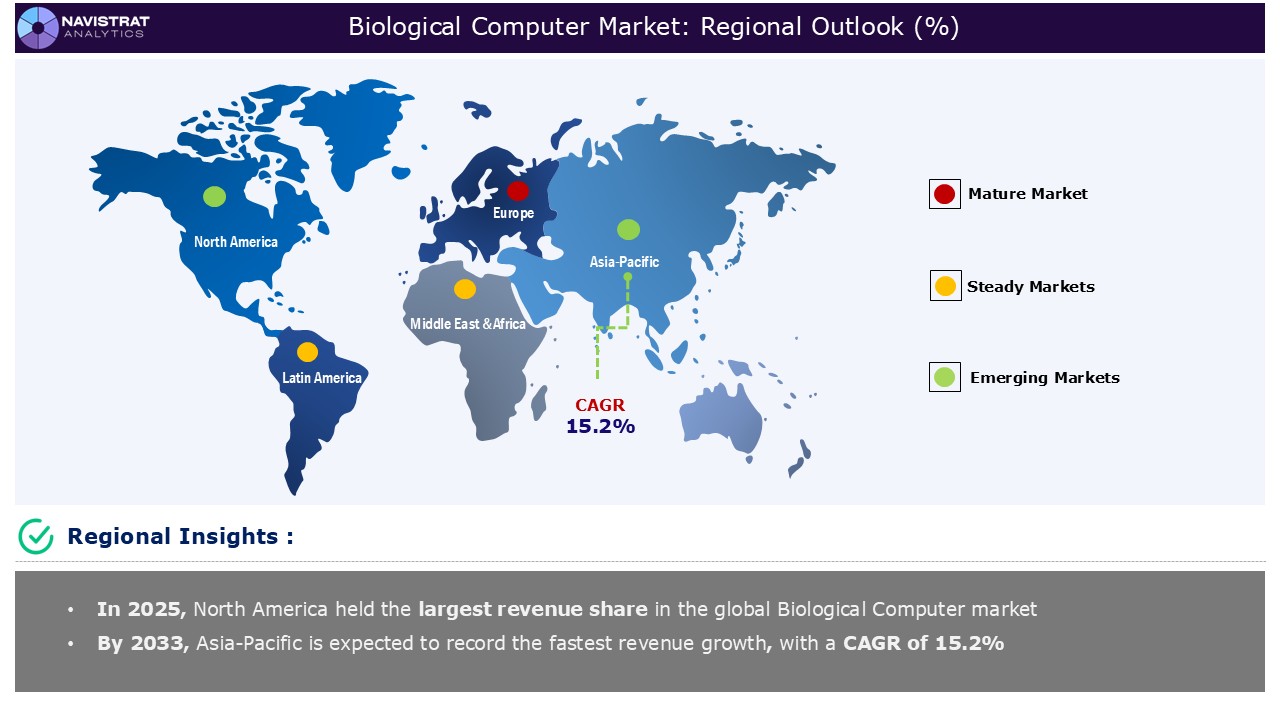
Market in North America accounted for largest revenue share in 2025 due to the region’s strong research ecosystem, high R&D spending, and early adoption of next-generation computing technologies. The presence of leading technology companies, biotechnology firms, and well-funded academic institutions in the region is accelerating the development and commercialization of DNA-based computing, biological data storage, and bio-electronic hybrid systems. Growing demand for ultra-dense data storage, advanced drug discovery platforms, and energy-efficient computing solutions is encouraging investments from both the private sector and government agencies.
In January 2025, American technology company NVIDIA announced new strategic collaborations aimed at reshaping the nearly $10 trillion healthcare and life sciences sector by speeding up drug discovery, strengthening genomic research, and advancing next-generation healthcare services through the use of agentic and generative AI technologies. These partnerships are driving revenue growth of the biological computer market in North America by accelerating adoption of bio-integrated computing technologies across healthcare and life science research.
Asia Pacific Biological Computer Market:
Asia Pacific is expected to register a fast revenue growth rate during the forecast period due to the rapid expansion of biotechnology research, rising healthcare and life science investments, and strong government support for next-generation computing and synthetic biology. Countries such as China, Japan, South Korea, Singapore, and Australia are increasing funding for advanced drug discovery, genomics, and data-intensive biomedical research, which is boosting demand for biological computing platforms. The region is also witnessing fast growth in digital data generation and research infrastructure, encouraging interest in DNA-based data storage and energy-efficient computing alternatives.
In August 2025, Researchers in China revealed a brain-inspired supercomputer modeled on the neural architecture of a monkey. Known as Darwin Monkey, or “Wukong,” the system incorporates more than 2 billion artificial neurons and over 100 billion synapses. It is a scale comparable to the neural complexity of a macaque. This design reflects a growing focus on biologically inspired computing architectures to achieve advanced parallel processing capabilities. Developments such as brain-inspired supercomputing systems are driving revenue growth of the market in the region by strengthening regional investment in biologically inspired and hybrid computing architectures.
Europe Biological Computer Market:
Market in Europe accounted for a significant revenue share in 2025 due to the strong public research funding, a mature life sciences ecosystem, and increasing focus on sustainable and energy-efficient computing technologies in the region. European governments and research bodies are actively supporting advances in synthetic biology, DNA-based data storage, and bio-electronic hybrid systems through long-term R&D programs and cross-border collaborations. Rising demand for advanced drug discovery tools, genomics research, and long-term data archiving solutions is encouraging adoption of biological computing platforms across academia, healthcare, and industry.
In June 2024, FinalSpark, a Swiss technology startup, has begun offering access to biocomputers that integrate lab-grown human brain organoids with silicon-based hardware. The product, known as the Neuroplatform, replaces conventional silicon processing with miniature human brain models to perform computational tasks. This development is driving revenue growth of the biological computer market in Europe by accelerating commercialization of neuronal and bio-electronic computing platforms. Solutions like the Neuroplatform are increasing demand for specialized hardware, bio-interfaces, and research services from universities, laboratories, and technology firms.
Competition Analysis:
The biological computer market is characterized by a consolidated structure, with few players competing across various segments and regions. List of major players included in the Biological Computer market report are:
- Microsoft Corporation
- IBM Corporation
- Google LLC
- Intel Corporation
- Illumina, Inc.
- Twist Bioscience Corporation
- Ginkgo Bioworks
- Synthetic Genomics, Inc.
- Catalog Technologies, Inc.
- Iridia, Inc.
- Cohere Technologies
- Cortical Labs
- FinalSpark
- Koniku, Inc.
- Biomemory
Strategic Developments in Biological Computer Market:
- In March 2025, Biological computing startup Cortical Labs has introduced CL1, which it describes as the world’s first commercially available biological computer. The system merges lab-grown neurons derived from human stem cells with silicon hardware to develop a more advanced and energy-efficient form of artificial intelligence, referred to as Synthetic Biological Intelligence (SBI). These neurons are embedded within Cortical Labs’ Biological Intelligence Operating System (biOS), a platform designed to support and run complex simulations.
- In December 2020. Baidu introduced its latest machine learning–driven bio-computing framework, called PaddleHelix. The platform offers a comprehensive set of algorithms and models, covering areas such as RNA secondary structure prediction, large-scale molecular pre-training, drug–target affinity analysis, and ADMET and druggability prediction. PaddleHelix is designed to address AI requirements across applications in medicine, vaccine development, and precision healthcare.
Key Advantages for Stakeholders:
Navistrat Analytics’ industry report provides an in-depth quantitative analysis of various market segments, historical and current trends, market forecasts, and dynamics within the global market. The historical years covered in this report are 2023 to 2024, with 2025 serving as the base year for market size calculations. The forecast period extends from 2026 to 2033.
The report includes an executive summary and a comprehensive overview of market drivers, restraints, opportunities, and challenges (DROC), along with insights into regulatory standards. It features detailed analyses such as PORTER’s Five Forces, SWOT, and PESTLE, as well as assessments of technological trends and the competitive landscape.
PORTER’s Five Forces analysis helps stakeholders evaluate the impact of new entrants, competitive rivalry, supplier power, buyer power, and substitution threats, enabling them to assess the level of competition and the attractiveness of the global market. The competitive landscape provides stakeholders with a clear understanding of the current market positions of key players, offering valuable insights into their competitive environment.
Scope And Key Highlights of The Biological Computer Market Report:
| Report Features | Details |
| Market Size in 2025 | USD 5726.3 Million |
| Market Growth Rate in CAGR (2026–2033) | 12.2% |
| Market Revenue Forecast to 2033 | USD 14,248.9 Million |
| Base year | 2025 |
| Historical year | 2023–2024 |
| Forecast period | 2026–2033 |
| Report Pages | 450 |
| Segments Covered |
|
| Regional scope |
|
| Country Scope |
|
| Key Market Players |
|
| Delivery Format | Reports are delivered in PDF format via email. |
| Customization scope | Request Customization |
The Biological Computer market report offers a detailed analysis of market size, including historical revenue (in USD Million) data for 2023-2024 and revenue forecasts for 2026-2033 across the following segments:
- Component Outlook (Revenue, USD Million; 2023-2033)
- Hardware
- Microelectrode Arrays
- Specialized Chips & Instrumentation
- Lab automation & Robotics
- Others
- Consumables
- Biochemical Reagents
- Cell Lines
- DNA/RNA Synthesis
- Others
- Software
- Sequence Design & Encoding Tools
- Bioinformatics
- Control & Interfacing Firmware
- Others
- Services
- R&D & Prototyping
- Integration & Consulting
- Outsourced Synthesis
- Others
- Hardware
- Technology Outlook (Revenue, USD Million; 2023-2033)
- DNA-Based Computing
- RNA-Based Computing
- Protein-Based Computing
- Cellular-Based Computing
- Organoid-based computing
- Hybrid systems
- Application Outlook (Revenue, USD Million; 2023-2033)
- Data Storage & Archival
- Computation & Optimization
- Diagnostics & Biosensing
- Drug Discovery & Screening
- Robotics / autonomous control
- Environmental Monitoring
- Others
- End-Use (Revenue, USD Million; 2023-2033)
- Pharmaceutical & Biotechnology Companies
- Research Institutes & Universities
- Healthcare Providers & Hospitals
- IT, Cloud & Data Centers
- Others
- Regional Outlook (Revenue, USD Million; 2023-2033)
- North America
- U.S.
- Canada
- Mexico
- Europe
- Germany
- France
- U.K.
- Italy
- Spain
- Benelux
- Nordic Countries
- Rest of Europe
- Asia Pacific
- China
- India
- Japan
- South Korea
- Oceania
- ASEAN Countries
- Rest of APAC
- Latin America
- Brazil
- Rest of LATAM
- Middle East & Africa
- GCC Countries
- South Africa
- Israel
- Turkey
- Rest of MEA
- North America
Frequently Asked Questions (FAQ) about the Biological Computer Market Report
The biological computer market size was USD 5,726.3 million in 2025.
The biological computer market revenue is expected to register a Compound Annual Growth Rate (CAGR) of 12.2% during the forecast period.
Rapid advances in synthetic biology and bioengineering, growing demand for ultra-dense and long-term data storage, rising need for energy-efficient and sustainable computing, and growing adoption of bio-computing in sensing and diagnostics are the key drivers of the biological computer market revenue growth.
Technical complexity and low computational speed, high R&D and operational costs, and long development and commercialization timelines are key factors restraining revenue growth of the market.
Asia Pacific is expected to account for the fastest revenue growth of 15.2%.
DNA-Based computing segment is the leading segment of biological computer market in terms of technology.
- Market Definition
- Research Objective
- Research Methodology
- Research Design
- Data Collection Methods
- Primary
- Secondary
- Market Size Estimation
- Top-down method
- Bottom-up method
- Forecasting Methodology
- Tools and Models Used
- Market Overview and Trends
- Market Size and Forecast
- Industry Analysis
- Market Driver, Restraints, Opportunity and Challenges (DROC) Analysis
- Market Drivers
- Rapid advances in synthetic biology and bioengineering
- Growing demand for ultra-dense and long-term data storage
- Rising need for energy-efficient and sustainable computing
- Growing adoption of bio-computing in sensing and diagnostics
- Market Restraints
- Technical complexity and low computational speed
- High R&D and operational costs
- Long development and commercialization timelines
- Market Opportunities
- Expansion of advanced drug discovery and life science research
- Convergence of biology, AI, and neuromorphic computing
- Increased government and defense R&D funding
- Rising expansion of automation and lab-on-chip technologies
- Market Challenges
- Lack of standardization and interoperability
- Ethical, biosafety, and regulatory challenges
- Integration challenges with conventional computing systems
- Regulatory Landscape
- North America
- Europe
- Asia Pacific
- Latin America
- Middle East and Africa
- Strategic Insights
- Porter’s Five Forces Analysis
- PESTLE Analysis
- Price Trend Analysis
- Value Chain Analysis
- Technological Trends
- Advances in DNA-Based Data Storage Systems
- Integration of Bio-Electronic Hybrid Architectures
- Development of Neuronal and Organoid Computing Platforms
- AI-Assisted Design and Simulation Tools for Biological Logic Systems
- Microfluidics and Lab-on-Chip Integration for Scalable Workflow Automation
- Recent Developments
- Funding
- Merger and Acquisition
- Expansion
- Partnership and Collaboration
- Product/Service Launch
- Component Market Revenue Estimates and Forecasts, 2023-2033
- Hardware
- Microelectrode Arrays
- Specialized Chips & Instrumentation
- Lab automation & Robotics
- Others
- Consumables
- Biochemical Reagents
- Cell Lines
- DNA/RNA Synthesis
- Others
- Software
- Sequence Design & Encoding Tools
- Bioinformatics
- Control & Interfacing Firmware
- Others
- Services
- R&D & Prototyping
- Integration & Consulting
- Outsourced Synthesis
- Others
- Hardware
- Technology Market Revenue Estimates and Forecasts, 2023-2033
- DNA-Based Computing
- RNA-Based Computing
- Protein-Based Computing
- Cellular-Based Computing
- Organoid-based computing
- Hybrid systems
- Application Market Revenue Estimates and Forecasts, 2023-2033
- Data Storage & Archival
- Computation & Optimization
- Diagnostics & Biosensing
- Drug Discovery & Screening
- Robotics / autonomous control
- Environmental Monitoring
- Others
- End-Use Market Revenue Estimates and Forecasts, 2023-2033
- Pharmaceutical & Biotechnology Companies
- Research Institutes & Universities
- Healthcare Providers & Hospitals
- IT, Cloud & Data Centers
- Others
- Biological Computer Market Revenue Estimates and Forecasts by Region, 2023-2033, USD Million
- North America
- North America Biological Computer Market By Component, Market Revenue Estimates and Forecasts, 2023-2033, USD Million
- Hardware
- Microelectrode Arrays
- Specialized Chips & Instrumentation
- Lab automation & Robotics
- Others
- Consumables
- Biochemical Reagents
- Cell Lines
- DNA/RNA Synthesis
- Others
- Software
- Sequence Design & Encoding Tools
- Bioinformatics
- Control & Interfacing Firmware
- Others
- Services
- R&D & Prototyping
- Integration & Consulting
- Outsourced Synthesis
- Others
- Hardware
- North America Biological Computer Market By Technology, Market Revenue Estimates and Forecasts, 2023-2033, USD Million
- DNA-Based Computing
- RNA-Based Computing
- Protein-Based Computing
- Cellular-Based Computing
- Organoid-based computing
- Hybrid systems
- North America Biological Computer Market By Application, Market Revenue Estimates and Forecasts, 2023-2033, USD Million
- Data Storage & Archival
- Computation & Optimization
- Diagnostics & Biosensing
- Drug Discovery & Screening
- Robotics / autonomous control
- Environmental Monitoring
- Others
- North America Biological Computer Market By End-Use, Market Revenue Estimates and Forecasts, 2023-2033, USD Million
- Pharmaceutical & Biotechnology Companies
- Research Institutes & Universities
- Healthcare Providers & Hospitals
- IT, Cloud & Data Centers
- Others
- North America Biological Computer Market Revenue Estimates and Forecasts by Country, 2023-2033, USD Million
- United States
- Canada
- Mexico
- North America Biological Computer Market By Component, Market Revenue Estimates and Forecasts, 2023-2033, USD Million
- Europe
- Europe Biological Computer Market By Component, Market Revenue Estimates and Forecasts, 2023-2033, USD Million
- Hardware
- Microelectrode Arrays
- Specialized Chips & Instrumentation
- Lab automation & Robotics
- Others
- Consumables
- Biochemical Reagents
- Cell Lines
- DNA/RNA Synthesis
- Others
- Software
- Sequence Design & Encoding Tools
- Bioinformatics
- Control & Interfacing Firmware
- Others
- Services
- R&D & Prototyping
- Integration & Consulting
- Outsourced Synthesis
- Others
- Hardware
- Europe Biological Computer Market By Technology, Market Revenue Estimates and Forecasts, 2023-2033, USD Million
- DNA-Based Computing
- RNA-Based Computing
- Protein-Based Computing
- Cellular-Based Computing
- Organoid-based computing
- Hybrid systems
- Europe Biological Computer Market By Application, Market Revenue Estimates and Forecasts, 2023-2033, USD Million
- Data Storage & Archival
- Computation & Optimization
- Diagnostics & Biosensing
- Drug Discovery & Screening
- Robotics / autonomous control
- Environmental Monitoring
- Others
- Europe Biological Computer Market By End-Use, Market Revenue Estimates and Forecasts, 2023-2033, USD Million
- Pharmaceutical & Biotechnology Companies
- Research Institutes & Universities
- Healthcare Providers & Hospitals
- IT, Cloud & Data Centers
- Others
- Europe Biological Computer Market Revenue Estimates and Forecasts by Country, 2023-2033, USD Million
- Germany
- United Kingdom
- France
- Italy
- Spain
- Benelux
- Nordic Countries
- Rest of Europe
- Europe Biological Computer Market By Component, Market Revenue Estimates and Forecasts, 2023-2033, USD Million
- Asia-Pacific
- Asia-Pacific Biological Computer Market By Component, Market Revenue Estimates and Forecasts, 2023-2033, USD Million
- Hardware
- Microelectrode Arrays
- Specialized Chips & Instrumentation
- Lab automation & Robotics
- Others
- Consumables
- Biochemical Reagents
- Cell Lines
- DNA/RNA Synthesis
- Others
- Software
- Sequence Design & Encoding Tools
- Bioinformatics
- Control & Interfacing Firmware
- Others
- Services
- R&D & Prototyping
- Integration & Consulting
- Outsourced Synthesis
- Others
- Hardware
- Asia-Pacific Biological Computer Market By Technology, Market Revenue Estimates and Forecasts, 2023-2033, USD Million
- DNA-Based Computing
- RNA-Based Computing
- Protein-Based Computing
- Cellular-Based Computing
- Organoid-based computing
- Hybrid systems
- Asia-Pacific Biological Computer Market By Application, Market Revenue Estimates and Forecasts, 2023-2033, USD Million
- Data Storage & Archival
- Computation & Optimization
- Diagnostics & Biosensing
- Drug Discovery & Screening
- Robotics / autonomous control
- Environmental Monitoring
- Others
- Asia-Pacific Biological Computer Market By End-Use, Market Revenue Estimates and Forecasts, 2023-2033, USD Million
- Pharmaceutical & Biotechnology Companies
- Research Institutes & Universities
- Healthcare Providers & Hospitals
- IT, Cloud & Data Centers
- Others
- Asia-Pacific Biological Computer Market Revenue Estimates and Forecasts by Country, 2023-2033, USD Million
- China
- India
- Japan
- South Korea
- Oceania
- ASEAN Countries
- Rest of Asia-Pacific
- Asia-Pacific Biological Computer Market By Component, Market Revenue Estimates and Forecasts, 2023-2033, USD Million
- Latin America
- Latin America Biological Computer Market By Component, Market Revenue Estimates and Forecasts, 2023-2033, USD Million
- Hardware
- Microelectrode Arrays
- Specialized Chips & Instrumentation
- Lab automation & Robotics
- Others
- Consumables
- Biochemical Reagents
- Cell Lines
- DNA/RNA Synthesis
- Others
- Software
- Sequence Design & Encoding Tools
- Bioinformatics
- Control & Interfacing Firmware
- Others
- Services
- R&D & Prototyping
- Integration & Consulting
- Outsourced Synthesis
- Others
- Hardware
- Latin America Biological Computer Market By Technology, Market Revenue Estimates and Forecasts, 2023-2033, USD Million
- DNA-Based Computing
- RNA-Based Computing
- Protein-Based Computing
- Cellular-Based Computing
- Organoid-based computing
- Hybrid systems
- Latin America Biological Computer Market By Application, Market Revenue Estimates and Forecasts, 2023-2033, USD Million
- Data Storage & Archival
- Computation & Optimization
- Diagnostics & Biosensing
- Drug Discovery & Screening
- Robotics / autonomous control
- Environmental Monitoring
- Others
- Latin America Biological Computer Market By End-Use, Market Revenue Estimates and Forecasts, 2023-2033, USD Million
- Pharmaceutical & Biotechnology Companies
- Research Institutes & Universities
- Healthcare Providers & Hospitals
- IT, Cloud & Data Centers
- Others
- Latin America Biological Computer Market Revenue Estimates and Forecasts by Country, 2023-2033, USD Million
- Brazil
- Rest of Latin America
- Latin America Biological Computer Market By Component, Market Revenue Estimates and Forecasts, 2023-2033, USD Million
- Middle East & Africa
- Middle East & Africa Biological Computer Market By Component, Market Revenue Estimates and Forecasts, 2023-2033, USD Million
- Hardware
- Microelectrode Arrays
- Specialized Chips & Instrumentation
- Lab automation & Robotics
- Others
- Consumables
- Biochemical Reagents
- Cell Lines
- DNA/RNA Synthesis
- Others
- Software
- Sequence Design & Encoding Tools
- Bioinformatics
- Control & Interfacing Firmware
- Others
- Services
- R&D & Prototyping
- Integration & Consulting
- Outsourced Synthesis
- Others
- Hardware
- Middle East & Africa Biological Computer Market By Technology, Market Revenue Estimates and Forecasts, 2023-2033, USD Million
- DNA-Based Computing
- RNA-Based Computing
- Protein-Based Computing
- Cellular-Based Computing
- Organoid-based computing
- Hybrid systems
- Middle East & Africa Biological Computer Market By Application, Market Revenue Estimates and Forecasts, 2023-2033, USD Million
- Data Storage & Archival
- Computation & Optimization
- Diagnostics & Biosensing
- Drug Discovery & Screening
- Robotics / autonomous control
- Environmental Monitoring
- Others
- Middle East & Africa Biological Computer Market By End-Use, Market Revenue Estimates and Forecasts, 2023-2033, USD Million
- Pharmaceutical & Biotechnology Companies
- Research Institutes & Universities
- Healthcare Providers & Hospitals
- IT, Cloud & Data Centers
- Others
- Middle East & Africa Biological Computer Market Revenue Estimates and Forecasts by Country, 2023-2033, USD Million
- GCC Countries
- South Africa
- Israel
- Turkey
- Rest of Middle East & Africa
- Middle East & Africa Biological Computer Market By Component, Market Revenue Estimates and Forecasts, 2023-2033, USD Million
- Market Share Analysis
- Revenue Market Share by Key Players (2025-2026)
- Analysis of Top Players by Market Presence
- Competitive Matrix
- Competitive Strategies
- Mergers and Acquisitions
- Partnerships and Collaboration
- Investment and Funding
- Agreement
- Expansion
- New Product/Service Launches
- Technological Innovations
- Microsoft Corporation
- Company Overview
- Financial Insights
- Product/ Services Component
- Strategic Developments
- SWOT Analysis
- IBM Corporation
- Company Overview
- Financial Insights
- Product/ Services Component
- Strategic Developments
- SWOT Analysis
- Google LLC
- Company Overview
- Financial Insights
- Product/ Services Component
- Strategic Developments
- SWOT Analysis
- Intel Corporation
- Company Overview
- Financial Insights
- Product/ Services Component
- Strategic Developments
- SWOT Analysis
- Twist Bioscience Corporation
- Company Overview
- Financial Insights
- Product/ Services Component
- Strategic Developments
- SWOT Analysis
- Ginkgo Bioworks
- Company Overview
- Financial Insights
- Product/ Services Component
- Strategic Developments
- SWOT Analysis
- Illumina, Inc.
- Company Overview
- Financial Insights
- Product/ Services Component
- Strategic Developments
- SWOT Analysis
- Synthetic Genomics, Inc.
- Company Overview
- Financial Insights
- Product/ Services Component
- Strategic Developments
- SWOT Analysis
- Catalog Technologies, Inc.
- Company Overview
- Financial Insights
- Product/ Services Component
- Strategic Developments
- SWOT Analysis
- Iridia, Inc.
- Company Overview
- Financial Insights
- Product/ Services Component
- Strategic Developments
- SWOT Analysis
- Cohere Technologies
- Company Overview
- Financial Insights
- Product/ Services Component
- Strategic Developments
- SWOT Analysis
- Cortical Labs
- Company Overview
- Financial Insights
- Product/ Services Component
- Strategic Developments
- SWOT Analysis
- FinalSpark
- Company Overview
- Financial Insights
- Product/ Services Component
- Strategic Developments
- SWOT Analysis
- Koniku, Inc.
- Company Overview
- Financial Insights
- Product/ Services Component
- Strategic Developments
- SWOT Analysis
- Biomemory
- Company Overview
- Financial Insights
- Product/ Services Component
- Strategic Developments
- SWOT Analysis