

Smart Shopping Cart Market Overview and Key Insights:
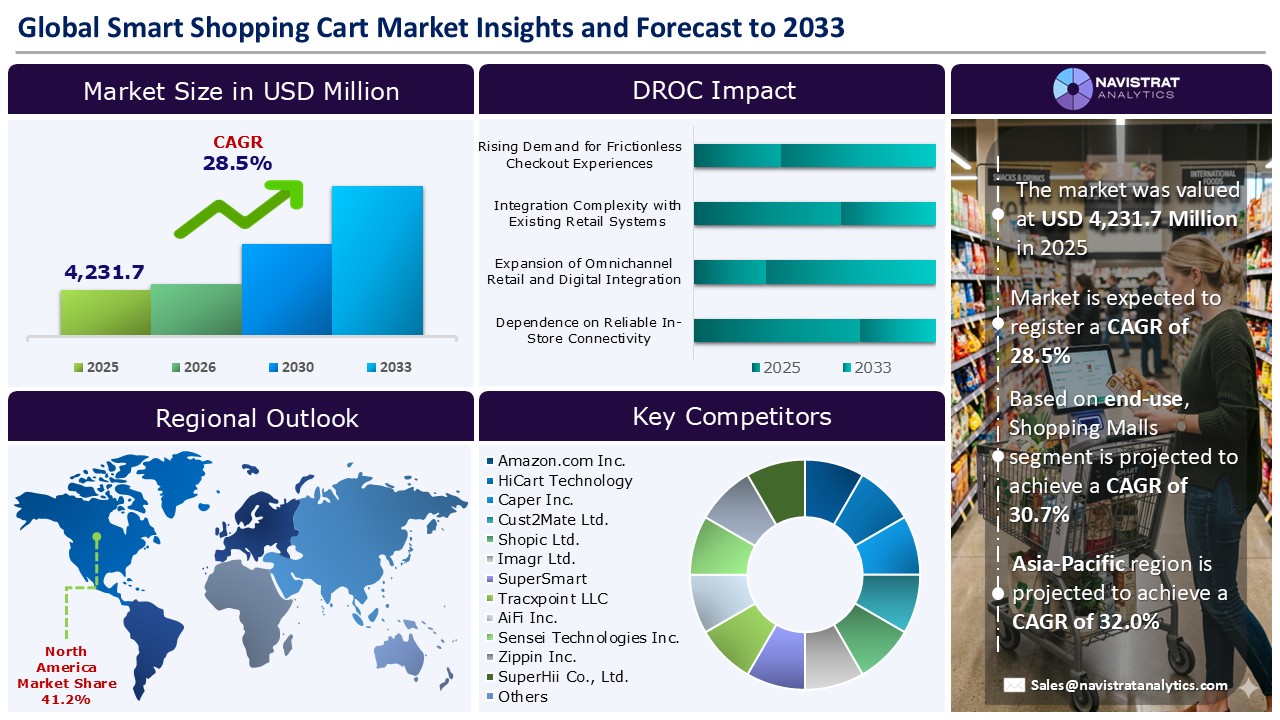
The global Smart Shopping Cart market reached USD 4231.7 million in 2025 and is expected to register a revenue CAGR of 28.5% during the forecast period. Rising demand for frictionless checkout experiences, rapid adoption of AI and computer vision in retail, increasing focus on retail automation and operational efficiency, growing labor costs and workforce shortages, and rising expansion of cashless and digital payment ecosystems are expected to drive revenue growth of the market.
Market Drivers:
Rising demand for frictionless checkout experiences is driving strong revenue growth of the market. Long checkout waits times remain the most significant pain point for 78% of grocery shoppers, leading to a documented shift toward automated in-store technologies. Smart shopping carts address this industrial challenge by providing “scan-as-you-shop” and autonomous payment functionalities. It eliminates the need for traditional checkout lanes. Retailers deploying these systems have reported average checkout time reductions of 58% to 65%, significantly enhancing store throughput during peak operating hours.
In February 2025, for instance, Instacart introduced its AI-powered “Caper Carts” at Coles Supermarkets in Australia, featuring AI-enabled cameras and weight sensors to automate item identification and shorten checkout times. This development is contributing to increasing adoption as retailers seek to improve customer retention rates and mitigate the impact of escalating labor costs in developed markets. The industrial implication of this shift is a fundamental restructuring of store operations, where every 50 smart carts deployed can reduce the requirement for manned checkout lines by up to three units.
Market Opportunity:
Expansion of omnichannel retail and digital integration is creating significant opportunities for the market. As retailers transition toward “Agentic Commerce,” smart carts are evolving from simple scanning devices into proactive digital assistants that sync with online shopping profiles and loyalty programs. This synergy allows for the delivery of real-time, context-aware insights, such as dietary suggestions or recipe-based navigation, based on the shopper’s past digital behavior and current in-cart contents.
In December 2025, A2Z Cust2Mate secured a purchase order from the Israeli supermarket chain Super Sapir for 3,000 smart carts, with rollout scheduled for the first half of 2026. This agreement underscores the forward-looking strategy of retailers to harness real-time shopper data for optimized merchandising and personalized engagement. Furthermore, the expansion of retail media networks on these platforms provides an emerging revenue stream, with in-cart promotions capable of boosting conversion rates by up to 36.8%. These developments are expected to boost demand for integrated digital platforms that can manage complex retail data across thousands of locations.
Recent Trends:
AI-powered computer vision for automatic product recognition has emerged as a key technological trend in the smart shopping cart market. Unlike legacy systems that rely solely on manual barcode scanning, modern smart carts utilize deep learning algorithms and sensor fusion to identify items—including loose produce and non-barcoded goods—simply as they are placed in the basket. This trend is accelerating commercialization by reducing the friction associated with manual entry and improving the accuracy of loss prevention systems.
In January 2026, Amazon unveiled a redesigned version of its Dash Cart, featuring upgraded computer vision and improved sensors for faster item recognition and precise indoor location tracking. The new model also introduced a 40% increase in basket capacity and automated self-charging capabilities, reflecting an industrial focus on scalability and operational uptime. This shift toward more reliable, low-latency item recognition is expected to drive revenue growth by increasing retailer confidence in large-scale deployments across high-traffic formats.
Restraints & Challenges:
The high initial capital expenditure (CAPEX) associated with smart cart hardware remains a significant factor restraining the revenue growth of the market, particularly among smaller store formats. The cost of advanced components—including high-resolution cameras, load cells, and ruggedized touchscreens—can be prohibitive for independent retailers operating on thin margins. Currently, only 30% of independent stores have implemented such technologies, as the required investment in store-wide digital infrastructure, including robust Wi-Fi and POS integration, often exceeds their budgets.
In 2023, a study by the U.S. Small Business Administration highlighted that 34% of small retailers identified implementation and maintenance costs as their primary barrier to adoption. These financial hurdles, combined with long payback cycles of 2.5 to 4 years, discourage smaller players from fleet-wide upgrades. Additionally, the complexity of integrating these smart systems with legacy point-of-sale and inventory platforms can lead to significant operational downtime, further limiting technology penetration in mainstream retail segments.
Product Type Segment Insights and Analysis:
Based on product type, the smart shopping cart market is segmented into fully integrated smart carts and retrofit smart carts. Fully integrated smart carts segment is further sub-segmented into built-in touchscreen displays, AI-enabled vision systems, integrated payment systems and weight sensors & auto-billing modules. Retrofit smart cart segment is further sub-segmented into clip-on devices for existing carts, smart handles with display units, mobile scanning devices, and add-on IoT modules for legacy carts.
Fully integrated smart carts segment contributed the largest share in 2025.These purpose-built units are designed from the ground up with embedded sensors, weight scales, and touchscreen displays. It offers the highest levels of accuracy and durability for high-traffic environments. Retailers favor integrated solutions for new store openings and premium retail experiences where seamless hardware-software integration is paramount.
In September 2025, A2Z Cust2Mate announced an order for 5,000 next-generation Cust2Mate 3.0 smart carts from the Israeli retailer Yochananof, valued at over USD 55 Million. This development highlights the market’s preference for sophisticated, end-to-end automation platforms. The dominance of this segment is expected to continue as large-format hypermarkets prioritize long-term ROI through enhanced customer satisfaction and reduced labor dependency.
Technology Segment Insights and Analysis:
Based on technology, the smart shopping cart market is segmented into barcode-based systems, RFID-based systems, computer vision / AI-based systems, wireless communication technologies and others.
Barcode-based systems segment contributed the largest share in 2025 due to their widespread adoption as a cost-effective and reliable technology for retail automation. Barcode systems offer retailers an affordable entry point into smart cart deployment compared to more advanced AI- or RFID-based solutions, making them particularly attractive for small and mid-sized retail chains. These systems are highly compatible with existing retail infrastructure, including conventional POS systems, inventory management software, and product databases, reducing integration complexity and implementation costs. Their operational simplicity, proven accuracy, and low maintenance requirements continue to support strong demand across supermarkets, convenience stores, and specialty retail outlets.
In April 2026, A2Z Cust2Mate launched its RFID-enabled 3.0 intelligent shopping cart, designed to provide seamless product recommendations and self-checkout at the cart. The shift toward RFID and computer vision is being driven by the need for advanced loss prevention and real-time inventory visibility. As these technologies become more affordable and scalable, their adoption in high-throughput environments is expected to boost demand for next-generation cart platforms.
End-Use Segment Insights and Analysis:
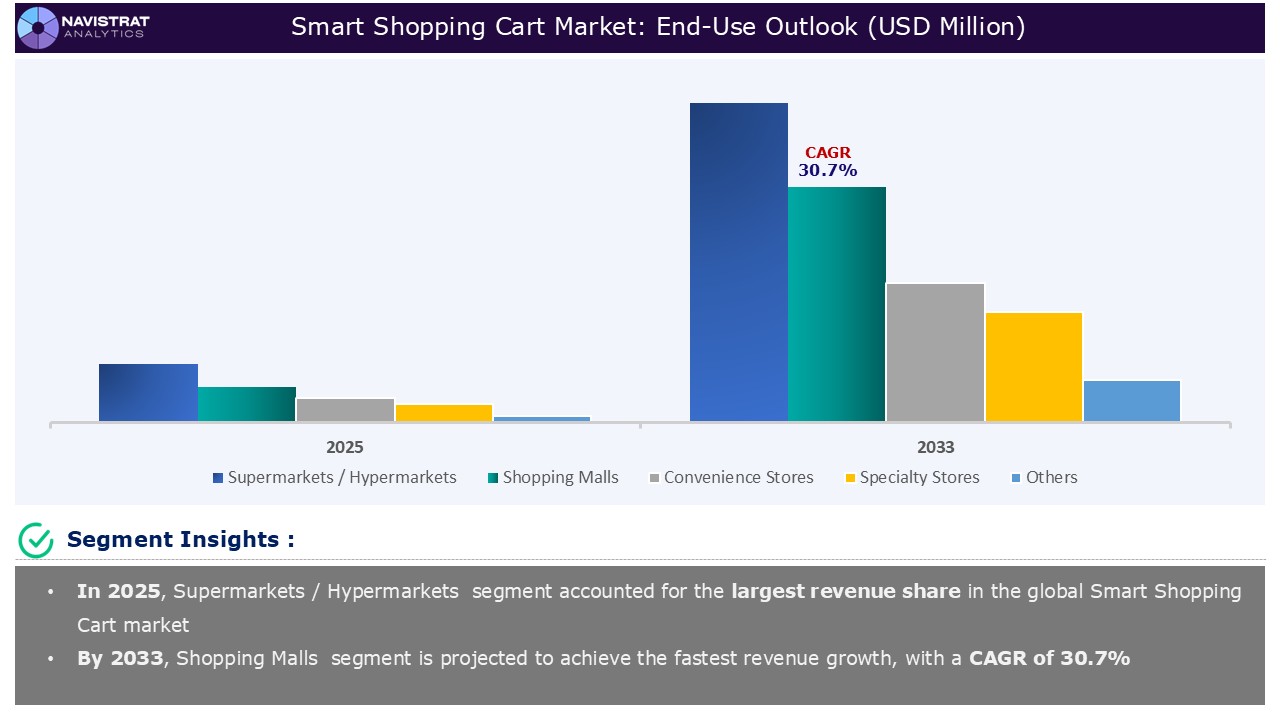
Based on end-use, the smart shopping cart market is segmented into supermarkets / hypermarkets, shopping malls, convenience stores, specialty stores, and others.
Supermarkets / Hypermarkets segment contributed the largest share in 2025 due to the high customer traffic and increasing demand for faster, more convenient shopping experiences in large-format retail stores. These retail environments handle substantial daily transaction volumes, making checkout efficiency and operational optimization critical priorities. Smart shopping carts help supermarkets and hypermarkets reduce long billing queues, improve customer flow, and enhance overall shopping convenience through features such as self-scanning, automated billing, and contactless payment integration. Large retail chains are also investing heavily in digital transformation and retail automation to reduce labor dependency and improve operational efficiency amid rising workforce costs.
In July 2025, Instacart expanded its Caper Cart deployments to Wegmans locations, marking the first use of the technology at this chain to enhance the in-store checkout experience. This initiative is part of a broader industry trend where supermarkets leverage granular behavioral analytics to optimize store layouts and shelf placements. The segment is expected to register the highest CAGR as global retail chains prioritize digital transformation to attract tech-savvy consumers and streamline inventory management.
Geographical Outlook:
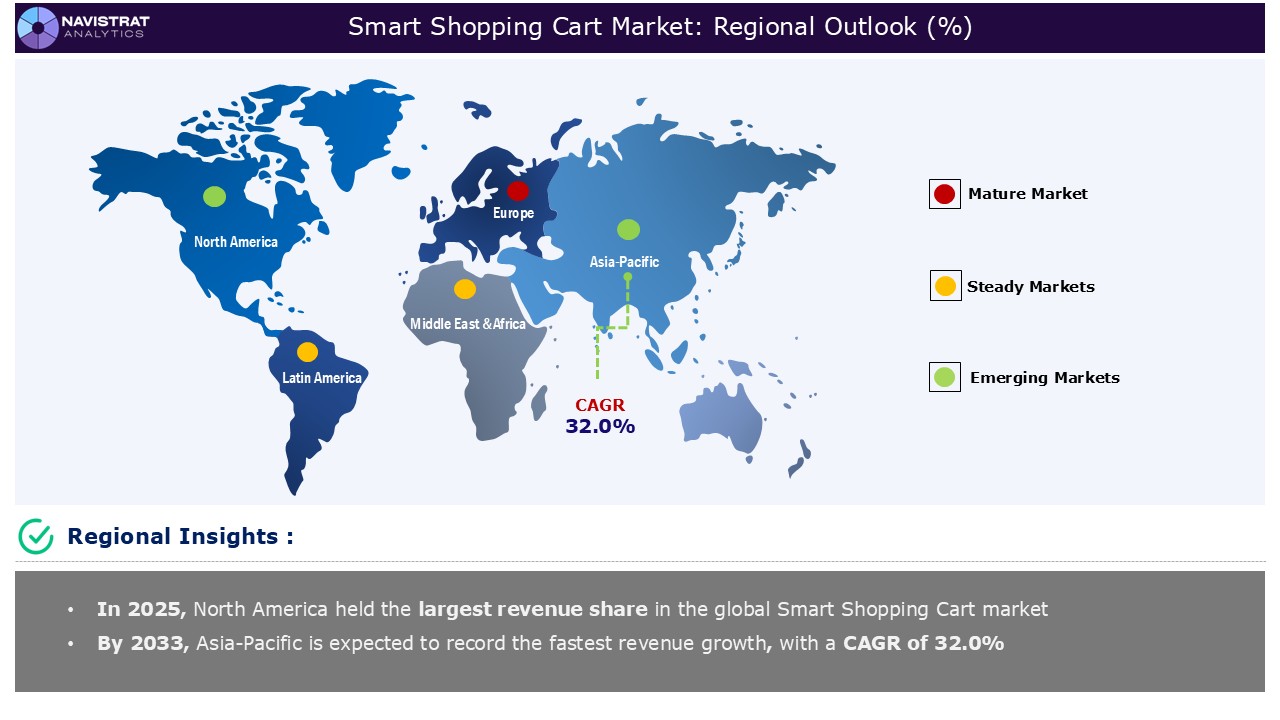
Smart Shopping Cart market is strategically segmented by geography to provide a comprehensive understanding of regional market dynamic. Discover demand analysis, emerging trends, and growth opportunities shaping market performance across different region and countries.
North America Smart Shopping Cart Market:
Market in North America accounted for largest revenue share in 2025 due to a highly consolidated grocery sector and strong technological adoption among major chains like Kroger, Walmart, and Amazon Fresh in the region. Acute labor pressures, exacerbated by minimum wage increases across multiple U.S. states, have incentivized retailers to view smart carts as a vital mechanism to reduce cashier dependency. In March 2025, Veeve an AI startup based out of Seattle, had expanded its partnerships to include Albertsons’ namesake banner and Safeway brands. It is highlighting the region’s focus on connecting e-commerce activity with the in-store experience.
Retailers across the U.S. and Canada are increasingly deploying smart shopping carts equipped with computer vision, RFID, weight sensors, and integrated payment systems to reduce checkout congestion, lower labor dependency, and enhance shopping convenience. Growing labor shortages and rising operational costs in the retail sector are further accelerating adoption of autonomous and self-checkout technologies.
Additionally, Amazon introduced an upgraded version of its Dash Cart in early 2026 for deployment across multiple Whole Foods locations in the U.S. The redesigned carts reportedly increased carrying capacity by 40% while reducing cart weight by 25%. It is reflecting ongoing innovation in AI-enabled retail automation. Furthermore, increasing investments in omnichannel retail integration, personalized in-cart advertising, and autonomous checkout ecosystems continue to strengthen North America’s position as a major revenue-generating region in the global smart shopping cart market.
Asia Pacific Smart Shopping Cart Market:
Asia Pacific is expected to register a fast revenue growth rate during the forecast period due to the rapid retail digitalization, expanding organized retail infrastructure, and rising adoption of AI- and IoT-enabled shopping technologies across major economies such as China, Japan, South Korea, India, and Australia. The region is experiencing strong growth in supermarkets, hypermarkets, and smart convenience store formats. These countrues are increasingly investing in autonomous checkout and customer engagement technologies to improve operational efficiency and shopping convenience. Rising urbanization, increasing disposable income, and growing smartphone penetration are also accelerating consumer acceptance of digitally connected retail experiences.
Several international and regional companies are expanding their smart cart presence in Asia-Pacific through strategic partnerships and pilot deployments. In August 2024, Instacart expanded its Caper Cart technology internationally through partnerships with ALDI in Austria and Coles Supermarkets in Australia. It marks a significant step toward global commercialization of AI-powered smart carts. Furthermore, retailers in Asia-Pacific are increasingly integrating personalized promotions, digital loyalty systems, and mobile payment technologies into smart cart ecosystems to improve customer retention and in-store monetization.
In 2024, Xi’an Chaohi smart carts were reported to be deployed in 21% of Chinese supermarkets, demonstrating the rapid scale of regional penetration. The region also benefits from a competitive manufacturing landscape where local players like SuperHii are democratizing the market by offering cost-effective hardware.
Europe Smart Shopping Cart Market:
Market in Europe accounted for a significant revenue share in 2025, supported by grocers like Carrefour, Tesco, and Lidl. The regional focus is on privacy-compliant computer vision solutions that adhere to strict GDPR regulations. In November 2024, Intermarché partnered with Shopic and Capgemini to pilot AI-powered smart carts at its Provins store in France. They are representing a major step in bringing digital benefits to physical aisles. Additionally, there is a strong emphasis on integrating smart carts into “green” retail initiatives to promote sustainable product choices through real-time displays. European retailers are increasingly modernizing supermarkets and hypermarkets to improve operational efficiency, reduce checkout congestion, and enhance customer engagement amid growing labor costs and changing consumer expectations.
Recent developments highlight the region’s increasing momentum in smart retail transformation. In October 2025, Morrisons announced plans to introduce Instacart’s AI-powered Caper Carts in the UK. It is marking the first deployment of the technology in the British supermarket sector. Additionally, in December 2025, Tesco entered into a three-year strategic partnership with the French AI company Mistral AI to accelerate AI integration across retail operations and customer engagement systems. Tesco also reported that it had doubled the size of its technology team over the previous five years to support AI-driven retail innovation initiatives.
Competition Analysis:
The Smart Shopping Cart market is characterized by a consolidated structure, with few players competing across various segments and regions. List of major players included in the Smart Shopping Cart market report are:
- Amazon.com Inc.
- HiCart Technology
- Caper Inc.
- Cust2Mate Ltd.
- Shopic Ltd.
- Imagr Ltd.
- SuperSmart
- Tracxpoint LLC
- AiFi Inc.
- Sensei Technologies Inc.
- Zippin Inc.
- SuperHii Co., Ltd.
- Instacart
- IoT Retail Tech
- Shopreme
Strategic Developments in Smart Shopping Cart Market:
- In April 2026, Global Retail, a major franchise operator of the Carrefour Group in Israel (Carrefour Israel), signed a five-year strategic partnership agreement with A2Z Cust2Mate Solutions Corp. It is worth nearly USD 50 million to deploy around 4,000 smart shopping carts across Carrefour Israel outlets. The collaboration also includes integrated retail media, data analytics, and digital service initiatives. This large-scale deployment positions Carrefour Israel among the earliest retailers globally to introduce smart cart technology on such a significant scale. It is creating a benchmark for future international smart retail implementations.
- In January 2026, Amazon has introduced an upgraded version of its Dash Cart at Whole Foods Market locations in McKinney, Texas, Reston, Virginia, and Westford, Massachusetts. They are aiming to enhance shopping speed and convenience for grocery customers. The smart cart features an integrated display screen that shows product prices and continuously updates the total purchase amount during shopping. It is allowing customers to better monitor their spending and manage budgets before completing checkout. The latest version of the Dash Cart also supports a wider range of payment methods. It is providing greater flexibility and convenience during the payment process.
- In February 2025, Instacart, a leading grocery technology provider in North America, partnered with Coles Supermarkets, one of Australia’s major retail chains, to introduce Caper Carts. It is Instacart’s AI-enabled smart shopping trolleys at the Richmond Traders store in Melbourne. The deployment allows customers to place items directly into bags while shopping and complete payments through the smart trolley itself. It is creating a more seamless and efficient in-store shopping experience. The Coles Smart Trolleys are available near the supermarket entrance and utilize a combination of artificial intelligence, integrated cameras, and built-in weighing systems to identify products added to the cart automatically.
Key Advantages for Stakeholders:
Navistrat Analytics’ industry report provides an in-depth quantitative analysis of various market segments, historical and current trends, market forecasts, and dynamics within the global market. The historical years covered in this report are 2023 to 2024, with 2025 serving as the base year for market size calculations. The forecast period extends from 2026 to 2033.
The report includes an executive summary and a comprehensive overview of market drivers, restraints, opportunities, and challenges (DROC), along with insights into regulatory standards. It features detailed analyses such as PORTER’s Five Forces, SWOT, and PESTLE, as well as assessments of technological trends and the competitive landscape.
PORTER’s Five Forces analysis helps stakeholders evaluate the impact of new entrants, competitive rivalry, supplier power, buyer power, and substitution threats, enabling them to assess the level of competition and the attractiveness of the global market. The competitive landscape provides stakeholders with a clear understanding of the current market positions of key players, offering valuable insights into their competitive environment.
Scope And Key Highlights of The Smart Shopping Cart Market Report:
| Report Features | Details |
| Market Size in 2025 | USD 4231.7 Million |
| Market Growth Rate in CAGR (2026–2033) | 28.5% |
| Market Revenue Forecast to 2033 | USD 30,361.4 Million |
| Base year | 2025 |
| Historical year | 2023–2024 |
| Forecast period | 2026–2033 |
| Report Pages | 450 |
| Segments Covered |
|
| Regional scope |
|
| Country Scope |
|
| Key Market Players |
|
| Delivery Format | Reports are delivered in PDF format via email. |
| Customization scope | Request Customization |
The Smart Shopping Cart market report offers a detailed analysis of market size, including historical revenue (in USD Million) data for 2023-2024 and revenue forecasts for 2026-2033 across the following segments:
- Product Type (Revenue, USD Million; 2023-2033)
- Fully integrated smart carts
- Built-in touchscreen displays
- AI-enabled vision systems
- Integrated payment systems
- Weight sensors & auto-billing modules
- Retrofit smart cart solutions
- Clip-on devices for existing carts
- Smart handles with display units
- Mobile scanning devices (barcode/RFID scanners)
- Add-on IoT modules for legacy carts
- Fully integrated smart carts
- Component Outlook (Revenue, USD Million; 2023-2033)
- Hardware
- Display units (LCD, OLED)
- Barcode scanners
- RFID readers
- Cameras (AI vision systems)
- Weight sensors
- POS/payment terminals
- Batteries & power modules
- Software
- Cart management software
- AI/ML-based product recognition
- Inventory integration systems
- Payment processing software
- Customer analytics & personalization engines
- Services
- Installation & integration
- Maintenance & support
- Cloud services & SaaS platforms
- Data analytics services
- Hardware
- Technology Outlook (Revenue, USD Million; 2023-2033)
- RFID-Based Systems
- Barcode-Based Systems
- Computer Vision / AI-Based Systems
- Wireless Communication Technologies
- Others
- End-Use Outlook (Revenue, USD Million; 2023-2033)
- Supermarkets / Hypermarkets
- Shopping Malls
- Convenience Stores
- Specialty Stores
- Others
- Business Model Outlook (Revenue, USD Million; 2023-2033)
- Direct Sales
- Distributor / Channel Sales
- Subscription-Based / Leasing Models
- Regional Outlook (Revenue, USD Million; 2023-2033)
- North America
- U.S.
- Canada
- Mexico
- Europe
- Germany
- France
- U.K.
- Italy
- Spain
- Benelux
- Nordic Countries
- Rest of Europe
- Asia Pacific
- China
- India
- Japan
- South Korea
- Oceania
- ASEAN Countries
- Rest of APAC
- Latin America
- Brazil
- Rest of LATAM
- Middle East & Africa
- GCC Countries
- South Africa
- Israel
- Turkey
- Rest of MEA
- North America
Frequently Asked Questions (FAQ) about the Smart Shopping Cart Market Report
The smart shopping cart market size was USD 4231.7 million in 2025.
The smart shopping cart market revenue is expected to register a Compound Annual Growth Rate (CAGR) of 28.5% during the forecast period.
Rising demand for frictionless checkout experiences, rapid adoption of AI and computer vision in retail, increasing focus on retail automation and operational efficiency, growing labor costs and workforce shortages, and rising expansion of cashless and digital payment ecosystems are the key drivers of the smart shopping cart market revenue growth.
High initial capital investment, integration complexity with existing retail systems, limited adoption among small retailers, and risk of theft, misuse, and system manipulation are key factors restraining revenue growth of the market.
Asia Pacific is expected to account for the fastest revenue growth of 28.6%.
Supermarkets / Hypermarkets segment is the leading segment of smart shopping cart market in terms of end-use.
- Market Definition
- Research Objective
- Research Methodology
- Research Design
- Data Collection Methods
- Primary
- Secondary
- Market Size Estimation
- Top-down method
- Bottom-up method
- Forecasting Methodology
- Tools and Models Used
- Market Overview and Trends
- Market Size and Forecast
- Industry Analysis
- Market Driver, Restraints, Opportunity and Challenges (DROC) Analysis
- Market Drivers
- Rising Demand for Frictionless Checkout Experiences
- Rapid Adoption of AI and Computer Vision in Retail
- Increasing Focus on Retail Automation and Operational Efficiency
- Growing Labor Costs and Workforce Shortages
- Rising Expansion of Cashless and Digital Payment Ecosystems
- Market Restraints
- High Initial Capital Investment
- Integration Complexity with Existing Retail Systems
- Limited Adoption Among Small Retailers
- Risk of Theft, Misuse, and System Manipulation
- Market Opportunities
- Expansion of Omnichannel Retail and Digital Integration
- Rising Demand for Personalized Shopping Experiences
- Expansion of IoT and Connected Retail Infrastructure
- Market Challenges
- Technical Limitations and Accuracy Issues
- Dependence on Reliable In-Store Connectivity
- Consumer Adoption Barriers and Learning Curve
- Regulatory Landscape
- North America
- Europe
- Asia Pacific
- Latin America
- Middle East and Africa
- Strategic Insights
- Porter’s Five Forces Analysis
- PESTLE Analysis
- Price Trend Analysis
- Value Chain Analysis
- Technological Trends
- AI-Powered Computer Vision for Automatic Product Recognition
- Integration of Edge Computing for Real-Time Processing
- Personalized In-Cart Advertising and Retail Media Integration
- Autonomous Checkout and Cashier-Less Retail Ecosystems
- IoT-Enabled Smart Retail Infrastructure
- Recent Developments
- Funding
- Merger and Acquisition
- Expansion
- Partnership and Collaboration
- Product/ Service Launch
- Component Market Revenue Estimates and Forecasts, 2023-2033
- Hardware
- Display units (LCD, OLED)
- Barcode scanners
- RFID readers
- Cameras (AI vision systems)
- Weight sensors
- POS/payment terminals
- Batteries & power modules
- Software
- Cart management software
- AI/ML-based product recognition
- Inventory integration systems
- Payment processing software
- Customer analytics & personalization engines
- Services
- Installation & integration
- Maintenance & support
- Cloud services & SaaS platforms
- Data analytics services
- Hardware
- Product Type Market Revenue Estimates and Forecasts, 2023-2033
- Fully Integrated Smart Carts
- Built-in touchscreen displays
- AI-enabled vision systems
- Integrated payment systems
- Weight sensors & auto-billing modules
- Retrofit Smart Cart
- Clip-on devices for existing carts
- Smart handles with display units
- Mobile scanning devices (barcode/RFID scanners)
- Add-on IoT modules for legacy carts
- Fully Integrated Smart Carts
- Technology Market Revenue Estimates and Forecasts, 2023-2033
- RFID-Based Systems
- Barcode-Based Systems
- Computer Vision / AI-Based Systems
- Wireless Communication Technologies
- Others
- End-Use Market Revenue Estimates and Forecasts, 2023-2033
- Supermarkets / Hypermarkets
- Shopping Malls
- Convenience Stores
- Specialty Stores
- Others
- Business Model Market Revenue Estimates and Forecasts, 2023-2033
- Direct Sales
- Distributor / Channel Sales
- Subscription-Based / Leasing Models
- Smart Shopping Cart Market Revenue Estimates and Forecasts by Region, 2023-2033, USD Million
- North America
- North America Smart Shopping Cart Market By Component, Market Revenue Estimates and Forecasts, 2023-2033, USD Million
- Hardware
- Display units (LCD, OLED)
- Barcode scanners
- RFID readers
- Cameras (AI vision systems)
- Weight sensors
- POS/payment terminals
- Batteries & power modules
- Software
- Cart management software
- AI/ML-based product recognition
- Inventory integration systems
- Payment processing software
- Customer analytics & personalization engines
- Services
- Installation & integration
- Maintenance & support
- Cloud services & SaaS platforms
- Data analytics services
- Hardware
- North America Smart Shopping Cart Market By Product Type, Market Revenue Estimates and Forecasts, 2023-2033, USD Million
- Fully Integrated Smart Carts
- Built-in touchscreen displays
- AI-enabled vision systems
- Integrated payment systems
- Weight sensors & auto-billing modules
- Retrofit Smart Cart
- Clip-on devices for existing carts
- Smart handles with display units
- Mobile scanning devices (barcode/RFID scanners)
- Add-on IoT modules for legacy carts
- Fully Integrated Smart Carts
- North America Smart Shopping Cart Market By Technology, Market Revenue Estimates and Forecasts, 2023-2033, USD Million
- RFID-Based Systems
- Barcode-Based Systems
- Computer Vision / AI-Based Systems
- Wireless Communication Technologies
- Others
- North America Smart Shopping Cart Market By End-Use, Market Revenue Estimates and Forecasts, 2023-2033, USD Million
- Supermarkets / Hypermarkets
- Shopping Malls
- Convenience Stores
- Specialty Stores
- Others
- North America Smart Shopping Cart Market By Business Model, Market Revenue Estimates and Forecasts, 2023-2033, USD Million
- Direct Sales
- Distributor / Channel Sales
- Subscription-Based / Leasing Models
- North America Smart Shopping Cart Market Revenue Estimates and Forecasts by Country, 2023-2033, USD Million
- United States
- Canada
- Mexico
- North America Smart Shopping Cart Market By Component, Market Revenue Estimates and Forecasts, 2023-2033, USD Million
- Europe
- Europe Smart Shopping Cart Market By Component, Market Revenue Estimates and Forecasts, 2023-2033, USD Million
- Hardware
- Display units (LCD, OLED)
- Barcode scanners
- RFID readers
- Cameras (AI vision systems)
- Weight sensors
- POS/payment terminals
- Batteries & power modules
- Software
- Cart management software
- AI/ML-based product recognition
- Inventory integration systems
- Payment processing software
- Customer analytics & personalization engines
- Services
- Installation & integration
- Maintenance & support
- Cloud services & SaaS platforms
- Data analytics services
- Hardware
- Europe Smart Shopping Cart Market By Product Type, Market Revenue Estimates and Forecasts, 2023-2033, USD Million
- Fully Integrated Smart Carts
- Built-in touchscreen displays
- AI-enabled vision systems
- Integrated payment systems
- Weight sensors & auto-billing modules
- Retrofit Smart Cart
- Clip-on devices for existing carts
- Smart handles with display units
- Mobile scanning devices (barcode/RFID scanners)
- Add-on IoT modules for legacy carts
- Fully Integrated Smart Carts
- Europe Smart Shopping Cart Market By Technology, Market Revenue Estimates and Forecasts, 2023-2033, USD Million
- RFID-Based Systems
- Barcode-Based Systems
- Computer Vision / AI-Based Systems
- Wireless Communication Technologies
- Others
- Europe Smart Shopping Cart Market By End-Use, Market Revenue Estimates and Forecasts, 2023-2033, USD Million
- Supermarkets / Hypermarkets
- Shopping Malls
- Convenience Stores
- Specialty Stores
- Others
- Europe Smart Shopping Cart Market By Business Model, Market Revenue Estimates and Forecasts, 2023-2033, USD Million
- Direct Sales
- Distributor / Channel Sales
- Subscription-Based / Leasing Models
- Europe Smart Shopping Cart Market Revenue Estimates and Forecasts by Country, 2023-2033, USD Million
- Germany
- United Kingdom
- France
- Italy
- Spain
- Benelux
- Nordic Countries
- Rest of Europe
- Europe Smart Shopping Cart Market By Component, Market Revenue Estimates and Forecasts, 2023-2033, USD Million
- Asia-Pacific
- Asia-Pacific Smart Shopping Cart Market By Component, Market Revenue Estimates and Forecasts, 2023-2033, USD Million
- Hardware
- Display units (LCD, OLED)
- Barcode scanners
- RFID readers
- Cameras (AI vision systems)
- Weight sensors
- POS/payment terminals
- Batteries & power modules
- Software
- Cart management software
- AI/ML-based product recognition
- Inventory integration systems
- Payment processing software
- Customer analytics & personalization engines
- Services
- Installation & integration
- Maintenance & support
- Cloud services & SaaS platforms
- Data analytics services
- Hardware
- Asia-Pacific Smart Shopping Cart Market By Product Type, Market Revenue Estimates and Forecasts, 2023-2033, USD Million
- Fully Integrated Smart Carts
- Built-in touchscreen displays
- AI-enabled vision systems
- Integrated payment systems
- Weight sensors & auto-billing modules
- Retrofit Smart Cart
- Clip-on devices for existing carts
- Smart handles with display units
- Mobile scanning devices (barcode/RFID scanners)
- Add-on IoT modules for legacy carts
- Fully Integrated Smart Carts
- Asia-Pacific Smart Shopping Cart Market By Technology, Market Revenue Estimates and Forecasts, 2023-2033, USD Million
- RFID-Based Systems
- Barcode-Based Systems
- Computer Vision / AI-Based Systems
- Wireless Communication Technologies
- Others
- Asia-Pacific Smart Shopping Cart Market By End-Use, Market Revenue Estimates and Forecasts, 2023-2033, USD Million
- Supermarkets / Hypermarkets
- Shopping Malls
- Convenience Stores
- Specialty Stores
- Others
- Asia-Pacific Smart Shopping Cart Market By Business Model, Market Revenue Estimates and Forecasts, 2023-2033, USD Million
- Direct Sales
- Distributor / Channel Sales
- Subscription-Based / Leasing Models
- Asia-Pacific Smart Shopping Cart Market Revenue Estimates and Forecasts by Country, 2023-2033, USD Million
- China
- India
- Japan
- South Korea
- Oceania
- ASEAN Countries
- Rest of Asia-Pacific
- Asia-Pacific Smart Shopping Cart Market By Component, Market Revenue Estimates and Forecasts, 2023-2033, USD Million
- Latin America
- Latin America Smart Shopping Cart Market By Component, Market Revenue Estimates and Forecasts, 2023-2033, USD Million
- Hardware
- Display units (LCD, OLED)
- Barcode scanners
- RFID readers
- Cameras (AI vision systems)
- Weight sensors
- POS/payment terminals
- Batteries & power modules
- Software
- Cart management software
- AI/ML-based product recognition
- Inventory integration systems
- Payment processing software
- Customer analytics & personalization engines
- Services
- Installation & integration
- Maintenance & support
- Cloud services & SaaS platforms
- Data analytics services
- Hardware
- Latin America Smart Shopping Cart Market By Product Type, Market Revenue Estimates and Forecasts, 2023-2033, USD Million
- Fully Integrated Smart Carts
- Built-in touchscreen displays
- AI-enabled vision systems
- Integrated payment systems
- Weight sensors & auto-billing modules
- Retrofit Smart Cart
- Clip-on devices for existing carts
- Smart handles with display units
- Mobile scanning devices (barcode/RFID scanners)
- Add-on IoT modules for legacy carts
- Fully Integrated Smart Carts
- Latin America Smart Shopping Cart Market By Technology, Market Revenue Estimates and Forecasts, 2023-2033, USD Million
- RFID-Based Systems
- Barcode-Based Systems
- Computer Vision / AI-Based Systems
- Wireless Communication Technologies
- Others
- Latin America Smart Shopping Cart Market By End-Use, Market Revenue Estimates and Forecasts, 2023-2033, USD Million
- Supermarkets / Hypermarkets
- Shopping Malls
- Convenience Stores
- Specialty Stores
- Others
- Latin America Smart Shopping Cart Market By Business Model, Market Revenue Estimates and Forecasts, 2023-2033, USD Million
- Direct Sales
- Distributor / Channel Sales
- Subscription-Based / Leasing Models
- Latin America Smart Shopping Cart Market Revenue Estimates and Forecasts by Country, 2023-2033, USD Million
- Brazil
- Rest of Latin America
- Latin America Smart Shopping Cart Market By Component, Market Revenue Estimates and Forecasts, 2023-2033, USD Million
- Middle East & Africa
- Middle East & Africa Smart Shopping Cart Market By Component, Market Revenue Estimates and Forecasts, 2023-2033, USD Million
- Hardware
- Display units (LCD, OLED)
- Barcode scanners
- RFID readers
- Cameras (AI vision systems)
- Weight sensors
- POS/payment terminals
- Batteries & power modules
- Software
- Cart management software
- AI/ML-based product recognition
- Inventory integration systems
- Payment processing software
- Customer analytics & personalization engines
- Services
- Installation & integration
- Maintenance & support
- Cloud services & SaaS platforms
- Data analytics services
- Hardware
- Middle East & Africa Smart Shopping Cart Market By Product Type, Market Revenue Estimates and Forecasts, 2023-2033, USD Million
- Fully Integrated Smart Carts
- Built-in touchscreen displays
- AI-enabled vision systems
- Integrated payment systems
- Weight sensors & auto-billing modules
- Retrofit Smart Cart
- Clip-on devices for existing carts
- Smart handles with display units
- Mobile scanning devices (barcode/RFID scanners)
- Add-on IoT modules for legacy carts
- Fully Integrated Smart Carts
- Middle East & Africa Smart Shopping Cart Market By Technology, Market Revenue Estimates and Forecasts, 2023-2033, USD Million
- RFID-Based Systems
- Barcode-Based Systems
- Computer Vision / AI-Based Systems
- Wireless Communication Technologies
- Others
- Middle East & Africa Smart Shopping Cart Market By End-Use, Market Revenue Estimates and Forecasts, 2023-2033, USD Million
- Supermarkets / Hypermarkets
- Shopping Malls
- Convenience Stores
- Specialty Stores
- Others
- Middle East & Africa Smart Shopping Cart Market By Business Model, Market Revenue Estimates and Forecasts, 2023-2033, USD Million
- Direct Sales
- Distributor / Channel Sales
- Subscription-Based / Leasing Models
- Middle East & Africa Smart Shopping Cart Market Revenue Estimates and Forecasts by Country, 2023-2033, USD Million
- GCC Countries
- South Africa
- Israel
- Turkey
- Rest of Middle East & Africa
- Middle East & Africa Smart Shopping Cart Market By Component, Market Revenue Estimates and Forecasts, 2023-2033, USD Million
- Market Share Analysis
- Revenue Market Share by Key Players (2025-2026)
- Analysis of Top Players by Market Presence
- Competitive Matrix
- Competitive Strategies
- Mergers and Acquisitions
- Partnerships and Collaboration
- Investment and Fundings
- Agreement
- Expansion
- New Product/ Services Launches
- Technological Innovations
- Amazon.com Inc.
- Company Overview
- Financial Insights
- Product/ Services Component
- Strategic Developments
- SWOT Analysis
- HiCart Technology
- Company Overview
- Financial Insights
- Product/ Services Component
- Strategic Developments
- SWOT Analysis
- Caper Inc.
- Company Overview
- Financial Insights
- Product/ Services Component
- Strategic Developments
- SWOT Analysis
- Cust2Mate Ltd.
- Company Overview
- Financial Insights
- Product/ Services Component
- Strategic Developments
- SWOT Analysis
- Shopic Ltd.
- Company Overview
- Financial Insights
- Product/ Services Component
- Strategic Developments
- SWOT Analysis
- Imagr Ltd.
- Company Overview
- Financial Insights
- Product/ Services Component
- Strategic Developments
- SWOT Analysis
- SuperSmart
- Company Overview
- Financial Insights
- Product/ Services Component
- Strategic Developments
- SWOT Analysis
- Tracxpoint LLC
- Company Overview
- Financial Insights
- Product/ Services Component
- Strategic Developments
- SWOT Analysis
- AiFi Inc.
- Company Overview
- Financial Insights
- Product/ Services Component
- Strategic Developments
- SWOT Analysis
- Sensei Technologies Inc.
- Company Overview
- Financial Insights
- Product/ Services Component
- Strategic Developments
- SWOT Analysis
- Zippin Inc.
- Company Overview
- Financial Insights
- Product/ Services Component
- Strategic Developments
- SWOT Analysis
- SuperHii Co., Ltd.
- Company Overview
- Financial Insights
- Product/ Services Component
- Strategic Developments
- SWOT Analysis
- Instacart
- Company Overview
- Financial Insights
- Product/ Services Component
- Strategic Developments
- SWOT Analysis
- IoT Retail Tech
- Company Overview
- Financial Insights
- Product/ Services Component
- Strategic Developments
- SWOT Analysis
- Shopreme
- Company Overview
- Financial Insights
- Product/ Services Component
- Strategic Developments
- SWOT Analysis