

Space Debris Removal Market Overview and Key Insights:
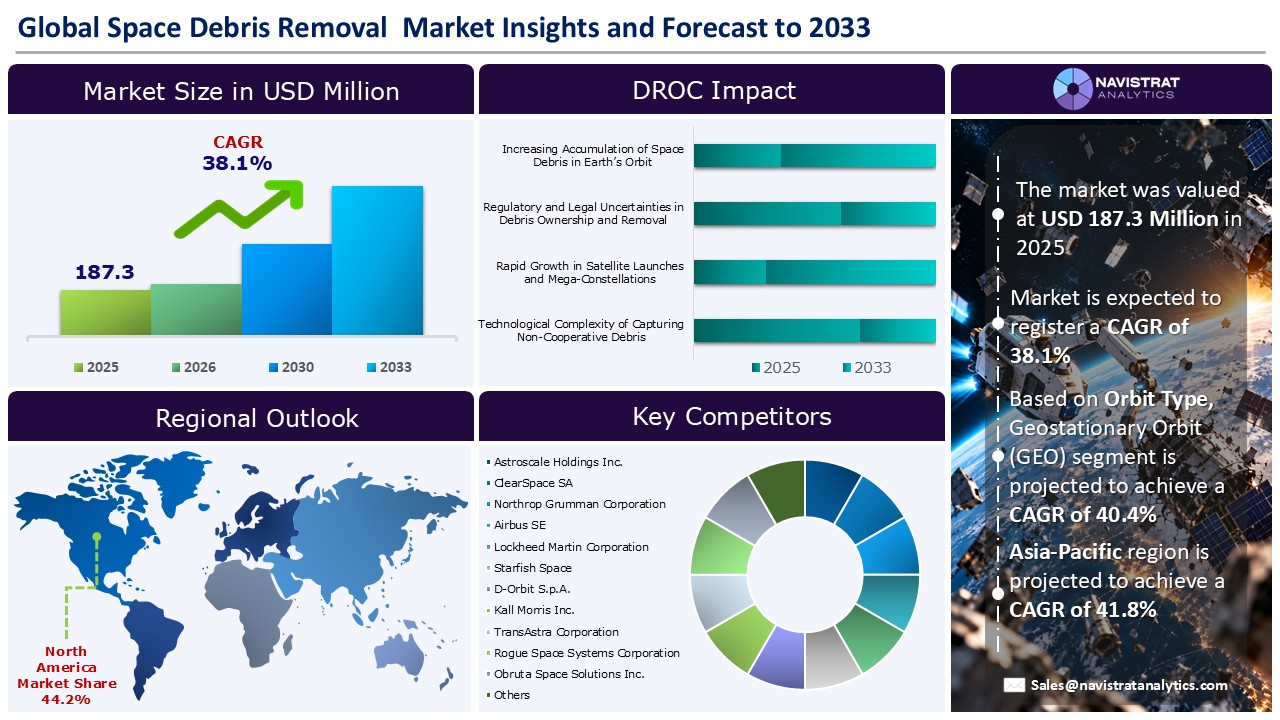
The global Space Debris Removal market reached USD 187.3 Million in 2025 and is expected to register a revenue CAGR of 38.1% during the forecast period. Increasing accumulation of space debris in Earth’s orbit, rising risk of orbital collisions and the Kessler syndrome, stringent space debris mitigation guidelines and regulatory pressure, growing commercialization of in-orbit servicing, and increasing demand for sustainable and responsible space operations are expected to drive revenue growth of the market.
Market Drivers:
The increasing accumulation of space debris in Earth’s orbit is driving revenue growth of the market. Over six decades of uncoordinated orbital activity, deliberate anti-satellite weapons testing, and accidental upper-stage breakups have congested critical orbital shells with hazardous artificial fragments. The European Space Agency (ESA) estimates that more than 35,000 catalogued objects larger than 10 centimetres and over 1 million fragments between 1 and 10 centimetres currently circle the Earth at hypervelocity speeds exceeding 27,000 kilometres per hour.
At these velocities, an impact with even a centimeter-sized fragment can disable an operational communications satellite or breach a crewed space habitat. This rapid congestion raises the likelihood of the Kessler syndrome, a cascade where orbital collisions generate fragments that trigger subsequent collisions, rendering vital orbital bands unusable.
Regulatory agencies have responded by shifting from voluntary space-safety guidelines to binding financial penalties and shortened operational lifespans. In October 2023, the U.S. Federal Communications Commission (FCC) issued its first-ever orbital debris enforcement penalty against Dish Network, fining the operator USD 150,000 for failing to properly de-orbit its defunct EchoStar-7 satellite into an approved disposal orbit. Concurrently, the FCC enacted a binding rule requiring low Earth orbit satellite operators to de-orbit their spacecraft within five years of mission completion, reducing the allowable threshold from the historical 25-year guideline.
Market Opportunity:
Rapid growth in satellite launches and mega-constellations is creating significant expansion opportunities for the space debris removal market. Commercial space transportation and standardized satellite buses have lowered orbital launch costs, resulting in a large increase in operational satellites, with the active fleet exceeding 10,000 spacecraft in mid-2024 and continuing to expand toward tens of thousands by the early 2030s. Commercial broadband mega-constellations, operated by enterprises such as SpaceX and Amazon, deploy hundreds of satellites annually into dense orbital shells between 500 and 1,200 kilometers. This operational density increases conjunction alerts and requires frequent evasive maneuvers, straining orbital traffic management and raising collision probabilities.
This congestion establishes a commercial addressable market for third-party orbital servicing, automated disposal, and fleet remediation. Regulatory agencies now require post-mission disposal reliability rates exceeding 90% for constellation licenses, compelling operators to integrate active remediation mechanisms or contract commercial orbital tugs. Demonstrating this commercial evolution, in January 2026, the U.S. Space Development Agency (SDA) awarded Starfish Space a landmark USD 52.5 million contract to provide satellite disposal-as-a-service for defunct military satellites from the Proliferated Warfighter Space Architecture (PWSA) constellation. This contract validates outsourced debris remediation business models for constellation operators.
Recent Trends:
The maturation and operational validation of autonomous Rendezvous and Proximity Operations (RPO) and non-cooperative capture architectures have emerged as major technological trends within the market. Historical debris removal concepts relied heavily on ground-commanded trajectories or passive drag enhancement sails. In contrast, modern orbital remediation focuses on deploying dedicated autonomous servicer spacecraft equipped with multi-sensor fusion architectures, including machine-vision optical cameras, light detection and ranging (LiDAR), and edge artificial intelligence algorithms designed to approach and stabilize uncooperative, tumbling debris objects.
Commercial momentum accelerated noticeably between 2024 and 2025 as specialized providers completed landmark orbital trials. In July 2024, Astroscale Japan’s ADRAS-J (Active Debris Removal by Astroscale-Japan) spacecraft completed approach maneuvers to within 50 meters and executed 360-degree fly-around inspection operations around an unprepared, non-cooperative Japanese H-IIA upper stage rocket body that had drifted in low Earth orbit since 2009.
In December 2024, ADRAS-J achieved an extreme 15-meter proximity approach, validating relative navigation, autonomous trajectory control, and model-matching computer vision on an unassisted client target. Similar autonomous relative navigation milestones demonstrated by Starfish Space’s Otter Pup vehicle in May 2024 prove that commercial servicers can inspect and dock with uncooperative orbital objects.
Restraints & Challenges:
Regulatory and legal uncertainties in debris ownership and orbital salvage rights pose a significant challenge to the space debris removal market. Under existing international space law, anchored by Article VIII of the 1967 Outer Space Treaty and the 1972 Space Liability Convention, a State of Registry retains absolute jurisdiction, ownership, and control over a registered space object, including its constituent parts, regardless of whether the asset is functional, defunct, or fragmented. Unlike terrestrial maritime law, which contains established salvage frameworks allowing third parties to recover distressed or abandoned vessels, international space law lacks an orbital salvage doctrine.
Securing diplomatic and multilateral consensus is further complicated by the dual-use nature of active debris removal technologies. Spacecraft equipped with advanced robotic arms, grappling nets, harpoons, or directional high-power lasers can be perceived as counter-space weapons capable of disabling military intelligence or defense satellites. Geopolitical tensions among leading space-faring nations hinder the sharing of orbital telemetry data and prevent bilateral debris remediation agreements.
Debris Type Segment Insights and Analysis:
Based on the debris type segment, the space debris removal market is segmented into large debris, small debris, and microscopic debris.
Large debris contributed the largest share in 2025 due to the massive, derelict objects that present the greatest environmental threat to orbital sustainability. When large orbital structures collide, they generate thousands of high-velocity fragments, triggering exponential debris propagation. Space agencies recognise that active removal of 5 to 10 massive derelict objects per year can stabilize the low Earth orbit environment, making large-body remediation the priority for national space agencies.
In August 2024, the Japan Aerospace Exploration Agency (JAXA) finalized a Phase II contract valued at approximately JPY 13.2 billion (USD 82 million) with Astroscale Japan for the Commercial Removal of Debris Demonstration (CRD2) mission. This program tasks Astroscale’s ADRAS-J2 spacecraft with approaching, grappling, and de-orbiting a defunct H-IIA upper stage rocket body using a specialized robotic arm. Large debris removal contracts command higher revenues due to the complex engineering, advanced propulsion, and robotic manipulation systems required to capture and remove non-cooperative objects. This is driving revenue growth of this segment.
Removal Technology Segment Insights and Analysis:
Based on removal technology, the space debris removal market is segmented into tether-based removal, propulsion-based removal, laser-based removal, magnetic capture, and others.
Propulsion-based removal segment accounted for the largest revenue share in 2025. Propulsion systems provide the controlled thrust needed to capture, alter the orbit of, and execute guided de-orbiting burns for multi-ton objects. Controlled atmospheric disposal is essential for preventing orbital remnants from causing ground casualties, making propulsion-based retro-thrust systems standard across civil and defense procurement programs.
In May 2024, the U.S. Space Force Space Systems Command (SSC) awarded Starfish Space a USD 37.5 million Strategic Funding Increase (STRATFI) contract to build, launch, and operate an Otter servicing spacecraft. The Otter vehicle uses autonomous electric propulsion to execute proximity maneuvers and augment orbital mobility for government assets. Similarly, D-Orbit has expanded the commercial deployment of its ION Satellite Carrier, using chemical propulsion modules to de-orbit hosted payloads on schedule.
Orbit Type Segment Insights and Analysis:
Based on orbit type, the space debris removal market is segmented into Low Earth Orbit (LEO), Medium Earth Orbit (MEO), Geostationary Orbit (GEO), and other orbits.
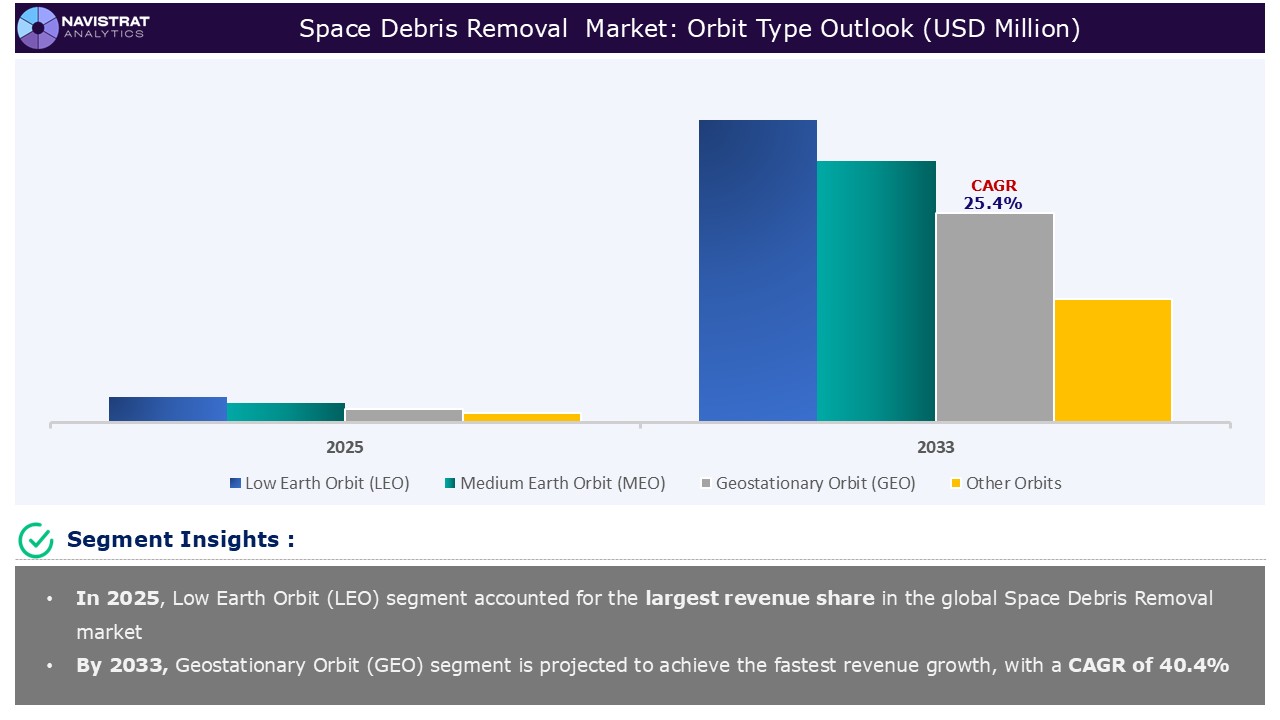
The Low Earth Orbit (LEO) segment contributed the largest revenue share to the space debris removal market in 2025. LEO includes thousands of derelict rocket boosters, making it the most congested region in space. Commercial broadband mega-constellations and Earth observation spacecraft operate primarily between 500 and 1,200 kilometers, an orbital belt where debris speeds exceed 7.5 km/s. Unmitigated collisions in this zone can disrupt global connectivity and critical Earth monitoring infrastructure, driving commercial operators and civil regulators to focus debris removal spending on LEO.
In May 2024, twelve European nations alongside the European Space Agency signed the Zero Debris Charter, setting a target to eliminate debris generation in LEO and geostationary regimes by 2030 and mandating strict five-year de-orbit windows. Furthermore, an upper stage from a Chinese Long March 6A rocket broke apart in LEO in August 2024, generating a cloud of over 700 trackable fragments and highlighting the urgent need for orbital protection in this zone. Driven by high commercial traffic, defense investments, and strict regulatory deadlines, LEO dominates overall market expenditure.
Geographical Outlook:
Space Debris Removal market is strategically segmented by geography to provide a comprehensive understanding of regional market dynamic. Discover demand analysis, emerging trends, and growth opportunities shaping market performance across different region and countries.
North America Space Debris Removal Market:
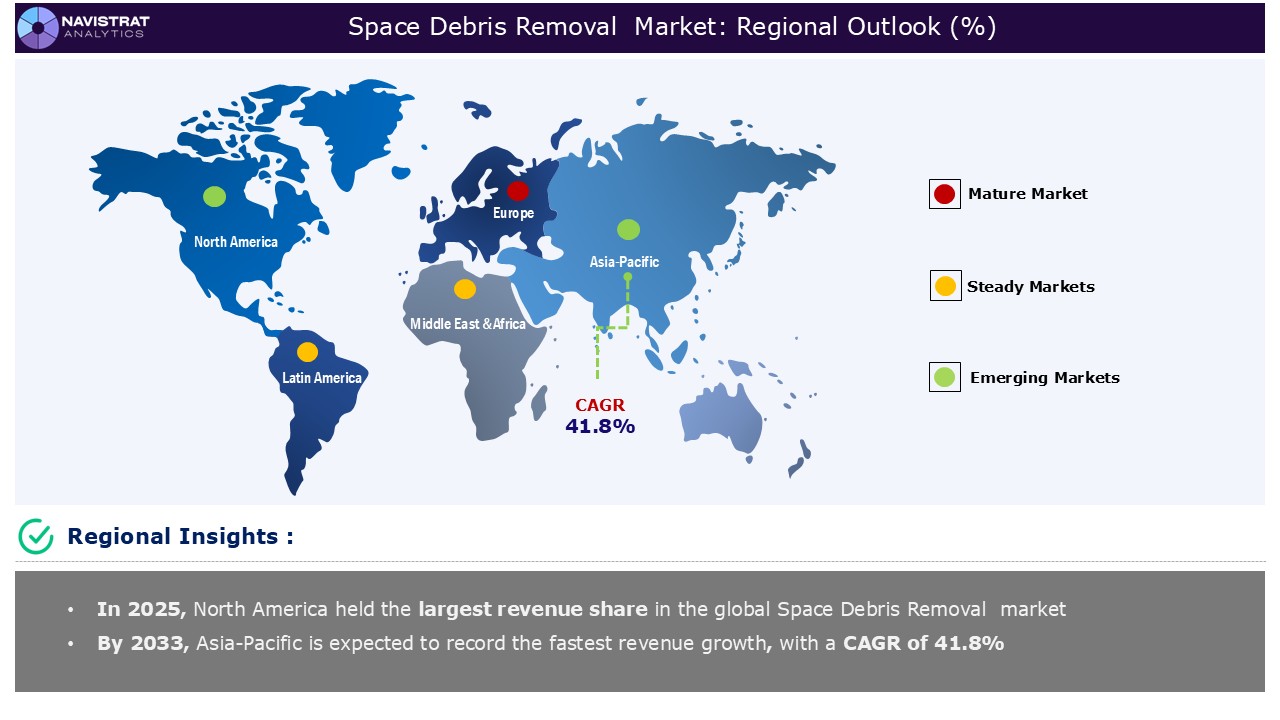
The market in North America accounted for the largest revenue share in the global space debris removal market in 2025 due to substantial defense space appropriations, the concentration of commercial mega-constellation operators, and strict orbital safety regulations. The presence of major institutional bodies such as the U.S. Space Force Space Systems Command (SSC), the Space Development Agency (SDA), DARPA, and NASA accelerates the procurement of rendezvous, proximity operations, and orbital disposal services.
Commercial space companies in North America are securing large-scale government contracts and venture capital funding to advance operational remediation capabilities. In January 2026, the U.S. Space Development Agency awarded Tukwila-based Starfish Space a USD 52.5 million contract to provide satellite disposal services for defunct military satellites within the Proliferated Warfighter Space Architecture (PWSA) constellation.
This was complemented by Starfish Space securing over USD 100 million in Series B financing in February 2026 to scale its Otter servicing spacecraft production line. These contract awards and private capital flows expand North America’s market lead, driving recurring revenue growth across active debris removal and orbital logistics services.
Asia Pacific Space Debris Removal Market:
Asia Pacific is expected to register a fast revenue growth rate during the forecast period due to expanding national launch cadences, rising regional investments in space domain awareness, and forward-leaning commercial regulatory frameworks in Japan, China, India, and South Korea. Regional governments are prioritizing the preservation of orbital assets by funding dedicated active debris removal technology demonstrators and enacting national space safety guidelines.
Japan has established itself as an early mover through the Japan Aerospace Exploration Agency’s (JAXA) Commercial Removal of Debris Demonstration (CRD2) project and national licensing guidelines for on-orbit servicing. Similarly, the Indian Space Research Organisation (ISRO) is advancing its IS4OM space sustainability framework, while Chinese research institutions expand automated tracking and debris mitigation systems.
The regional market is also supported by institutional and commercial developments. In August 2024, JAXA finalized a contract valued at approximately JPY 13.2 billion (USD 82 million) for Phase II of the CRD2 program with Astroscale Japan, tasking the company with capturing and removing an uncooperative upper-stage rocket body using robotic arm technology.
This followed the milestone achieved in July 2024, when Astroscale’s ADRAS-J spacecraft completed fly-around inspection maneuvers within 50 meters of an upper stage. In June 2024, Astroscale Holdings went public on the Tokyo Stock Exchange Growth Market, raising USD 63.2 million to scale manufacturing infrastructure. These capital investments and sovereign procurement contracts establish Asia Pacific as the fastest-growing regional market.
Europe Space Debris Removal Market:
Market in Europe accounted for a significant revenue share in 2025 due to strong institutional funding, mature public-private research partnerships, and policy frameworks championing orbital environmental protection. The European Space Agency (ESA) leads international clean-space initiatives through its Space Safety Programme, actively funding orbital remediation architectures, non-cooperative capture mechanisms, and life-extension platforms. European governments prioritize zero-debris goals to preserve critical orbital regimes and secure sovereign access to space.
Policy momentum peaked in May 2024 when twelve European nations—including Germany, the United Kingdom, France, and Sweden—and the European Space Agency signed the Zero Debris Charter at the EU/ESA Space Council. The charter establishes an operational framework to achieve net-zero orbital debris generation by 2030, encouraging operators to incorporate de-orbit subsystems and contract commercial remediation providers. Concurrently,
Swiss commercial servicer ClearSpace passed design milestones for ClearSpace-1, the active debris removal mission procured by ESA to capture and de-orbit a derelict payload adapter using a multi-arm grapple mechanism, scheduled to launch on an Arianespace Vega C rocket. In December 2024, European launch provider Avio signed the Zero Debris Charter, committing to integrate de-orbiting capabilities into its Vega C upper stages. These combined regulatory policies and active institutional missions sustain Europe’s market share.
Competition Analysis:
The space debris removal market is characterized by a consolidated structure, with few players competing across various segments and regions. List of major players included in the Space Debris Removal market report are:
- Astroscale Holdings Inc.
- ClearSpace SA
- Northrop Grumman Corporation
- Airbus SE
- Lockheed Martin Corporation
- Starfish Space
- D-Orbit S.p.A.
- Kall Morris Inc.
- TransAstra Corporation
- Rogue Space Systems Corporation
- Obruta Space Solutions Inc.
- Thales Alenia Space
- Surrey Satellite Technology
- Electro Optic Systems
- Aurora Propulsion Technologies Oy
Strategic Developments in Space Debris Removal Market:
- In January 2026, the U.S. Space Force Space Development Agency (SDA) awarded Starfish Space a USD 52.5 million contract to provide satellite disposal-as-a-service for defunct military satellites from the Proliferated Warfighter Space Architecture network, validating operational commercial debris removal procurement for defense constellations.
- In August 2024, the Japan Aerospace Exploration Agency (JAXA) finalized a Phase II commercial contract valued at approximately JPY 13.2 billion (USD 82 million) with Astroscale Japan Inc. for the Commercial Removal of Debris Demonstration (CRD2), tasking the company with capturing and removing a derelict upper-stage rocket body using robotic arm technology.
- In June 2024, Astroscale Holdings Inc. completed its initial public offering on the Tokyo Stock Exchange Growth Market, raising approximately USD 63.2 million to scale manufacturing infrastructure and advance commercial rendezvous, proximity operations, and active debris removal missions.
Key Advantages for Stakeholders:
Navistrat Analytics’ industry report provides an in-depth quantitative analysis of global market segments and industry dynamics. It covers historical trends, current developments, and market forecasts.
The report covers historical years from 2023 to 2024. The year 2025 serves as the base year for market size calculations. The forecast period extends from 2026 to 2033.
The report includes an executive summary and a comprehensive analysis of market drivers, restraints, opportunities, and challenges (DROC). It also provides insights into relevant regulatory standards and requirements.
The report features detailed PORTER’s Five Forces, SWOT, and PESTLE analyses. It also examines technological trends and the competitive landscape.
PORTER’s Five Forces analysis evaluates new entrants, competitive rivalry, supplier power, buyer power, and substitution threats. This analysis helps stakeholders understand market competition and overall industry attractiveness.
The competitive landscape evaluates the market positions of key industry players. It provides insights into competitive strategies, market presence, and the broader competitive environment.
Scope And Key Highlights of The Space Debris Removal Market Report:
| Report Features | Details |
| Market Size in 2025 | USD 187.3 Million |
| Market Growth Rate in CAGR (2026–2033) | 38.1% |
| Market Revenue Forecast to 2033 | USD 2,407.1 Million |
| Base year | 2025 |
| Historical year | 2023–2024 |
| Forecast period | 2026–2033 |
| Report Pages | 450 |
| Segments Covered |
|
| Regional scope |
|
| Country Scope |
|
| Key Market Players |
|
| Delivery Format | Reports are delivered in PDF format via email. |
| Customization scope | Request Customization |
The Space Debris Removal market report offers a detailed analysis of market size, including historical revenue (in USD Million) data for 2023-2024 and revenue forecasts for 2026-2033 across the following segments:
- Debris Type Outlook (Revenue, USD Million; 2023-2033)
- Large Debris
- Small Debris
- Microscopic Debris
- Removal Technology Outlook (Revenue, USD Million; 2023-2033)
- Tether-Based Removal
- Propulsion-Based Removal
- Laser-Based Removal
- Magnetic Capture
- Others
- Orbit Type Outlook (Revenue, USD Million; 2023-2033)
- Low Earth Orbit (LEO)
- Medium Earth Orbit (MEO)
- Geostationary Orbit (GEO)
- Other Orbits
- Service Type Outlook (Revenue, USD Million; 2023-2033)
- Active Debris Removal (ADR)
- On-Orbit Servicing and Debris Removal
- End-of-Life Disposal Services
- Others
- End-Use Outlook (Revenue, USD Million; 2023-2033)
- Government and Space Agencies
- Commercial Satellite Operators
- Spacecraft Manufacturers
- Defense and Aerospace Contractors
- Research and Academic Institutions
- Others
- Regional Outlook (Revenue, USD Million; 2023-2033)
- North America
- U.S.
- Canada
- Mexico
- Europe
- Germany
- France
- U.K.
- Italy
- Spain
- Benelux
- Nordic Countries
- Rest of Europe
- Asia Pacific
- China
- India
- Japan
- South Korea
- Oceania
- ASEAN Countries
- Rest of APAC
- Latin America
- Brazil
- Rest of LATAM
- Middle East & Africa
- GCC Countries
- South Africa
- Israel
- Turkey
- Rest of MEA
- North America
Frequently Asked Questions (FAQ) about the Space Debris Removal Market Report
The space debris removal market size was USD 187.3 million in 2025.
The space debris removal market revenue is expected to register a Compound Annual Growth Rate (CAGR) of 38.1% during the forecast period.
Increasing accumulation of space debris in Earth’s orbit, rising risk of orbital collisions and the Kessler syndrome, stringent space debris mitigation guidelines and regulatory pressure, growing commercialization of in-orbit servicing, and increasing demand for sustainable and responsible space operations are the key drivers of the market revenue growth.
High costs associated with space debris removal missions, regulatory and legal uncertainties in debris ownership and removal, risk of generating additional debris during removal operations, and difficulty in tracking and identifying small space debris are key factors restraining revenue growth of the market.
Asia Pacific is expected to account for the fastest revenue growth of 41.8%.
Low Earth Orbit (LEO) segment is the leading segment of space debris removal market in terms of orbit type.
- Market Definition
- Research Objective
- Research Methodology
- Research Design
- Data Collection Methods
- Primary
- Secondary
- Market Size Estimation
- Top-down method
- Bottom-up method
- Forecasting Methodology
- Tools and Models Used
- Market Overview and Trends
- Market Size and Forecast
- Industry Analysis
- Market Driver, Restraints, Opportunity and Challenges (DROC) Analysis
- Market Drivers
- Increasing Accumulation of Space Debris in Earth’s Orbit
- Rising Risk of Orbital Collisions and the Kessler Syndrome
- Stringent Space Debris Mitigation Guidelines and Regulatory Pressure
- Growing Commercialization of In-Orbit Servicing and Debris Removal
- Increasing Demand for Sustainable and Responsible Space Operations
- Market Restraints
- High Costs Associated with Space Debris Removal Missions
- Regulatory and Legal Uncertainties in Debris Ownership and Removal
- Risk of Generating Additional Debris During Removal Operations
- Difficulty in Tracking and Identifying Small Space Debris
- Market Opportunities
- Rapid Growth in Satellite Launches and Mega-Constellations
- Increasing Government Investments and Space Sustainability Initiatives
- Technological Advancements in Active Debris Removal Systems
- Market Challenges
- Technological Complexity of Capturing Non-Cooperative Debris
- Limited Technological Maturity and Operational Demonstrations
- Rising Dependence on Launch Infrastructure and Mission Availability
- Regulatory Landscape
- North America
- Europe
- Asia Pacific
- Latin America
- Middle East and Africa
- Strategic Insights
- Porter’s Five Forces Analysis
- PESTLE Analysis
- Price Trend Analysis
- Value Chain Analysis
- Technological Trends
- Maturation of autonomous Rendezvous and Proximity Operations (RPO)
- Robotic Capture of Large and Non-Cooperative Debris
- Standardized Design-for-Removal Interfaces
- Multi-Target and Reusable Debris Removal Servicers
- Advanced Non-Contact and Low-Mass Deorbit Technologies
- Recent Developments
- Funding
- Merger and Acquisition
- Expansion
- Partnership and Collaboration
- Product/ Service Launch
- Debris Type Market Revenue Estimates and Forecasts, 2023-2033
- Large Debris
- Small Debris
- Microscopic Debris
- Removal Technology Market Revenue Estimates and Forecasts, 2023-2033
- Tether-Based Removal
- Propulsion-Based Removal
- Laser-Based Removal
- Magnetic Capture
- Others
- Orbit Type Market Revenue Estimates and Forecasts, 2023-2033
- Low Earth Orbit (LEO)
- Medium Earth Orbit (MEO)
- Geostationary Orbit (GEO)
- Other Orbits
- Service Type Market Revenue Estimates and Forecasts, 2023-2033
- Active Debris Removal (ADR)
- On-Orbit Servicing and Debris Removal
- End-of-Life Disposal Services
- Others
- End-Use Market Revenue Estimates and Forecasts, 2023-2033
- Government and Space Agencies
- Commercial Satellite Operators
- Spacecraft Manufacturers
- Defense and Aerospace Contractors
- Research and Academic Institutions
- Others
- Space Debris Removal Market Revenue Estimates and Forecasts by Region, 2023-2033, USD Million
- North America
- North America Space Debris Removal Market By Debris Type, Market Revenue Estimates and Forecasts, 2023-2033, USD Million
- Large Debris
- Small Debris
- Microscopic Debris
- North America Space Debris Removal Market By Removal Technology, Market Revenue Estimates and Forecasts, 2023-2033, USD Million
- Tether-Based Removal
- Propulsion-Based Removal
- Laser-Based Removal
- Magnetic Capture
- Others
- North America Space Debris Removal Market By Orbit Type, Market Revenue Estimates and Forecasts, 2023-2033, USD Million
- Low Earth Orbit (LEO)
- Medium Earth Orbit (MEO)
- Geostationary Orbit (GEO)
- Other Orbits
- North America Space Debris Removal Market By Service Type, Market Revenue Estimates and Forecasts, 2023-2033, USD Million
- Active Debris Removal (ADR)
- On-Orbit Servicing and Debris Removal
- End-of-Life Disposal Services
- Others
- North America Space Debris Removal Market By End-Use, Market Revenue Estimates and Forecasts, 2023-2033, USD Million
- Government and Space Agencies
- Commercial Satellite Operators
- Spacecraft Manufacturers
- Defense and Aerospace Contractors
- Research and Academic Institutions
- Others
- North America Space Debris Removal Market Revenue Estimates and Forecasts by Country, 2023-2033, USD Million
- United States
- Canada
- Mexico
- North America Space Debris Removal Market By Debris Type, Market Revenue Estimates and Forecasts, 2023-2033, USD Million
- Europe
- Europe Space Debris Removal Market By Debris Type, Market Revenue Estimates and Forecasts, 2023-2033, USD Million
- Large Debris
- Small Debris
- Microscopic Debris
- Europe Space Debris Removal Market By Removal Technology, Market Revenue Estimates and Forecasts, 2023-2033, USD Million
- Tether-Based Removal
- Propulsion-Based Removal
- Laser-Based Removal
- Magnetic Capture
- Others
- Europe Space Debris Removal Market By Orbit Type, Market Revenue Estimates and Forecasts, 2023-2033, USD Million
- Low Earth Orbit (LEO)
- Medium Earth Orbit (MEO)
- Geostationary Orbit (GEO)
- Other Orbits
- Europe Space Debris Removal Market By Service Type, Market Revenue Estimates and Forecasts, 2023-2033, USD Million
- Active Debris Removal (ADR)
- On-Orbit Servicing and Debris Removal
- End-of-Life Disposal Services
- Others
- Europe Space Debris Removal Market By End-Use, Market Revenue Estimates and Forecasts, 2023-2033, USD Million
- Government and Space Agencies
- Commercial Satellite Operators
- Spacecraft Manufacturers
- Defense and Aerospace Contractors
- Research and Academic Institutions
- Others
- Europe Space Debris Removal Market Revenue Estimates and Forecasts by Country, 2023-2033, USD Million
- Germany
- United Kingdom
- France
- Italy
- Spain
- Benelux
- Nordic Countries
- Rest of Europe
- Europe Space Debris Removal Market By Debris Type, Market Revenue Estimates and Forecasts, 2023-2033, USD Million
- Asia-Pacific
- Asia-Pacific Space Debris Removal Market By Debris Type, Market Revenue Estimates and Forecasts, 2023-2033, USD Million
- Large Debris
- Small Debris
- Microscopic Debris
- Asia-Pacific Space Debris Removal Market By Removal Technology, Market Revenue Estimates and Forecasts, 2023-2033, USD Million
- Tether-Based Removal
- Propulsion-Based Removal
- Laser-Based Removal
- Magnetic Capture
- Others
- Asia-Pacific Space Debris Removal Market By Orbit Type, Market Revenue Estimates and Forecasts, 2023-2033, USD Million
- Low Earth Orbit (LEO)
- Medium Earth Orbit (MEO)
- Geostationary Orbit (GEO)
- Other Orbits
- Asia-Pacific Space Debris Removal Market By Service Type, Market Revenue Estimates and Forecasts, 2023-2033, USD Million
- Active Debris Removal (ADR)
- On-Orbit Servicing and Debris Removal
- End-of-Life Disposal Services
- Others
- Asia-Pacific Space Debris Removal Market By End-Use, Market Revenue Estimates and Forecasts, 2023-2033, USD Million
- Government and Space Agencies
- Commercial Satellite Operators
- Spacecraft Manufacturers
- Defense and Aerospace Contractors
- Research and Academic Institutions
- Others
- Asia-Pacific Space Debris Removal Market Revenue Estimates and Forecasts by Country, 2023-2033, USD Million
- China
- India
- Japan
- South Korea
- Oceania
- ASEAN Countries
- Rest of Asia-Pacific
- Asia-Pacific Space Debris Removal Market By Debris Type, Market Revenue Estimates and Forecasts, 2023-2033, USD Million
- Latin America
- Latin America Space Debris Removal Market By Debris Type, Market Revenue Estimates and Forecasts, 2023-2033, USD Million
- Large Debris
- Small Debris
- Microscopic Debris
- Latin America Space Debris Removal Market By Removal Technology, Market Revenue Estimates and Forecasts, 2023-2033, USD Million
- Tether-Based Removal
- Propulsion-Based Removal
- Laser-Based Removal
- Magnetic Capture
- Others
- Latin America Space Debris Removal Market By Orbit Type, Market Revenue Estimates and Forecasts, 2023-2033, USD Million
- Low Earth Orbit (LEO)
- Medium Earth Orbit (MEO)
- Geostationary Orbit (GEO)
- Other Orbits
- Latin America Space Debris Removal Market By Service Type, Market Revenue Estimates and Forecasts, 2023-2033, USD Million
- Active Debris Removal (ADR)
- On-Orbit Servicing and Debris Removal
- End-of-Life Disposal Services
- Others
- Latin America Space Debris Removal Market By End-Use, Market Revenue Estimates and Forecasts, 2023-2033, USD Million
- Government and Space Agencies
- Commercial Satellite Operators
- Spacecraft Manufacturers
- Defense and Aerospace Contractors
- Research and Academic Institutions
- Others
- Latin America Space Debris Removal Market Revenue Estimates and Forecasts by Country, 2023-2033, USD Million
- Brazil
- Rest of Latin America
- Latin America Space Debris Removal Market By Debris Type, Market Revenue Estimates and Forecasts, 2023-2033, USD Million
- Middle East & Africa
- Middle East & Africa Space Debris Removal Market By Debris Type, Market Revenue Estimates and Forecasts, 2023-2033, USD Million
- Large Debris
- Small Debris
- Microscopic Debris
- Middle East & Africa Space Debris Removal Market By Removal Technology, Market Revenue Estimates and Forecasts, 2023-2033, USD Million
- Tether-Based Removal
- Propulsion-Based Removal
- Laser-Based Removal
- Magnetic Capture
- Others
- Middle East & Africa Space Debris Removal Market By Orbit Type, Market Revenue Estimates and Forecasts, 2023-2033, USD Million
- Low Earth Orbit (LEO)
- Medium Earth Orbit (MEO)
- Geostationary Orbit (GEO)
- Other Orbits
- Middle East & Africa Space Debris Removal Market By Service Type, Market Revenue Estimates and Forecasts, 2023-2033, USD Million
- Active Debris Removal (ADR)
- On-Orbit Servicing and Debris Removal
- End-of-Life Disposal Services
- Others
- Middle East & Africa Space Debris Removal Market By End-Use, Market Revenue Estimates and Forecasts, 2023-2033, USD Million
- Government and Space Agencies
- Commercial Satellite Operators
- Spacecraft Manufacturers
- Defense and Aerospace Contractors
- Research and Academic Institutions
- Others
- Middle East & Africa Space Debris Removal Market Revenue Estimates and Forecasts by Country, 2023-2033, USD Million
- GCC Countries
- South Africa
- Israel
- Turkey
- Rest of Middle East & Africa
- Middle East & Africa Space Debris Removal Market By Debris Type, Market Revenue Estimates and Forecasts, 2023-2033, USD Million
- Market Share Analysis
- Revenue Market Share by Key Players (2025-2026)
- Analysis of Top Players by Market Presence
- Competitive Matrix
- Competitive Strategies
- Mergers and Acquisitions
- Partnerships and Collaboration
- Investment and Fundings
- Agreement
- Expansion
- New Product/ Services Launches
- Technological Innovations
- Astroscale Holdings Inc.
- Company Overview
- Financial Insights
- Product/ Services Type
- Strategic Developments
- SWOT Analysis
- ClearSpace SA
- Company Overview
- Financial Insights
- Product/ Services Type
- Strategic Developments
- SWOT Analysis
- Northrop Grumman Corporation
- Company Overview
- Financial Insights
- Product/ Services Type
- Strategic Developments
- SWOT Analysis
- Airbus SE
- Company Overview
- Financial Insights
- Product/ Services Type
- Strategic Developments
- SWOT Analysis
- Lockheed Martin Corporation
- Company Overview
- Financial Insights
- Product/ Services Type
- Strategic Developments
- SWOT Analysis
- Starfish Space
- Company Overview
- Financial Insights
- Product/ Services Type
- Strategic Developments
- SWOT Analysis
- D-Orbit S.p.A.
- Company Overview
- Financial Insights
- Product/ Services Type
- Strategic Developments
- SWOT Analysis
- Kall Morris Inc.
- Company Overview
- Financial Insights
- Product/ Services Type
- Strategic Developments
- SWOT Analysis
- Kall Morris Inc.
- Company Overview
- Financial Insights
- Product/ Services Type
- Strategic Developments
- SWOT Analysis
- Rogue Space Systems Corporation
- Company Overview
- Financial Insights
- Product/ Services Type
- Strategic Developments
- SWOT Analysis
- Obruta Space Solutions Inc.
- Company Overview
- Financial Insights
- Product/ Services Type
- Strategic Developments
- SWOT Analysis
- Thales Alenia Space
- Company Overview
- Financial Insights
- Product/ Services Type
- Strategic Developments
- SWOT Analysis
- Surrey Satellite Technology
- Company Overview
- Financial Insights
- Product/ Services Type
- Strategic Developments
- SWOT Analysis
- Electro Optic Systems
- Company Overview
- Financial Insights
- Product/ Services Type
- Strategic Developments
- SWOT Analysis
- Aurora Propulsion Technologies Oy
- Company Overview
- Financial Insights
- Product/ Services Type
- Strategic Developments
- SWOT Analysis