

AI in Patient Scheduling Software Market Overview and Key Insights:
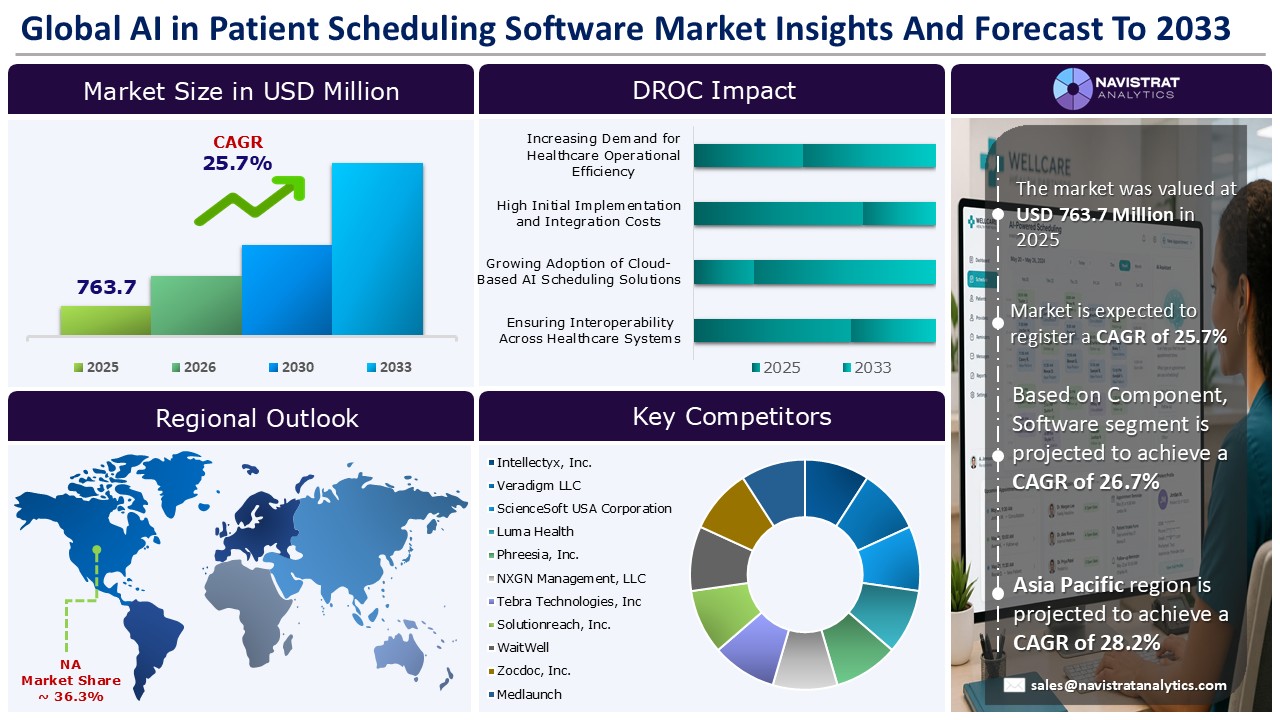
AI in patient scheduling software market size reached USD 763.7 Million in 2025 and is expected to register a revenue CAGR of 25.7% during the forecast period. AI-powered patient scheduling optimization software leverages predictive analytics, machine learning, and conversational AI to automate and enhance the entire healthcare appointment management process. Beyond traditional calendar-based systems, these solutions intelligently balance appointment demand with available clinical resources. By continuously optimizing schedules around the clock, they improve appointment slot utilization, reduce administrative call volumes, prevent double-bookings, and enhance operational efficiency in busy healthcare environments.
Market Drivers:
Increasing demand for healthcare operational efficiency is a key driver driving the market revenue growth. Artificial Intelligence (AI) has become an increasingly important component of the healthcare industry, transforming areas ranging from medical diagnostics and treatment planning to administrative operations. In 2025, the application of AI has expanded beyond clinical functions to include healthcare administration, particularly patient scheduling and resource allocation. AI-powered scheduling systems provide patients with greater flexibility by offering personalized appointment options and automated reminders, helping reduce waiting times and improve patient engagement and satisfaction.
Furthermore, automating routine scheduling tasks enables healthcare staff to devote more time to patient care and other essential responsibilities. This reduces administrative pressure, supports improved job satisfaction, and helps minimize staff burnout, contributing to a more efficient and supportive healthcare work environment. AI agents are enhancing healthcare scheduling while improving overall operational productivity by automating repetitive and time-intensive administrative activities. They help streamline routine processes and ensure that information is recorded accurately and consistently, reducing manual errors and allowing healthcare staff to focus on more critical responsibilities.
On August 2026, Johannesburg-based technology firm Knockturnal (Pty) Ltd has introduced Hlokomela, a secure digital healthcare platform powered by artificial intelligence (AI) to simplify medical appointment scheduling and improve care coordination throughout South Africa. The platform aims to minimize missed appointments through automated reminders, reduce administrative workloads for healthcare practices, and support smaller providers that may lack the resources to employ full-time receptionists.
Market Opportunity:
Integration of generative AI and voice-based scheduling assistants act as opportunity for AI in patient scheduling software market. Healthcare organizations are continually looking for ways to streamline operations, improve patient satisfaction, and reduce inefficiencies. By applying machine learning and generative AI, healthcare providers can anticipate missed appointments, automate patient reminders, and optimize appointment scheduling. This data-driven approach helps minimize idle time and create a more efficient scheduling process. AI-powered systems can identify cancellations in real time, reassign vacant appointment slots, and maintain a consistent flow of patients. They can also analyse trends and behavioural patterns to identify potential scheduling bottlenecks in advance. Automating these processes enables healthcare organizations to make better use of available resources and enhance overall operational efficiency.
Automating appointment booking calls has emerged as a key application of voice AI in healthcare. Medical clinics devote considerable time to handling routine scheduling inquiries, many of which can be managed efficiently by AI-powered voice agents. These assistants understand patients’ requests, review available time slots in the scheduling system, and confirm appointments during the call. They can also capture patient information and update clinic calendars automatically, reducing the need for manual staff involvement and streamlining administrative workflows.
Recent Trends:
Emerging trends include predictive analytics for appointment no-show prevention, natural language processing and voice-based appointment booking, dynamic scheduling and intelligent slot allocation, AI-driven resource and capacity optimization, and AI-powered patient engagement and personalized reminders.
Predictive analytics plays a vital role in data-driven patient scheduling, particularly in healthcare processes managed by business process outsourcing (BPO) providers. By examining historical information, including patient behavior, missed appointment rates, and appointment durations, predictive models can estimate patient demand and anticipate scheduling outcomes more effectively. In addition, continuous analysis of real-time factors, such as patient arrivals, cancellations, and available clinic capacity, enables healthcare customer experience (CX) providers to make timely scheduling adjustments. This helps minimize patient waiting times, optimize resource allocation, and deliver a smoother, more satisfactory healthcare experience.
On April 2025, Relatient, a leading provider of patient scheduling solutions, introduced Dash Voice AI, an advanced conversational AI feature integrated into its Dash Schedule platform. The solution enhances appointment management by automating large volumes of patient phone calls related to appointment confirmations, rescheduling, and cancellations. By utilizing the existing rule-based intelligence of the Dash platform, the AI agent ensures that each interaction aligns with healthcare providers’ specific scheduling requirements and preferences in real time.
Restraints & Challenges:
Ensuring interoperability across healthcare systems is a significant challenge for the growth of this market. AI scheduling platforms must exchange information reliably with EHRs, hospital information systems, laboratory systems, and third-party patient engagement applications. Differences in data formats, software architectures, and interoperability standards can complicate integration and prevent healthcare providers from achieving seamless scheduling workflows. Effective AI scheduling depends on continuously updated information regarding clinician availability, room capacity, appointment changes, and equipment status. Delayed updates or synchronization failures can lead to double bookings, incorrect slot recommendations, and disruptions to patient care.
Healthcare providers need evidence that AI scheduling software can reduce missed appointments, administrative costs, waiting times, and unused capacity. Vendors may face challenges demonstrating consistent financial and operational benefits across facilities with different patient volumes, staffing structures, and existing technology systems. Scheduling requirements vary significantly between hospitals, independent clinics, diagnostic centers, telehealth providers, and specialty practices. Vendors must configure their systems to accommodate different appointment durations, clinical priorities, staffing models, and operational rules without compromising usability or prediction accuracy.
Component Segment Insights and Analysis:
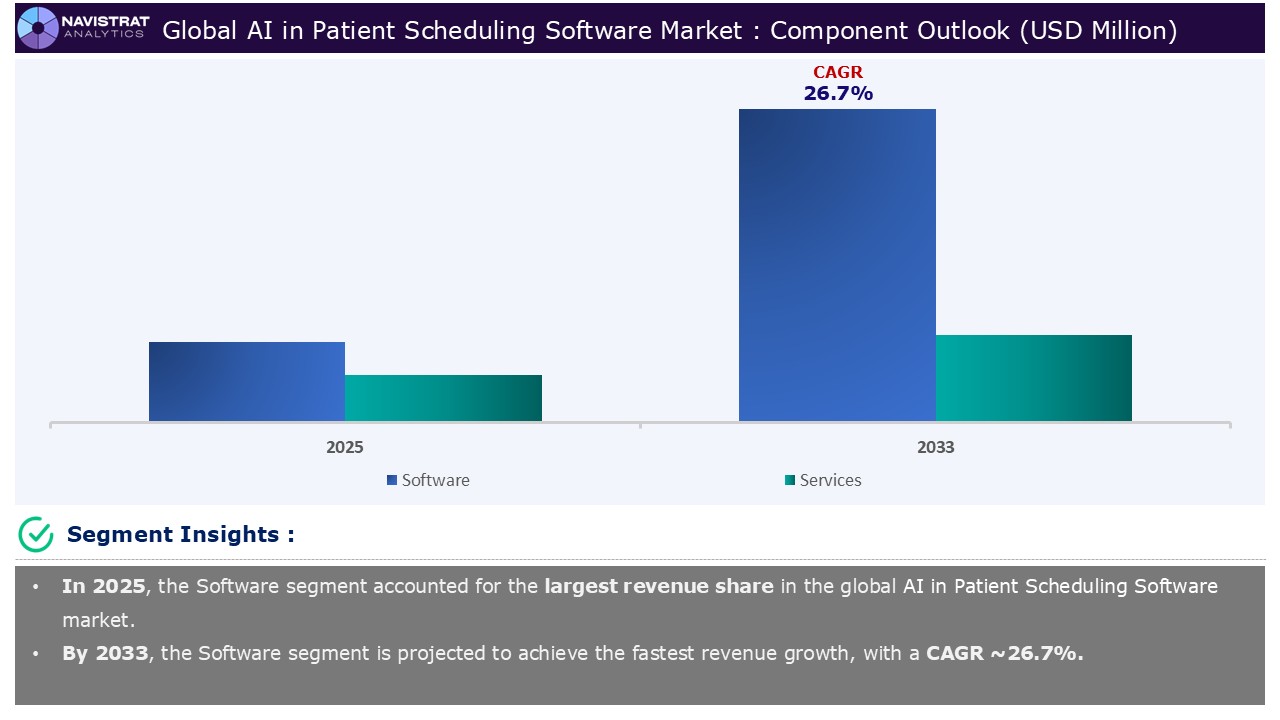
Based on the component, AI in patient scheduling software market is segmented into software and services.
Software segment contributed the largest market share in 2025. AI in Patient Scheduling Efficient healthcare facility management involves coordinating multiple operational activities, including managing medical staff, scheduling patient appointments, allocating rooms, and organizing work schedules. Patient scheduling software helps streamline these interconnected processes by integrating them into a centralized system, enabling healthcare facilities to improve coordination and manage daily operations more effectively. Traditional manual scheduling methods often struggle to effectively balance the requirements of both patients and healthcare professionals.
AI-powered scheduling solutions apply intelligent algorithms to organize appointments based on factors such as clinical urgency, physician specialization, and historical trends in cancellations and delays. For instance, Ontario, Canada, tested the Integrated Online Booking (IOB) system, which uses AI to distribute appointment demand more efficiently across clinics. This approach helps reduce patient waiting times and improves referral management. Although the system was evaluated outside the United States, its underlying principles are equally relevant to the U.S. healthcare system, where multi-clinic networks encounter comparable scheduling and resource allocation challenges.
On February 2026, athenahealth has introduced an upgraded version of its AI-powered patient engagement suite within the athenaOne platform, aimed at improving communication between patients and healthcare practices. The enhanced solution features advanced text and voice functionalities, allowing patients to interact with a virtual assistant at their healthcare provider’s office to obtain basic information and book appointments. These capabilities are integrated directly into existing athenaOne workflows, helping simplify patient interactions and streamline administrative processes.
Deployment Mode Segment Insights and Analysis:
Based on the deployment mode, AI in patient scheduling software market is segmented into cloud, on-premise, and hybrid.
Cloud segment contributed the fastest growth rate in 2025. Cloud deployment is becoming an increasingly important component of AI-powered patient scheduling software, enabling healthcare providers to manage appointments and administrative activities through internet-based platforms. By integrating artificial intelligence with cloud computing, healthcare organizations can access intelligent scheduling solutions without maintaining extensive on-premises IT infrastructure. Cloud-based AI scheduling platforms use machine learning, predictive analytics, and automation to optimize appointment allocation, forecast patient no-shows, manage cancellations, and send automated reminders. These systems can also synchronize scheduling information across multiple departments and healthcare facilities, improving coordination and operational efficiency.
On May 2026, Predictiv AI Inc. announced a strategic healthcare partnership and reseller agreement with ADDATech Systems Inc. to deploy and commercialize its CloudRep AI communications and workflow automation platform. Through this collaboration, CloudRep AI has been directly integrated with the Clinicmaster platform, allowing healthcare clinics to incorporate AI-powered voice agents, automated appointment scheduling, multilingual patient interactions, chatbot services, and workflow automation into their existing clinical and administrative operations.
Application Segment Insights and Analysis:
Based on the application, AI in patient scheduling software market is segmented into appointment management, predictive no-show management, resource optimization, telehealth scheduling, automated patient communication, and others.
Appointment management segment contributed the largest market share in 2025. AI-driven patient scheduling and appointment management solutions are becoming increasingly important in addressing the growing challenges of healthcare appointment coordination. Advanced hospital scheduling software helps patients and healthcare providers optimize the use of available resources while improving appointment accessibility. These systems can also support revenue growth by offering greater scheduling flexibility and convenience for patients, while enhancing staff productivity and operational efficiency. As digital healthcare adoption expands, individuals are increasingly embracing solutions such as mHealth applications and medication adherence platforms to simplify care coordination and make healthcare consultations more convenient.
On September 2026, Parakeet Health, a healthcare AI company, has partnered with Qualderm, a management services organization, to improve patient access, enhance continuity of care, and re-engage individuals after appointment cancellations, missed visits, or delayed follow-ups. With a network of nearly 160 practices across 17 states, Qualderm provides services in medical, surgical, and cosmetic dermatology, skin cancer treatment, and plastic surgery. Through this collaboration, Parakeet Health uses AI to analyze provider schedules and identify available appointment slots, helping Qualderm reconnect patients with timely care opportunities.
Geographical Outlook:
AI in patient scheduling software market is strategically segmented by geography to provide a comprehensive understanding of regional market dynamic. Discover demand analysis, emerging trends, and growth opportunities shaping market performance across different region and countries.
North America AI in Patient Scheduling Software Market:
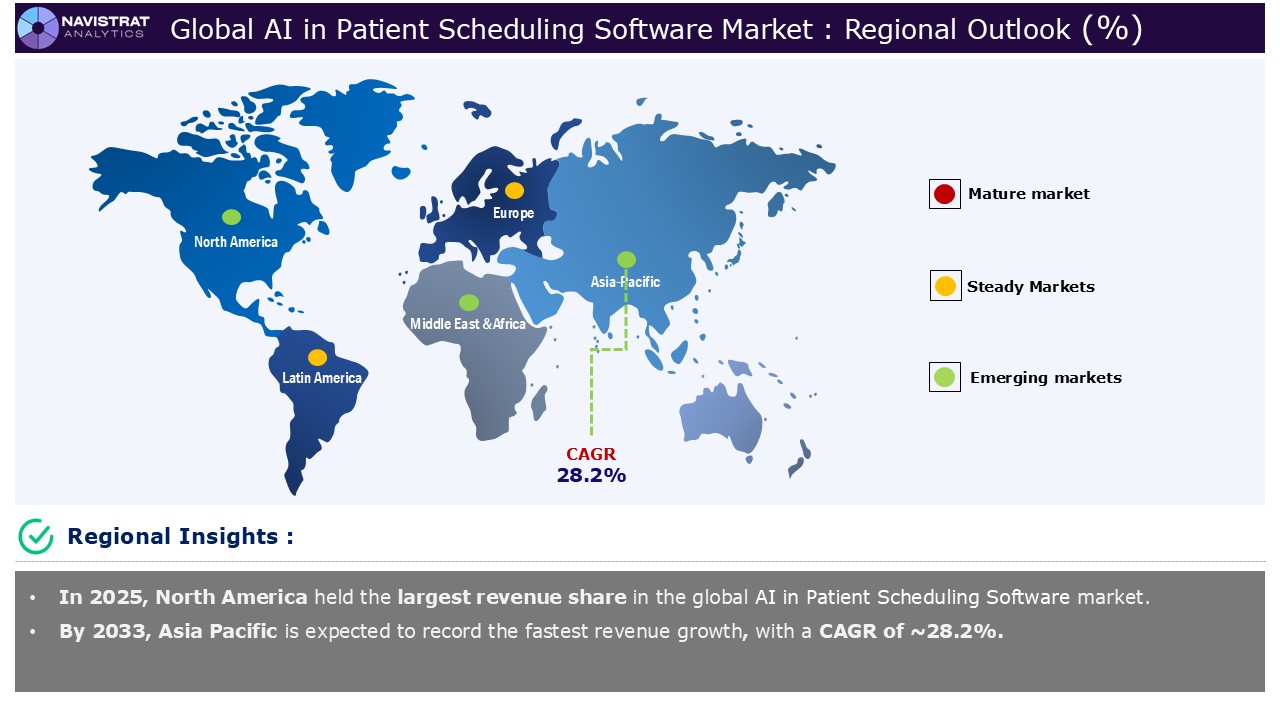
North America is registered to have highest market share in AI in patient scheduling software market in 2025, driven by widespread adoption of digital healthcare technologies, advanced healthcare infrastructure, and increasing demand for efficient patient access solutions. Healthcare providers across the United States, Canada, and Mexico are increasingly implementing AI-enabled scheduling platforms to automate appointment booking, reduce patient no-shows, optimize provider availability, and streamline administrative workflows. Furthermore, the region’s strong adoption of Electronic Health Records (EHRs), cloud-based healthcare solutions, and telehealth services further supports market growth.
On March 2026, Amazon has introduced its Health AI agent on its website and mobile app, offering Prime members free, round-the-clock access to virtual healthcare support. The agentic AI-powered assistant helps users interpret medical records, provides personalized health insights, and connects them with licensed healthcare professionals. By accessing patient information through state health information exchanges, Health AI can review medical histories, diagnoses, and medications to deliver more informed responses to health-related queries. The platform also supports healthcare coordination by assisting users with appointment bookings and prescription management.
Asia Pacific AI in Patient Scheduling Software Market:
Asia Pacific is expected to register the fastest growth rate during the forecasted period. The Asia-Pacific region is undergoing significant digital transformation, supported by rising healthcare spending, expanding patient populations, and government-led initiatives promoting AI adoption across clinical, diagnostic, and administrative functions. Countries such as China, Japan, and India are advancing healthcare innovation through research investments and the implementation of AI-based solutions in clinical settings. The combination of increasing healthcare costs, growing demand for medical services, and rapid technological progress is expected to create substantial opportunities for regional market growth.
On May 2025, Hippocratic AI, a global provider of safety-focused generative AI agents for healthcare, has partnered with EUCALIA Inc. to introduce the first Japanese-language generative AI healthcare agent focused on non-diagnostic, patient-facing clinical activities. The solution aims to assist healthcare professionals by automating essential but time-intensive tasks, including appointment scheduling, patient follow-up communications, chronic care monitoring, and medication adherence support, allowing clinicians to focus more on direct patient care.
Competition Analysis:
AI in patient scheduling software market is characterized by a fragmented structure, with several players competing across various segments and regions. List of major players included in AI in patient scheduling software market report are:
- Intellectyx, Inc.
- Veradigm LLC
- ScienceSoft USA Corporation
- Luma Health
- Phreesia, Inc.
- NXGN Management, LLC
- Tebra Technologies, Inc
- Solutionreach, Inc.
- WaitWell
- Zocdoc, Inc.
- Medlaunch
- Curogram, Inc.
- Healthtalk AI, Inc.
- NextPatient, Inc.
- X-Byte Enterprise Solutions
- Clearwave Corporation
Strategic Developments in AI in Patient Scheduling Software Market:
- In June 2026, Prosper AI, a leading AI platform provider, has announced a USD 30 million Series A funding round, reflecting its rapid market adoption and growing business momentum. As healthcare organizations increasingly seek to automate insurance verification, patient billing, and appointment scheduling, Prosper AI is gaining traction as a preferred solution for streamlining financial clearance and ensuring patients are financially ready before their appointments.
- In May 2025, Epic Systems has introduced an AI-powered conversational SMS scheduling feature that enables patients to book appointments through text messages. The solution removes the need to access patient portals or wait on phone lines, offering a more convenient booking experience through direct interaction with an intelligent scheduling assistant.
Key Advantages for Stakeholders:
Navistrat Analytics’ industry report provides an in-depth quantitative analysis of various market segments, historical and current trends, market forecasts, and dynamics within the global market. The historical years covered in this report are 2023 to 2024, with 2025 serving as the base year for market size calculations. The forecast period extends from 2026 to 2033.
The report includes an executive summary and a comprehensive overview of market drivers, restraints, opportunities, and challenges (DROC), along with insights into regulatory standards. It features detailed analyses such as PORTER’s Five Forces, SWOT, and PESTLE, as well as assessments of technological trends and the competitive landscape.
PORTER’s Five Forces analysis helps stakeholders evaluate the impact of new entrants, competitive rivalry, supplier power, buyer power, and substitution threats, enabling them to assess the level of competition and the attractiveness of the global market. The competitive landscape provides stakeholders with a clear understanding of the current market positions of key players, offering valuable insights into their competitive environment.
Scope And Key Highlights Of AI in Patient Scheduling Software Market Report:
| Report Features | Details |
| Market Size in 2025 | USD 763.7 Million |
| Market Growth Rate in CAGR (2026–2033) | 25.7% |
| Market Revenue forecast to 2033 | USD 4,780.1 Million |
| Base year | 2025 |
| Historical year | 2023-2024 |
| Forecast period | 2026-2033 |
| Report Pages | 450 |
| Segments covered |
|
| Regional scope |
|
| Country Scope |
|
| Key Market Players |
|
| Delivery Format | Reports are delivered in PDF format via email. |
| Customization scope | Request for Customization |
AI in Patient Scheduling Software market report offers a detailed analysis of market size, including historical revenue (in USD Million) data for 2023-2024 and revenue forecasts for 2026-2033 across the following segments:
- Component Outlook (Revenue, USD Million; 2023-2033)
- Software
- Services
- Scheduling Type Outlook (Revenue, USD Million; 2023-2033)
- Outpatient
- Inpatient
- Specialty care
- Emergency and Urgent Care
- Deployment Mode Outlook (Revenue, USD Million; 2023-2033)
- Cloud
- On-Premise
- Hybrid
- Application Outlook (Revenue, USD Million; 2023-2033)
- Appointment Management
- Predictive No-Show Management
- Resource Optimization
- Telehealth Scheduling
- Automated Patient Communication
- Others
- End-Use Outlook (Revenue, USD Million; 2023-2033)
- Hospitals and Clinics
- Diagnostic and Imaging Centers
- Ambulatory Surgical Centers (ASCs)
- Telehealth Providers
- Regional Outlook (Revenue, USD Million; 2023-2033)
- North America
- U.S.
- Canada
- Mexico
- Europe
- Germany
- France
- U.K.
- Italy
- Spain
- Benelux
- Nordic Countries
- Rest of Europe
- Asia Pacific
- China
- India
- Japan
- South Korea
- Oceania
- ASEAN Countries
- Rest of APAC
- Latin America
- Brazil
- Rest of LATAM
- Middle East & Africa
- GCC Countries
- South Africa
- Israel
- Turkey
- Rest of MEA
- North America
Frequently Asked Questions (FAQ) about AI in Patient Scheduling Software Market report
The market size of AI in patient scheduling software market was 763.7 million in 2025.
The market size of AI in patient scheduling software market is expected to register compound annual growth rate (CAGR) of 25.7% over the forecast period.
Increasing demand for healthcare operational efficiency, rising patient no-show rates and appointment cancellations, growing adoption of electronic health records and digital healthcare platforms are major key factors driving the market revenue growth of AI in patient scheduling software market.
High initial implementation and integration costs and data privacy and cybersecurity concerns are key limiting factors driving the market.
Asia Pacific account for fastest revenue growth of 28.2%.
Software is the major leading segment of AI in patient scheduling software market in terms of component.
- Market Definition
- Research Objective
- Research Methodology
- Research Design
- Data Collection Methods
- Primary
- Secondary
- Market Size Estimation
- Top-down Model Method
- Bottom-up Model Method
- Forecasting Methodology
- Tools and Models Use
- Market Overview and Trends
- Market Size and Forecast
- Industry Analysis
- Market Driver, Restraints, Opportunity, and Challenges (DROC) Analysis
- Market Drivers
- Increasing demand for healthcare operational efficiency
- Rising patient no-show rates and appointment cancellations
- Growing adoption of electronic health records and digital healthcare platforms
- Expansion of telehealth and virtual consultations
- Market Restraints
- High initial implementation and integration costs
- Data privacy and cybersecurity concerns
- Integration challenges with legacy healthcare systems
- Market Opportunities
- Growing adoption of cloud-based AI scheduling solutions
- Expansion of predictive and preventive scheduling capabilities
- Integration of generative AI and voice-based scheduling assistants
- Market Challenges
- Ensuring interoperability across healthcare systems
- Maintaining accurate real-time scheduling information
- Regulatory Landscape
- North America
- Europe
- Asia Pacific
- Latin America
- Middle East and Africa
- Strategic Insights
- Porter’s Five Forces Analysis
- PESTLE Analysis
- Price Trend Analysis
- Value Chain Analysis
- Technological Trends
- Predictive analytics for appointment no-show prevention
- Natural language processing and voice-based appointment booking
- Dynamic scheduling and intelligent slot allocation
- AI-driven resource and capacity optimization
- AI-powered patient engagement and personalized reminders
- Recent Developments
- Funding
- Merger and Acquisition
- Expansion
- Partnership and Collaboration
- Product/ Service Launch
- Component Market Revenue Estimates and Forecasts, 2023-2033
- Software
- Services
- Scheduling Type Market Revenue Estimates and Forecasts, 2023-2033
- Outpatient
- Inpatient
- Specialty care
- Emergency and Urgent Care
- Deployment Mode Market Revenue Estimates and Forecasts, 2023-2033
- Cloud
- On-Premise
- Hybrid
- Application Market Revenue Estimates and Forecasts, 2023-2033
- Appointment Management
- Predictive No-Show Management
- Resource Optimization
- Telehealth Scheduling
- Automated Patient Communication
- Others
- End-Use Market Revenue Estimates and Forecasts, 2023-2033
- Hospitals and Clinics
- Diagnostic and Imaging Centers
- Ambulatory Surgical Centers (ASCs)
- Telehealth Providers
- AI in Patient Scheduling Software Market Revenue Estimates and Forecasts by Region, 2023-2033, USD Million
- North America
- North America AI in Patient Scheduling Software Market By Component, Market Revenue Estimates and Forecasts, 2023-2033, USD Million
- Software
- Services
- North America AI in Patient Scheduling Software Market By Scheduling Type, Market Revenue Estimates and Forecasts, 2023-2033, USD Million
- Outpatient
- Inpatient
- Specialty care
- Emergency and Urgent Care
- North America AI in Patient Scheduling Software Market By Deployment Mode, Market Revenue Estimates and Forecasts, 2023-2033, USD Million
- Cloud
- On-Premise
- Hybrid
- North America AI in Patient Scheduling Software Market By Application, Market Revenue Estimates and Forecasts, 2023-2033, USD Million
- Appointment Management
- Predictive No-Show Management
- Resource Optimization
- Telehealth Scheduling
- Automated Patient Communication
- Others
- North America AI in Patient Scheduling Software Market By End-Use, Market Revenue Estimates and Forecasts, 2023-2033, USD Million
- Hospitals and Clinics
- Diagnostic and Imaging Centers
- Ambulatory Surgical Centers (ASCs)
- Telehealth Providers
- North America AI in Patient Scheduling Software Market Revenue Estimates and Forecasts by Country, 2023-2033, USD Million
- United States
- Canada
- Mexico
- North America AI in Patient Scheduling Software Market By Component, Market Revenue Estimates and Forecasts, 2023-2033, USD Million
- Europe
- Europe AI in Patient Scheduling Software Market By Component, Market Revenue Estimates and Forecasts, 2023-2033, USD Million
- Software
- Services
- Europe AI in Patient Scheduling Software Market By Scheduling Type, Market Revenue Estimates and Forecasts, 2023-2033, USD Million
- Outpatient
- Inpatient
- Specialty care
- Emergency and Urgent Care
- Europe AI in Patient Scheduling Software Market By Deployment Mode, Market Revenue Estimates and Forecasts, 2023-2033, USD Million
- Cloud
- On-Premise
- Hybrid
- Europe AI in Patient Scheduling Software Market By Application, Market Revenue Estimates and Forecasts, 2023-2033, USD Million
- Appointment Management
- Predictive No-Show Management
- Resource Optimization
- Telehealth Scheduling
- Automated Patient Communication
- Others
- Europe AI in Patient Scheduling Software Market By End-Use, Market Revenue Estimates and Forecasts, 2023-2033, USD Million
- Hospitals and Clinics
- Diagnostic and Imaging Centers
- Ambulatory Surgical Centers (ASCs)
- Telehealth Providers
- Europe AI in Patient Scheduling Software Market Revenue Estimates and Forecasts by Country, 2023-2033, USD Million
- Germany
- United Kingdom
- France
- Italy
- Spain
- Benelux
- Nordic Countries
- Rest of Europe
- Europe AI in Patient Scheduling Software Market By Component, Market Revenue Estimates and Forecasts, 2023-2033, USD Million
- Asia Pacific
- Asia Pacific AI in Patient Scheduling Software Market By Component, Market Revenue Estimates and Forecasts, 2023-2033, USD Million
- Software
- Services
- Asia Pacific AI in Patient Scheduling Software Market By Scheduling Type, Market Revenue Estimates and Forecasts, 2023-2033, USD Million
- Outpatient
- Inpatient
- Specialty care
- Emergency and Urgent Care
- Asia Pacific AI in Patient Scheduling Software Market By Deployment Mode, Market Revenue Estimates and Forecasts, 2023-2033, USD Million
- Cloud
- On-Premise
- Hybrid
- Asia Pacific AI in Patient Scheduling Software Market By Application, Market Revenue Estimates and Forecasts, 2023-2033, USD Million
- Appointment Management
- Predictive No-Show Management
- Resource Optimization
- Telehealth Scheduling
- Automated Patient Communication
- Others
- Asia Pacific AI in Patient Scheduling Software Market By End-Use, Market Revenue Estimates and Forecasts, 2023-2033, USD Million
- Hospitals and Clinics
- Diagnostic and Imaging Centers
- Ambulatory Surgical Centers (ASCs)
- Telehealth Providers
- Asia Pacific AI in Patient Scheduling Software Market Revenue Estimates and Forecasts by Country, 2023-2033, USD Million
- China
- India
- Japan
- South Korea
- Oceania
- ASEAN Countries
- Rest of Asia-Pacific
- Asia Pacific AI in Patient Scheduling Software Market By Component, Market Revenue Estimates and Forecasts, 2023-2033, USD Million
- Latin America
- Latin America AI in Patient Scheduling Software Market By Component, Market Revenue Estimates and Forecasts, 2023-2033, USD Million
- Software
- Services
- Latin America AI in Patient Scheduling Software Market By Scheduling Type, Market Revenue Estimates and Forecasts, 2023-2033, USD Million
- Outpatient
- Inpatient
- Specialty care
- Emergency and Urgent Care
- Latin America AI in Patient Scheduling Software Market By Deployment Mode, Market Revenue Estimates and Forecasts, 2023-2033, USD Million
- Cloud
- On-Premise
- Hybrid
- Latin America AI in Patient Scheduling Software Market By Application, Market Revenue Estimates and Forecasts, 2023-2033, USD Million
- Appointment Management
- Predictive No-Show Management
- Resource Optimization
- Telehealth Scheduling
- Automated Patient Communication
- Others
- Latin America AI in Patient Scheduling Software Market By End-Use, Market Revenue Estimates and Forecasts, 2023-2033, USD Million
- Hospitals and Clinics
- Diagnostic and Imaging Centers
- Ambulatory Surgical Centers (ASCs)
- Telehealth Providers
- Latin America AI in Patient Scheduling Software Market Revenue Estimates and Forecasts by Country, 2023-2033, USD Million
- Brazil
- Rest of Latin America
- Latin America AI in Patient Scheduling Software Market By Component, Market Revenue Estimates and Forecasts, 2023-2033, USD Million
- Middle East and Africa
- Middle East and Africa AI in Patient Scheduling Software Market By Component, Market Revenue Estimates and Forecasts, 2023-2033, USD Million
- Software
- Services
- Middle East and Africa AI in Patient Scheduling Software Market By Scheduling Type, Market Revenue Estimates and Forecasts, 2023-2033, USD Million
- Outpatient
- Inpatient
- Specialty care
- Emergency and Urgent Care
- Middle East and Africa AI in Patient Scheduling Software Market By Deployment Mode, Market Revenue Estimates and Forecasts, 2023-2033, USD Million
- Cloud
- On-Premise
- Hybrid
- Middle East and Africa AI in Patient Scheduling Software Market By Application, Market Revenue Estimates and Forecasts, 2023-2033, USD Million
- Appointment Management
- Predictive No-Show Management
- Resource Optimization
- Telehealth Scheduling
- Automated Patient Communication
- Others
- Middle East and Africa AI in Patient Scheduling Software Market By End-Use, Market Revenue Estimates and Forecasts, 2023-2033, USD Million
- Hospitals and Clinics
- Diagnostic and Imaging Centers
- Ambulatory Surgical Centers (ASCs)
- Telehealth Providers
- Middle East and Africa AI in Patient Scheduling Software Market Revenue Estimates and Forecasts by Country, 2023-2033, USD Million
- GCC Countries
- South Africa
- Israel
- Turkey
- Rest of Middle East & Africa
- Middle East and Africa AI in Patient Scheduling Software Market By Component, Market Revenue Estimates and Forecasts, 2023-2033, USD Million
- North America
- Market Share Analysis
- Revenue Market Share by Key Players (2024-2025)
- Analysis of Top Players by Market Presence
- Competitive Matrix
- Competitive Strategies
- Mergers and Acquisitions
- Partnerships and Collaboration
- Investment and Fundings
- Agreement
- Expansion
- New Product/ Services Launches
- Technological Innovations
- Intellectyx, Inc.
- Company Overview
- Financial Insights
- Product/ Services Offerings
- Strategic Developments
- SWOT Analysis
- Veradigm LLC
- Company Overview
- Financial Insights
- Product / Services Offerings
- Strategic Developments
- SWOT Analysis
- ScienceSoft USA Corporation
- Company Overview
- Financial Insights
- Product/ Services Offerings
- Strategic Developments
- SWOT Analysis
- Luma Health
- Company Overview
- Financial Insights
- Product / Services Offerings
- Strategic Developments
- SWOT Analysis
- Phreesia, Inc.
- Company Overview
- Financial Insights
- Product / Services Offerings
- Strategic Developments
- SWOT Analysis
- NXGN Management, LLC
- Company Overview
- Financial Insights
- Product / Services Offerings
- Strategic Developments
- SWOT Analysis
- Tebra Technologies, Inc
- Company Overview
- Financial Insights
- Product / Services Offerings
- Strategic Developments
- SWOT Analysis
- Solutionreach, Inc.
- Company Overview
- Financial Insights
- Product / Services Offerings
- Strategic Developments
- SWOT Analysis
- WaitWell
- Company Overview
- Financial Insights
- Product / Services Offerings
- Strategic Developments
- SWOT Analysis
- Zocdoc, Inc.
- Company Overview
- Financial Insights
- Product / Services Offerings
- Strategic Developments
- SWOT Analysis
- Medlaunch
- Company Overview
- Financial Insights
- Product / Services Offerings
- Strategic Developments
- SWOT Analysis
- Curogram, Inc.
- Company Overview
- Financial Insights
- Product / Services Offerings
- Strategic Developments
- SWOT Analysis
- Healthtalk AI, Inc.
- Company Overview
- Financial Insights
- Product / Services Offerings
- Strategic Developments
- SWOT Analysis
- NextPatient, Inc.
- Company Overview
- Financial Insights
- Product / Services Offerings
- Strategic Developments
- SWOT Analysis
- X-Byte Enterprise Solutions
- Company Overview
- Financial Insights
- Product / Services Offerings
- Strategic Developments
- SWOT Analysis
- Clearwave Corporation
- Company Overview
- Financial Insights
- Product / Services Offerings
- Strategic Developments
- SWOT Analysis