

Lunar Surface Infrastructure Market Overview and Key Insights:
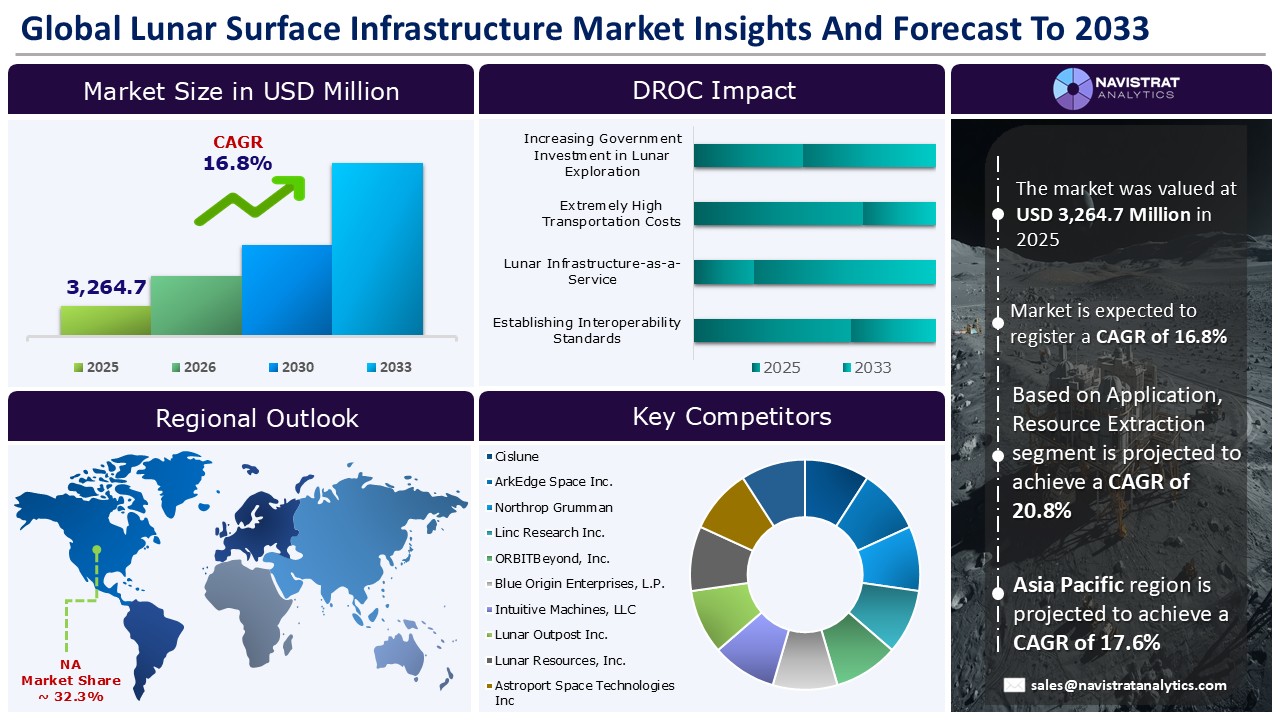
Lunar surface infrastructure market size reached USD 3,264.7 Million in 2025 and is expected to register a revenue CAGR of 16.8% during the forecast period. Moon surface infrastructure refers to the systems, facilities, equipment, and technologies required to establish and sustain human and robotic operations on the moon. It includes power generation, habitats, communication and navigation networks, transportation systems, landing pads, robotic construction, resource extraction, and life-support facilities.
Market Drivers:
Increasing government and private investment in lunar exploration is a key driver driving the market revenue growth. Commercial lunar infrastructure is reshaping space exploration by shifting the focus from individual missions toward establishing a sustainable, long-term human presence beyond Earth. NASA’s Moon Base initiative is supporting this transition through collaborations with private companies developing lunar landers, cargo delivery systems, rovers, and autonomous robotic technologies. Companies such as Blue Origin, Astrolab, Lunar Outpost, Astrobotic, and Intuitive Machines are advancing solutions for lunar transportation, surface mobility, scientific research, and infrastructure development. These technologies are expected to facilitate the preparation of the lunar South Pole for future crewed missions while generating critical operational data to support sustained lunar exploration and long-duration surface activities.
On July 2026, NASA has awarded contracts totalling nearly USD 600 million to three commercial space companies (Astrobotic, Firefly Aerospace, and Intuitive Machines) to conduct four additional lunar missions scheduled for late 2026. Under these agreements, the companies will oversee procurement activities, assess previously deployed lunar landers with comparable designs, and incorporate lessons learned from earlier missions to enhance operational reliability. Meanwhile, NASA continues to advance its Moon Base initiative, which aims to establish a sustained human presence on the lunar surface while promoting scientific research, technological development, and commercial activities.
On September 2026, Firefly Aerospace, a leading space and defense technology company has announced a commercial payload agreement with Starcloud to demonstrate advanced artificial intelligence (AI) computing capabilities in lunar orbit. Under the agreement, Starcloud’s SC-1L computing payload will be integrated into Firefly’s Elytra orbital vehicle to test key technologies for a future lunar-orbit data center capable of supporting surface and orbital infrastructure. The SC-1L processor will analyze data collected by Firefly’s onboard Solux vision system, perform high-performance AI processing in space, and transmit the processed information back to Earth.
Market Opportunity:
Lunar infrastructure-as-a-service act as opportunity for lunar surface infrastructure market. Government and military agencies are expected to be the primary drivers of demand for commercial lunar infrastructure offered through as-a-service models. These approaches can help reduce development costs while enabling the delivery of long-term operational and maintenance services. Public–private partnerships between commercial providers and government or military organizations will play a crucial role in advancing the lunar economy through initiatives such as Commercial Lunar Payload Services (CLPS), Human Landing System (HLS), Lunar Cargo Transportation and Landing by Soft Touchdown (LCNS), Advanced Tipping Point Technologies (ATPT), and Lunar Surface Technology Research (LuSTR).
As lunar operations become more sustainable and reliable, supported by improvements in transportation, positioning, navigation and timing (PNT), and communication services, the adoption of commercial as-a-service models is expected to increase. Commercial companies should therefore prioritise these models in their development strategies, leveraging established infrastructure to serve government, military, and commercial missions. In addition, companies should diversify their strategic plans by pursuing commercial opportunities alongside government and military contracts. Although public-sector contracts are expected to remain a major source of demand, expanding into commercial ventures will help companies maximise infrastructure utilisation, diversify revenue streams, and capitalise on emerging opportunities in the lunar market between 2023 and 2033.
Recent Trends:
Emerging trends include shift toward autonomous robotic construction, regolith-based additive manufacturing, vertical solar power systems, nuclear fission surface power, and digital twins and AI-based infrastructure management.
Robotic systems facilitate efficient lunar operations by handling cargo, transporting materials, assembling structures, and deploying equipment with high precision. These capabilities optimize logistics, minimize astronaut workload, and support the reliable establishment of habitats and essential infrastructure for long-term lunar exploration and development. Additionally, robotic technologies help maintain and enhance lunar assets serving scientific, commercial, and security objectives through inspection, repair, upgrades, and controlled disassembly. These functions extend asset lifecycles, enable safe infrastructure reconfiguration, and ensure the continued reliability of lunar systems to support exploration, development, and national security.
On April 2026, Astroport Space Technologies has partnered with Vermeer Corporation to develop autonomous construction machinery for future lunar infrastructure projects. The collaboration brings together Vermeer’s expertise in heavy industrial and surface mining equipment with Astroport’s capabilities in robotic autonomy and lunar regolith construction. The initiative aims to modify Vermeer’s machinery to withstand the Moon’s low-gravity conditions, extreme temperatures, and abrasive surface environment by incorporating Astroport’s Universal Tool Implement Payload Adapter (UTIPA) system.
Restraints & Challenges:
Despite the advantages of expandable habitats, several engineering challenges must be addressed before their widespread deployment on the Moon. Lunar structures must endure severe temperature variations, micrometeoroid impacts, and intense cosmic radiation. Surface temperatures can range from approximately −173°C during lunar nights to over 120°C under direct sunlight. While these thermal variations may offer opportunities for thermal energy utilization, they place substantial demands on construction materials and equipment. Lunar systems must maintain consistent performance under these harsh conditions, as repeated temperature fluctuations and prolonged exposure can accelerate material deterioration and cause mechanical component failures.
Establishing sustainable human habitats on the Moon presents considerable challenges due to the absence of an atmosphere and the effects of low gravity. In-situ resource utilization technologies, including 3D printing, offer opportunities to produce construction materials using locally available lunar resources. However, construction activities remain constrained by lunar dust, irregular terrain, and the need to ensure the durability and structural stability of buildings.
Furthermore, extended lunar missions may expose astronauts to psychological stress, isolation, and various physiological challenges resulting from the harsh environment and prolonged separation from Earth. Reduced gravity can contribute to bone density loss and muscle deterioration, while long-term exposure to cosmic radiation increases the risk of cancer and other health complications.
Infrastructure Type Segment Insights and Analysis:
Based on the infrastructure type, lunar surface infrastructure market is segmented into power infrastructure, communication and navigation infrastructure, transportation and mobility infrastructure, landing and surface-logistics infrastructure, habitat, and others.
Communication and navigation infrastructure segment contributed the largest market share in 2025. Lunar surface infrastructure relies on these systems to support reliable connectivity, precise positioning, and coordinated operations across the moon. Communication infrastructure includes lunar relay satellites, surface antennas, and data transmission networks, enables continuous information exchange between astronauts, robotic systems, and earth-based control centres. Increasing investments in sustained lunar exploration, commercial missions, and permanent lunar habitats are expected to drive demand for robust communication and navigation solutions, strengthening the operational capabilities required for long-term lunar infrastructure development.
On June 2026, AiRANACULUS, a Massachusetts-based deep technology company specializing in intelligent radio frequency (RF) and autonomous networking systems, has secured a USD 5 million contract under NASA’s Civilian Commercialization Readiness Pilot Program (CCRPP). The initiative aims to advance the development of next-generation heterogeneous communication networks for lunar and deep-space missions. The project will be carried out in collaboration with NASA Ames Research Center and industry partners, including NVIDIA, Nokia Federal Solutions, Dell Technologies, Curtiss-Wright, Supermicro, and Radisys.
Deployment Segment Insights and Analysis:
Based on the deployment, lunar surface infrastructure market is segmented into earth-supplied infrastructure, in-situ manufactured infrastructure, and hybrid.
In-situ manufactured infrastructure segment contributed the fastest growth rate in 2025. In-situ manufacturing focuses on the flexible, small-scale production of functional components designed for specific applications, including magnetic parts and radiation shielding. Lunar regolith is a promising resource for in-situ resource utilization (ISRU) due to its widespread availability and accessibility across the lunar surface. It can potentially be used to manufacture protective shielding, structural supports for scientific instruments, landing and launch pads, energy infrastructure, and even large-scale lunar habitats.
Additionally, regolith can be processed to extract essential resources such as oxygen, water, and metals, supporting life-support systems and reducing reliance on supplies transported from Earth. These capabilities could significantly lower the costs and operational risks associated with establishing and maintaining long-term human settlements on the Moon.
On April 2023, OffWorld Europe and the Luxembourg Space Agency (LSA) have entered into an agreement to initiate a comprehensive, multi-year development program focused on an In-Situ Resource Utilization (ISRU) system for processing lunar ice resources. The initiative aims to support sustainable lunar exploration by facilitating the extraction, processing, and storage of essential resources directly on the Moon. Supervised by the European Space Agency, the program will utilize OffWorld’s advanced robotic modules to perform resource prospecting, mining, processing, storage, and delivery of oxygen, hydrogen, and other volatile substances to customers across the lunar surface. The program is currently underway, with its first lunar surface demonstration mission planned for 2027.
Application Segment Insights and Analysis:
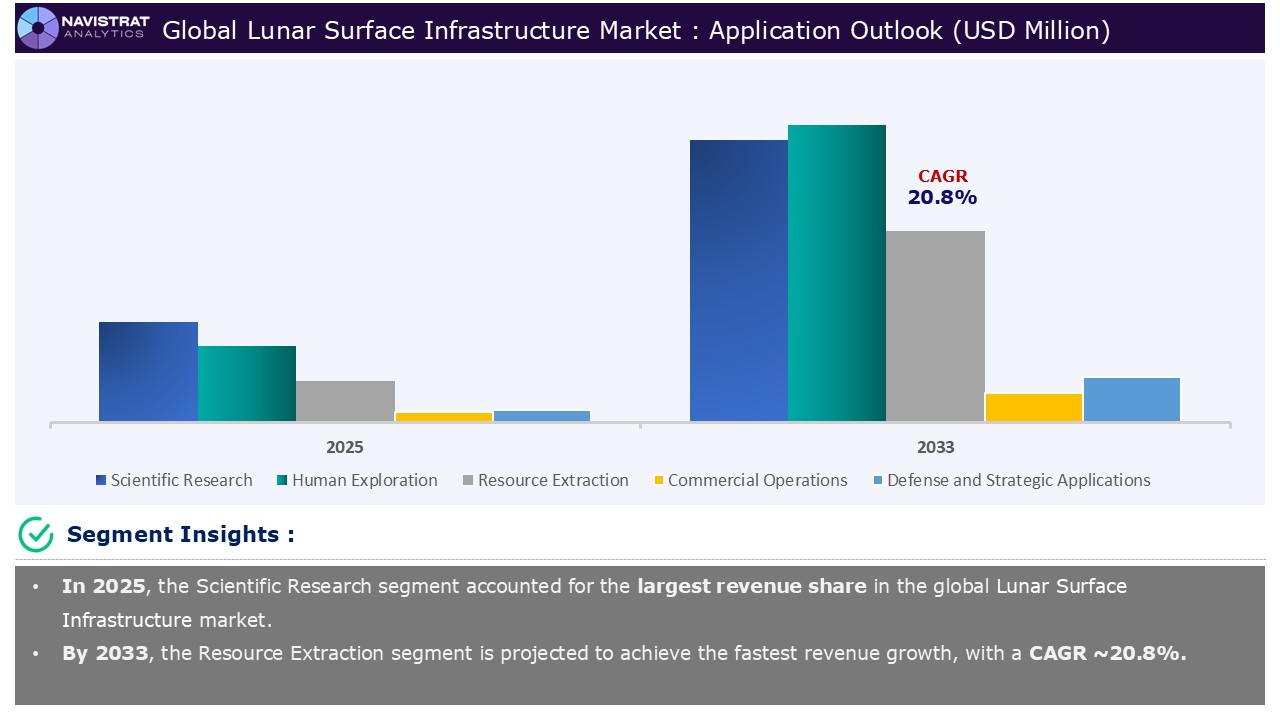
Based on the application, lunar surface infrastructure market is segmented into scientific research, human exploration, resource extraction, commercial operations, and defense and strategic applications.
Scientific research segment contributed the largest market share in 2025, is driven by the growing need for specialized facilities and supporting systems to conduct scientific investigations on the moon. Infrastructure such as research stations, observatories, instrument deployment platforms, power supply systems, and communication networks enables researchers to study lunar geology, surface composition, environmental conditions, and potential resources. Furthermore, increasing investments in robotic exploration, ISRU, and long duration lunar missions are generating demand for reliable infrastructure to support experiments, sample collection, data transmission, and continuous environmental monitoring.
On October 2026, ispace-EUROPE S.A., the Luxembourg-based European subsidiary of ispace, inc., has signed a Memorandum of Understanding with ALTEC – Aerospace Logistics Technology Engineering Company S.p.A. to explore potential cooperation in lunar rover testing, mission simulation, and operational training. Under the agreement, both organizations will evaluate the use of ALTEC’s facilities by ispace-EUROPE to simulate rover operations in lunar analogue environments. The collaboration will also consider broader opportunities in lunar exploration technologies, surface mobility solutions, and space resource utilization.
Geographical Outlook:
Lunar surface infrastructure market is strategically segmented by geography to provide a comprehensive understanding of regional market dynamic. Discover demand analysis, emerging trends, and growth opportunities shaping market performance across different region and countries.
North America Lunar Surface Infrastructure Market:
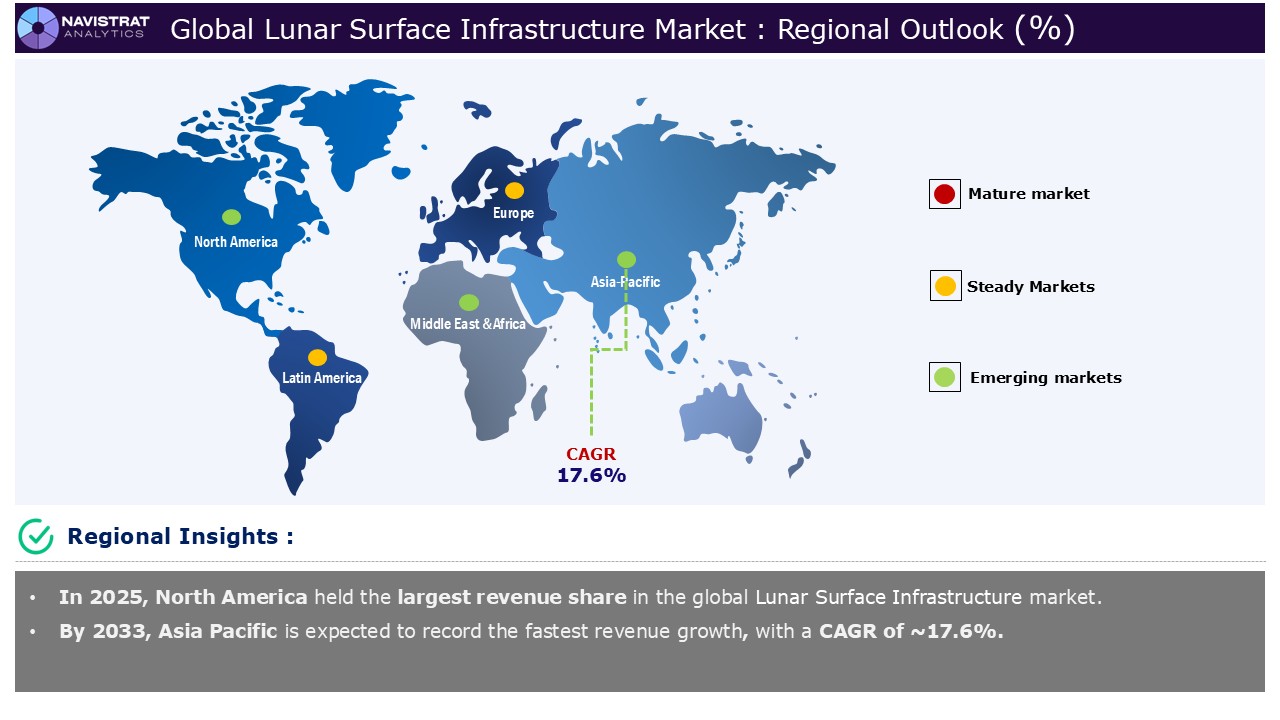
North America is registered to have highest market share in lunar surface infrastructure market in 2025, driven by substantial investments in lunar exploration programs, advanced space technology development, and growing collaboration between government agencies and private space companies. Furthermore, the presence of established aerospace companies, innovative space technology, and a well-developed research ecosystem supports the development and deployment of advanced lunar infrastructure.
On August 2026, Northrop Grumman Corporation is developing a series of Lunar Infrastructure Demo (LID) missions to accelerate the development of essential power and data infrastructure for a future lunar base. The missions aim to advance technologies capable of withstanding the harsh lunar night and supporting a sustained human presence near the Moon’s South Pole. To expedite development and deployment, the company is leveraging existing hardware and technologies from NASA’s Habitation and Logistics Outpost (HALO) program. By reusing HALO’s power, data, and mechanical interfaces, Northrop Grumman aims to streamline NASA’s development timeline and enable the early collection of real-world lunar surface performance data.
Asia Pacific Lunar Surface Infrastructure Market:
Asia Pacific is expected to register the fastest growth rate during the forecasted period. The Asia-Pacific region benefits from extensive national lunar exploration programs and well-established capabilities in launch systems, robotics, electronics, and satellite manufacturing. China and India are among the region’s leading space powers, playing an increasingly important role in shaping the emerging cislunar environment, which encompasses the space between Earth and the Moon, including lunar orbit. China is advancing its lunar exploration capabilities with the long-term objective of establishing a sustained presence near the lunar South Pole. Upcoming missions, including Chang’e 7, planned for 2026, aim to investigate and map water-ice deposits in permanently shadowed regions. These resources could play a crucial role in supporting long-term lunar habitation, life-support systems, and future fuel production.
On July 2024, Kurita Water Industries Ltd. has entered into a strategic partnership with ispace, Inc., a Japan-based space startup specializing in lunar resource development, through the signing of a memorandum of understanding (MoU). The collaboration will focus on jointly developing strategies and plans for lunar water resource utilization. The partnership aims to strengthen the existing relationship between the two companies, build on their ongoing initiatives in lunar surface water development, and further define their shared plans for advancing the extraction and utilization of water resources on the Moon.
Competition Analysis:
Lunar surface infrastructure market is characterized by a fragmented structure, with several players competing across various segments and regions. List of major players included in lunar surface infrastructure market report are:
- Cislune
- ArkEdge Space Inc.
- Northrop Grumman
- Linc Research Inc.
- ORBITBeyond, Inc.
- Blue Origin Enterprises, L.P.
- Intuitive Machines, LLC
- Lunar Outpost Inc.
- Lunar Resources, Inc.
- Astroport Space Technologies Inc
- Lunar Forge Inc.
- Lockheed Martin Corporation
- ICON Technology, Inc.
- Redwire Corporation
- Sierra Space Corporation
- Nokia Corporation
Strategic Developments in Lunar Surface Infrastructure Market:
- In July 2026, Lunar Outpost has announced a collaboration with NVIDIA to expand the deployment of space computing technologies across its upcoming lunar missions. By integrating NVIDIA’s Jetson platform and CUDA-X libraries, the company aims to enhance onboard data processing, lunar surface mapping, autonomous operations, and communication capabilities across its expanding mission portfolio. NVIDIA’s accelerated computing platform will support several forthcoming Lunar Outpost missions, beginning with Lunar Voyage 2 (LV2), which is scheduled to launch later this year to explore the Reiner Gamma region of the Moon.
- In June 2026, Intuitive Machines, Inc. secured a NASA contract worth up to USD 148.3 million to deliver a production-line-qualified Nova-C lunar lander by 2028. The mission will carry scientific and operational payloads, including SCALPSS cameras for lunar plume-surface analysis, a Laser Retroreflector Array for precise cislunar positioning, and a LETS spectrometer for radiation monitoring and environmental safety assessment.
Key Advantages for Stakeholders:
Navistrat Analytics’ industry report provides an in-depth quantitative analysis of various market segments, historical and current trends, market forecasts, and dynamics within the global market. The historical years covered in this report are 2023 to 2024, with 2025 serving as the base year for market size calculations. The forecast period extends from 2026 to 2033.
The report includes an executive summary and a comprehensive overview of market drivers, restraints, opportunities, and challenges (DROC), along with insights into regulatory standards. It features detailed analyses such as PORTER’s Five Forces, SWOT, and PESTLE, as well as assessments of technological trends and the competitive landscape.
PORTER’s Five Forces analysis helps stakeholders evaluate the impact of new entrants, competitive rivalry, supplier power, buyer power, and substitution threats, enabling them to assess the level of competition and the attractiveness of the global market. The competitive landscape provides stakeholders with a clear understanding of the current market positions of key players, offering valuable insights into their competitive environment.
Scope And Key Highlights Of Lunar Surface Infrastructure Market Report:
| Report Features | Details |
| Market Size in 2025 | USD 3,264.7 Million |
| Market Growth Rate in CAGR (2026–2033) | 16.8% |
| Market Revenue forecast to 2033 | USD 11,359.4 Million |
| Base year | 2025 |
| Historical year | 2023-2024 |
| Forecast period | 2026-2033 |
| Report Pages | 450 |
| Segments covered |
|
| Regional scope |
|
| Country Scope |
|
| Key Market Players |
|
| Delivery Format | Reports are delivered in PDF format via email. |
| Customization scope | Request for Customization |
Lunar Surface Infrastructure market report offers a detailed analysis of market size, including historical revenue (in USD Million) data for 2023-2024 and revenue forecasts for 2026-2033 across the following segments:
- Infrastructure Type Outlook (Revenue, USD Million; 2023-2033)
- Power Infrastructure
- Communication and Navigation Infrastructure
- Transportation and Mobility Infrastructure
- Landing and Surface-Logistics Infrastructure
- Habitat
- Others
- Deployment Outlook (Revenue, USD Million; 2023-2033)
- Earth-Supplied Infrastructure
- In-Situ Manufactured Infrastructure
- Hybrid
- Level of Autonomy Outlook (Revenue, USD Million; 2023-2033)
- Human-Operated
- Semi-Autonomous
- Fully Autonomous
- Application Outlook (Revenue, USD Million; 2023-2033)
- Scientific Research
- Human Exploration
- Resource Extraction
- Commercial Operations
- Defense and Strategic Applications
- End-Use Outlook (Revenue, USD Million; 2023-2033)
- Government Space Agencies
- Commercial Space Companies
- Research Institutions
- Resource Companies
- Regional Outlook (Revenue, USD Million; 2023-2033)
- North America
- U.S.
- Canada
- Mexico
- Europe
- Germany
- France
- U.K.
- Italy
- Spain
- Benelux
- Nordic Countries
- Rest of Europe
- Asia Pacific
- China
- India
- Japan
- South Korea
- Oceania
- ASEAN Countries
- Rest of APAC
- Latin America
- Brazil
- Rest of LATAM
- Middle East & Africa
- GCC Countries
- South Africa
- Israel
- Turkey
- Rest of MEA
- North America
Frequently Asked Questions (FAQ) about Lunar Surface Infrastructure Market report
The market size of lunar surface infrastructure market was 3,264.7 million in 2025.
The market size of lunar surface infrastructure market is expected to register compound annual growth rate (CAGR) of 16.8% over the forecast period.
Increasing government investment in lunar exploration, growing importance of ISRU, and development of commercial lunar services are major key factors driving the market revenue growth of lunar surface infrastructure market.
Extremely high transportation costs and limited technology readiness and lack of established maintenance infrastructure are key limiting factors driving the market.
Asia Pacific account for fastest revenue growth of 17.6%.
Scientific research is the major leading segment of lunar surface infrastructure market in terms of infrastructure type.
- Market Definition
- Research Objective
- Research Methodology
- Research Design
- Data Collection Methods
- Primary
- Secondary
- Market Size Estimation
- Top-down Model Method
- Bottom-up Model Method
- Forecasting Methodology
- Tools and Models Used
- Market Overview and Trends
- Market Size and Forecast
- Industry Analysis
- Market Driver, Restraints, Opportunity, and Challenges (DROC) Analysis
- Market Drivers
- Increasing Government Investment in Lunar Exploration
- Growing Importance of ISRU
- Development of Commercial Lunar Services
- Market Restraints
- Extremely High Transportation Costs
- Limited Technology Readiness and Lack of Established Maintenance Infrastructure
- Market Opportunities
- Lunar Infrastructure-as-a-Service
- Autonomous Robotic Construction
- Lunar Resource Processing
- Market Challenges
- Establishing Interoperability Standards
- Energy Storage Through Lunar Night
- Regulatory Landscape
- North America
- Europe
- Asia Pacific
- Latin America
- Middle East and Africa
- Strategic Insights
- Porter’s Five Forces Analysis
- PESTLE Analysis
- Price Trend Analysis
- Value Chain Analysis
- Technological Trends
- Shift Toward Autonomous Robotic Construction
- Regolith-Based Additive Manufacturing
- Vertical Solar Power Systems
- Nuclear Fission Surface Power
- Digital Twins and AI-Based Infrastructure Management
- Recent Developments
- Funding
- Merger and Acquisition
- Expansion
- Partnership and Collaboration
- Product/ Service Launch
- Infrastructure Type Market Revenue Estimates and Forecasts, 2023-2033
- Power Infrastructure
- Communication and Navigation Infrastructure
- Transportation and Mobility Infrastructure
- Landing and Surface-Logistics Infrastructure
- Habitat
- Others
- Deployment Market Revenue Estimates and Forecasts, 2023-2033
- Earth-Supplied Infrastructure
- In-Situ Manufactured Infrastructure
- Hybrid
- Level of Autonomy Market Revenue Estimates and Forecasts, 2023-2033
- Human-Operated
- Semi-Autonomous
- Fully Autonomous
- Application Market Revenue Estimates and Forecasts, 2023-2033
- Scientific Research
- Human Exploration
- Resource Extraction
- Commercial Operations
- Defense and Strategic Applications
- End-Use Market Revenue Estimates and Forecasts, 2023-2033
- Government Space Agencies
- Commercial Space Companies
- Research Institutions
- Resource Companies
- Lunar Surface Infrastructure Market Revenue Estimates and Forecasts by Region, 2023-2033, USD Million
- North America
- North America Lunar Surface Infrastructure Market By Infrastructure Type, Market Revenue Estimates and Forecasts, 2023-2033, USD Million
- Power Infrastructure
- Communication and Navigation Infrastructure
- Transportation and Mobility Infrastructure
- Landing and Surface-Logistics Infrastructure
- Habitat
- Others
- North America Lunar Surface Infrastructure Market By Deployment, Market Revenue Estimates and Forecasts, 2023-2033, USD Million
- Earth-Supplied Infrastructure
- In-Situ Manufactured Infrastructure
- Hybrid
- North America Lunar Surface Infrastructure Market By Level of Autonomy, Market Revenue Estimates and Forecasts, 2023-2033, USD Million
- Human-Operated
- Semi-Autonomous
- Fully Autonomous
- North America Lunar Surface Infrastructure Market By Application, Market Revenue Estimates and Forecasts, 2023-2033, USD Million
- Scientific Research
- Human Exploration
- Resource Extraction
- Commercial Operations
- Defense and Strategic Applications
- North America Lunar Surface Infrastructure Market By End-Use, Market Revenue Estimates and Forecasts, 2023-2033, USD Million
- Government Space Agencies
- Commercial Space Companies
- Research Institutions
- Resource Companies
- North America Lunar Surface Infrastructure Market Revenue Estimates and Forecasts by Country, 2023-2033, USD Million
- United States
- Canada
- Mexico
- North America Lunar Surface Infrastructure Market By Infrastructure Type, Market Revenue Estimates and Forecasts, 2023-2033, USD Million
- Europe
- Europe Lunar Surface Infrastructure Market By Infrastructure Type, Market Revenue Estimates and Forecasts, 2023-2033, USD Million
- Power Infrastructure
- Communication and Navigation Infrastructure
- Transportation and Mobility Infrastructure
- Landing and Surface-Logistics Infrastructure
- Habitat
- Others
- Europe Lunar Surface Infrastructure Market By Deployment, Market Revenue Estimates and Forecasts, 2023-2033, USD Million
- Earth-Supplied Infrastructure
- In-Situ Manufactured Infrastructure
- Hybrid
- Europe Lunar Surface Infrastructure Market By Level of Autonomy, Market Revenue Estimates and Forecasts, 2023-2033, USD Million
- Human-Operated
- Semi-Autonomous
- Fully Autonomous
- Europe Lunar Surface Infrastructure Market By Application, Market Revenue Estimates and Forecasts, 2023-2033, USD Million
- Scientific Research
- Human Exploration
- Resource Extraction
- Commercial Operations
- Defense and Strategic Applications
- Europe Lunar Surface Infrastructure Market By End-Use, Market Revenue Estimates and Forecasts, 2023-2033, USD Million
- Government Space Agencies
- Commercial Space Companies
- Research Institutions
- Resource Companies
- Europe Lunar Surface Infrastructure Market Revenue Estimates and Forecasts by Country, 2023-2033, USD Million
- Germany
- United Kingdom
- France
- Italy
- Spain
- Benelux
- Nordic Countries
- Rest of Europe
- Europe Lunar Surface Infrastructure Market By Infrastructure Type, Market Revenue Estimates and Forecasts, 2023-2033, USD Million
- Asia Pacific
- Asia Pacific Lunar Surface Infrastructure Market By Infrastructure Type, Market Revenue Estimates and Forecasts, 2023-2033, USD Million
- Power Infrastructure
- Communication and Navigation Infrastructure
- Transportation and Mobility Infrastructure
- Landing and Surface-Logistics Infrastructure
- Habitat
- Others
- Asia Pacific Lunar Surface Infrastructure Market By Deployment, Market Revenue Estimates and Forecasts, 2023-2033, USD Million
- Earth-Supplied Infrastructure
- In-Situ Manufactured Infrastructure
- Hybrid
- Asia Pacific Lunar Surface Infrastructure Market By Level of Autonomy, Market Revenue Estimates and Forecasts, 2023-2033, USD Million
- Human-Operated
- Semi-Autonomous
- Fully Autonomous
- Asia Pacific Lunar Surface Infrastructure Market By Application, Market Revenue Estimates and Forecasts, 2023-2033, USD Million
- Scientific Research
- Human Exploration
- Resource Extraction
- Commercial Operations
- Defense and Strategic Applications
- Asia Pacific Lunar Surface Infrastructure Market By End-Use, Market Revenue Estimates and Forecasts, 2023-2033, USD Million
- Government Space Agencies
- Commercial Space Companies
- Research Institutions
- Resource Companies
- Asia Pacific Lunar Surface Infrastructure Market Revenue Estimates and Forecasts by Country, 2023-2033, USD Million
- China
- India
- Japan
- South Korea
- Oceania
- ASEAN Countries
- Rest of Asia-Pacific
- Asia Pacific Lunar Surface Infrastructure Market By Infrastructure Type, Market Revenue Estimates and Forecasts, 2023-2033, USD Million
- Latin America
- Latin America Lunar Surface Infrastructure Market By Infrastructure Type, Market Revenue Estimates and Forecasts, 2023-2033, USD Million
- Power Infrastructure
- Communication and Navigation Infrastructure
- Transportation and Mobility Infrastructure
- Landing and Surface-Logistics Infrastructure
- Habitat
- Others
- Latin America Lunar Surface Infrastructure Market By Deployment, Market Revenue Estimates and Forecasts, 2023-2033, USD Million
- Earth-Supplied Infrastructure
- In-Situ Manufactured Infrastructure
- Hybrid
- Latin America Lunar Surface Infrastructure Market By Level of Autonomy, Market Revenue Estimates and Forecasts, 2023-2033, USD Million
- Human-Operated
- Semi-Autonomous
- Fully Autonomous
- Latin America Lunar Surface Infrastructure Market By Application, Market Revenue Estimates and Forecasts, 2023-2033, USD Million
- Scientific Research
- Human Exploration
- Resource Extraction
- Commercial Operations
- Defense and Strategic Applications
- Latin America Lunar Surface Infrastructure Market By End-Use, Market Revenue Estimates and Forecasts, 2023-2033, USD Million
- Government Space Agencies
- Commercial Space Companies
- Research Institutions
- Resource Companies
- Latin America Lunar Surface Infrastructure Market Revenue Estimates and Forecasts by Country, 2023-2033, USD Million
- Brazil
- Rest of Latin America
- Latin America Lunar Surface Infrastructure Market By Infrastructure Type, Market Revenue Estimates and Forecasts, 2023-2033, USD Million
- Middle East and Africa
- Middle East and Africa Lunar Surface Infrastructure Market By Infrastructure Type, Market Revenue Estimates and Forecasts, 2023-2033, USD Million
- Power Infrastructure
- Communication and Navigation Infrastructure
- Transportation and Mobility Infrastructure
- Landing and Surface-Logistics Infrastructure
- Habitat
- Others
- Middle East and Africa Lunar Surface Infrastructure Market By Deployment, Market Revenue Estimates and Forecasts, 2023-2033, USD Million
- Earth-Supplied Infrastructure
- In-Situ Manufactured Infrastructure
- Hybrid
- Middle East and Africa Lunar Surface Infrastructure Market By Level of Autonomy, Market Revenue Estimates and Forecasts, 2023-2033, USD Million
- Human-Operated
- Semi-Autonomous
- Fully Autonomous
- Middle East and Africa Lunar Surface Infrastructure Market By Application, Market Revenue Estimates and Forecasts, 2023-2033, USD Million
- Scientific Research
- Human Exploration
- Resource Extraction
- Commercial Operations
- Defense and Strategic Applications
- Middle East and Africa Lunar Surface Infrastructure Market By End-Use, Market Revenue Estimates and Forecasts, 2023-2033, USD Million
- Government Space Agencies
- Commercial Space Companies
- Research Institutions
- Resource Companies
- Middle East and Africa Lunar Surface Infrastructure Market Revenue Estimates and Forecasts by Country, 2023-2033, USD Million
- GCC Countries
- South Africa
- Israel
- Turkey
- Rest of Middle East & Africa
- Middle East and Africa Lunar Surface Infrastructure Market By Infrastructure Type, Market Revenue Estimates and Forecasts, 2023-2033, USD Million
- North America
- Market Share Analysis
- Revenue Market Share by Key Players (2024-2025)
- Analysis of Top Players by Market Presence
- Competitive Matrix
- Competitive Strategies
- Mergers and Acquisitions
- Partnerships and Collaboration
- Investment and Fundings
- Agreement
- Expansion
- New Product/ Services Launches
- Technological Innovations
- Cislune
- Company Overview
- Financial Insights
- Product/ Services Offerings
- Strategic Developments
- SWOT Analysis
- ArkEdge Space Inc.
- Company Overview
- Financial Insights
- Product / Services Offerings
- Strategic Developments
- SWOT Analysis
- Northrop Grumman
- Company Overview
- Financial Insights
- Product/ Services Offerings
- Strategic Developments
- SWOT Analysis
- Linc Research Inc.
- Company Overview
- Financial Insights
- Product / Services Offerings
- Strategic Developments
- SWOT Analysis
- ORBITBeyond, Inc.
- Company Overview
- Financial Insights
- Product / Services Offerings
- Strategic Developments
- SWOT Analysis
- Blue Origin Enterprises, L.P.
- Company Overview
- Financial Insights
- Product / Services Offerings
- Strategic Developments
- SWOT Analysis
- Intuitive Machines, LLC
- Company Overview
- Financial Insights
- Product / Services Offerings
- Strategic Developments
- SWOT Analysis
- Lunar Outpost Inc.
- Company Overview
- Financial Insights
- Product / Services Offerings
- Strategic Developments
- SWOT Analysis
- Lunar Resources, Inc.
- Company Overview
- Financial Insights
- Product / Services Offerings
- Strategic Developments
- SWOT Analysis
- Astroport Space Technologies Inc
- Company Overview
- Financial Insights
- Product / Services Offerings
- Strategic Developments
- SWOT Analysis
- Lunar Forge Inc.
- Company Overview
- Financial Insights
- Product / Services Offerings
- Strategic Developments
- SWOT Analysis
- Lockheed Martin Corporation
- Company Overview
- Financial Insights
- Product / Services Offerings
- Strategic Developments
- SWOT Analysis
- ICON Technology, Inc.
- Company Overview
- Financial Insights
- Product / Services Offerings
- Strategic Developments
- SWOT Analysis
- Redwire Corporation
- Company Overview
- Financial Insights
- Product / Services Offerings
- Strategic Developments
- SWOT Analysis
- Sierra Space Corporation
- Company Overview
- Financial Insights
- Product / Services Offerings
- Strategic Developments
- SWOT Analysis
- Nokia Corporation
- Company Overview
- Financial Insights
- Product / Services Offerings
- Strategic Developments
- SWOT Analysis