

Global Next-Generation Biomanufacturing Market Overview and Key Insights:
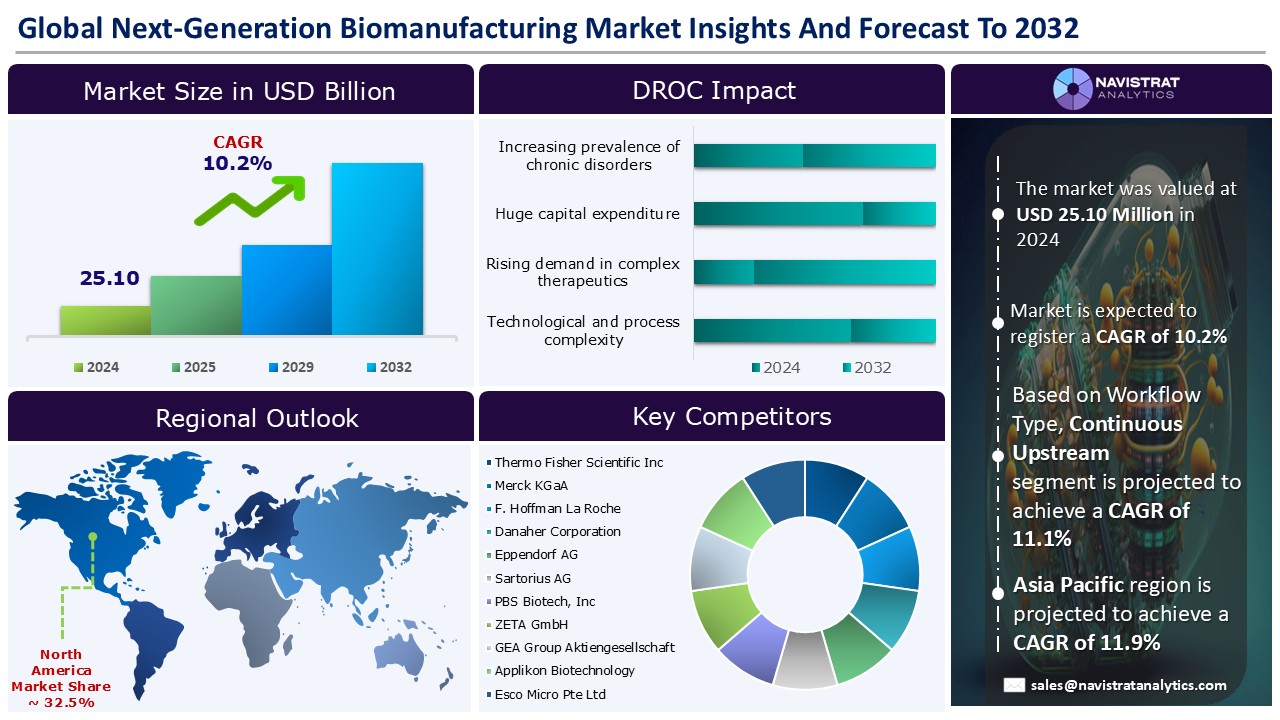
The Next-Generation biomanufacturing market size reached USD 25.10 billion in 2024 and is expected to register a revenue CAGR of 10.2% during the forecast period. Next-generation biomanufacturing provides a game-changing approach to biopharmaceutical production, providing unprecedented efficiency, quality control, and flexibility.
Market Drivers:
Rising demand for advanced biomanufacturing processes is a key driver of revenue growth in the Next-Generation biomanufacturing market. Manufacturing technology innovation improves cost-effectiveness, flexibility, and quality, thereby benefiting patients directly and indirectly. New products are being introduced to improve medicine effectiveness and patient compliance, including improved drug delivery methods and drug-device combinations. On August 2024, Primient, a leader in plant-based, renewable ingredients, and Synonym, a biomanufacturing infrastructure developer, have announced a strategic partnership to accelerate bioproduct innovation and commercialization, furthering the U.S.’ competitive advantage in the race to bring new, functional, and affordable biomaterials to market.
Increasing investment in research and development (R&D) is driving the demand for Next-Generation biomanufacturing market. On June 2024, the Korean Science Ministry announced that it will set aside 24.8 trillion won (USD 17.9 billion) for its research and development (R&D) budget in 2025, with increased investment for artificial intelligence, bio, and quantum initiatives. Furthermore, the government would invest 3.5 trillion won next year in three sectors – artificial intelligence chips, advanced biotechnology, and quantum technology – to promote national innovation.
Market Opportunity:
Increase in demand for personalized medicine acts as an opportunity for the Next-Generation biomanufacturing market. Personalized medicine, also known as precision medicine, entails tailoring medical decisions and interventions to individual characteristics, such as genetic makeup, lifestyle, and environmental factors. This approach not only improves patient outcomes but also has significant implications for biomanufacturing processes.
On November 2024, Nutcracker Therapeutics, Inc., a pioneering biotechnology company dedicated to enabling transformative RNA therapies through its proprietary technology platform, has announced the launch of new contract research, development, and manufacturing organization (CRDMO) capabilities. These capabilities will provide RNA drug developers with next-generation design and biomanufacturing solutions.
Recent Trends:
Recent trends include the continuous biomanufacturing processes and integration of advanced analytics and automation.
Industry 4.0, defined as the digitalization-led convergence of digital, physical, and virtual assets, represents a paradigm shift in all aspects of operations across the value chain. While many industries are already embracing the value and benefits of digitalization in manufacturing operations, the biopharmaceutical industry is gradually moving in this direction, with the industry goal of Biopharma 4.0.
Biotherapeutic products, particularly complex products like monoclonal antibodies (mAbs), can have up to 20-30 critical quality attributes (CQAs), necessitating the use of a variety of orthogonal, high-resolution analytical tools for characterization and making it a resource-intensive task.
Restraints & Challenges:
High initial investment poses a significant hurdle to the implementation of Next-Generation biomanufacturing market. Smaller companies or startups might struggle to adopt next-generation technologies due to financial constraints. High initial investments may raise product costs, though operational efficiencies often offset this over time. Modular and flexible facilities, while cot-efficient in the long term, require substantial upfront investment.
Workflow Segment Insights and Analysis:
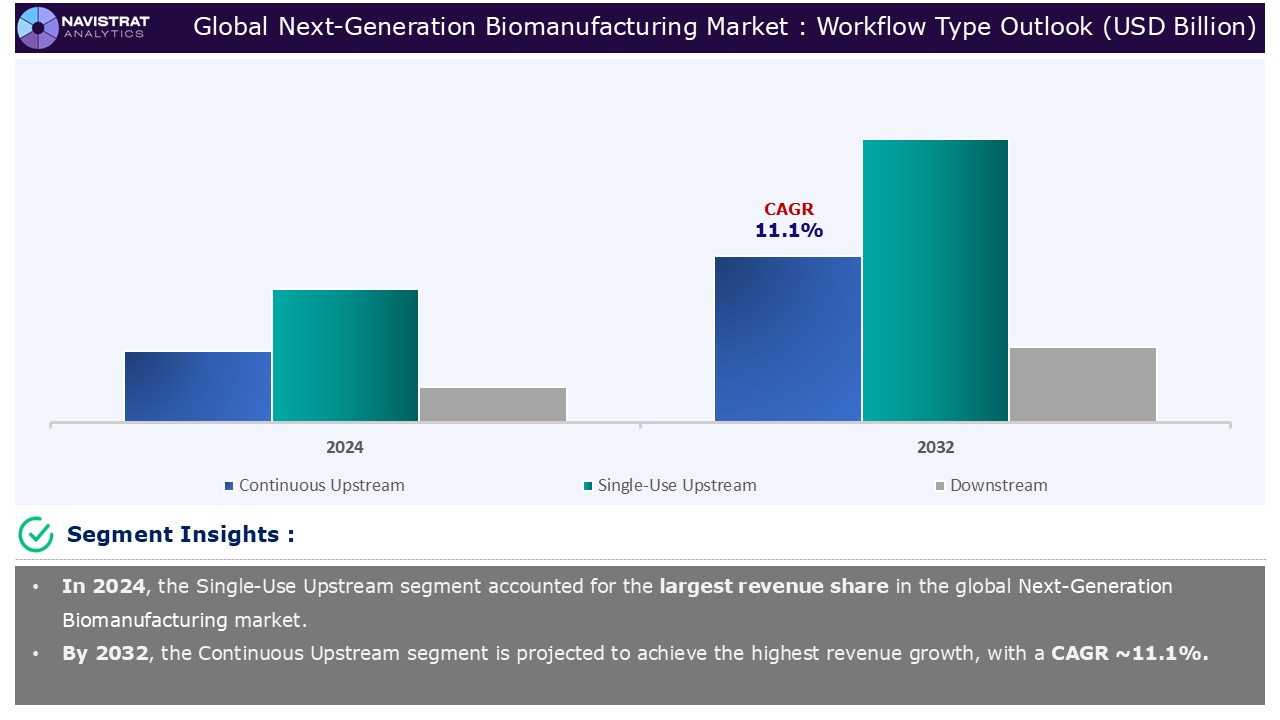
Based on the workflow, the Next-Generation biomanufacturing market is segmented into single-use upstream biomanufacturing workflow, continuous upstream biomanufacturing, and downstream biomanufacturing workflow.
Single-use upstream biomanufacturing workflow segment contributed largest share in 2024. The emergence of new therapeutic modalities, such as cell and gene therapy and antibody drug conjugates, is driving up demand for single-use solutions. This has also prompted suppliers to introduce new single-use goods to fulfill the unique requirements of these modalities. Single-use technologies have gained widespread acceptance in cell culture-based production, including both upstream and downstream processing, particularly in CHO and other high-titer mammalian cell culture systems.
On November 2024, Cellevate has announced the commercial availability of the world’s first nanofiber-based cell culture systems for viral vector synthesis. Cellevat3d nanofiber-based cell culture systems have the potential to revolutionize upstream bioprocessing by providing up to 60 times more surface area for cell growth than current methods. The nanofibers create a real three-dimensional cell culture environment, dramatically improving cell densities, viral vector yields, and productivity in stirred tank bioreactors.
Continuous upstream biomanufacturing segment is expected to have the highest growth rate throughout the forecasted period. Continuous bioprocesses have become a key technical change in regulated industries, and process analytical technology (PAT) and quality-by-design (QbD) are required to enable continuous biomanufacturing. Continuous production decreases wait periods and saves processing times, resulting in higher product quality, less waste, cheaper costs, and greater manufacturing flexibility and agility.
On March 2024, Evotec Biologics has announced that it is building a new biomanufacturing facility in Toulouse, France. The facility incorporates the company’s successful J.POD architecture, which includes a single-use continuous cell culture manufacturing platform housed within production-on-demand modules in a ballroom manufacturing area. The business announced an investment of roughly Euro150 million in April 2021, and construction began in September 2022.
Application Segment Insights and Analysis:
Based on the application, the Next-Generation biomanufacturing market is segmented into vaccines, hormones, recombinant proteins, monoclonal antibodies, and others.
Monoclonal antibodies segment contributed largest share in 2024. The next-generation Abs offer significant improvements over conventional mAbs, namely enhanced precision, target multiple Ags, resistance to pathogen mutations, simplified manufacturing, reduced immunogenicity, extended half-lives, and versatile administration options. Soon, mAbs and next-generation Abs are projected to change immunotherapy, making it more effective and accessible.
On May 2024, Sanofi plans to invest Euro 1 billion in Vitry-sur-Seine to establish a new facility that will treble the site’s monoclonal antibody production capacity. Several biologics in development, including Sanofi’s 12 potential blockbusters for chronic obstructive pulmonary disorder (COPD), asthma, multiple sclerosis, and type 1 diabetes, might be manufactured in Vitry to satisfy the requirements of millions of patients in France and around the world. Sanofi expects to create 350 jobs because of this investment.
Recombinant proteins segment is expected to have the highest growth rate throughout the forecasted period. Recombinant protein manufacturing is a critical technique in biotechnology and pharmaceuticals because it enables the creation of useful proteins for research, diagnostics, and treatment. To produce the desired protein, certain genes are inserted into host cells such as bacteria or yeast. The method consists of multiple processes that require knowledge and experience in molecular biology, biological sciences, and protein biochemistry.
On November 2023, Nature’s Toolbox, Inc., a life sciences firm developing next-generation platforms for RNA and protein production, reported that it has secured USD 47.5 million in Series B funding. The investment, led by RA Capital Management, will help the company expand its biomanufacturing platforms, NTxscribe and NTxpress. Accelerating these technological underpinnings will allow for the global distribution of manufacturing capabilities, ultimately providing answers for future pandemic occurrences, tailored medicine therapy, and increased access to vital vaccinations and medications.
End-Use Segment Insights and Analysis:
Based on the end-use, the Next-Generation biomanufacturing market is segmented into biopharmaceutical companies, Contract Research Organizations (CROs), and academic and research institutions.
Biotechnology companies segment contributed largest share in 2024. Novel technologies such as vaccines, monoclonal antibodies, and hormones have catapulted biomanufacturing into a state of fast innovation. Biopharma firms that are ready to embrace next-generation biomanufacturing can collaborate with life sciences organizations like Danaher Corporation to create new, flexible processes at every level of production, from R&D to cGMP manufacturing. The range of flexible manufacturing equipment and services is continuously expanding, providing drug developers with several alternatives for optimizing precision medicine production.
On April 2024, ZETA, a leading provider of end-to-end solutions for the biopharma and pharmaceutical industries, has announced the acquisition of a majority ownership in INOSIM Software GmbH, a German business that specializes in software solutions for optimizing manufacturing processes. INOSIM’s products, including simulation software and the new “INOSIM Foresight” platform, will be sold and marketed as part of the cooperation.
Contract Research Organizations (CROs) segment is expected to have the highest growth rate throughout the forecasted period. Contract research organizations (CROs) provide specialized research services to biotechnology, pharmaceutical, and medical device businesses on a contract basis, including preclinical research, clinical trials, and a variety of other research-related offers. Sponsors can save time and money by outsourcing to a CRO, which speeds up drug development and creates a network of experts to support the product throughout its lifecycle.
On July 2024, Partners Group, one of the world’s top private equity firms, has agreed to buy a controlling investment in FairJourney Biologics, a premier antibody discovery Contract Research Organization, from GHO Capital Partners. FairJourney is a CRO that works with pharmaceutical and biotech firms on the cutting edge of research to create the next generation of antibody-based therapeutics. The company provides services for antibody discovery, engineering, manufacture, and characterisation.
Geographical Outlook:
North America Next-Generation Biomanufacturing Market:
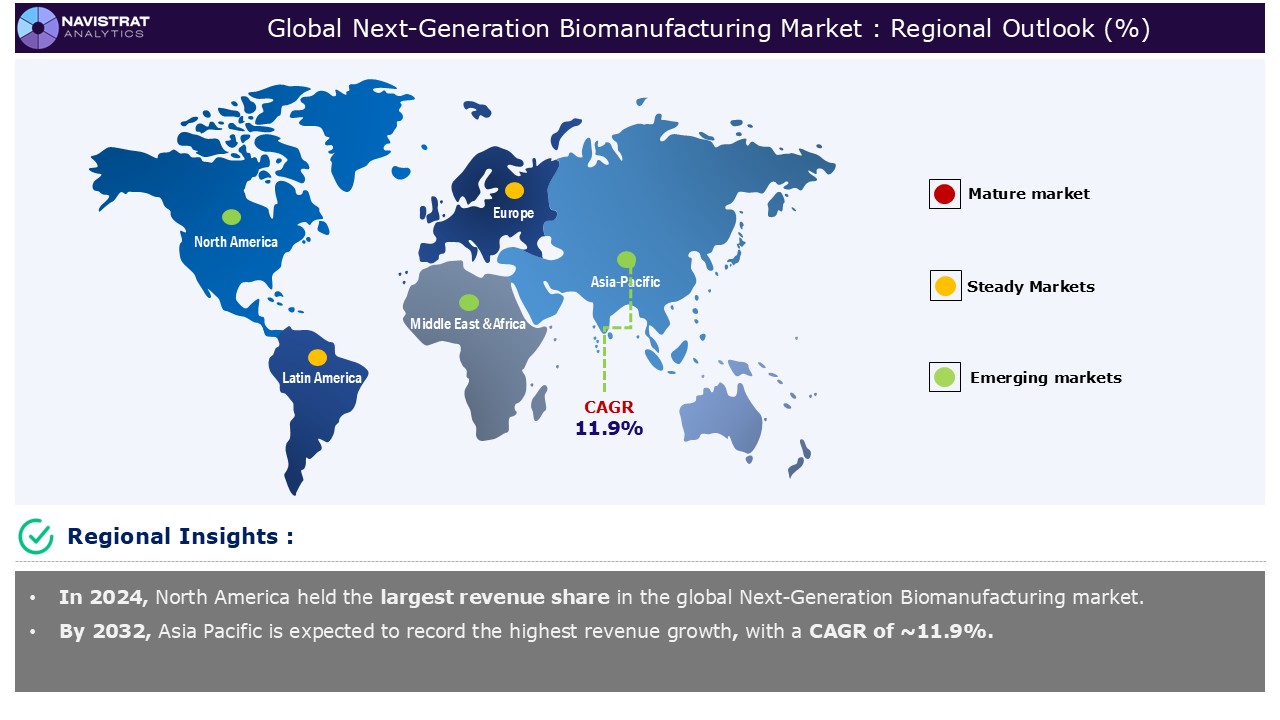
North America is registered highest revenue market share in Next-Generation biomanufacturing market in 2024 driven by increasing prevalence of chronic disorders and rising demand for advanced biomanufacturing processes. According to the Centre of Disease Control and Prevention (CDC), diabetes affects 37.3 million individuals in the United States, accounting for 11.3% of the population. An estimated 28.7 million persons were diagnosed with diabetes. Approximately 8.6 million people have diabetes but have yet to be diagnosed. 1.6 million persons aged 20 and up—or 5.7% of all US adults with diagnosed diabetes—reported having type 1 diabetes and using insulin.
On August 2024, the United States National Science Foundation has made five awards totalling USD 75 million to support the establishment of five bio foundries that will spur innovation, provide tools and technologies to researchers across the country, and advance biology, biotechnology, and the broader science, technology, engineering, and mathematics enterprise. NSF Bio Foundries are integrated facilities that allow researchers to quickly design, build, test, and simplify the development of tools and products to speed up research and promote the bioeconomy.
Asia Pacific Next-Generation Biomanufacturing Market:
Asia Pacific is registered the fastest growth rate during the forecasted period. Asia Pacific is on track to become a manufacturing powerhouse, building on its achievements in clinical trials and biotechnology innovations. While China has already established itself as a manufacturing leader, and countries such as Singapore, South Korea, and India have recently announced ambitious policies to boost the sector, the region is poised for a significant transformation in bio-manufacturing capabilities.
Strategic collaborations are formed between government agencies and biopharma businesses to improve research capacity, develop novel bioprocessing technologies, and promote industry expansion to accelerate drug development and commercialization. On October 2024, Cauldron Ferm, a next-generation biomanufacturer, received financing from the Queensland Government’s Industry Partnership Programme (IPP) to build a cutting-edge precision fermentation contract manufacturing plant in Mackay. This project is in line with Queensland’s new-industry development strategy, which aims to build industries that will be in demand as the globe decarbonizes. This industrial biomanufacturing facility will use Cauldron’s novel hyper-fermentation technology, a revolutionary continuous fermentation process that significantly reduces costs. Cauldron’s proprietary platform has the potential to transform the global bioeconomy across a variety of sectors by driving down product costs to parity with conventional products.
Europe Next-Generation Biomanufacturing Market:
Europe is to register a considerable market share in Next-Generation biomanufacturing market in 2024. Biotechnology and biomanufacturing are promising technologies that can modernize the EU’s agriculture, forestry, energy, food and feed, and industry sectors, due to advances in life sciences, digitalization, and artificial intelligence. Furthermore, these technologies can enhance the EU’s competitiveness and resilience, leading to improved healthcare for citizens and successful green and digital transitions.
On November 2024, SyVento Biotech has opened its new mRNA manufacturing facility, a Cytiva FlexFactory encompassing 7,000 m2, which includes lab and production areas, offices, and communal spaces. This breakthrough marks a key milestone for SyVento Biotech, allowing the CDMO to speed and improve its service offers to medication producers. It also places SyVento Biotech as a market pioneer in Poland, as it is the country’s first mRNA FlexFactory and Europe’s first to use the Historian automation system. The FlexFactory is an end-to-end platform that combines technology such as critical encapsulation steps from Cytiva’s nanomedicines business (previously Precision NanoSystems) with single-use filling consumables.
Competition Analysis:
The Next-Generation biomanufacturing market is characterized by a fragmented structure, with several players competing across various segments and regions. List of major players included in the Next-Generation biomanufacturing market report are:
- Thermo Fisher Scientific Inc
- Merck KGaA
- Hoffman La Roche
- Danaher Corporation
- Eppendorf AG
- Sartorius AG
- PBS Biotech, Inc
- ZETA GmbH
- GEA Group Aktiengesellschaft
- Applikon Biotechnology
- Esco Micro Pte Ltd
- Pierre Guerin
- Esco Group of Companies
- Shanghai Bailun Biotechnology Co. Ltd
Strategic Developments in Global Next-Generation Biomanufacturing Market:
- In September 2024, Cellino Biotech, Inc. has announced that it has received up to USD 25 million in funding from the Advanced Research Projects Agency for Health (ARPA-H), a division of the United States Department of Health and Human Services, to develop an ultra-scalable, autonomous, cassette-based advanced biomanufacturing technology for personalized regenerative medicines. The Scalable Solutions Mission Office has sponsored the first project under the ARPA-H Open Broad Agency Announcement, Cellino’s NEBULA (NExt-generation Biomanufacturing ULtra-scalable Approach).
- In March 2024, Novel Bio has partnered with Culture Biosciences to develop scalable fermentation processes for their proprietary NBx Platform for plasmid DNA production. Novel Bio has spent the last two years researching a new microorganism to address critical production issues. After improving the microbe’s genome using synthetic biology and demonstrating the benefits at the laboratory scale, the team is now optimizing the fermentation settings to enable large-scale production.
Key Advantages for Stakeholders:
Navistrat Analytics’ industry report provides an in-depth quantitative analysis of various market segments, historical and current trends, market forecasts, and dynamics within the global market. The historical years covered in this report are 2022 to 2023, with 2024 serving as the base year for market size calculations. The forecast period extends from 2025 to 2032.
The report includes an executive summary and a comprehensive overview of market drivers, restraints, opportunities, and challenges (DROC), along with insights into regulatory standards. It features detailed analyses such as PORTER’s Five Forces, SWOT, and PESTLE, as well as assessments of technological trends and the competitive landscape.
PORTER’s Five Forces analysis helps stakeholders evaluate the impact of new entrants, competitive rivalry, supplier power, buyer power, and substitution threats, enabling them to assess the level of competition and the attractiveness of the global market. The competitive landscape provides stakeholders with a clear understanding of the current market positions of key players, offering valuable insights into their competitive environment.
Scope And Key Highlights Of The Global Next-Generation Biomanufacturing Market Report:
| Report Features | Details |
| Market Size in 2024 | USD 25.10 Billion |
| Market Growth Rate in CAGR (2025–2032) | 10.2% |
| Market Revenue forecast to 2032 | USD 54.85 Billion |
| Base year | 2024 |
| Historical year | 2022-2023 |
| Forecast period | 2025-2032 |
| Report Pages | 350 |
| Segments covered |
|
| Regional scope |
|
| Country Scope |
|
| Key Market Players |
|
| Delivery Format | Reports are delivered in PDF format via email. |
| Customization scope | Request for Customization |
The Global Next-Generation Biomanufacturing Market report offers a detailed analysis of market size, including historical revenue (in USD Billion) data for 2022-2023 and revenue forecasts for 2025-2032 across the following segments:
- Workflow Type Outlook (Revenue, USD Billion; 2022-2032)
- Single-Use Upstream Biomanufacturing Workflow
- Continuous Upstream Biomanufacturing
- Downstream Biomanufacturing Workflow
- Application Outlook (Revenue, USD Billion; 2022-2032)
- Vaccines
- Hormones
- Recombinant Proteins
- Monoclonal Antibodies
- Others
- End-Use Outlook (Revenue, USD Billion; 2022-2032)
- Biopharmaceutical companies
- Contract Research Organizations (CROs)
- Academic And Research Institutions
- Regional Outlook (Revenue, USD Billion; 2022-2032)
- North America
- U.S.
- Canada
- Mexico
- Europe
- Germany
- France
- U.K.
- Italy
- Spain
- Benelux
- Nordic Countries
- Rest of Europe
- Asia Pacific
- China
- India
- Japan
- South Korea
- Oceania
- ASEAN Countries
- Rest of APAC
- Latin America
- Brazil
- Rest of LATAM
- Middle East & Africa
- GCC Countries
- South Africa
- Israel
- Turkey
- Rest of MEA
- North America
Frequently Asked Questions (FAQ) about the Next-Generation Biomanufacturing market report
The market size of Next-Generation biomanufacturing market was 25.10 billion in 2024.
The market size of Next-Generation biomanufacturing market is expected to register compound annual growth rate (CAGR) of 10.2% over the forecast period.
Increase in prevalence of chronic diseases worldwide and rising demand for advanced biomanufacturing processes are major key factors driving the market revenue growth of the Next-Generation biomanufacturing market.
Huge capital expenditure and lack of skilled personnel are key limiting factors driving the market.
Asia Pacific account for fastest revenue growth of 11.9%.
Single-Use Upstream is the major leading segment of Next-Generation biomanufacturing market in terms of workflow type.
- Market Definition
- Research Objective
- Research Methodology
- Research Design
- Data Collection Methods
- Primary
- Secondary
- Market Size Estimation
- Top-down method
- Bottom-up method
- Forecasting Methodology
- Tools and Models Used
- Market Overview and Trends
- Market Size and Forecast
- Industry Analysis
- Market Driver, Restraints, Opportunity, and Challenges (DROC) Analysis
- Market Drivers
- Increase in prevalence of chronic diseases worldwide
- Rising demand for advanced biomanufacturing processes
- Increasing investment in research and development (R&D)
- Market Restraints
- Huge capital expenditure
- Lack of skilled personnel
- Market Opportunities
- Increase in demand for personalized medicine
- Rising demand in complex therapeutics
- Market Challenges
- Technological and process complexity
- Regulatory and compliance challenges
- Regulatory Landscape
- North America
- Europe
- Asia Pacific
- Latin America
- Middle East and Africa
- Strategic Insights
- Porter’s Five Forces Analysis
- PESTLE Analysis
- Price Trend Analysis
- Value Chain Analysis
- Technological Trends
- Recent Developments
- Funding
- Merger and Acquisition
- Expansion
- Partnership and Collaboration
- Product/ Service Launch
- Workflow Type Market Revenue Estimates and Forecasts, 2022-2032
- Single-Use Upstream Biomanufacturing Workflow
- Continuous Upstream Biomanufacturing
- Downstream Biomanufacturing Workflow
- Application Market Revenue Estimates and Forecasts, 2022-2032
- Vaccines
- Hormones
- Recombinant Proteins
- Monoclonal Antibodies
- Others
- End-Use Market Revenue Estimates and Forecasts, 2022-2032
- Biopharmaceutical companies
- Contract Research Organizations (CROs)
- Academic And Research Institutions
- Next-Generation Biomanufacturing Market Revenue Estimates and Forecasts by Region, 2022-2032, USD Billion
- North America
- North America Next-Generation Biomanufacturing Market By Workflow Type, Market Revenue Estimates and Forecasts, 2022-2032, USD Billion
- Single-Use Upstream Biomanufacturing Workflow
- Continuous Upstream Biomanufacturing
- Downstream Biomanufacturing Workflow
- North America Next-Generation Biomanufacturing Market By Application, Market Revenue Estimates and Forecasts, 2022-2032, USD Billion
- Vaccines
- Hormones
- Recombinant Proteins
- Monoclonal Antibodies
- Others
- North America Next-Generation Biomanufacturing Market By End-Use, Market Revenue Estimates and Forecasts, 2022-2032, USD Billion
- Biopharmaceutical companies
- Contract Research Organizations (CROs)
- Academic And Research Institutions
- North America Next-Generation Biomanufacturing Market Revenue Estimates and Forecasts by Country, 2022-2032, USD Billion
- United States
- Canada
- Mexico
- North America Next-Generation Biomanufacturing Market By Workflow Type, Market Revenue Estimates and Forecasts, 2022-2032, USD Billion
- North America
- Europe
- Europe Next-Generation Biomanufacturing Market By Workflow Type, Market Revenue Estimates and Forecasts, 2022-2032, USD Billion
- Single-Use Upstream Biomanufacturing Workflow
- Continuous Upstream Biomanufacturing
- Downstream Biomanufacturing Workflow
- Europe Next-Generation Biomanufacturing Market By Application, Market Revenue Estimates and Forecasts, 2022-2032, USD Billion
- Vaccines
- Hormones
- Recombinant Proteins
- Monoclonal Antibodies
- Others
- Europe Next-Generation Biomanufacturing Market By End-Use, Market Revenue Estimates and Forecasts, 2022-2032, USD Billion
- Biopharmaceutical companies
- Contract Research Organizations (CROs)
- Academic And Research Institutions
- Europe Next-Generation Biomanufacturing Market Revenue Estimates and Forecasts by Country, 2022-2032, USD Billion
- Germany
- United Kingdom
- France
- Italy
- Spain
- Benelux
- Nordic Countries
- Rest of Europe
- Europe Next-Generation Biomanufacturing Market By Workflow Type, Market Revenue Estimates and Forecasts, 2022-2032, USD Billion
- Asia-Pacific
- Asia Pacific Next-Generation Biomanufacturing Market By Workflow Type, Market Revenue Estimates and Forecasts, 2022-2032, USD Billion
- Single-Use Upstream Biomanufacturing Workflow
- Continuous Upstream Biomanufacturing
- Downstream Biomanufacturing Workflow
- Asia Pacific Next-Generation Biomanufacturing Market By Application, Market Revenue Estimates and Forecasts, 2022-2032, USD Billion
- Vaccines
- Hormones
- Recombinant Proteins
- Monoclonal Antibodies
- Others
- Asia Pacific Next-Generation Biomanufacturing Market By End-Use, Market Revenue Estimates and Forecasts, 2022-2032, USD Billion
- Biopharmaceutical companies
- Contract Research Organizations (CROs)
- Academic And Research Institutions
- Asia Pacific Next-Generation Biomanufacturing Market Revenue Estimates and Forecasts by Country, 2022-2032, USD Billion
- China
- India
- Japan
- South Korea
- Oceania
- ASEAN Countries
- Rest of Asia-Pacific
- Asia Pacific Next-Generation Biomanufacturing Market By Workflow Type, Market Revenue Estimates and Forecasts, 2022-2032, USD Billion
- Latin America
- Latin America Next-Generation Biomanufacturing Market By Workflow Type, Market Revenue Estimates and Forecasts, 2022-2032, USD Billion
- Single-Use Upstream Biomanufacturing Workflow
- Continuous Upstream Biomanufacturing
- Downstream Biomanufacturing Workflow
- Latin America Next-Generation Biomanufacturing Market By Application, Market Revenue Estimates and Forecasts, 2022-2032, USD Billion
- Vaccines
- Hormones
- Recombinant Proteins
- Monoclonal Antibodies
- Others
- Latin America Next-Generation Biomanufacturing Market By End-Use, Market Revenue Estimates and Forecasts, 2022-2032, USD Billion
- Biopharmaceutical companies
- Contract Research Organizations (CROs)
- Academic And Research Institutions
- Latin America Next-Generation Biomanufacturing Market Revenue Estimates and Forecasts by Country, 2022-2032, USD Billion
- Brazil
- Rest of Latin America
- Latin America Next-Generation Biomanufacturing Market By Workflow Type, Market Revenue Estimates and Forecasts, 2022-2032, USD Billion
- Middle East & Africa
-
- Middle East & Africa Next-Generation Biomanufacturing Market By Workflow Type, Market Revenue Estimates and Forecasts, 2022-2032, USD Billion
- Single-Use Upstream Biomanufacturing Workflow
- Continuous Upstream Biomanufacturing
- Downstream Biomanufacturing Workflow
- Middle East & Africa Next-Generation Biomanufacturing Market By Application, Market Revenue Estimates and Forecasts, 2022-2032, USD Billion
- Vaccines
- Hormones
- Recombinant Proteins
- Monoclonal Antibodies
- Others
- Middle East & Africa Next-Generation Biomanufacturing Market By End-Use, Market Revenue Estimates and Forecasts, 2022-2032, USD Billion
- Biopharmaceutical companies
- Contract Research Organizations (CROs)
- Academic And Research Institutions
- Middle East & Africa Next-Generation Biomanufacturing Market Revenue Estimates and Forecasts by Country, 2022-2032, USD Billion
- GCC Countries
- South Africa
- Israel
- Turkey
- Rest of Middle East & Africa
- Middle East & Africa Next-Generation Biomanufacturing Market By Workflow Type, Market Revenue Estimates and Forecasts, 2022-2032, USD Billion
- Market Share Analysis
- Revenue Market Share by Key Players (2023-2024)
- Analysis of Top Players by Market Presence
- Competitive Matrix
- Competitive Strategies
- Mergers and Acquisitions
- Partnerships and Collaboration
- Investment and Fundings
- Agreement
- Expansion
- New Product/ Services Launches
- Technological Innovations
- Thermo Fisher Scientific Inc
- Company Overview
- Financial Insights
- Product/ Services Offerings
- Strategic Developments
- SWOT Analysis
- Merck KGaA
- Company Overview
- Financial Insights
- Product/ Services Offerings
- Strategic Developments
- SWOT Analysis
- Hoffman La Roche
- Company Overview
- Financial Insights
- Product/ Services Offerings
- Strategic Developments
- SWOT Analysis
- Danaher Corporation
- Company Overview
- Financial Insights
- Product/ Services Offerings
- Strategic Developments
- SWOT Analysis
- Eppendorf AG
- Company Overview
- Financial Insights
- Product/ Services Offerings
- Strategic Developments
- SWOT Analysis
- Sartorius AG
- Company Overview
- Financial Insights
- Product/ Services Offerings
- Strategic Developments
- SWOT Analysis
- PBS Biotech, Inc
- Company Overview
- Financial Insights
- Product/ Services Offerings
- Strategic Developments
- SWOT Analysis
- ZETA GmbH
- Company Overview
- Financial Insights
- Product/ Services Offerings
- Strategic Developments
- SWOT Analysis
- GEA Group Aktiengesellschaft
- Company Overview
- Financial Insights
- Product/ Services Offerings
- Strategic Developments
- SWOT Analysis
- Applikon Biotechnology
- Company Overview
- Financial Insights
- Product/ Services Offerings
- Strategic Developments
- SWOT Analysis
- Esco Micro Pte Ltd
- Company Overview
- Financial Insights
- Product/ Services Offerings
- Strategic Developments
- SWOT Analysis
- Pierre Guerin
- Company Overview
- Financial Insights
- Product/ Services Offerings
- Strategic Developments
- SWOT Analysis
- Esco Group of Companies
- Company Overview
- Financial Insights
- Product/ Services Offerings
- Strategic Developments
- SWOT Analysis
- Shanghai Bailun Biotechnology Co. Ltd
- Company Overview
- Financial Insights
- Product/ Services Offerings
- Strategic Developments
- SWOT Analysis