

Low Earth Orbit (LEO) Positioning, Navigation and Timing (PNT) Market Overview and Key Insights:
The global Low Earth Orbit (LEO) Positioning, Navigation and Timing (PNT) Market size reached USD 3,647.8 Million in 2024 and is expected to register a revenue CAGR of 21.8 % during the forecast period. Rising demand for Low Earth Orbit (LEO) Positioning, Navigation, and Timing (PNT) in autonomous systems is driving the revenue growth of the global Low Earth Orbit (LEO) PNT market.
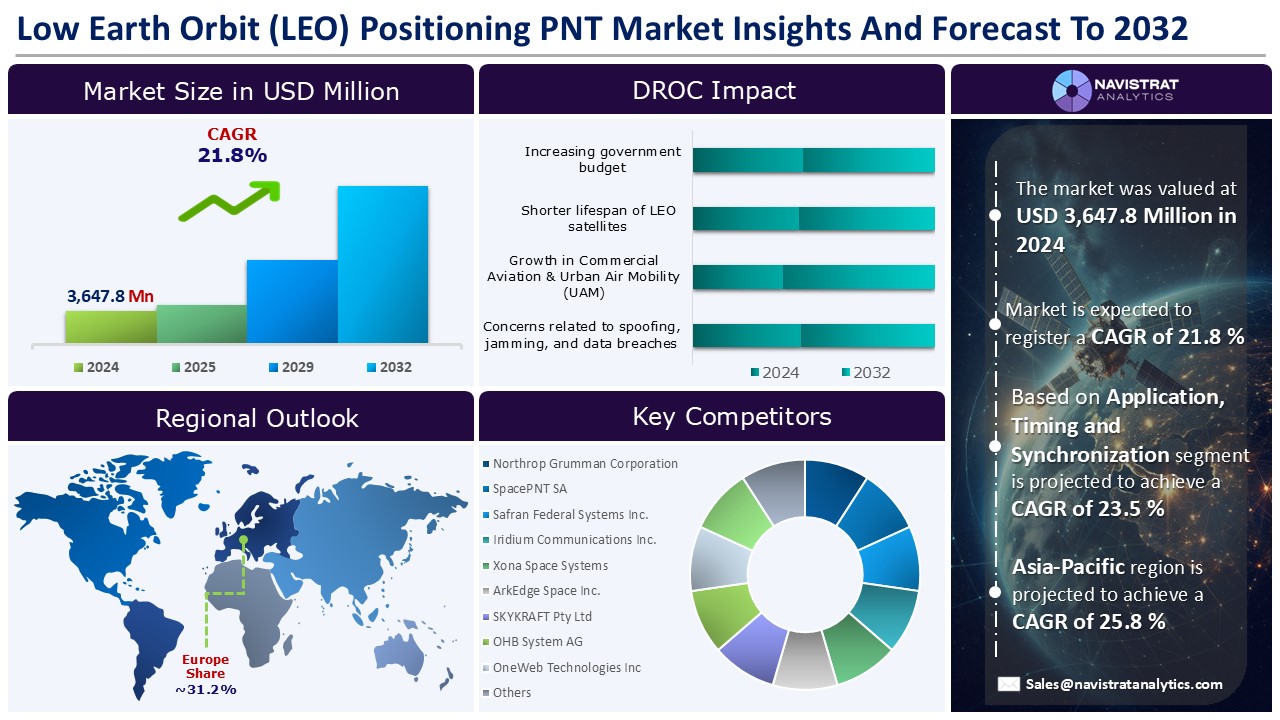
LEO PNT is increasingly being integrated into autonomous systems, including autonomous vehicles, unmanned aerial vehicles (UAVs), maritime vehicles, and military platforms, to deliver high-precision, low-latency Positioning, Navigation, and Timing (PNT), particularly in challenging environments such as tunnels, dense urban areas, and remote landscapes.
Conventional Global Navigation Satellite System (GNSS) satellites operate at an altitude of approximately 20,000 km above Earth, which can lead to connectivity disruptions for autonomous systems operating in challenging environments. The LEO PNT constellation can operate at significantly lower altitudes, ranging between 900 and 1,200 km.
Market Drivers:
Rising government budget for military and defense is significantly contributing to revenue growth of Low Earth Orbit (LEO) Positioning, Navigation, and Timing (PNT) market. LEO-based PNT solutions provide stronger signal power, improved resistance to jamming, and centimeter-level positioning accuracy over traditional GPS.
These capabilities are highly required in defense and military operations, where precise location tracking and secure communications are essential. Globally, military and defense forces highly rely on LEO PNT for jam-proof navigation to protect against interference with GPS and Global Navigation Satellite System (GNSS) signals.
Governments across top military spending countries are allocating significant budgets to strengthen national security and enhance security of critical infrastructure. According to the Stockholm International Peace Research Institute (SIPRI), global military expenditure increased for the seventh consecutive year in 2023, reaching a total of USD 2,443 billion. Increased global military spending in 2023-24 is largely driven by the ongoing war in Ukraine and rising geopolitical tensions in Asia, Oceania, and the Middle East.
Market Opportunity:
Rapid adoption of LEO PNT in 5G/6G telecommunications, and Internet of Things (IoT) network synchronization, is expected to drive revenue growth over the forecast period. LEO PNT can provide precise timing synchronization, and enhance communication 5G/6G and Internet of Things (IoT) network by providing low-latency positioning, and seamless integration with terrestrial infrastructure.
Globally, telecom operators are expanding 5G infrastructure and laying the groundwork for 6G. According to the GSM Association, global 5G connections are expected to surpass 2 billion by 2025. Integrating LEO PNT into terrestrial networks enhances the reliability and performance of IoT connectivity, Device-to-Device (D2D) communication, and Machine-to-Machine (M2M) operations.
Moreover, growth in Commercial Aviation and Urban Air Mobility (UAM) is further expected to fuel the demand for Low Earth Orbit (LEO) Positioning, Navigation, and Timing (PNT). Electric vertical takeoff and landing (eVTOL) aircraft highly depend on robust and accurate Air Traffic Management (ATM) solutions to operate in complex urban environments.
Integration of Satellite Time and Location (STL) signals, Full Spectrum/Jam Resistant GNSS in LEO PNT ensures positioning and timing synchronization to support autonomous flight, collision avoidance, and route optimization.
According to the International Civil Aviation Organization (ICAO), global air traffic is projected to exceed 200,000 daily flights by the mid-2030s. The World Economic Forum (WEF) emphasizes that successfully integrating private sector and government-led innovations in mobility solutions can significantly transform the transportation landscape.
Recent Trends:
Shift towards cost-effective and multi-functional LEO PNT constellations such as Starlink, OneWeb, BeiDou is emerging as a key industry trend in Low Earth Orbit (LEO) PNT Market. The multi-functional satellite platforms use Software-Defined Radios (SDRs) to serve multiple applications including telecommunications, radar imaging, and spectrum monitoring. These functionalities enhance the operational efficiency of LEO PNT and creating new spectrum of opportunities for cost-competitive solutions across diverse industries.
Space exploration agencies such as The European Space Agency (ESA) and The National Aeronautics and Space Administration (NASA) collaborating with key competitors of LEO PNT to improve precision of navigation systems. For instance, On May 20th, 2024, the European Space Agency (ESA) awarded a contract to France-based Syntony GNSS to provide advanced receivers compatible with the latest LEO PNT signals, as well as GPS and Galileo systems.
Restraints & Challenges:
Complex regulations and spectrum interference are restraining the market revenue growth of LEO PNT Market. LEO PNT systems operate in L-band (1-2 GHz), S-band (2-4 GHz), C-band (4-8 GHz), X-band (8-12 GHz), Ka-band (26-40 GHz), and other bands. The International Telecommunication Union (ITU) allocates global radio spectrum and establishes technical standards to ensure networks and technologies seamlessly integrate.
Also, national spectrum regulators such as The Federal Communications Commission (FCC) of the U.S., the Office of Communications of the U.K., and the Federal Network Agency of Germany issue licenses for satellite operations within respective countries. Delays in the regulation filing process and spectrum interference can delay LEO PNT deployment, which may increase the overall cost, this in turn can limit the market revenue growth.
Moreover, the shorter operational lifespan of Low Earth Orbit (LEO) satellites compared to Medium Earth Orbit (MEO) and Geostationary Earth Orbit (GEO) satellites is expected to hinder market revenue growth. LEO satellites operate at an altitude between 160 km to 2,000 km, where they experience higher atmospheric drag.
LEO satellites complete an orbit in 90 to 120 minutes at speeds of approximately 28,000 km/h which can cover only a small area at any given time. As a result, large satellite constellations are required to achieve global PNT coverage can increase capital expenditures (CAPEX) and operational costs (OPEX) for satellite operators.
Satellite Size Segment Insights and Analysis:
Based on the satellite size, the Low Earth Orbit (LEO) Positioning, Navigation and Timing (PNT) Market is segmented into small satellites (<500 Kg) and medium satellites (500–1,000 Kg).
The small satellite segment is sub-segmented into the key areas of mini satellites, micro satellites, CubeSats, and pico-satellites.
The small satellites segment account contributed the largest revenue share in 2024. Rapid deployment of LEO-PNT solutions for applications such as autonomous systems, critical infrastructure monitoring, and military operations is a key contributor to the largest revenue share in 2024. Small satellites are capable of integrating multiple PNT functions within small satellite platforms while maintaining overall cost efficiency in manufacturing, launch, and maintenance.
Several key competitors are strategically expanding their presence across major regions to deploy constellations of small LEO PNT satellites. For example, in September 2024, Xona Space Systems announced its expansion into Canada as part of its preparations to launch LEO PNT constellation in 2025. Xona aims to operate a constellation of 250 to 300 small PNT satellites.
Subsystem Segment Insights and Analysis:
Based on the subsystem, the Low Earth Orbit (LEO) Positioning, Navigation and Timing (PNT) Market is segmented into payload and software.
The software segment is expected to register fastest revenue share by 2032. The rise of mega-constellations and the commercialization of space services are expected to propel market revenue growth over the forecast period. Advanced software solutions optimize service delivery by enhancing signal processing, and addressing challenges in positioning errors of LEO PNT systems.
These solutions enable the strategic integration of upcoming LEO PNT launch missions with existing global navigation satellite systems (GNSS). For instance, in April 2024, Safran Electronics and Defence launched Skydel GNSS simulation software to offer full support for the upcoming Galileo Open Service Navigation Message Authentication (OSNMA) service of the European Space Agency (ESA). Additionally, the software segment driving critical role in system design optimization, analysis of signal propagation, and mitigates satellite positioning errors.
Application Segment Insights and Analysis:
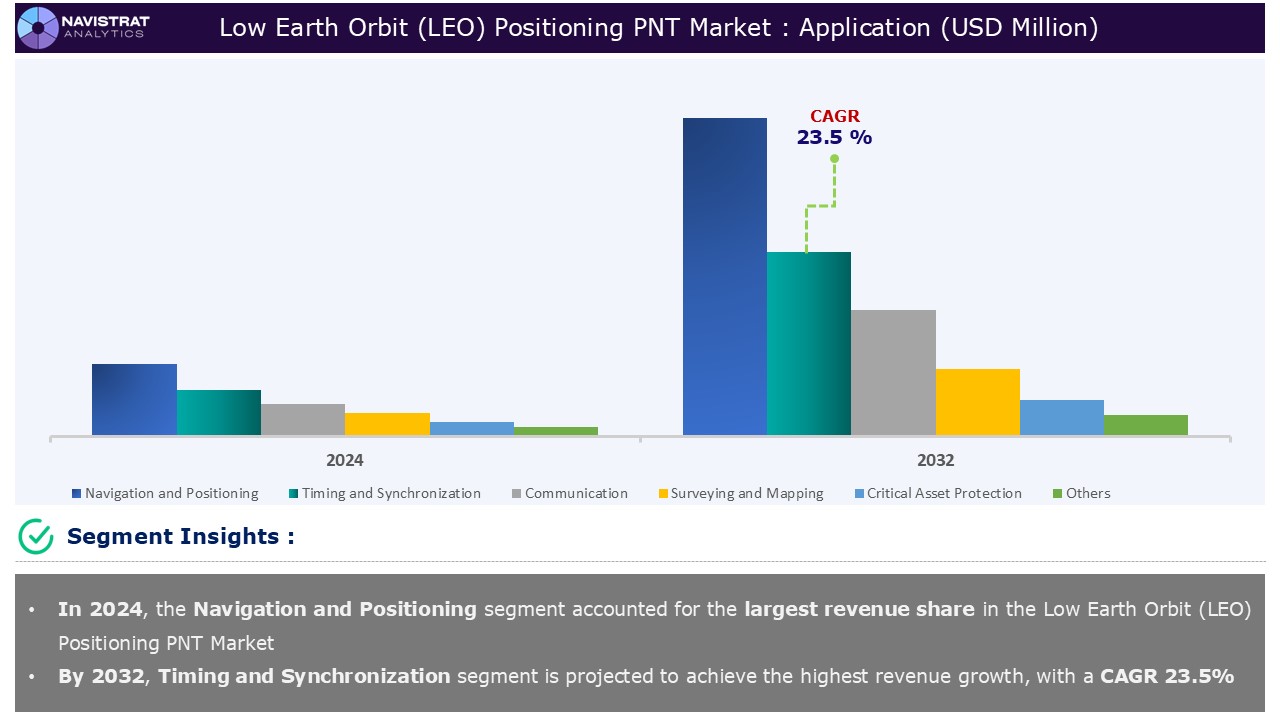
Based on the application, the Low Earth Orbit (LEO) Positioning, Navigation and Timing (PNT) Market is segmented into navigation and positioning, timing and synchronization, communication, surveying and mapping, critical asset protection, and others.
The navigation and positioning segment contributed the largest revenue share in 2024. Increasing demand for high-precision, low-latency positioning solutions for autonomous systems accelerated adoption of LEO PNT. LEO satellites operate at significantly lower altitudes compared to traditional Medium Earth Orbit (MEO) and Geostationary Earth Orbit (GEO) satellites.
The lower altitude of LEO satellites also significantly reduces data transmission latency from approximately 477 milliseconds in GEO systems to under 27 milliseconds, this ensures near-instantaneous communication, which is significantly critical for end-use such as autonomous systems, aerospace and defense.
Geographical Outlook:
Low Earth Orbit (LEO) Positioning, Navigation and Timing (PNT) Market is strategically segmented by geography to provide a comprehensive understanding of regional market dynamics. Discover demand analysis, emerging trends, and growth opportunities shaping market performance across different regions and countries.
North America Low Earth Orbit (LEO) Positioning, Navigation and Timing (PNT) Market:
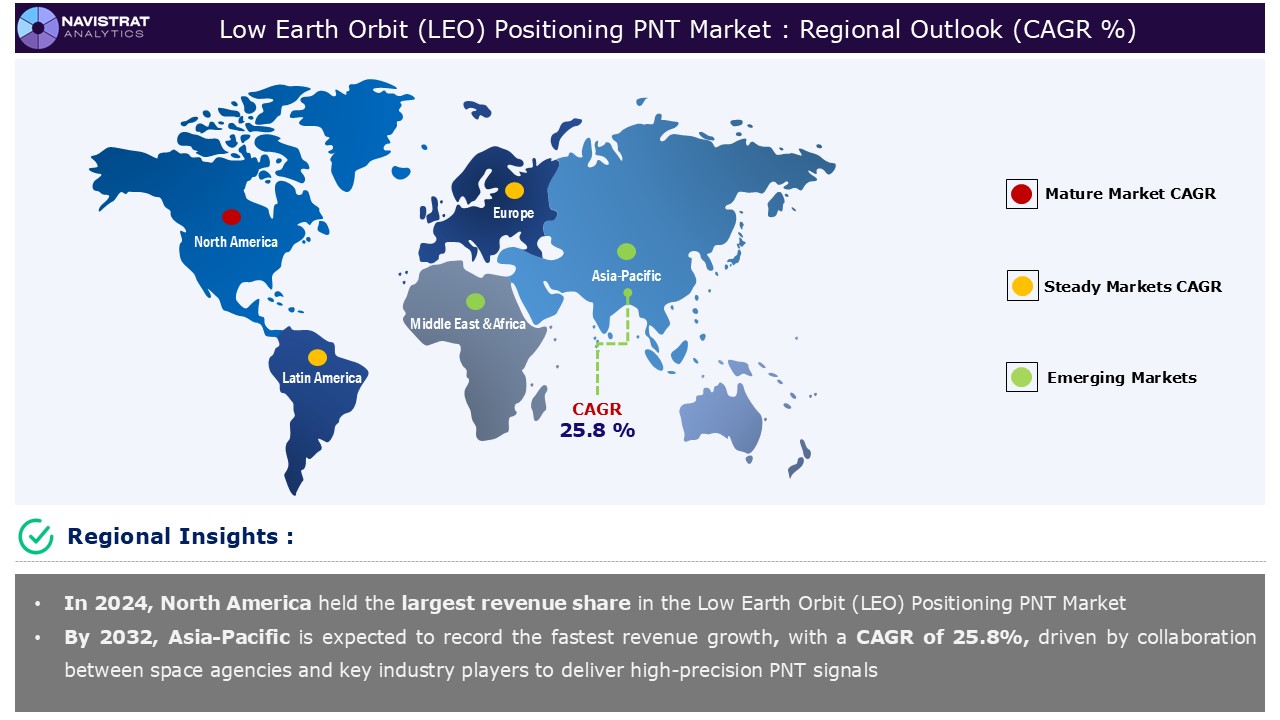
North America registered highest market share in the Low Earth Orbit (LEO) PNT Market. Rapid investments in defense and military expenditure, and research & development (R&D) are major contributors to LEO. In 2024, the U.S. Department of Defense (DOD) has allocated a substantial budget to strengthen national security and enhance military capabilities.
In the fiscal year 2024, the United States Department of the Air Force (DAF)’s Research, Development, Test, and Evaluation (RDT&E) budget was USD 55.4 billion, which was an increase of USD 4.9 billion budget compared to fiscal year 2023.
Competitors in this region are securing funding and contracts to advance the development of intelligent and autonomous technologies. For instance, on 9th May 2024, California-based Xona Space Systems announced an oversubscribed USD 19 Million Series A funding round to develop low Earth orbit (LEO) satellite navigation service.
Moreover, On 21st August 2024, California-based TrustPoint, Inc., received a 3.8 million Contract from SpaceWERX (Air Force Research Laboratory) to deploy a C-band satellite constellation in Low Earth Orbit (LEO) to deliver commercial Positioning, Navigation, and Timing (PNT) services.
Europe Low Earth Orbit (LEO) Positioning, Navigation and Timing (PNT) Market:
Europe contributed a substantial revenue share in 2024. The LEO PNT revenue share in Europe market witnessed exponential growth, fueled by the initiatives from European Space Agency’s (ESA) FutureNAV and The Navigation Innovation and Support Programme (NAVISP). The ESA is investing in several LEO-PNT missions to secure governmental connectivity services and provide high-end commercial services across member countries in Europe.
In April 2024, the European Space Agency (ESA) awarded contracts total of USD 250 million (EUR 233 million) to companies across the Europe region to assess the potential of LEO constellations for a diverse range of applications, including transportation, critical infrastructure, and asset monitoring, which as a result generating revenue growth in this region.
Moreover, In March 2024, Madrid, Spain-based GMV Innovating Solutions S.L. has secured a contract of USD 85 million (EUR 78.4 million) to lead the European Space Agency’s (ESA) initiative for developing a five-satellite Low-Earth Orbit (LEO) constellation dedicated to Positioning, Navigation, and Timing (PNT).
Asia Pacific Low Earth Orbit (LEO) Positioning, Navigation and Timing (PNT) Market:
Asia Pacific is expected to register fastest revenue growth by 2032. Rising demand for internet connectivity across this location is expected to propel market revenue growth in this region. According to the International Telecommunications Union (ITU), around 2.4 billion people, or 55% of the region’s population remain offline in this region.
Over 3 billion people are located more than 10 kilometers away from high-capacity fiber optic cable infrastructure. Remote and rural communities across countries in Asia Pacific continue to face challenges due to lack of internet connectivity. LEO PNT constellations can help to bridge the gap, particularly for landlocked developing countries and small island developing areas.
Collaboration between space agencies and key industry players to deliver high-precision PNT signals is also anticipated to expand substantial growth by 2032. For instance, In October 2024, The Japan Aerospace Exploration Agency (JAXA) awarded a contract to Japanese startup ArkEdge Space to deliver high-precision PNT signals on a global scale.
Additionally, In December 2024, Australia-based Skykraft signed an agreement with International Space Investment (ISI) of India to focus on advancing next-generation collaborative PNT systems by demonstrating the viability of large-scale LEO constellations.
Competition Analysis:
The Low Earth Orbit (LEO) Positioning, Navigation and Timing (PNT) Market is characterized by a numerous player, with major players competing across segments and regions. The list of major players included in the Low Earth Orbit (LEO) Positioning, Navigation and Timing (PNT) Market report are:
- Northrop Grumman Corporation (U.S.)
- SpacePNT SA (Switzerland)
- Safran Federal Systems Inc. (U.S.)
- Iridium Communications Inc. (U.S.)
- Xona Space Systems (U.S.)
- ArkEdge Space Inc. (Japan)
- SKYKRAFT Pty Ltd (Australia)
- OHB System AG (Germany)
- OneWeb Technologies Inc (U.S.)
- GMV Innovating Solutions S.L. (Spain)
- Thales Alenia Space (U.K.)
- TrustPoint, Inc. (U.S.)
- Celestia Technologies (U.K.)
- Syntony GNSS (France)
- Alén Space (Spain)
- RUAG Group (Switzerland)
- Deimos Space S.L.U (Italy)
Strategic Developments in Low Earth Orbit (LEO) Positioning, Navigation, and Timing (PNT) Market:
- On September 17th 2024, OneWeb Technologies Inc., launched Astra solution, designed to provide seamless LEO SATCOM connectivity and maintain operational performance in the absence or disruption of GPS/Global Navigation Satellite System (GNSS) signals.
- On October 11th, 2024, Safran Federal Systems Inc., introduced the latest advancement in its GSG simulator series, ION GNSS+, GSG-8 Gen2. Additionally, Safran announced the integration of Xona Space Systems’ PULSAR XL with its Skydel simulation software.
- On February 5th, 2025, Iridium Communications is planning to develop small satellites to demonstrate advanced Positioning, Navigation, and Timing (PNT) capabilities. Unlike traditional small satellites deployed for LEO communications, which typically weigh between a few dozen to a few hundred kilograms.
Key Advantages for Stakeholders:
Navistrat Analytics’ industry report provides an in-depth quantitative analysis of various market segments, historical and current trends, market forecasts, and dynamics within the global market. The historical years covered in this report are 2022 to 2023, with 2024 serving as the base year for market size calculations. The forecast period extends from 2025 to 2032.
The report includes an executive summary and a comprehensive overview of market drivers, restraints, opportunities, and challenges (DROC), along with insights into regulatory standards. It features detailed analyses such as PORTER’s Five Forces, SWOT, and PESTLE, as well as assessments of technological trends and the competitive landscape.
PORTER’s Five Forces analysis helps stakeholders evaluate the impact of new entrants, competitive rivalry, supplier power, buyer power, and substitution threats, enabling them to assess the level of competition and the attractiveness of the global market. The competitive landscape provides stakeholders with a clear understanding of the current market positions of key players, offering valuable insights into their competitive environment.
Scope And Key Highlights of The Low Earth Orbit (LEO) Positioning, Navigation, and Timing (PNT) Market Report:
| Report Features | Details |
| Market Size in 2024 | USD 3,647.8 Million |
| Market Growth Rate in CAGR (2025–2032) | 21.8% |
| Market Revenue Forecast to 2032 | USD 17,314.6 Million |
| Base Year | 2024 |
| Historical Year | 2022–2023 |
| Forecast Period | 2025–2032 |
| Report Pages | 450 |
| Segments Covered |
|
| Regional Scope |
|
| Country Scope |
|
| Key Market Players |
|
| Delivery Format | Reports are delivered in PDF format via email. |
| Customization Scope | Request for Customization |
The Low Earth Orbit (LEO) Positioning, Navigation and Timing (PNT) Market report offers a detailed analysis of market size, including historical revenue (in USD Million) data for 2022-2023 and revenue forecasts for 2025-2032 across the following segments:
- Satellite Size Outlook (Revenue, USD Million; 2022-2032)
- Small Satellites (<500 Kg)
- Mini satellite
- Micro satellite
- CubeSats
- Pico-satellites
- Medium Satellites (500–1,000 Kg)
- Small Satellites (<500 Kg)
- Subsystem Outlook (Revenue, USD Million; 2022-2032)
- Payload
- GNSS Receivers
- Atomic Clocks
- LiDAR
- Sensors
- Antenna
- Power Systems
- Others
- Software
- Software
- Simulation system
- Payload
- Frequency Band Outlook (Revenue, USD Million; 2022-2032)
- L-band
- C-band
- S-band
- X-band
- Ku-band
- Ka-band
- V-band
- UHF-band
- Optical/IR
- Application Outlook (Revenue, USD Million; 2022-2032)
- Navigation and Positioning
- Timing and Synchronization
- Communication
- Surveying and Mapping
- Critical Asset Protection
- Others
- End-Use Outlook (Revenue, USD Million; 2022-2032)
- Automotive and Transportation
- Aerospace and Defense
- Government and Public Sector
- Maritime and Shipping
- IT and Telecommunications
- Energy and Utilities
- Agriculture and Environmental
- Banking and Financial Services (BFSI)
- Regional Outlook (Revenue, USD Million; 2022-2032)
- North America
- U.S.
- Canada
- Mexico
- Europe
- Germany
- France
- U.K.
- Italy
- Spain
- Benelux
- Nordic Countries
- Rest of Europe
- Asia Pacific
- China
- India
- Japan
- South Korea
- Singapore
- Oceania
- ASEAN Countries
- Rest of APAC
- Latin America
- Brazil
- Rest of LATAM
- Middle East & Africa
- GCC Countries
- South Africa
- Israel
- Turkey
- Rest of MEA
- North America
Frequently Asked Questions (FAQ) About the Low Earth Orbit (LEO) Positioning, Navigation, and Timing (PNT) Market Report
The market size of Low Earth Orbit (LEO) Positioning, Navigation, and Timing (PNT) Market was 3,647.8 million in 2024.
The growth of Low Earth Orbit (LEO) Positioning, Navigation, and Timing (PNT) Market is expected to register a compound annual growth rate (CAGR) of 21.8% over the forecast period.
Rising demand for Low Earth Orbit (LEO) Positioning, Navigation, and Timing (PNT) in autonomous systems is a major factor driving the revenue growth of Low Earth Orbit (LEO) Positioning, Navigation, and Timing (PNT) Market.
High initial investment for LEO constellation deployment and maintenance are restraints of the Low Earth Orbit (LEO) Positioning, Navigation, and Timing (PNT) Market.
Asia Pacific accounts for the fastest revenue growth of 25.8%.
Navigation and positioning are the leading segment of the Low Earth Orbit (LEO) Positioning, Navigation, and Timing (PNT) Market in terms of application.
- Market Definition
- Research Objective
- Research Methodology
- Research Design
- Data Collection Methods
- Primary
- Secondary
- Market Size Estimation
- Top-down method
- Bottom-up method
- Forecasting Methodology
- Tools and Models Used
- Market Overview and Trends
- Market Size and Forecast
- Industry Analysis
- Market Driver, Restraints, Opportunity, and Challenges (DROC) Analysis
- Market Drivers
- Increasing demand for precise and reliable PNT in autonomous systems
- Increasing government budget to secure PNT for military and defense
- Growing reliance on accurate timing and synchronization for critical infrastructure
- Market Restraints
- High initial investment costs for LEO constellation deployment and maintenance
- Complex global regulations and spectrum interference
- Shorter lifespan of LEO satellites compared to MEO/GEO
- Market Opportunities
- Expansion of Direct-to-Device (D2D) LEO PNT services
- Growth in Commercial Aviation & Urban Air Mobility (UAM)
- Market Challenges
- Rising concerns related to spoofing, jamming, and data breaches
- Interoperability Issues with existing GNSS & PNT systems
- Regulatory Landscape
- North America
- Europe
- Asia Pacific
- Latin America
- Middle East and Africa
- Strategic Insights
- Porter’s Five Forces Analysis
- PESTLE Analysis
- Price Trend Analysis
- Value Chain Analysis
- Technological Trends
- Recent Developments
- Funding
- Merger and Acquisition
- Expansion
- Partnership and Collaboration
- Product/ Service Launch
- Satellite Size Market Revenue Estimates and Forecasts, 2022-2032
- Small Satellites (<500 Kg)
- Mini satellite
- Micro satellite
- CubeSats
- Pico-satellites
- Medium Satellites (500–1,000 Kg)
- Small Satellites (<500 Kg)
- Subsystem Market Revenue Estimates and Forecasts, 2022-2032
- Payload
- GNSS Receivers
- Atomic Clocks
- LiDAR
- Sensors
- Antenna
- Power Systems
- Others
- Software
- Software
- Simulation system
- Payload
- Frequency Band Market Revenue Estimates and Forecasts, 2022-2032
- L-band
- C-band
- S-band
- X-band
- Ku-band
- Ka-band
- V-band
- UHF-band
- Optical/IR
- Application Market Revenue Estimates and Forecasts, 2022-2032
- Navigation and Positioning
- Timing and Synchronization
- Communication
- Surveying and Mapping
- Critical Asset Protection
- Others
- End-Use Market Revenue Estimates and Forecasts, 2022-2032
- Automotive and Transportation
- Aerospace and Defense
- Government and Public Sector
- Maritime and Shipping
- IT and Telecommunications
- Energy and Utilities
- Agriculture and Environmental
- Banking and Financial Services (BFSI)
- Low Earth Orbit (LEO) Positioning, Navigation, and Timing (PNT) Market Geographical Outlook
- Low Earth Orbit (LEO) Positioning, Navigation, and Timing (PNT) Market Revenue Estimates and Forecasts by Region, 2022-2032, USD Million
- North America
- North America Low Earth Orbit (LEO) Positioning, Navigation, and Timing (PNT) Market By Satellite Size, Market Revenue Estimates and Forecasts, 2022-2032, USD Million
- Small Satellites (<500 Kg)
- Mini satellite
- Micro satellite
- CubeSats
- Pico-satellites
- Medium Satellites (500–1,000 Kg)
- Small Satellites (<500 Kg)
- North America Low Earth Orbit (LEO) Positioning, Navigation, and Timing (PNT) Market By Subsystem, Market Revenue Estimates and Forecasts, 2022-2032, USD Million
- Payload
- GNSS Receivers
- Atomic Clocks
- LiDAR
- Sensors
- Antenna
- Power Systems
- Others
- Software
- Software
- Simulation system
- Payload
- North America Low Earth Orbit (LEO) Positioning, Navigation, and Timing (PNT) Market By Frequency Band, Market Revenue Estimates and Forecasts, 2022-2032, USD Million
- L-band
- C-band
- S-band
- X-band
- Ku-band
- Ka-band
- V-band
- UHF-band
- Optical/IR
- North America Low Earth Orbit (LEO) Positioning, Navigation, and Timing (PNT) Market By Application, Market Revenue Estimates and Forecasts, 2022-2032, USD Million
- Navigation and Positioning
- Timing and Synchronization
- Communication
- Surveying and Mapping
- Critical Asset Protection
- Others
- North America Low Earth Orbit (LEO) Positioning, Navigation, and Timing (PNT) Market By End-Use, Market Revenue Estimates and Forecasts, 2022-2032, USD Million
- Automotive and Transportation
- Aerospace and Defense
- Government and Public Sector
- Maritime and Shipping
- IT and Telecommunications
- Energy and Utilities
- Agriculture and Environmental
- Banking and Financial Services (BFSI)
- North America Low Earth Orbit (LEO) Positioning, Navigation, and Timing (PNT) Market Revenue Estimates and Forecasts by Country, 2022-2032, USD Million
- United States
- Canada
- Mexico
- North America Low Earth Orbit (LEO) Positioning, Navigation, and Timing (PNT) Market By Satellite Size, Market Revenue Estimates and Forecasts, 2022-2032, USD Million
- Europe
- Europe Low Earth Orbit (LEO) Positioning, Navigation, and Timing (PNT) Market By Satellite Size, Market Revenue Estimates and Forecasts, 2022-2032, USD Million
- Small Satellites (<500 Kg)
- Mini satellite
- Micro satellite
- CubeSats
- Pico-satellites
- Medium Satellites (500–1,000 Kg)
- Small Satellites (<500 Kg)
- Europe Low Earth Orbit (LEO) Positioning, Navigation, and Timing (PNT) Market By Subsystem, Market Revenue Estimates and Forecasts, 2022-2032, USD Million
- Payload
- GNSS Receivers
- Atomic Clocks
- LiDAR
- Sensors
- Antenna
- Power Systems
- Others
- Software
- Software
- Simulation system
- Payload
- Europe Low Earth Orbit (LEO) Positioning, Navigation, and Timing (PNT) Market By Frequency Band, Market Revenue Estimates and Forecasts, 2022-2032, USD Million
- L-band
- C-band
- S-band
- X-band
- Ku-band
- Ka-band
- V-band
- UHF-band
- Optical/IR
- Europe Low Earth Orbit (LEO) Positioning, Navigation, and Timing (PNT) Market By Application, Market Revenue Estimates and Forecasts, 2022-2032, USD Million
- Navigation and Positioning
- Timing and Synchronization
- Communication
- Surveying and Mapping
- Critical Asset Protection
- Others
- Europe Low Earth Orbit (LEO) Positioning, Navigation, and Timing (PNT) Market By End-Use, Market Revenue Estimates and Forecasts, 2022-2032, USD Million
- Automotive and Transportation
- Aerospace and Defense
- Government and Public Sector
- Maritime and Shipping
- IT and Telecommunications
- Energy and Utilities
- Agriculture and Environmental
- Banking and Financial Services (BFSI)
- Europe Low Earth Orbit (LEO) Positioning, Navigation, and Timing (PNT) Market Revenue Estimates and Forecasts by Country, 2022-2032, USD Million
- Germany
- United Kingdom
- France
- Italy
- Spain
- Benelux
- Nordic Countries
- Rest of Europe
- Europe Low Earth Orbit (LEO) Positioning, Navigation, and Timing (PNT) Market By Satellite Size, Market Revenue Estimates and Forecasts, 2022-2032, USD Million
- Asia-Pacific
- Asia-Pacific Low Earth Orbit (LEO) Positioning, Navigation, and Timing (PNT) Market By Satellite Size, Market Revenue Estimates and Forecasts, 2022-2032, USD Million
- Small Satellites (<500 Kg)
- Mini satellite
- Micro satellite
- CubeSats
- Pico-satellites
- Medium Satellites (500–1,000 Kg)
- Small Satellites (<500 Kg)
- Asia-Pacific Low Earth Orbit (LEO) Positioning, Navigation, and Timing (PNT) Market By Subsystem, Market Revenue Estimates and Forecasts, 2022-2032, USD Million
- Payload
- GNSS Receivers
- Atomic Clocks
- LiDAR
- Sensors
- Antenna
- Power Systems
- Others
- Software
- Software
- Simulation system
- Payload
- Asia-Pacific Low Earth Orbit (LEO) Positioning, Navigation, and Timing (PNT) Market By Frequency Band, Market Revenue Estimates and Forecasts, 2022-2032, USD Million
- L-band
- C-band
- S-band
- X-band
- Ku-band
- Ka-band
- V-band
- UHF-band
- Optical/IR
- Asia-Pacific Low Earth Orbit (LEO) Positioning, Navigation, and Timing (PNT) Market By Application, Market Revenue Estimates and Forecasts, 2022-2032, USD Million
- Navigation and Positioning
- Timing and Synchronization
- Communication
- Surveying and Mapping
- Critical Asset Protection
- Others
- Asia-Pacific Low Earth Orbit (LEO) Positioning, Navigation, and Timing (PNT) Market By End-Use, Market Revenue Estimates and Forecasts, 2022-2032, USD Million
- Automotive and Transportation
- Aerospace and Defense
- Government and Public Sector
- Maritime and Shipping
- IT and Telecommunications
- Energy and Utilities
- Agriculture and Environmental
- Banking and Financial Services (BFSI)
- Asia-Pacific Low Earth Orbit (LEO) Positioning, Navigation, and Timing (PNT) Market Revenue Estimates and Forecasts by Country, 2022-2032, USD Million
- China
- India
- Japan
- South Korea
- Singapore
- Oceania
- ASEAN Countries
- Asia-Pacific Low Earth Orbit (LEO) Positioning, Navigation, and Timing (PNT) Market By Satellite Size, Market Revenue Estimates and Forecasts, 2022-2032, USD Million
- Latin America
- Latin America Low Earth Orbit (LEO) Positioning, Navigation, and Timing (PNT) Market By Satellite Size, Market Revenue Estimates and Forecasts, 2022-2032, USD Million
- Small Satellites (<500 Kg)
- Mini satellite
- Micro satellite
- CubeSats
- Pico-satellites
- Medium Satellites (500–1,000 Kg)
- Small Satellites (<500 Kg)
- Latin America Low Earth Orbit (LEO) Positioning, Navigation, and Timing (PNT) Market By Subsystem, Market Revenue Estimates and Forecasts, 2022-2032, USD Million
- Payload
- GNSS Receivers
- Atomic Clocks
- LiDAR
- Sensors
- Antenna
- Power Systems
- Others
- Software
- Software
- Simulation system
- Payload
- Latin America Low Earth Orbit (LEO) Positioning, Navigation, and Timing (PNT) Market By Frequency Band, Market Revenue Estimates and Forecasts, 2022-2032, USD Million
- L-band
- C-band
- S-band
- X-band
- Ku-band
- Ka-band
- V-band
- UHF-band
- Optical/IR
- Latin America Low Earth Orbit (LEO) Positioning, Navigation, and Timing (PNT) Market By Application, Market Revenue Estimates and Forecasts, 2022-2032, USD Million
- Navigation and Positioning
- Timing and Synchronization
- Communication
- Surveying and Mapping
- Critical Asset Protection
- Others
- Latin America Low Earth Orbit (LEO) Positioning, Navigation, and Timing (PNT) Market By End-Use, Market Revenue Estimates and Forecasts, 2022-2032, USD Million
- Automotive and Transportation
- Aerospace and Defense
- Government and Public Sector
- Maritime and Shipping
- IT and Telecommunications
- Energy and Utilities
- Agriculture and Environmental
- Banking and Financial Services (BFSI)
- Latin America Low Earth Orbit (LEO) Positioning, Navigation, and Timing (PNT) Market Revenue Estimates and Forecasts by Country, 2022-2032, USD Million
- Brazil
- Rest of Latin America
- Latin America Low Earth Orbit (LEO) Positioning, Navigation, and Timing (PNT) Market By Satellite Size, Market Revenue Estimates and Forecasts, 2022-2032, USD Million
- Middle East & Africa
- Middle East & Africa Low Earth Orbit (LEO) Positioning, Navigation, and Timing (PNT) Market By Satellite Size, Market Revenue Estimates and Forecasts, 2022-2032, USD Million
- Small Satellites (<500 Kg)
- Mini satellite
- Micro satellite
- CubeSats
- Pico-satellites
- Medium Satellites (500–1,000 Kg)
- Small Satellites (<500 Kg)
- Middle East & Africa Low Earth Orbit (LEO) Positioning, Navigation, and Timing (PNT) Market By Subsystem, Market Revenue Estimates and Forecasts, 2022-2032, USD Million
- Payload
- GNSS Receivers
- Atomic Clocks
- LiDAR
- Sensors
- Antenna
- Power Systems
- Others
- Software
- Software
- Simulation system
- Payload
- Middle East & Africa Low Earth Orbit (LEO) Positioning, Navigation, and Timing (PNT) Market By Frequency Band, Market Revenue Estimates and Forecasts, 2022-2032, USD Million
- L-band
- C-band
- S-band
- X-band
- Ku-band
- Ka-band
- V-band
- UHF-band
- Optical/IR
- Middle East & Africa Low Earth Orbit (LEO) Positioning, Navigation, and Timing (PNT) Market By Application, Market Revenue Estimates and Forecasts, 2022-2032, USD Million
- Navigation and Positioning
- Timing and Synchronization
- Communication
- Surveying and Mapping
- Critical Asset Protection
- Others
- Middle East & Africa Low Earth Orbit (LEO) Positioning, Navigation, and Timing (PNT) Market By End-Use, Market Revenue Estimates and Forecasts, 2022-2032, USD Million
- Automotive and Transportation
- Aerospace and Defense
- Government and Public Sector
- Maritime and Shipping
- IT and Telecommunications
- Energy and Utilities
- Agriculture and Environmental
- Banking and Financial Services (BFSI)
- Middle East & Africa Low Earth Orbit (LEO) Positioning, Navigation, and Timing (PNT) Market Revenue Estimates and Forecasts by Country, 2022-2032, USD Million
- GCC Countries
- South Africa
- Israel
- Turkey
- Rest of Middle East & Africa
- Middle East & Africa Low Earth Orbit (LEO) Positioning, Navigation, and Timing (PNT) Market By Satellite Size, Market Revenue Estimates and Forecasts, 2022-2032, USD Million
- North America
- Low Earth Orbit (LEO) Positioning, Navigation, and Timing (PNT) Market Revenue Estimates and Forecasts by Region, 2022-2032, USD Million
- Market Share Analysis
- Revenue Market Share by Key Players (2023-2024)
- Analysis of Top Players by Market Presence
- Competitive Matrix
- Competitive Strategies
- Mergers and Acquisitions
- Partnerships and Collaboration
- Investment and Fundings
- Agreement
- Expansion
- New Product/ Services Launches
- Technological Innovations
- Northrop Grumman Corporation
- Company Overview
- Financial Insights
- Product/ Services Offerings
- Strategic Developments
- SWOT Analysis
- SpacePNT SA
- Company Overview
- Financial Insights
- Product/ Services Offerings
- Strategic Developments
- SWOT Analysis
- Safran Federal Systems Inc.
- Company Overview
- Financial Insights
- Product/ Services Offerings
- Strategic Developments
- SWOT Analysis
- Iridium Communications Inc.
- Company Overview
- Financial Insights
- Product/ Services Offerings
- Strategic Developments
- SWOT Analysis
- Xona Space Systems
- Company Overview
- Financial Insights
- Product/ Services Offerings
- Strategic Developments
- SWOT Analysis
- ArkEdge Space Inc.
- Company Overview
- Financial Insights
- Product/ Services Offerings
- Strategic Developments
- SWOT Analysis
- SKYKRAFT Pty Ltd
- Company Overview
- Financial Insights
- Product/ Services Offerings
- Strategic Developments
- SWOT Analysis
- OHB System AG
- Company Overview
- Financial Insights
- Product/ Services Offerings
- Strategic Developments
- SWOT Analysis
- OneWeb Technologies Inc
- Company Overview
- Financial Insights
- Product/ Services Offerings
- Strategic Developments
- SWOT Analysis
- GMV Innovating Solutions S.L.
- Company Overview
- Financial Insights
- Product/ Services Offerings
- Strategic Developments
- Thales Alenia Space
- Company Overview
- Financial Insights
- Product/ Services Offerings
- Strategic Developments
- SWOT Analysis
- TrustPoint, Inc.
- Company Overview
- Financial Insights
- Product/ Services Offerings
- Strategic Developments
- SWOT Analysis
- Celestia Technologies
- Company Overview
- Financial Insights
- Product/ Services Offerings
- Strategic Developments
- SWOT Analysis
- Syntony GNSS
- Company Overview
- Financial Insights
- Product/ Services Offerings
- Strategic Developments
- SWOT Analysis
- Alén Space
- Company Overview
- Financial Insights
- Product/ Services Offerings
- Strategic Developments
- SWOT Analysis
- RUAG Group
- Company Overview
- Financial Insights
- Product/ Services Offerings
- Strategic Developments
- SWOT Analysis
- Deimos Space S.L.U
- Company Overview
- Financial Insights
- Product/ Services Offerings
- Strategic Developments
- SWOT Analysis