

3D Food Printing Market Overview and Key Insights:
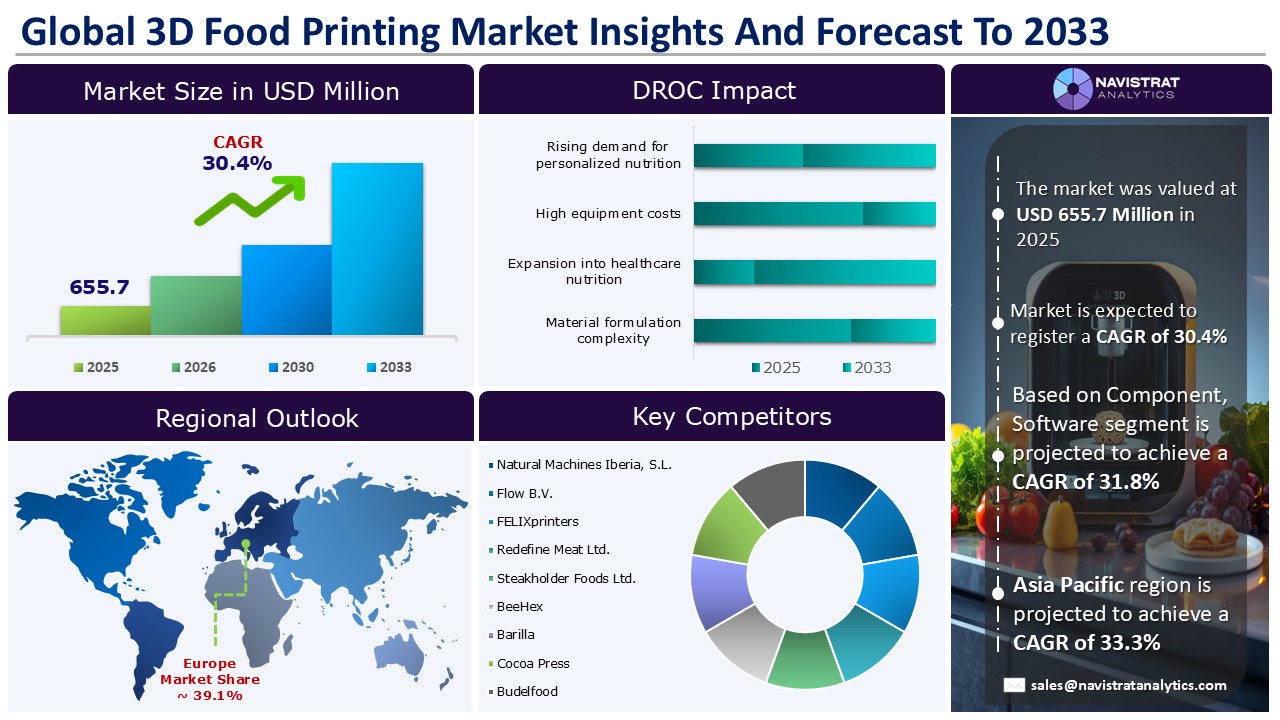
3D food printing market size reached USD 655.7 Million in 2025 and is expected to register a revenue CAGR of 30.4% during the forecast period. 3D-printed food (3DPF) is made up of eatables that have been created using the automated, additive 3D printing technique. Similar to other printing processes, 3D-printed food is built in sophisticated shapes layer by layer. These printers use computer-aided design (CAD) software to duplicate uploaded artwork, whether original or pre-fixed. 3DFP has potential in tackling urgent global concerns like as food security, famine, and malnutrition by allowing for the manufacture of fortified, shelf-stable food products ideal for resource-constrained areas.
Market Drivers:
Rising demand for personalized nutrition is a key driver driving the market revenue growth. Advances in 3D food printing rely on a combination of precise control and novel materials to produce bespoke edible goods. This method assembles food layer by layer, allowing for intricate shapes, customized textures, and personalized nutritional value. The way food is deposited, the sorts of ingredients that can be used, and the qualities of the finished dish all differ between approaches. These changes affect production speed, cost, flexibility, and the possibility of creating elaborate food structures.
3D food printing has the potential to significantly reduce malnutrition. Customers’ particular nutritional demands are met via 3D-printed foods, which can be created using technology to provide individualized nutrition. Although international companies such as PepsiCo, Barilla, Mazola, Hershey’s, and Oreo have already introduced 3D items to the market. Beyond aesthetics, 3D printing enables the development of food products that are adapted to individual dietary requirements. For example, research indicates that 3D printing has promise for strengthening foods with helpful probiotic microbes.
On January 2024, Revo Foods, an Austrian food technology startup, has introduced the Food Fabricator X2, a revolutionary high-throughput food 3D printer. The Food Fabricator X2 enables high-volume manufacturing of a wide variety of whole-cut meat alternatives and other food products with customized shapes, structures, and textures. This revolutionary 3D printer uses high-precision extrusion technology to mix multiple ingredients into specified structures with accuracy. As a result, manufacturers can produce unique foods such as authentic meat substitutes and products with innovative structures, forms, and textures at scale.
Market Opportunity:
Adoption of AI and advanced analytics act as opportunity for 3D Food Printing market. Integrating artificial intelligence (AI) into 3D food printing has significant potential because it improves efficiency and accuracy. AI-powered 3D food printing improves food design precision, material variety, and personalization while encouraging sustainability through waste reduction and innovative bio-ingredients.
Advances in multimaterial printing, shape-shifting capabilities, and nanotechnology integration enhance texture, nutrition, and consumer appeal, paving the way for disruptive impacts in the gastronomy, healthcare, and food technology sectors. Reinforcement learning and deep learning are two ML approaches that greatly improve parameter optimization, material behavior, and printing quality. AI enables real-time control of extrusion force, viscosity, and structural integrity. Applications include individualized nutrition, tissue engineering, and gastronomy. 4D printing provides dynamic shape-shifting capabilities.
On March 2025, researchers at Hong Kong University of Science and Technology (HKUST) have created a cutting-edge AI-assisted 3D food printing solution that combines printing and infrared frying, opening the door to safer, more efficient, and visually appealing food production. The system is powered by AI-assisted design, which uses generative algorithms and Python scripts to create complicated food patterns. By utilizing AI, the design process becomes accessible to even computer beginners.
Recent Trends:
Emerging trends include advancement in extrusion-based printing technology, integration of Artificial Intelligence (AI), development of advanced food inks, personalized nutrition technology, and 4D food printing evolution.
Extrusion-based three-dimensional (3D) food printing is a method of depositing food items layer by layer via an extrusion nozzle. Extrusion-based 3D food printing technology can be used to create nutrient-dense food pastes. This novel technique provides exact stratification of edible elements, allowing for highly tailored and nutritionally optimized diets. By exploiting this technology, the food business can experiment with novel approaches, such as personalized nutrition and diets based on individual preferences and dietary needs.
Advances in 3D printing food have significant implications for tackling global food security challenges by encouraging efficient resource use and the creation of nutritionally packed meals, particularly in non-traditional settings. 3D printing enables the use of a wide range of materials, including alternative and sustainable sources. This diversity broadens the number of food options accessible while reducing reliance on traditional agricultural practices.
Restraints & Challenges:
Integrating 3D printing technology into the food manufacturing business has a number of engineering issues, ranging from material formulation and equipment design to scaling up production and garnering customer approval. The nutritional quality of 3D printed food is another issue that must be addressed before 3D printing can be used in the realm of nutrition. The procedures involved in 3D food printing, as well as its post-processing (steaming or baking), may have an impact on nutritional quality. Many chemical reactions and physical changes occur during processing and post-processing, such as protein denaturation, starch gelatinization and fragmentation, and moisture reduction, which may modify the nutritional content of the final product.
Component Segment Insights and Analysis:
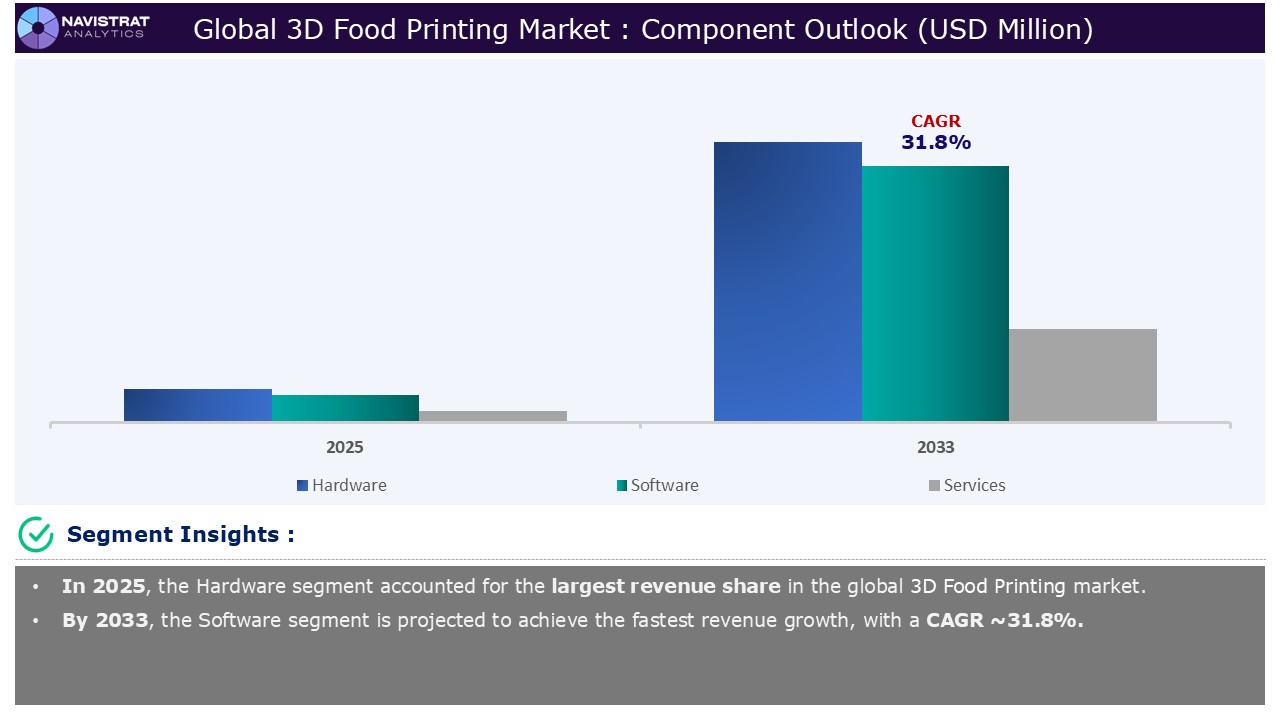
Based on the component, 3D food printing market is segmented into hardware, software, and services.
Hardware segment contributed the largest market share in 2025. 3D printers can create pastries, chocolates, and even meals. These devices provide a great deal of flexibility and creativity in the kitchen, and they can sometimes assist reduce food waste. 3D printers can create pastries, chocolates, and even meals. These devices provide a great deal of flexibility and creativity in the kitchen, and they can sometimes assist reduce food waste. These printers use computer-aided design (CAD) software to duplicate uploaded artwork, whether original or pre-fixed. And, instead of plastics, they dispense paste-like or flexible foods like as pasta, chocolate, cheese, cookie dough, sugar-based confectionery, gelatin, cultured meat, mashed potatoes, and pizza.
On February 2024, Steakholder Foods, an Israeli bioprinting technology expert, and Wyler Farms, Israel’s largest tofu producer, have signed a memorandum of understanding (MOU) to deploy industrial-scale 3D printing technology to make 3D printed plant-based beef steaks. Wyler Farms will buy Steakholder Foods’ 3D Fusion Pro meat printer, as well as a subscription to SH Software and NutriBlend ink, which are specifically intended for plant-based meat.
Printing Technology Segment Insights and Analysis:
Based on the printing technology, 3D food printing market is segmented into extrusion-based printing, inkjet printing, binder printing, Selective Laser Sintering (SLS), and hybrid systems.
Extrusion-based printing segment contributed the largest market share in 2025. It is the most commonly used technique in the food industry. Extrusion-based printing uses both hot-melt and room-temperature extrusion. Chocolate is the most common food material that requires hot-melt extrusion, followed by hydrogels like carrageenan and agar, as well as meat, starch, vegetables, and fruits. Notably, some hydrogels have been successfully printed using room temperature extrusion. Using extrusion-based printing technology, many personalized foods have been successfully made to fulfil the individual needs of customers.
Currently, the most common approaches for improving printability and efficiency are modifying the physiochemical properties of printing inks, optimizing printing settings, and upgrading printer design. The approach for improving the printing printability of various food materials must take into account the personalized purpose of the printed product. Integrated printing equipment with many nozzles, post-processing, and intelligent detection are excellent for commercial printing.
End-Use Segment Insights and Analysis:
Based on the end-use, 3D food printing market is segmented into commercial foodservice, food manufacturers, consumers, healthcare institutions, and research organizations.
Healthcare institutions segment contributed the fastest growth rate in 2025. 3D food printing has especially potential applications in the fields of health and personalized nutrition. This technology enables accurate adaptation of the nutritional composition of each food item to an individual’s specific needs, such as age, health state, physical activity, or nutritional goals. For persons with allergies or who follow a special diet, 3D printing allows them to create completely controlled foods without the chance of cross contamination. Each portion can be tailored to eliminate specific allergens while accounting for any nutritional shortfalls.
This technology paves the path for totally individualized catering in hospitals, with each meal tray tailored to the patient’s care regimen and containing precise amounts of proteins, carbohydrates, fats, vitamins, and minerals. This nutritional accuracy accelerates recovery and enhances the patient experience, both of which are critical aspects of the healing process.
On August 2025, researchers from Kyushu University and Cardiff University have collaborated to develop a new approach for creating tailored meals for people with dysphagia using 3D printing technology. The team’s research showed that by just modifying the frequency of the energy supplied, they were able to create gels with a variety of characteristics suitable for varied dysphagia diet requirements. The ability to control protein aggregation and even capture tastes within the oil phase could result in flavor-enhanced food-tech products.
Geographical Outlook:
3D food printing market is strategically segmented by geography to provide a comprehensive understanding of regional market dynamic. Discover demand analysis, emerging trends, and growth opportunities shaping market performance across different region and countries.
Europe 3D Food Printing Market:
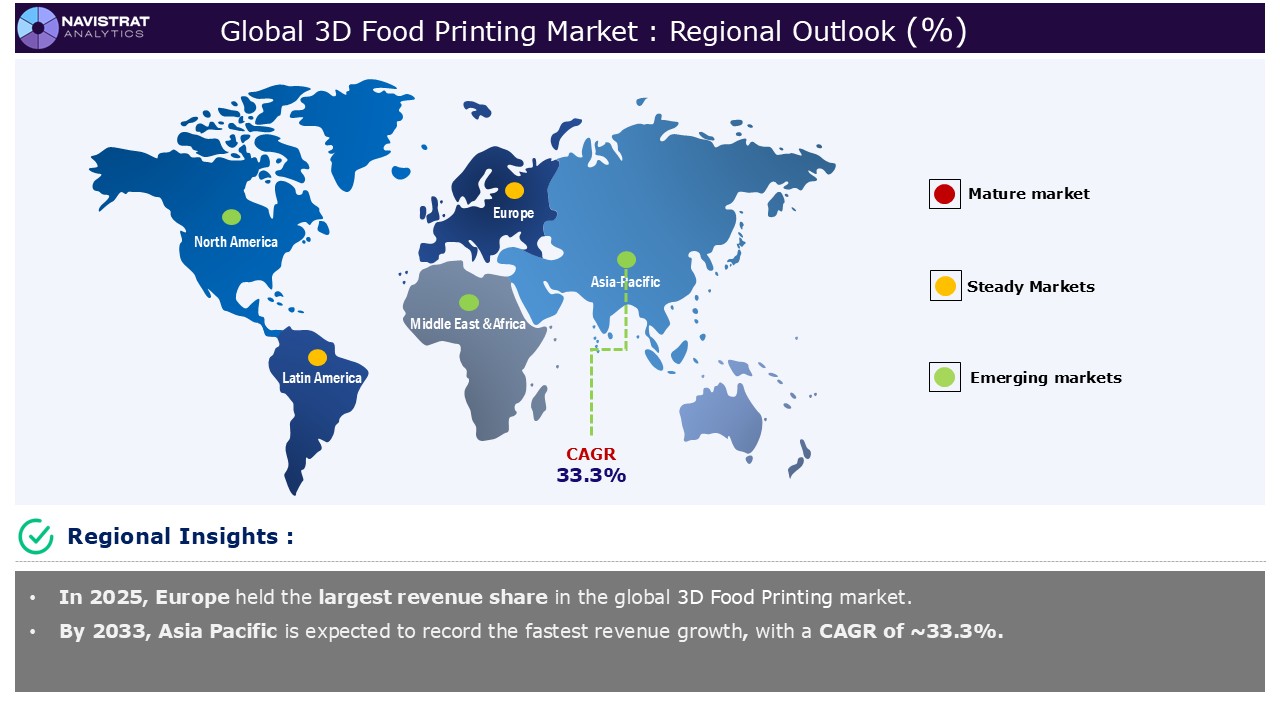
Europe is registered to have highest market share in 3D Food Printing market in 2025. The market for 3D food printing in Europe is expanding quickly due to new developments in technology, rising customer demand for customized nutrition, and creative culinary uses. Food producers and suppliers are looking for new ways to improve product efficiency, sustainability, and customization. The expanding acceptability of 3D printed foods in both commercial and residential settings, partnerships between technology companies and culinary institutes, and increased investments in food tech firms all contribute to the market’s growth.
On October 2024, Revo Foods, an Austrian firm, has launched the world’s largest industrial 3D food printing factory in Vienna. The Taste Factory uses the company’s proprietary 3D Structuring technology to create plant-based seafood substitutes that mimic the feel and nutritional profile of traditional fish products. The facility has the potential to create up to 60 tons of plant-based products each month, representing a significant expansion in the use of additive manufacturing in food production.
Asia Pacific 3D Food Printing Market:
Asia Pacific is expected to register the fastest growth rate during the forecasted period. In Asia, 3D food printing (3DFP) and nutritious meals are emerging as critical developments in the food industry’s quest for sustainability. Health and wellness are the primary trends influencing Asia’s food and beverage business. People are increasingly prioritizing their whole well-being; therefore, they seek out nutritious eating options for their bodies and brains. As a result, wellness-focused menus are becoming increasingly popular across Asia. Functional meals that offer additional health advantages and nutrition are becoming more popular. Superfoods, probiotics, and adaptogens are now available to enhance the nutritional value of meals.
On September 2023, Maruha Nichiro, Japan’s largest fishing company, has announced a strategic investment and collaborative cooperation with Singapore’s Umami Bioworks to develop and commercialize cell-cultured seafood in Japan and possibly other countries. This cooperation is the first time a Japanese seafood company has teamed with a foreign company specializing in cellular agriculture for seafood production, and it also paves the way for Umami’s initiatives into 3D printed seafood to transform how consumers perceive alternative seafood products.
Competition Analysis:
3D food printing market is characterized by a fragmented structure, with several players competing across various segments and regions. List of major players included in 3D food printing market report are:
- Natural Machines Iberia, S.L.
- Flow B.V.
- FELIXprinters
- Redefine Meat Ltd.
- Steakholder Foods Ltd.
- BeeHex
- Barilla
- Cocoa Press
- Budelfood
- Markforged
- Bioedtech
- Novameat
- Sculpteo
Strategic Developments in 3D Food Printing Market:
- In November 2025, Barilla Group has officially opened its Barilla Innovation & Technology Experience (BITE), a cutting-edge facility designed to boost the company’s food innovation capabilities across its pasta, sauce, and bakery product lines. This is Barilla’s largest investment in food innovation to date, with over USD 25 million devoted to the 150,000-square-foot facility, which aspires to reimagine the future of Italian culinary tradition through advanced research and technology. AI-driven smart sensors and 3D printing are two cutting-edge technologies used at BITE to enable rapid prototyping and optimize production processes.
- In June 2024, Steakholder Foods Ltd., a pioneer in alternative proteins and 3D printing technologies, has signed a memorandum of understanding to form a strategic partnership with Sherry Herring, a well-known gourmet fish delicacies brand, to launch a new line of vegan fish salads made with the Company’s proprietary SHFISH premix blends. Steakholder Foods and Sherry Herring hope to reinvent the seafood experience by creating plant-based alternatives that resemble the flavor, texture, and nutritional profile of traditional fish salads.
Key Advantages for Stakeholders:
Navistrat Analytics’ industry report provides an in-depth quantitative analysis of various market segments, historical and current trends, market forecasts, and dynamics within the global market. The historical years covered in this report are 2023 to 2024, with 2025 serving as the base year for market size calculations. The forecast period extends from 2026 to 2033.
The report includes an executive summary and a comprehensive overview of market drivers, restraints, opportunities, and challenges (DROC), along with insights into regulatory standards. It features detailed analyses such as PORTER’s Five Forces, SWOT, and PESTLE, as well as assessments of technological trends and the competitive landscape.
PORTER’s Five Forces analysis helps stakeholders evaluate the impact of new entrants, competitive rivalry, supplier power, buyer power, and substitution threats, enabling them to assess the level of competition and the attractiveness of the global market. The competitive landscape provides stakeholders with a clear understanding of the current market positions of key players, offering valuable insights into their competitive environment.
Scope And Key Highlights Of 3D Food Printing Market Report:
| Report Features | Details |
| Market Size in 2025 | USD 655.7 Million |
| Market Growth Rate in CAGR (2026–2033) | 30.4% |
| Market Revenue forecast to 2033 | USD 5,640.6 Million |
| Base year | 2025 |
| Historical year | 2023-2024 |
| Forecast period | 2026-2033 |
| Report Pages | 450 |
| Segments covered |
|
| Regional scope |
|
| Country Scope |
|
| Key Market Players |
|
| Delivery Format | Reports are delivered in PDF format via email. |
| Customization scope | Request for Customization |
3D Food Printing market report offers a detailed analysis of market size, including historical revenue (in USD Million) data for 2023-2024 and revenue forecasts for 2026-2033 across the following segments:
- Component Outlook (Revenue, USD Million; 2023-2033)
- Hardware
- Software
- Recipe Modeling Software
- CAD-based Food Design Platforms
- Texture Simulation Software
- Nutritional Analysis Software
- Print Path Optimization Software
- Services
- Printing Technology Outlook (Revenue, USD Million; 2023-2033)
- Extrusion-Based Printing
- Inkjet Printing
- Binder Printing
- Selective Laser Sintering (SLS)
- Hybrid Systems
- Ingredient Type Outlook (Revenue, USD Million; 2023-2033)
- Dough
- Chocolate
- Diary Products
- Proteins
- Fruits and Vegetable
- Others
- End-Use Outlook (Revenue, USD Million; 2023-2033)
- Commercial Foodservice
- Food Manufacturers
- Consumers
- Healthcare Institutions
- Research Organizations
- Regional Outlook (Revenue, USD Million; 2023-2033)
- North America
- U.S.
- Canada
- Mexico
- Europe
- Germany
- France
- U.K.
- Italy
- Spain
- Benelux
- Nordic Countries
- Rest of Europe
- Asia Pacific
- China
- India
- Japan
- South Korea
- Oceania
- ASEAN Countries
- Rest of APAC
- Latin America
- Brazil
- Rest of LATAM
- Middle East & Africa
- GCC Countries
- South Africa
- Israel
- Turkey
- Rest of MEA
- North America
Frequently Asked Questions (FAQ) about 3D Food Printing Market report
The market size of 3D food printing market was 655.7 million in 2025.
The market size of 3D food printing market is expected to register compound annual growth rate (CAGR) of 30.4% over the forecast period.
Rising demand for personalized nutrition, growing consumer preference for food customization, and expansion of plant-based food industry are major key factors driving the market revenue growth of 3D food printing market.
High equipment costs and limited printable ingredient range are key limiting factors driving the market.
Asia Pacific account for fastest revenue growth of 33.3%.
Hardware is the major leading segment of 3D food printing market in terms of component.
- Market Definition
- Research Objective
- Research Methodology
- Research Design
- Data Collection Methods
- Primary
- Secondary
- Market Size Estimation
- Top-down Model Method
- Bottom-up Model Method
- Forecasting Methodology
- Tools and Models Used
- Market Overview and Trends
- Market Size and Forecast
- Industry Analysis
- Market Driver, Restraints, Opportunity, and Challenges (DROC) Analysis
- Market Drivers
- Rising demand for personalized nutrition
- Growing consumer preference for food customization
- Expansion of plant-based food industry
- Technological advancement in printer capabilities
- Market Restraints
- High equipment costs
- Limited printable ingredient range
- Market Opportunities
- Expansion into healthcare nutrition
- Growth in premium confectionery and bakery customization
- Space food and defense nutrition
- Market Challenges
- Material formulation complexity
- Challenges of shelf life management
- Regulatory Landscape
- North America
- Europe
- Asia Pacific
- Latin America
- Middle East and Africa
- Strategic Insights
- Porter’s Five Forces Analysis
- PESTLE Analysis
- Price Trend Analysis
- Value Chain Analysis
- Technological Trends
- Advancement in Extrusion-Based Printing Technology
- Integration of Artificial Intelligence (AI)
- Development of Advanced Food Inks
- Personalized Nutrition Technology
- 4D Food Printing Evolution
- Recent Developments
- Funding
- Merger and Acquisition
- Expansion
- Partnership and Collaboration
- Product/ Service Launch
- Component Market Revenue Estimates and Forecasts, 2023-2033
- Hardware
- Software
- Recipe Modeling Software
- CAD-based Food Design Platforms
- Texture Simulation Software
- Nutritional Analysis Software
- Print Path Optimization Software
- Services
- Printing Technology Market Revenue Estimates and Forecasts, 2023-2033
- Extrusion-Based Printing
- Inkjet Printing
- Binder Printing
- Selective Laser Sintering (SLS)
- Hybrid Systems
- Ingredient Type Market Revenue Estimates and Forecasts, 2023-2033
- Dough
- Chocolate
- Diary Products
- Proteins
- Fruits and Vegetable
- Others
- End-Use Market Revenue Estimates and Forecasts, 2023-2033
- Commercial Foodservice
- Food Manufacturers
- Consumers
- Healthcare Institutions
- Research Organizations
- 3D Food Printing Market Revenue Estimates and Forecasts by Region, 2023-2033, USD Million
- North America
- North America 3D Food Printing Market By Component, Market Revenue Estimates and Forecasts, 2023-2033, USD Million
- Hardware
- Software
- Recipe Modeling Software
- CAD-based Food Design Platforms
- Texture Simulation Software
- Nutritional Analysis Software
- Print Path Optimization Software
- Services
- North America 3D Food Printing Market By Printing Technology, Market Revenue Estimates and Forecasts, 2023-2033, USD Million
- Extrusion-Based Printing
- Inkjet Printing
- Binder Printing
- Selective Laser Sintering (SLS)
- Hybrid Systems
- North America 3D Food Printing Market By Ingredient Type, Market Revenue Estimates and Forecasts, 2023-2033, USD Million
- Dough
- Chocolate
- Diary Products
- Proteins
- Fruits and Vegetable
- Others
- North America 3D Food Printing Market By End-Use, Market Revenue Estimates and Forecasts, 2023-2033, USD Million
- Commercial Foodservice
- Food Manufacturers
- Consumers
- Healthcare Institutions
- Research Organizations
- North America 3D Food Printing Market Revenue Estimates and Forecasts by Country, 2023-2033, USD Million
- United States
- Canada
- Mexico
- North America 3D Food Printing Market By Component, Market Revenue Estimates and Forecasts, 2023-2033, USD Million
- Europe
- Europe 3D Food Printing Market By Component, Market Revenue Estimates and Forecasts, 2023-2033, USD Million
- Hardware
- Software
- Recipe Modeling Software
- CAD-based Food Design Platforms
- Texture Simulation Software
- Nutritional Analysis Software
- Print Path Optimization Software
- Services
- Europe 3D Food Printing Market By Printing Technology, Market Revenue Estimates and Forecasts, 2023-2033, USD Million
- Extrusion-Based Printing
- Inkjet Printing
- Binder Printing
- Selective Laser Sintering (SLS)
- Hybrid Systems
- Europe 3D Food Printing Market By Ingredient Type, Market Revenue Estimates and Forecasts, 2023-2033, USD Million
- Dough
- Chocolate
- Diary Products
- Proteins
- Fruits and Vegetable
- Others
- Europe 3D Food Printing Market By End-Use, Market Revenue Estimates and Forecasts, 2023-2033, USD Million
- Commercial Foodservice
- Food Manufacturers
- Consumers
- Healthcare Institutions
- Research Organizations
- Europe 3D Food Printing Market Revenue Estimates and Forecasts by Country, 2023-2033, USD Million
- Germany
- United Kingdom
- France
- Italy
- Spain
- Benelux
- Nordic Countries
- Rest of Europe
- Europe 3D Food Printing Market By Component, Market Revenue Estimates and Forecasts, 2023-2033, USD Million
- Asia Pacific
- Asia Pacific 3D Food Printing Market By Component, Market Revenue Estimates and Forecasts, 2023-2033, USD Million
- Hardware
- Software
- Recipe Modeling Software
- CAD-based Food Design Platforms
- Texture Simulation Software
- Nutritional Analysis Software
- Print Path Optimization Software
- Services
- Asia Pacific 3D Food Printing Market By Printing Technology, Market Revenue Estimates and Forecasts, 2023-2033, USD Million
- Extrusion-Based Printing
- Inkjet Printing
- Binder Printing
- Selective Laser Sintering (SLS)
- Hybrid Systems
- Asia Pacific 3D Food Printing Market By Ingredient Type, Market Revenue Estimates and Forecasts, 2023-2033, USD Million
- Dough
- Chocolate
- Diary Products
- Proteins
- Fruits and Vegetable
- Others
- Asia Pacific 3D Food Printing Market By End-Use, Market Revenue Estimates and Forecasts, 2023-2033, USD Million
- Commercial Foodservice
- Food Manufacturers
- Consumers
- Healthcare Institutions
- Research Organizations
- Asia Pacific 3D Food Printing Market Revenue Estimates and Forecasts by Country, 2023-2033, USD Million
- China
- India
- Japan
- South Korea
- Oceania
- ASEAN Countries
- Rest of Asia-Pacific
- Asia Pacific 3D Food Printing Market By Component, Market Revenue Estimates and Forecasts, 2023-2033, USD Million
- Latin America
- Latin America 3D Food Printing Market By Component, Market Revenue Estimates and Forecasts, 2023-2033, USD Million
- Hardware
- Software
- Recipe Modeling Software
- CAD-based Food Design Platforms
- Texture Simulation Software
- Nutritional Analysis Software
- Print Path Optimization Software
- Services
- Latin America 3D Food Printing Market By Printing Technology, Market Revenue Estimates and Forecasts, 2023-2033, USD Million
- Extrusion-Based Printing
- Inkjet Printing
- Binder Printing
- Selective Laser Sintering (SLS)
- Hybrid Systems
- Latin America 3D Food Printing Market By Ingredient Type, Market Revenue Estimates and Forecasts, 2023-2033, USD Million
- Dough
- Chocolate
- Diary Products
- Proteins
- Fruits and Vegetable
- Others
- Latin America 3D Food Printing Market By End-Use, Market Revenue Estimates and Forecasts, 2023-2033, USD Million
- Commercial Foodservice
- Food Manufacturers
- Consumers
- Healthcare Institutions
- Research Organizations
- Latin America 3D Food Printing Market Revenue Estimates and Forecasts by Country, 2023-2033, USD Million
- Brazil
- Rest of Latin America
- Latin America 3D Food Printing Market By Component, Market Revenue Estimates and Forecasts, 2023-2033, USD Million
- Middle East and Africa
- Middle East and Africa 3D Food Printing Market By Component, Market Revenue Estimates and Forecasts, 2023-2033, USD Million
- Hardware
- Software
- Recipe Modeling Software
- CAD-based Food Design Platforms
- Texture Simulation Software
- Nutritional Analysis Software
- Print Path Optimization Software
- Services
- Middle East and Africa 3D Food Printing Market By Printing Technology, Market Revenue Estimates and Forecasts, 2023-2033, USD Million
- Extrusion-Based Printing
- Inkjet Printing
- Binder Printing
- Selective Laser Sintering (SLS)
- Hybrid Systems
- Middle East and Africa 3D Food Printing Market By Ingredient Type, Market Revenue Estimates and Forecasts, 2023-2033, USD Million
- Dough
- Chocolate
- Diary Products
- Proteins
- Fruits and Vegetable
- Others
- Middle East and Africa 3D Food Printing Market By End-Use, Market Revenue Estimates and Forecasts, 2023-2033, USD Million
- Commercial Foodservice
- Food Manufacturers
- Consumers
- Healthcare Institutions
- Research Organizations
- Middle East and Africa 3D Food Printing Market Revenue Estimates and Forecasts by Country, 2023-2033, USD Million
- GCC Countries
- South Africa
- Israel
- Turkey
- Rest of Middle East & Africa
- Middle East and Africa 3D Food Printing Market By Component, Market Revenue Estimates and Forecasts, 2023-2033, USD Million
- North America
- Market Share Analysis
- Revenue Market Share by Key Players (2024-2025)
- Analysis of Top Players by Market Presence
- Competitive Matrix
- Competitive Strategies
- Mergers and Acquisitions
- Partnerships and Collaboration
- Investment and Fundings
- Agreement
- Expansion
- New Product/ Services Launches
- Technological Innovations
- Natural Machines Iberia, S.L.
- Company Overview
- Financial Insights
- Product/ Services Offerings
- Strategic Developments
- SWOT Analysis
- Flow B.V.
- Company Overview
- Financial Insights
- Product / Services Offerings
- Strategic Developments
- SWOT Analysis
- FELIXprinters
- Company Overview
- Financial Insights
- Product/ Services Offerings
- Strategic Developments
- SWOT Analysis
- Redefine Meat Ltd.
- Company Overview
- Financial Insights
- Product / Services Offerings
- Strategic Developments
- SWOT Analysis
- Steakholder Foods Ltd.
- Company Overview
- Financial Insights
- Product / Services Offerings
- Strategic Developments
- SWOT Analysis
- BeeHex
- Company Overview
- Financial Insights
- Product / Services Offerings
- Strategic Developments
- SWOT Analysis
- Barilla
- Company Overview
- Financial Insights
- Product / Services Offerings
- Strategic Developments
- SWOT Analysis
- Cocoa Press
- Company Overview
- Financial Insights
- Product / Services Offerings
- Strategic Developments
- SWOT Analysis
- Budelfood
- Company Overview
- Financial Insights
- Product / Services Offerings
- Strategic Developments
- SWOT Analysis
- Markforged
- Company Overview
- Financial Insights
- Product / Services Offerings
- Strategic Developments
- SWOT Analysis
- Bioedtech
- Company Overview
- Financial Insights
- Product / Services Offerings
- Strategic Developments
- SWOT Analysis
- Novameat
- Company Overview
- Financial Insights
- Product / Services Offerings
- Strategic Developments
- SWOT Analysis
- Sculpteo
- Company Overview
- Financial Insights
- Product / Services Offerings
- Strategic Developments
- SWOT Analysis