

AI in Genomics Market Overview and Key Insights:
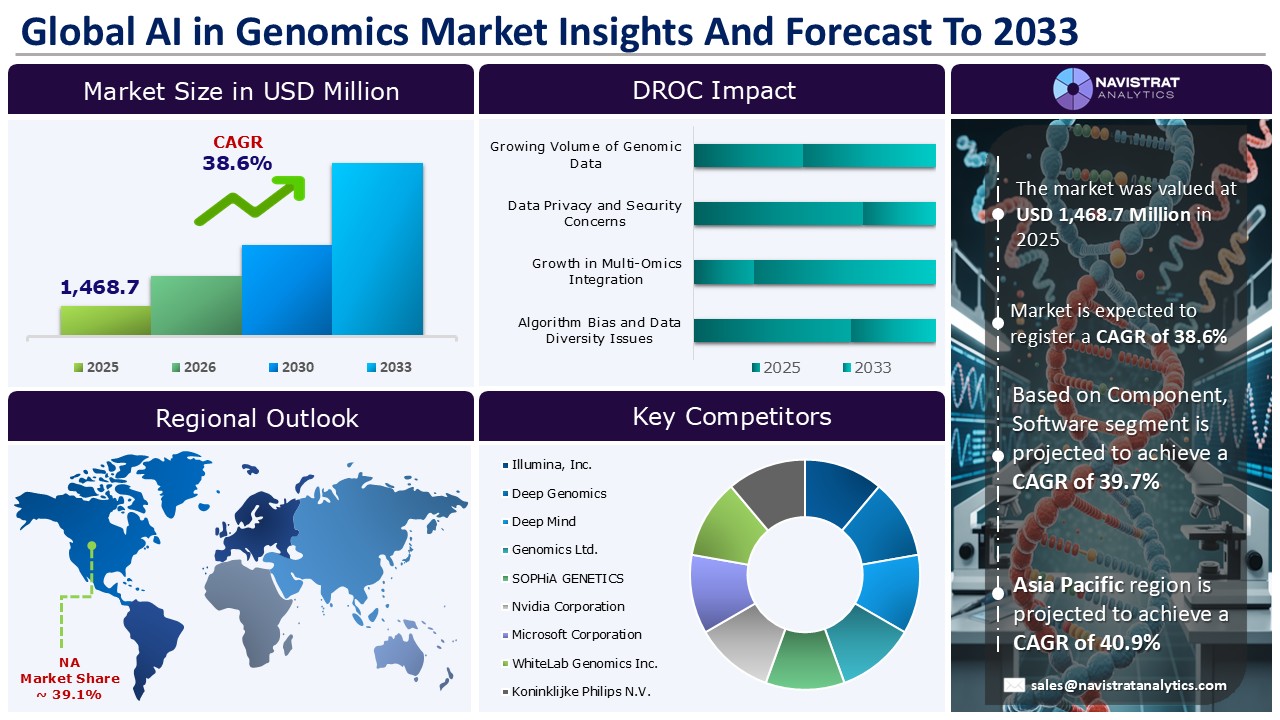
AI in genomics market size reached USD 1,468.7 Million in 2025 and is expected to register a revenue CAGR of 38.6% during the forecast period. Artificial intelligence (AI) is changing genomics by providing sophisticated tools for analyzing and interpreting complicated genetic and multi-omic data. Genomic AI augments standard analysis methods by increasing accuracy and offering full genome sequencing data annotation and interpretation. Furthermore, genomic AI has been utilized to boost crop production and livestock health. Researchers have identified genes associated with enhanced productivity by studying plant and animal DNA. Farmers have increased yields with less inputs by selectively breeding for these genes. Genomics AI is also being utilized to create new antibiotics and other medications.
Market Drivers:
Increasing demand for precision medicine is a key driver driving the market revenue growth. The integration of these diverse data types is crucial because it offers a deeper overview of the disease, including not only genetic variants but also how those variants physically manifest (via imaging) and how they interact with a patient’s overall health and previous treatments. By combining these datasets, AI models can help oncologists developing personalized therapy plans that are specifically tailored to the patient’s genetic makeup, cancer type, stage, and other unique characteristics.
AI can also predict therapeutic success or failure based on a patient’s genetic profile and previous data from similar situations. Furthermore, AI can help optimize treatment regimens by evaluating imaging data to track tumor progression and discover early symptoms of drug resistance. For example, radiomics, an emerging area that integrates machine learning to medical imaging, can extract quantitative data from imaging scans that indicate tumour characteristics. Furthermore, prediction models can assist optimize therapy over time by constantly learning from fresh data. As a patient proceeds through treatment, fresh genetic or clinical data can be added to the model, allowing it to change therapy recommendations in real time.
On November 2025, Complete Genomics, a pioneer in genomic sequencing, has announced a collaboration with SOPHiA GENETICS to launch and co-market MSK-ACCESS and MSK-IMPACT powered by SOPHiA DDM on Complete Genomics’ DNBSEQ-T1+ sequencing platform. The firms hope to increase access to precision oncology testing by providing customers around the world with best-in-class liquid biopsy and solid tumor applications. Complete Genomics and SOPHiA GENETICS will provide laboratories with an integrated sample-to-report workflow, significantly expanding their relationship into the precision cancer research sector.
Market Opportunity:
Growth in multi-omics integration act as opportunity for AI in genomics market. AI and advanced data processing approaches are transforming multi-omics analysis by tackling issues such as data integration, dimensionality reduction, and complex dataset interpretation. AI approaches, such as machine learning and neural networks, are critical in identifying molecular signatures across genomic, transcriptomic, proteomic, and metabolomic datasets, allowing for earlier illness detection and prognosis. For example, AI models such as support vector machines and random forests have been used to uncover biomarkers for cancer subtyping, significantly increasing diagnostic precision.
Several computational frameworks use techniques like autoencoders, graph convolutional networks, ensemble approaches, and contrastive learning to tackle the issues of heterogeneous data integration. These approaches make it easier to detect strong biomarkers by identifying shared latent features and learning cross-omics representations. Furthermore, AI not only helps with data integration but also enhances interpretability via explainable AI (XAI) techniques, fostering trust among clinicians and researchers who rely on these complicated, data-driven approaches.
On April 2025, SeqOne, a pioneer in AI-powered genomic analysis tools, has announced the purchase of Life & Soft, a Paris-based multi-omics data analysis and bioinformatics company. This strategic transaction boosts SeqOne’s position as a European genomic bioinformatics leader and accelerates the company’s global expansion plans. Life & Soft will become a completely owned subsidiary of SeqOne, retaining its unique expertise while benefiting from SeqOne’s strong infrastructure and global reach.
Recent Trends:
Emerging trends include adoption of deep learning models, development of biological foundation models, use of generative AI in synthetic biology, cloud-based genomic computing, and AI in CRISPR Optimization.
As CRISPR approaches clinical application, the transparency of AI predictions becomes critical. Modern explainability tools, such attention maps and SHAP values, assist researchers in determining which nucleotide locations and genetic properties influence model decisions. Models like inDelphi and SPROUT forecast the distribution of insertions and deletions at a specific target using deep neural networks trained on thousands of empirical repair patterns. These predictions include the probability of frameshift mutations, the predicted size of indels, and the relative frequency of repair outcomes.
Modern models take into account mismatch identity, positional sensitivity, seed-region effects, sequence context, and bulge formation, which refers to minor insertions or deletions that alter the alignment of guide and target DNA. The Elevation model, developed by Microsoft and the Broad Institute, integrates these features into a single probabilistic framework that greatly minimizes false positives and false negatives.
On March 2025, ElevateBio, a technology-driven company dedicated to powering the development of life-changing genetic medicines, announced a multi-year collaboration with Amazon Web Services (AWS) to accelerate the discovery and development of CRISPR gene editing therapeutics using generative artificial intelligence (AI). ElevateBio plans to increase the variety of disorders that can be treated with gene editing therapeutics by integrating ElevateBio Life Edit’s gene editing technologies and big CRISPR dataset with AWS’s powerful computational capabilities.
Restraints & Challenges:
Despite its potential applications, implementing AI in genomics involves distinct challenges. Using artificial intelligence in clinical and genomic diagnostics poses ethical concerns about data privacy, consent, and potential discrimination. Given the availability to sensitive genetic data, ensuring that AI systems be used properly and ethically is a major challenge. Genomic information is extremely complex and requires significant computational resources to analyze. Some institutions lack necessary infrastructure, limiting the widespread use of AI tools.
Many firms still regard AI as a standalone technical project. In truth, genetic medicine necessitates collaboration across numerous fields. It brings together medics, geneticists, data scientists, ethics committees, legal experts, and academic leaders. Even advanced technological systems may fail to generate long-term value if they lack this type of cross-functional structure.
Component Segment Insights and Analysis:
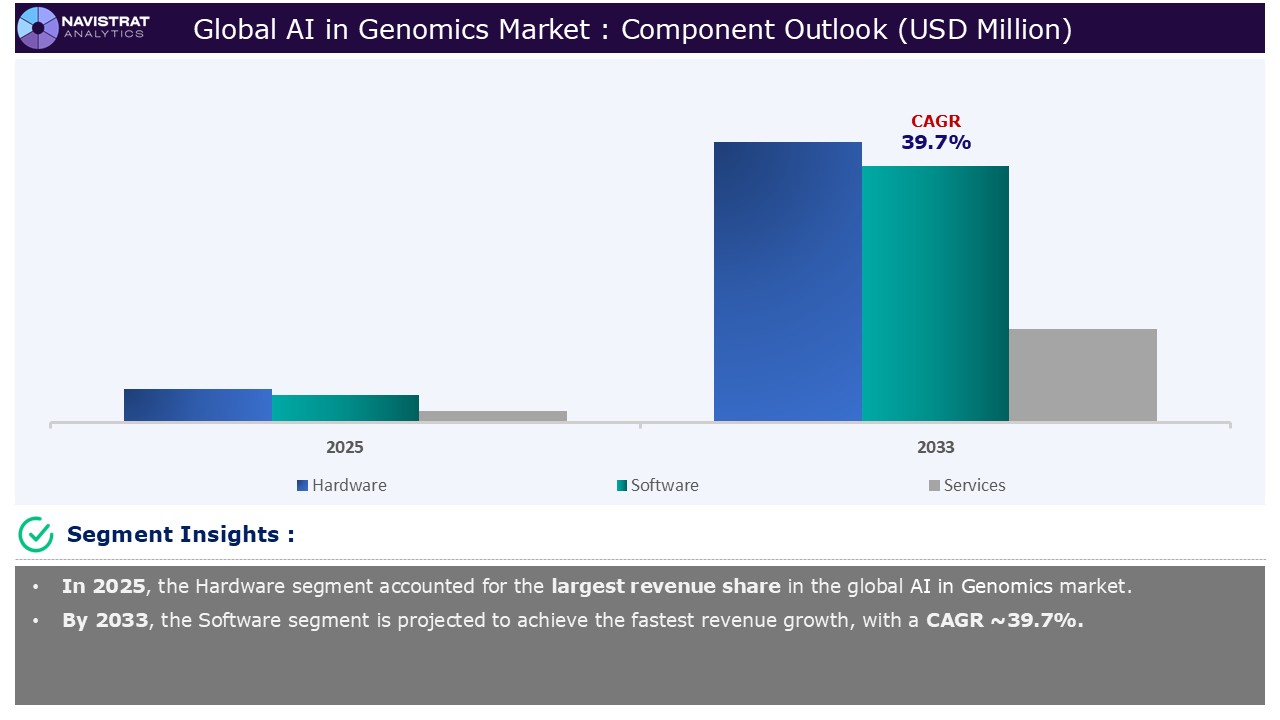
Based on the component, AI in genomics market is segmented into hardware, software, and services.
Hardware segment contributed the largest market share in 2025. As genomics research and precision medicine applications become more advanced, organizations increasingly rely on high-performance hardware infrastructure to support AI-based genomic analysis. Advanced hardware such as GPU, High Performance Computing (HPC) systems, and AI accelerators enable faster genome sequencing analysis, real-time variant identification, rapid AI model training, and large-scale biological data processing. Furthermore, deep learning models require enormous computational resources for training and inference. Precision medicine depends on rapid analysis of patient-specific genomic information.
On January 2025, Illumina, Inc., a global leader in genomic sequencing and analysis, announced it is cooperating with NVIDIA to expand technology platforms for the analysis and interpretation of multiomic data, accelerating advancements in clinical research, genomics AI development, and drug discovery. Leveraging Illumina’s leading sequencing technology and informatics tools alongside NVIDIA’s leading AI technology, the alliance intends to speed drug discovery and clinical development, delivering powerful tools to help pharmaceutical companies uncover new and better therapeutic targets.
Technology Segment Insights and Analysis:
Based on the technology, AI in genomics market is segmented into machine learning and computer vision.
Machine learning segment contributed the largest market share in 2025. AI approaches, particularly machine learning and deep learning, have shown tremendous promise in a variety of genomic applications. These include detecting genetic variations linked to diseases, estimating disease risks, and discovering therapeutic targets. The use of AI techniques into genomics has increased the speed and accuracy of genetic sequence analysis, improved variant interpretation, and enabled comprehension of non-coding sections of DNA. Furthermore, AI-based systems are boosting the analysis of gene expression patterns and the elucidation of complicated polygenic features, opening up new paths for genomic research and discovery.
AI is predicted to play an increasingly important role in genomics research. AI systems can assist adapt medicines to specific patients depending on their genetic profile. This can lead to more effective, focused treatments with fewer adverse effects. AI algorithms can be used to find prospective medication targets and create new medicines using genomic data. AI can be used to forecast the potential impacts of genomic editing tools like CRISPR-Cas9, as well as increase their precision and accuracy.
On January 2026, Variant Bio, a genomics-driven AI drug discovery firm, today announced the introduction of Inference, the world’s first agentic genomic drug discovery platform. The platform’s architecture represents a completely distinct design philosophy. Rather of providing static, precomputed findings, Inference makes organized, harmonized data immediately available for dynamic downstream analyses. The entire platform is powered by a proprietary application programming interface (API), which allows for the rapid retrieval of gene and variant-level data across hundreds of millions of data points in seconds.
End-Use Segment Insights and Analysis:
Based on the end-use, AI in genomics market is segmented into drug discovery & development, agricultural genomics, gene editing, diagnostics, and others.
Drug discovery & development segment contributed the fastest growth rate in 2025. AI’s most significant contribution to genomics is its capacity to interpret complexity and aid in target identification. As precision medicine gains traction in drug discovery, artificial intelligence is allowing researchers to glean useful insights from gigabytes of genomic and phenotypic data. For example, in the field of antisense oligonucleotide (ASO) medicines, which use RNA to modulate gene expression, AI significantly reduces the screening burden. AI-powered analysis of patient data can identify harmful mutations and forecast which ASO designs would be most successful, reducing development time from months to weeks.
The optimization of treatment regimens can be also integrated within machine learning tools. By continuously learning from patient responses, AI algorithms can adjust dosing regimens in real-time, ensuring maximum efficacy while minimizing side effects. This has been applied to optimize chemotherapy dosing schedules in cancer treatments. AI can integrate data from multiple sources, such as electronic health records, clinical trials, and real-world evidence, to develop personalized treatment regimens.
On April 2025, Illumina Inc. and Tempus AI, Inc., a technology company, have announced a collaboration to speed up clinical acceptance of next-generation sequencing tests through unique evidence creation. The agreement will bring together premier Illumina AI technologies and Tempus’ full multimodal data platform to train genomic algorithms and, ultimately, expedite clinical acceptance of molecular diagnostics in patients. This cooperation will use Tempus multimodal data to advance Illumina’s AI-driven molecular analysis tools and produce new insights into the clinical utility of sequencing.
Geographical Outlook:
AI in genomics market is strategically segmented by geography to provide a comprehensive understanding of regional market dynamic. Discover demand analysis, emerging trends, and growth opportunities shaping market performance across different region and countries.
North America AI in Genomics Market:
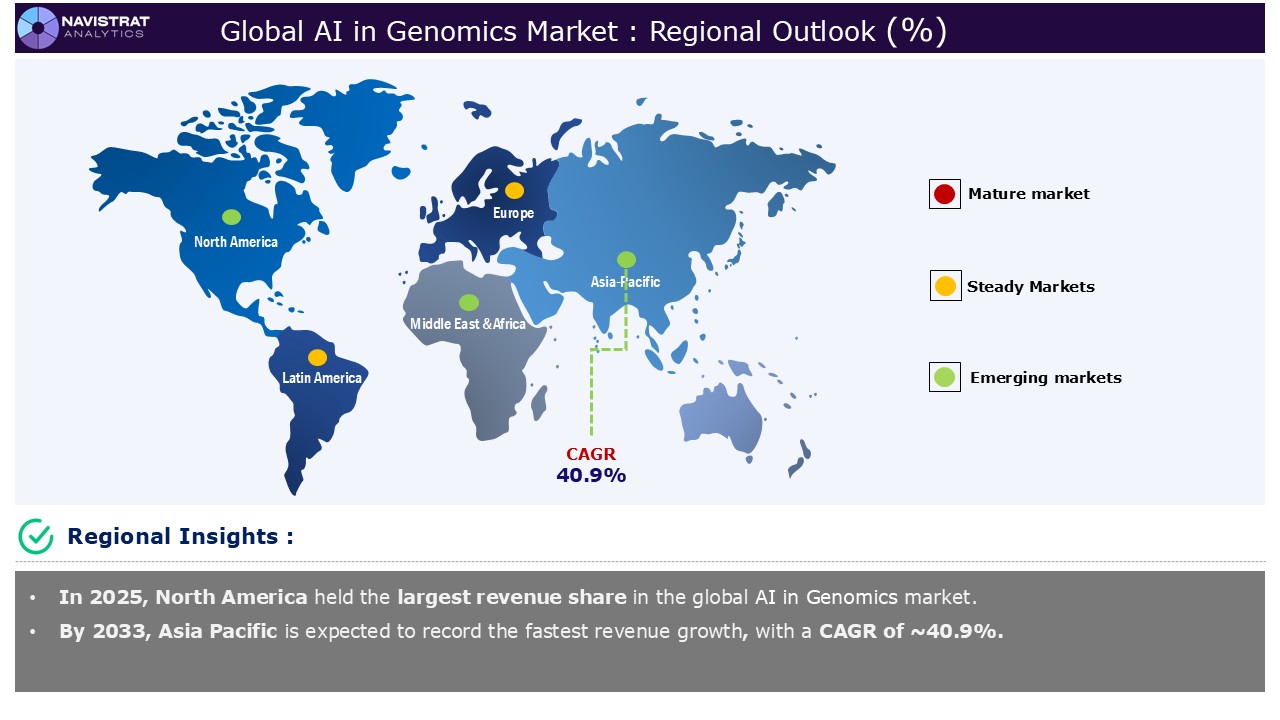
North America is registered to have highest market share in AI in genomics market in 2025. The US AI in genomics industry is rapidly expanding, owing mostly to advances in machine learning and big data analytics. As the US healthcare system pursues more efficient, focused medications, AI’s capacity to evaluate massive amounts of genomic data provides ground-breaking insights into individual genetic variants. Personalized medicine benefits greatly from AI applications in which algorithms forecast how a person’s unique genetic makeup will react to different therapies. CRISPR technology, powered by AI, is advancing gene editing applications, promising ground-breaking therapies for hereditary illnesses. Regulatory frameworks are changing to protect ethical standards and patient privacy, which will influence future market developments.
On April 2026, OpenAI introduced GPT-Rosalind, a reasoning model designed for research in biology, drug discovery, and translational medicine. The life sciences model series is designed for scientific workflows, combining easier tool use with greater understanding of chemistry, protein engineering, and genomics. This methodology is intended to help researchers speed up the early phases of discovery by facilitating evidence synthesis, hypothesis creation, experimental preparation, and other multi-step research processes. GPT-Rosalind is now accessible as a research preview in ChatGPT, Codex, and the API for qualified clients via our trusted access program.
Asia Pacific AI in Genomics Market:
Asia Pacific is expected to register the fastest growth rate during the forecasted period. The rapid advancement of genome sequencing is transforming healthcare by allowing for dramatic advances in diagnostics, medication discovery, and personalized therapy. Healthcare leaders across APAC are increasing their efforts to use genetic data as a foundation for innovation, spurred by the need to handle and analyse massive datasets at unprecedented speeds.
High-Performance Computing (HPC) and artificial intelligence (AI) are critical in this transition, reducing genomic processing time from days to minutes and enabling researchers, clinicians, and pharmaceutical companies to advance precision medicine, cancer research, and medication discovery. These technologies also help to solve healthcare access issues in rising APAC markets, making modern instruments more scalable and cost-effective.
On June 2025, MGI Tech Co., Ltd., a business dedicated to building key tools and technologies that drive innovation in life sciences, announced a strategic partnership with GenePoweRx, a pioneer in AI-powered customized medicine based on genetic insights. This collaboration intends to transform the landscape of predictive healthcare, precision medicine, and longevity science by leveraging cutting-edge sequencing and AI-powered analytics. With a common goal of making customized, preventive healthcare more accessible and effective, MGI and GenePoweRx will combine their expertise in genomics, bioinformatics, and artificial intelligence to provide quick, clinical-grade genomic services to individuals and institutions globally.
Europe AI in Genomics Market:
Europe is expected to register a considerable market share during the forecasted period, driven by increasing demand for precision medicine, rising pharmaceutical R&D Investments, and expansion of genomics-based diagnostics. On November 2025, BC Platforms, a technology company that powers global healthcare data and analytics, has introduced BC Catalyst, a first-of-its-kind AI-native platform that converts complicated genetic and real-world clinical data into meaningful insights across the medication lifecycle. BC Catalyst enables a truly data-driven approach to accelerating therapies and improving patient outcomes by connecting discovery, development, and real-world evidence via agentic AI-powered queries that aid in the identification of patient cohorts, the discovery of new drug targets, the understanding of genetic variants, and the delivery of insights on standards of care.
Competition Analysis:
AI in genomics market is characterized by a fragmented structure, with several players competing across various segments and regions. List of major players included in AI in genomics market report are:
- Illumina, Inc.
- Deep Genomics
- Deep Mind
- Genomics Ltd.
- SOPHiA GENETICS
- Nvidia Corporation
- Microsoft Corporation
- WhiteLab Genomics Inc.
- Koninklijke Philips N.V.
- BostonGene Corporation
- Insitro, Inc.
- Freenome Holdings Inc.
- Asimov, Inc.
- Lantern Pharma Inc.
- UGenome LLC
Strategic Developments in AI in Genomics Market:
- In January 2026, 10x Genomics, Inc., a leader in single cell and spatial biology, has announced a collaboration with the Cancer Research Institute (CRI) to promote immuno-oncology research using high-resolution molecular data and artificial intelligence. The multi-phase project will combine 10x’s Chromium single cell and Xenium spatial platforms with advanced AI to create one of the world’s most comprehensive translational and preclinical immuno-oncology datasets, with over 20,000 samples, to reveal how the immune system recognizes and responds to cancer, as well as to inform future smarter treatment and prevention strategies.
- In October 2025, SOPHiA GENETICS, a leader in AI-driven precision medicine, has announced the release of SOPHiA DDM Digital Twins, a groundbreaking research platform that generates dynamic, virtual representations of individual patients to simulate probable outcomes and assist oncologists in making better treatment decisions. SOPHiA DDM Digital Twins generates a computational copy of each patient and their disease based on their unique clinical, biochemical, imaging, and genomic data.
Key Advantages for Stakeholders:
Navistrat Analytics’ industry report provides an in-depth quantitative analysis of various market segments, historical and current trends, market forecasts, and dynamics within the global market. The historical years covered in this report are 2023 to 2024, with 2025 serving as the base year for market size calculations. The forecast period extends from 2026 to 2033.
The report includes an executive summary and a comprehensive overview of market drivers, restraints, opportunities, and challenges (DROC), along with insights into regulatory standards. It features detailed analyses such as PORTER’s Five Forces, SWOT, and PESTLE, as well as assessments of technological trends and the competitive landscape.
PORTER’s Five Forces analysis helps stakeholders evaluate the impact of new entrants, competitive rivalry, supplier power, buyer power, and substitution threats, enabling them to assess the level of competition and the attractiveness of the global market. The competitive landscape provides stakeholders with a clear understanding of the current market positions of key players, offering valuable insights into their competitive environment.
Scope And Key Highlights Of AI in Genomics Market Report:
| Report Features | Details |
| Market Size in 2025 | USD 1,468.7 Million |
| Market Growth Rate in CAGR (2026–2033) | 38.6% |
| Market Revenue forecast to 2033 | USD 20,077.1 Million |
| Base year | 2025 |
| Historical year | 2023-2024 |
| Forecast period | 2026-2033 |
| Report Pages | 450 |
| Segments covered |
|
| Regional scope |
|
| Country Scope |
|
| Key Market Players |
|
| Delivery Format | Reports are delivered in PDF format via email. |
| Customization scope | Request for Customization |
AI in Genomics market report offers a detailed analysis of market size, including historical revenue (in USD Million) data for 2023-2024 and revenue forecasts for 2026-2033 across the following segments:
- Component Outlook (Revenue, USD Million; 2023-2033)
- Hardware
- Software
- Services
- Technology Outlook (Revenue, USD Million; 2023-2033)
- Machine Learning
- Natural Language Processing (NLP)
- Deep Learning
- Supervised Learning
- Reinforcement Learning
- Unsupervised Learning
- Others
- Computer Vision
- Machine Learning
- Functionality Outlook (Revenue, USD Million; 2023-2033)
- Genome Sequencing Analysis
- Variant Interpretation
- Predictive Genomics
- Others
- Application Outlook (Revenue, USD Million; 2023-2033)
- Drug Discovery & Development
- Agricultural Genomics
- Gene Editing
- Diagnostics
- Others
- End-Use Outlook (Revenue, USD Million; 2023-2033)
- Commercial Foodservice
- Food Manufacturers
- Consumers
- Healthcare Institutions
- Research Organizations
- Regional Outlook (Revenue, USD Million; 2023-2033)
- North America
- U.S.
- Canada
- Mexico
- Europe
- Germany
- France
- U.K.
- Italy
- Spain
- Benelux
- Nordic Countries
- Rest of Europe
- Asia Pacific
- China
- India
- Japan
- South Korea
- Oceania
- ASEAN Countries
- Rest of APAC
- Latin America
- Brazil
- Rest of LATAM
- Middle East & Africa
- GCC Countries
- South Africa
- Israel
- Turkey
- Rest of MEA
- North America
Frequently Asked Questions (FAQ) about AI in Genomics Market report
The market size of AI in genomics market was 1,468.7 million in 2025.
The market size of AI in genomics market is expected to register compound annual growth rate (CAGR) of 38.6% over the forecast period.
Growing volume of genomic data, increasing demand for precision medicine, and rising pharmaceutical R&D investments are major key factors driving the market revenue growth of AI in genomics market.
Data privacy and security concerns and lack of standardized data formats are key limiting factors driving the market.
Asia Pacific account for fastest revenue growth of 40.9%.
Hardware is the major leading segment of AI in genomics market in terms of component.
- Market Definition
- Research Objective
- Research Methodology
- Research Design
- Data Collection Methods
- Primary
- Secondary
- Market Size Estimation
- Top-down Model Method
- Bottom-up Model Method
- Forecasting Methodology
- Tools and Models Used
- Market Overview and Trends
- Market Size and Forecast
- Industry Analysis
- Market Driver, Restraints, Opportunity, and Challenges (DROC) Analysis
- Market Drivers
- Growing Volume of Genomic Data
- Increasing Demand for Precision Medicine
- Rising Pharmaceutical R&D Investments
- Expansion of Genomics-Based Diagnostics
- Market Restraints
- Data Privacy and Security Concerns
- Lack of Standardized Data Formats
- High Computational and Infrastructure Costs
- Market Opportunities
- Growth in Multi-Omics Integration
- AI-Driven Rare Disease Diagnosis
- Expansion in Population Genomics
- Market Challenges
- Algorithm Bias and Data Diversity Issues
- Integration into Clinical Workflows
- Data Sharing Limitations
- Regulatory Landscape
- North America
- Europe
- Asia Pacific
- Latin America
- Middle East and Africa
- Strategic Insights
- Porter’s Five Forces Analysis
- PESTLE Analysis
- Price Trend Analysis
- Value Chain Analysis
- Technological Trends
- Adoption of Deep Learning Models
- Development of Biological Foundation Models
- Use of Generative AI in Synthetic Biology
- Cloud-Based Genomic Computing
- AI in CRISPR Optimization
- Recent Developments
- Funding
- Merger and Acquisition
- Expansion
- Partnership and Collaboration
- Product/ Service Launch
- Component Market Revenue Estimates and Forecasts, 2023-2033
- Hardware
- Software
- Services
- Technology Market Revenue Estimates and Forecasts, 2023-2033
- Machine Learning
- Natural Language Processing (NLP)
- Deep Learning
- Supervised Learning
- Reinforcement Learning
- Unsupervised Learning
- Others
- Computer Vision
- Machine Learning
- Functionality Market Revenue Estimates and Forecasts, 2023-2033
- Genome Sequencing Analysis
- Variant Interpretation
- Predictive Genomics
- Others
- Application Market Revenue Estimates and Forecasts, 2023-2033
- Drug Discovery & Development
- Agricultural Genomics
- Gene Editing
- Diagnostics
- Others
- End-Use Market Revenue Estimates and Forecasts, 2023-2033
- Pharmaceutical & Biotechnology Companies
- Research Institutes
- Hospitals & Diagnostic Laboratories
- Contract Research Organizations (CRO)
- AI in Genomics Market Revenue Estimates and Forecasts by Region, 2023-2033, USD Million
- North America
- North America AI in Genomics Market By Component, Market Revenue Estimates and Forecasts, 2023-2033, USD Million
- Hardware
- Software
- Services
- North America AI in Genomics Market By Technology, Market Revenue Estimates and Forecasts, 2023-2033, USD Million
- Machine Learning
- Natural Language Processing (NLP)
- Deep Learning
- Supervised Learning
- Reinforcement Learning
- Unsupervised Learning
- Others
- Computer Vision
- Machine Learning
- North America AI in Genomics Market By Functionality, Market Revenue Estimates and Forecasts, 2023-2033, USD Million
- Genome Sequencing Analysis
- Variant Interpretation
- Predictive Genomics
- Others
- North America AI in Genomics Market By Application, Market Revenue Estimates and Forecasts, 2023-2033, USD Million
- Drug Discovery & Development
- Agricultural Genomics
- Gene Editing
- Diagnostics
- Others
- North America AI in Genomics Market By End-Use, Market Revenue Estimates and Forecasts, 2023-2033, USD Million
- Pharmaceutical & Biotechnology Companies
- Research Institutes
- Hospitals & Diagnostic Laboratories
- Contract Research Organizations (CRO)
- North America AI in Genomics Market Revenue Estimates and Forecasts by Country, 2023-2033, USD Million
- United States
- Canada
- Mexico
- North America AI in Genomics Market By Component, Market Revenue Estimates and Forecasts, 2023-2033, USD Million
- Europe
- Europe AI in Genomics Market By Component, Market Revenue Estimates and Forecasts, 2023-2033, USD Million
- Hardware
- Software
- Services
- Europe AI in Genomics Market By Technology, Market Revenue Estimates and Forecasts, 2023-2033, USD Million
- Machine Learning
- Natural Language Processing (NLP)
- Deep Learning
- Supervised Learning
- Reinforcement Learning
- Unsupervised Learning
- Others
- Computer Vision
- Machine Learning
- Europe AI in Genomics Market By Functionality, Market Revenue Estimates and Forecasts, 2023-2033, USD Million
- Genome Sequencing Analysis
- Variant Interpretation
- Predictive Genomics
- Others
- Europe AI in Genomics Market By Application, Market Revenue Estimates and Forecasts, 2023-2033, USD Million
- Drug Discovery & Development
- Agricultural Genomics
- Gene Editing
- Diagnostics
- Others
- Europe AI in Genomics Market By End-Use, Market Revenue Estimates and Forecasts, 2023-2033, USD Million
- Pharmaceutical & Biotechnology Companies
- Research Institutes
- Hospitals & Diagnostic Laboratories
- Contract Research Organizations (CRO)
- Europe AI in Genomics Market Revenue Estimates and Forecasts by Country, 2023-2033, USD Million
- Germany
- United Kingdom
- France
- Italy
- Spain
- Benelux
- Nordic Countries
- Rest of Europe
- Europe AI in Genomics Market By Component, Market Revenue Estimates and Forecasts, 2023-2033, USD Million
- Asia Pacific
- Asia Pacific AI in Genomics Market By Component, Market Revenue Estimates and Forecasts, 2023-2033, USD Million
- Hardware
- Software
- Services
- Asia Pacific AI in Genomics Market By Technology, Market Revenue Estimates and Forecasts, 2023-2033, USD Million
- Machine Learning
- Natural Language Processing (NLP)
- Deep Learning
- Supervised Learning
- Reinforcement Learning
- Unsupervised Learning
- Others
- Computer Vision
- Machine Learning
- Asia Pacific AI in Genomics Market By Functionality, Market Revenue Estimates and Forecasts, 2023-2033, USD Million
- Genome Sequencing Analysis
- Variant Interpretation
- Predictive Genomics
- Others
- Asia Pacific AI in Genomics Market By Application, Market Revenue Estimates and Forecasts, 2023-2033, USD Million
- Drug Discovery & Development
- Agricultural Genomics
- Gene Editing
- Diagnostics
- Others
- Asia Pacific AI in Genomics Market By End-Use, Market Revenue Estimates and Forecasts, 2023-2033, USD Million
- Pharmaceutical & Biotechnology Companies
- Research Institutes
- Hospitals & Diagnostic Laboratories
- Contract Research Organizations (CRO)
- Asia Pacific AI in Genomics Market Revenue Estimates and Forecasts by Country, 2023-2033, USD Million
- China
- India
- Japan
- South Korea
- Oceania
- ASEAN Countries
- Rest of Asia-Pacific
- Asia Pacific AI in Genomics Market By Component, Market Revenue Estimates and Forecasts, 2023-2033, USD Million
- Latin America
- Latin America AI in Genomics Market By Component, Market Revenue Estimates and Forecasts, 2023-2033, USD Million
- Hardware
- Software
- Services
- Latin America AI in Genomics Market By Technology, Market Revenue Estimates and Forecasts, 2023-2033, USD Million
- Machine Learning
- Natural Language Processing (NLP)
- Deep Learning
- Supervised Learning
- Reinforcement Learning
- Unsupervised Learning
- Others
- Computer Vision
- Machine Learning
- Latin America AI in Genomics Market By Functionality, Market Revenue Estimates and Forecasts, 2023-2033, USD Million
- Genome Sequencing Analysis
- Variant Interpretation
- Predictive Genomics
- Others
- Latin America AI in Genomics Market By Application, Market Revenue Estimates and Forecasts, 2023-2033, USD Million
- Drug Discovery & Development
- Agricultural Genomics
- Gene Editing
- Diagnostics
- Others
- Latin America AI in Genomics Market By End-Use, Market Revenue Estimates and Forecasts, 2023-2033, USD Million
- Pharmaceutical & Biotechnology Companies
- Research Institutes
- Hospitals & Diagnostic Laboratories
- Contract Research Organizations (CRO)
- Latin America AI in Genomics Market Revenue Estimates and Forecasts by Country, 2023-2033, USD Million
- Brazil
- Rest of Latin America
- Latin America AI in Genomics Market By Component, Market Revenue Estimates and Forecasts, 2023-2033, USD Million
- Middle East and Africa
- Middle East and Africa AI in Genomics Market By Component, Market Revenue Estimates and Forecasts, 2023-2033, USD Million
- Hardware
- Software
- Services
- Middle East and Africa AI in Genomics Market By Technology, Market Revenue Estimates and Forecasts, 2023-2033, USD Million
- Machine Learning
- Natural Language Processing (NLP)
- Deep Learning
- Supervised Learning
- Reinforcement Learning
- Unsupervised Learning
- Others
- Computer Vision
- Machine Learning
- Middle East and Africa AI in Genomics Market By Functionality, Market Revenue Estimates and Forecasts, 2023-2033, USD Million
- Genome Sequencing Analysis
- Variant Interpretation
- Predictive Genomics
- Others
- Middle East and Africa AI in Genomics Market By Application, Market Revenue Estimates and Forecasts, 2023-2033, USD Million
- Drug Discovery & Development
- Agricultural Genomics
- Gene Editing
- Diagnostics
- Others
- Middle East and Africa AI in Genomics Market By End-Use, Market Revenue Estimates and Forecasts, 2023-2033, USD Million
- Pharmaceutical & Biotechnology Companies
- Research Institutes
- Hospitals & Diagnostic Laboratories
- Contract Research Organizations (CRO)
- Middle East and Africa AI in Genomics Market Revenue Estimates and Forecasts by Country, 2023-2033, USD Million
- GCC Countries
- South Africa
- Israel
- Turkey
- Rest of Middle East & Africa
- Middle East and Africa AI in Genomics Market By Component, Market Revenue Estimates and Forecasts, 2023-2033, USD Million
- North America
- Market Share Analysis
- Revenue Market Share by Key Players (2024-2025)
- Analysis of Top Players by Market Presence
- Competitive Matrix
- Competitive Strategies
- Mergers and Acquisitions
- Partnerships and Collaboration
- Investment and Fundings
- Agreement
- Expansion
- New Product/ Services Launches
- Technological Innovations
- Illumina, Inc.
- Company Overview
- Financial Insights
- Product/ Services Offerings
- Strategic Developments
- SWOT Analysis
- Deep Genomics
- Company Overview
- Financial Insights
- Product / Services Offerings
- Strategic Developments
- SWOT Analysis
- Deep Mind
- Company Overview
- Financial Insights
- Product/ Services Offerings
- Strategic Developments
- SWOT Analysis
- Genomics Ltd.
- Company Overview
- Financial Insights
- Product / Services Offerings
- Strategic Developments
- SWOT Analysis
- SOPHiA GENETICS
- Company Overview
- Financial Insights
- Product / Services Offerings
- Strategic Developments
- SWOT Analysis
- Nvidia Corporation
- Company Overview
- Financial Insights
- Product / Services Offerings
- Strategic Developments
- SWOT Analysis
- Microsoft Corporation
- Company Overview
- Financial Insights
- Product / Services Offerings
- Strategic Developments
- SWOT Analysis
- WhiteLab Genomics Inc.
- Company Overview
- Financial Insights
- Product / Services Offerings
- Strategic Developments
- SWOT Analysis
- Koninklijke Philips N.V.
- Company Overview
- Financial Insights
- Product / Services Offerings
- Strategic Developments
- SWOT Analysis
- BostonGene Corporation
- Company Overview
- Financial Insights
- Product / Services Offerings
- Strategic Developments
- SWOT Analysis
- Insitro, Inc.
- Company Overview
- Financial Insights
- Product / Services Offerings
- Strategic Developments
- SWOT Analysis
- Freenome Holdings Inc.
- Company Overview
- Financial Insights
- Product / Services Offerings
- Strategic Developments
- SWOT Analysis
- Asimov, Inc.
- Company Overview
- Financial Insights
- Product / Services Offerings
- Strategic Developments
- SWOT Analysis
- Lantern Pharma Inc.
- Company Overview
- Financial Insights
- Product / Services Offerings
- Strategic Developments
- SWOT Analysis
- UGenome LLC
- Company Overview
- Financial Insights
- Product / Services Offerings
- Strategic Developments
- SWOT Analysis