

AI Operating System Market Overview and Key Insights:
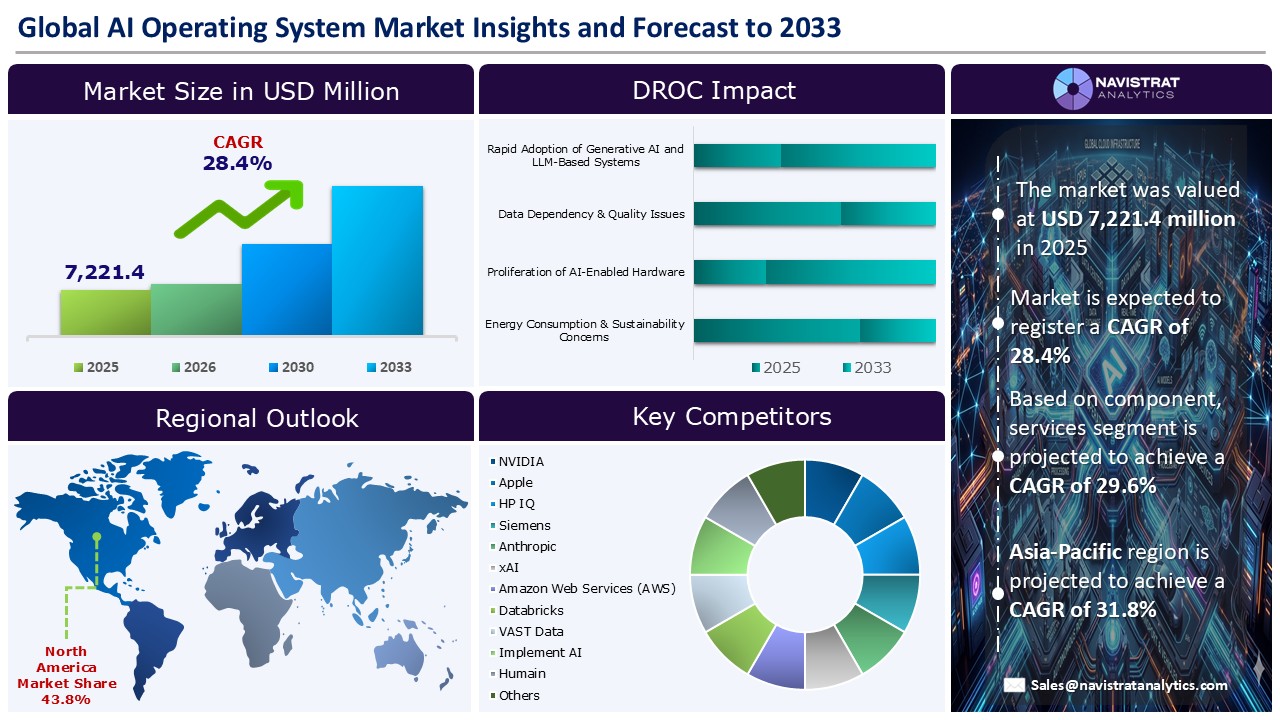
The global AI Operating System market reached USD 7,221.4 million in 2025 and is expected to register a revenue CAGR of 28.4% during the forecast period. Rapid adoption of generative AI and LLM-based systems, growing demand for on-device and edge AI processing, increasing enterprise demand for intelligent automation, rising shift toward human-machine natural interfaces, and growing emergence of agent-based and autonomous AI systems are expected to drive revenue growth of the market.
Market Drivers:
Rapid adoption of Generative AI and LLM-based systems is driving strong revenue growth of the market. As of late 2024, nearly 40% of the U.S. population aged 18-64 had engaged with generative AI tools. It is a rate of adoption that has outpaced both the personal computer and the internet in their respective early years. By August 2025, overall adoption in the United States reached 54.6%, with work-related usage climbing to 37.4%. This rapid integration has necessitated a fundamental redesign of software architecture, as traditional operating systems were not built to manage the non-linear, memory-intensive workloads associated with transformer-based models.
This trend is also reflected globally. In South Korea, generative AI usage grew from 26% to over 30% in just three months in late 2025, driven by localized model performance and government-backed initiatives. The transition from isolated applications to an integrated AI operating layer allows for a more seamless orchestration of data and workflows, fundamentally altering how users interact with technology.
The aggressive release cycles of foundational models now act as the “brain” for modern computing environments. In May 2024, OpenAI released the GPT-4o model, which offered dramatically increased capabilities in multimodal interaction, followed by the launch of GPT-5 in August 2025. These advancements provided the reasoning and context-handling capabilities necessary for an AI OS to manage complex user intents. For example, in November 2025, OpenAI introduced GPT-5.1, a model focused on deep personalization and long-context memory, positioning it as a foundational layer for AI-native workflows.
Market Opportunity:
Rise of autonomous systems and robotics are creating significant opportunities for the market by driving the need for intelligent, real-time decision-making platforms that can operate with minimal human intervention. Autonomous vehicles, industrial robots, drones, and service robots require operating systems capable of integrating perception, reasoning, and action within a unified framework. AI operating systems enable these machines to process sensor data, adapt to dynamic environments, and execute complex tasks with high precision and reliability. This demand is accelerating the development of real-time, edge-based AI OS solutions that can support low-latency processing, continuous learning, and coordination across multiple systems.
Strategic developments in 2025 highlight the scale of this opportunity. In May 2025, for instance, Toyota Motor Corporation launched the Toyota Software Academy to accelerate the development of AI and software-centered vehicles, emphasizing the role of AI in real-world manufacturing and transport. Furthermore, in August 2025, Apple revealed an expansive strategy that includes a tabletop robotic companion targeted for a 2027 release, powered by a customized, LLM-driven operating system. These physical systems require an AI OS that can handle “Agentic Ops”—the autonomous monitoring and execution of infrastructure tasks. It is reducing the need for human-in-the-loop oversight.
Recent Trends:
Rise of Agent-Based (Agentic) AI operating systems is emerging as one of the most transformative trends for the market. Unlike traditional AI that simply reacts to prompts, agentic systems are proactive, goal-oriented, and capable of autonomous decision-making. Agentic AI is the most important technology trend of 2025, predicting that by 2029, up to 80% of standard customer service requests will be handled by autonomous agents. These systems utilize an LLM as the “kernel,” treating individual AI agents as applications that can navigate software interfaces, fill out forms, and synchronize data across disparate platforms.
The year 2025 has seen several high-profile platform launches and acquisitions that solidify this trend. In February 2025, HP Inc. acquired the team and assets behind the Humane AI Pin for USD 116 million to integrate their “CosmOS”. It is an agent-first operating system in HP’s portfolio of PCs and connected devices. Additionally, in November 2025, Microsoft introduced “Agent 365” at its Ignite conference, describing it as a control plane that allows enterprises to manage and govern fleets of native and third-party AI agents within a unified infrastructure. This shift toward “multi-agent orchestration” allows for more complex digital workflows, such as product launch management and autonomous service recovery. It moves AI from an auxiliary tool to a core participant in enterprise operations.
Restraints & Challenges:
Data dependency & quality issues are major factors restraining revenue growth of the market. AI-driven operating layers are only as effective as the data they consume. Inaccurate, incomplete, or biased datasets lead to flawed decision-making, system hallucinations, and reduced reliability. In a 2025/26 survey of transformation professionals, 52% cited data quality and availability as the biggest obstacle to AI adoption. For example, in high-stakes retail environments, inaccurate shift data led to the failure of an AI scheduling tool, with managers manually overriding 84% of the AI-generated timetables because they failed to reflect real-world constraints.
Beyond technical failures, data quality issues present significant legal and regulatory risks. In March 2024, JPMorgan Chase was fined approximately USD 350 million for providing incomplete order data to surveillance platforms, highlighting the dangers of “data inadequacy” in regulated sectors. As governments increasingly mandate transparency and “explainability” in AI systems through legislation like the EU AI Act, the inability to verify the integrity of underlying datasets becomes a major bottleneck.
Component Segment Insights and Analysis:
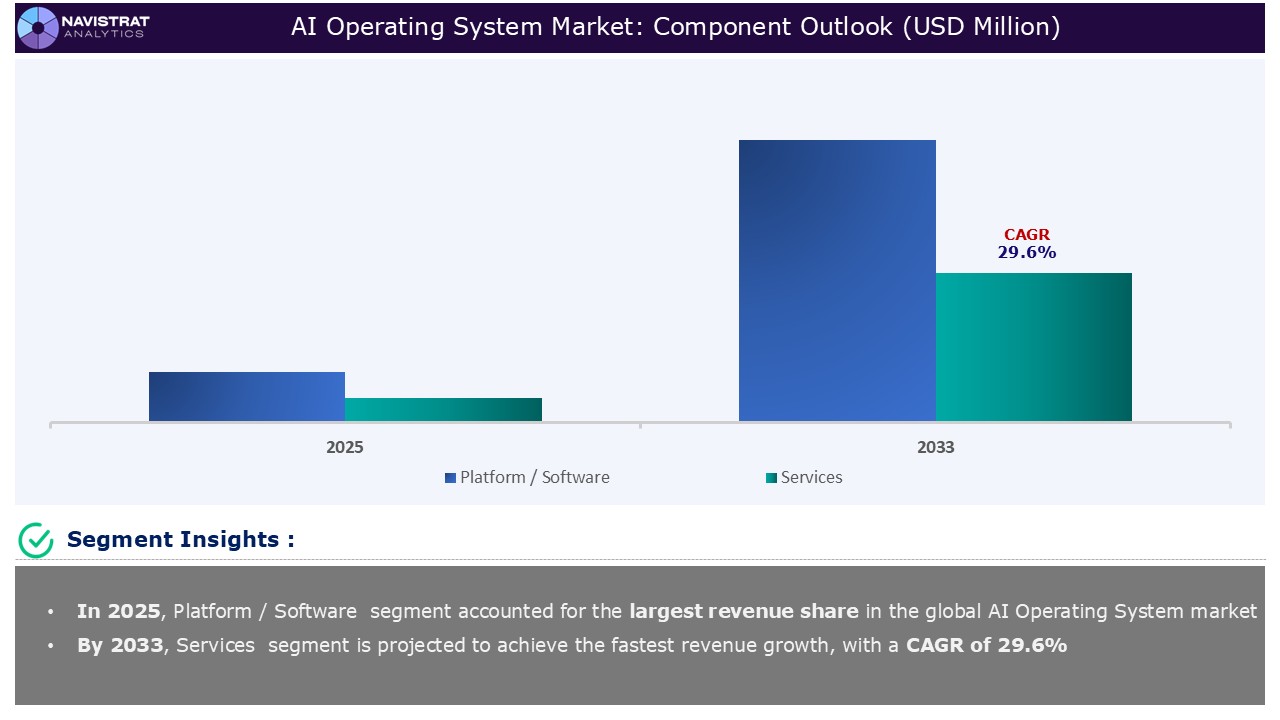
Based on the component segment, the AI operating system market is segmented into platform / software and services. Platform/software segment is further sub-segmented into core AI OS Kernel, AI orchestration layer, AI runtime engines, model management frameworks, and agent-based OS frameworks. Services segment is further sub-segmented into integration & deployment, custom AI OS development, support & maintenance and consulting & advisory.
Software and platform segment contributed the largest share in 2025 due to the increasing demand for AI-native platforms that can manage the full lifecycle of AI workloads, from model development and deployment to orchestration and continuous optimization. Enterprises are prioritizing scalable software layers that integrate large language models, multi-agent systems, and real-time analytics into a unified operating environment, reducing dependence on fragmented tools. The rise of cloud-based AI platforms, coupled with the need for seamless integration across heterogeneous hardware (CPU, GPU, NPU), is further accelerating adoption.
In AI software, the core kernel represents always-running software that manages system calls, resource allocation (GPU/NPU), and memory management. Orchestration layer coordinates multiple agents and knowledge stores. In October 2025, the release of platforms like OpenAI’s AgentKit—which includes an Agent Builder and Connector Registry—marked a significant step toward standardizing how AI agents interact with the OS layer. The strategic value of this segment lies in its ability to abstract the complexities of hardware, allowing developers to build “intelligent workflows” rather than managing low-level infrastructure.
Device Type Segment Insights and Analysis:
Based on device type, the AI operating system market is segmented into smartphones & tablets, laptops & AI PCs, servers/data centers, IoT devices, wearables, and autonomous systems.
Smartphones & tablets segment contributed the largest share in 2025 due to widespread integration of on-device AI capabilities into premium smartphones. The increasing adoption of on-device AI for features such as voice assistants, real-time translation, advanced photography, and personalized recommendations is driving demand for AI-optimized operating systems that efficiently manage local inference and hardware acceleration through NPUs and GPUs. Apple and Google have been at the forefront of this trend. In June 2025, Apple expanded its “Apple Intelligence” platform to 12 languages, including localized support for Chinese and European markets, fundamentally changing how mobile OSs manage user context and memory. The strategic significance of the mobile segment lies in its “individual AI OS” potential—orchestrating workflows across personal apps and wearable devices through a shared, persistent memory system.
In March 2024, Chinese technology major Xiaomi announced plans to invest a minimum of USD 8.7 billion in artificial intelligence over the next three years. The company also introduced three new AI models tailored for the “agent era,” referring to systems capable of autonomously performing real-world tasks such as sending emails and booking flights. This encourages higher consumer adoption of AI-enabled devices, premium pricing strategies, and continuous software upgrades, all of which contribute to expanding revenues within the AI operating system market for mobile platforms.
Geographical Outlook:
AI Operating System market is strategically segmented by geography to provide a comprehensive understanding of regional market dynamic. Discover demand analysis, emerging trends, and growth opportunities shaping market performance across different region and countries.
North America AI Operating System Market:
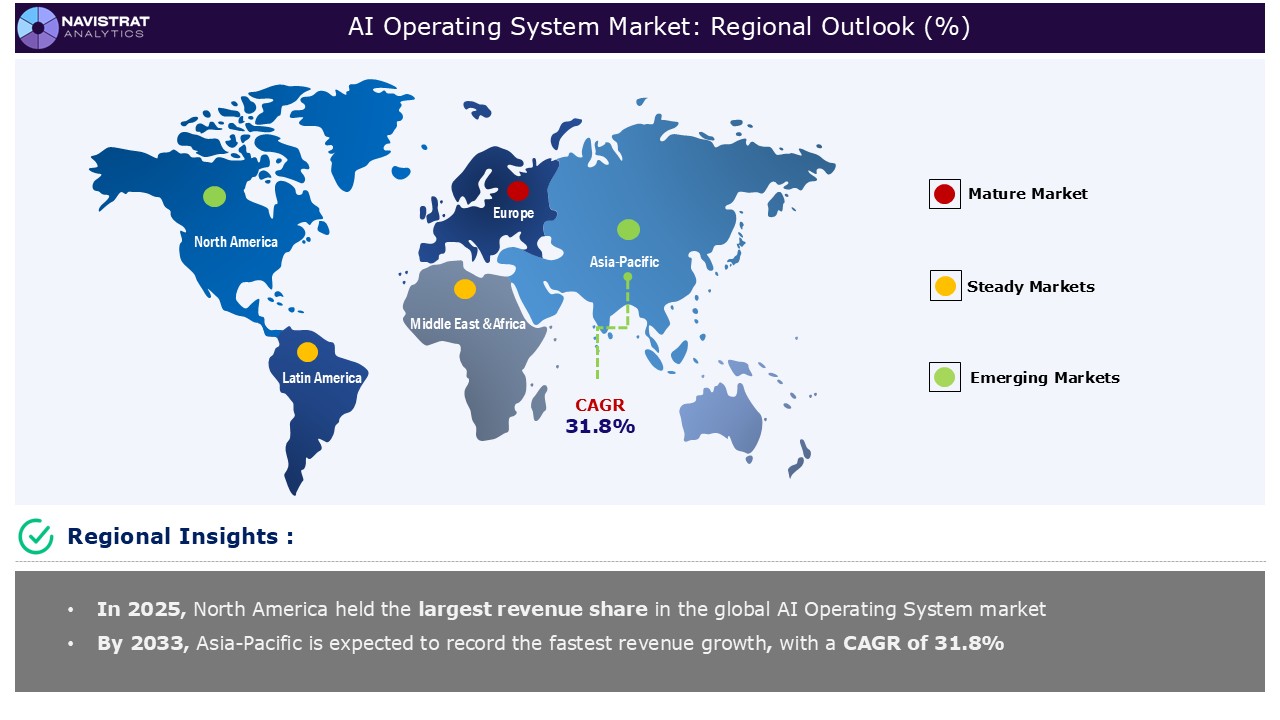
Market in North America accounted for largest revenue share in 2025 due to mature technology ecosystem, high R&D spending, and the presence of dominant “star players” such as Microsoft, AWS, Google, and NVIDIA. The region benefits from a dense concentration of venture capital, with the United States capturing the majority of a record-breaking $202.3 billion in global AI funding during 2025. High labor costs further accelerate this trend, as businesses prioritize autonomous systems to manage fragmented SaaS ecosystems and reduce human-in-the-loop overhead.
Governance in the region has shifted toward centralizing innovation through decisive federal mandates. In December, 2025, a new Executive Order was issued to protect American AI leadership by preempting “onerous” state-level regulations and conditioning broadband access funding on alignment with federal standards. This reorientation aims to eliminate barriers to U.S. dominance in high-stakes sectors like defense and national security. Additionally, the U.S. National Science Foundation, alongside partners like Intel, announced a $100 million investment in July 2025 to fund five National AI Research Institutes focused on drug development and human-AI collaboration.
Asia Pacific AI Operating System Market:
Asia Pacific is expected to register a fast revenue growth rate during the forecast period due to aggressive national digital transformation strategies and the rapid expansion of smartphone penetration, which creates a massive base for on-device AI operating systems. Regional leadership is further bolstered by the presence of significant AI talent hubs. For instance, India currently ranks first globally in AI skill penetration, surpassing both the U.S. and Germany. This burgeoning talent pool is essential for developing the next generation of agentic solutions and multi-agent orchestration frameworks.
Strategic government funding and sovereign AI initiatives serve as major catalysts for regional market expansion. In June 2025, China announced a landmark $98 billion investment plan—a 48% year-over-year increase—to strengthen domestic AI infrastructure and overcome semiconductor supply constraints. Similarly, South Korea launched a comprehensive five-year AI healthcare roadmap in early 2025, targeting oncology and drug discovery as key growth areas. By the second half of 2025, South Korea recorded the world’s largest leap in global AI adoption, with usage growing by 80% since late 2024 as the government expanded AI-focused education and public service integration.
Europe AI Operating System Market:
Market in Europe accounted for a significant revenue share in 2025 due to its steady growth and focus on compliance-driven integration. The regional market is fundamentally shaped by the EU AI Act of 2024, which employs a risk-based classification system to regulate high-stakes applications in critical infrastructure and healthcare. This regulatory framework creates a stable environment for “trustworthy AI,” prioritizing data privacy and ethical reasoning while encouraging sustainable digital transformation. Consequently, European firms are increasingly adopting AI-driven operating layers to digitize complex manufacturing sectors while remaining aligned with stringent data sovereignty requirements.
Proactive institutional support for safe and secure AI deployment is a hallmark of the European landscape. In late 2025, the Spanish regulator AESIA introduced self-assessment tools to help organizations comply with the AI Act’s core requirements and manage cybersecurity risks such as model poisoning. Furthermore, the UK has clarified security obligations for AI chatbots under the Online Safety Act, ensuring a unified baseline for conversational interfaces. These developments are complemented by innovative startups and research bodies focusing on energy-efficient computing, positioning Europe as a central hub for industrial AI applications that balance high-performance reasoning with rigorous governance.
Competition Analysis:
The AI Operating System market is characterized by a consolidated structure, with few players competing across various segments and regions. List of major players included in the AI Operating System market report are:
- NVIDIA
- Apple
- HP IQ
- Siemens
- Anthropic
- xAI
- Amazon Web Services (AWS)
- Databricks
- VAST Data
- Implement AI
- Humain
- MultiCortex
- deepc’s AI
- Fynd
Strategic Developments in AI Operating System Market:
- In January 2026, Siemens and NVIDIA announced an expanded strategic partnership focused on advancing artificial intelligence into real-world industrial applications. The collaboration aims to develop industrial and physical AI solutions that drive innovation across industries and streamline industrial workflows while enhancing the operational capabilities of both companies. As part of this initiative, NVIDIA will contribute AI infrastructure, simulation libraries, models, frameworks, and blueprints, while Siemens will deploy its extensive network of industrial AI experts along with advanced hardware and software capabilities.
- In February 2026, Commotion Inc., an AI-native enterprise startup supported by Tata Communications, launched a new AI Operating System developed in partnership with NVIDIA. The platform utilizes NVIDIA Nemotron open models along with the NVIDIA Riva library to deliver advanced speech capabilities. It is designed to help enterprises transition AI initiatives from pilot stages to full-scale production, enabling autonomous execution of business tasks with strong governance and measurable outcomes. Together, the companies empower organizations to move beyond insights toward scalable, intelligent action.
Key Advantages for Stakeholders:
Navistrat Analytics’ industry report provides an in-depth quantitative analysis of various market segments, historical and current trends, market forecasts, and dynamics within the global market. The historical years covered in this report are 2023 to 2024, with 2025 serving as the base year for market size calculations. The forecast period extends from 2026 to 2033.
The report includes an executive summary and a comprehensive overview of market drivers, restraints, opportunities, and challenges (DROC), along with insights into regulatory standards. It features detailed analyses such as PORTER’s Five Forces, SWOT, and PESTLE, as well as assessments of technological trends and the competitive landscape.
PORTER’s Five Forces analysis helps stakeholders evaluate the impact of new entrants, competitive rivalry, supplier power, buyer power, and substitution threats, enabling them to assess the level of competition and the attractiveness of the global market. The competitive landscape provides stakeholders with a clear understanding of the current market positions of key players, offering valuable insights into their competitive environment.
Scope And Key Highlights of The AI Operating System Market Report:
| Report Features | Details |
| Market Size in 2025 | USD 7,221.4 Million |
| Market Growth Rate in CAGR (2026–2033) | 28.4% |
| Market Revenue Forecast to 2033 | USD 51,420.5 Million |
| Base year | 2025 |
| Historical year | 2023–2024 |
| Forecast period | 2026–2033 |
| Report Pages | 450 |
| Segments Covered |
|
| Regional scope |
|
| Country Scope |
|
| Key Market Players |
|
| Delivery Format | Reports are delivered in PDF format via email. |
| Customization scope | Request Customization |
The AI Operating System market report offers a detailed analysis of market size, including historical revenue (in USD Million) data for 2023-2024 and revenue forecasts for 2026-2033 across the following segments:
- Component Outlook (Revenue, USD Million; 2023-2033)
- Platform / Software
- Core AI OS Kernel
- AI Orchestration Layer
- AI Runtime Engines
- Model Management Frameworks
- Agent-based OS Frameworks
- Services
- Integration & Deployment
- Custom AI OS Development
- Support & Maintenance
- Consulting & Advisory
- Platform / Software
- Deployment Outlook (Revenue, USD Million; 2023-2033)
- Cloud-Based AI OS
- Public Cloud
- Private Cloud
- Multi-Cloud AI OS
- On-Device
- Embedded AI OS
- Edge AI OS
- Hybrid AI OS
- Cloud-Based AI OS
- Device Type Outlook (Revenue, USD Million; 2023-2033)
- Smartphones & Tablets
- Laptops & AI PCs
- Servers / Data Centers
- IoT Devices
- Wearables
- Autonomous Systems
- Architecture Type Outlook (Revenue, USD Million; 2023-2033)
- Centralized AI OS
- Distributed AI OS
- Agent-Based AI OS
- Real-Time AI OS
- Application Outlook (Revenue, USD Million; 2023-2033)
- Human-Machine Interaction
- Autonomous Operations
- Predictive Maintenance
- Smart Resource Allocation
- Cybersecurity & Threat Detection
- Workflow Automation
- Others
- End-Use (Revenue, USD Million; 2023-2033)
- BFSI
- Healthcare
- IT & Telecom
- Manufacturing
- Retail & E-commerce
- Automotive
- Energy & Utilities
- Government & Defense
- Education
- Others
- Regional Outlook (Revenue, USD Million; 2023-2033)
- North America
- U.S.
- Canada
- Mexico
- Europe
- Germany
- France
- U.K.
- Italy
- Spain
- Benelux
- Nordic Countries
- Rest of Europe
- Asia Pacific
- China
- India
- Japan
- South Korea
- Oceania
- ASEAN Countries
- Rest of APAC
- Latin America
- Brazil
- Rest of LATAM
- Middle East & Africa
- GCC Countries
- South Africa
- Israel
- Turkey
- Rest of MEA
- North America
Frequently Asked Questions (FAQ) about the AI operating system Market Report
The AI operating system market size was USD 7,221.4 million in 2025.
The AI operating system market revenue is expected to register a Compound Annual Growth Rate (CAGR) of 28.4% during the forecast period.
Rapid adoption of generative AI and LLM-based systems, growing demand for on-device and edge AI processing, increasing enterprise demand for intelligent automation, rising shift toward human-machine natural interfaces, and growing emergence of agent-based and autonomous AI systems are the key drivers of the AI operating system market revenue growth.
High infrastructure & computational costs, data dependency & quality issues, and security, privacy & regulatory concerns are key factors restraining revenue growth of the market.
Asia Pacific is expected to account for the fastest revenue growth of 31.8%.
Platform / Software segment is the leading segment of AI operating system market in terms of component.
- Market Definition
- Research Objective
- Research Methodology
- Research Design
- Data Collection Methods
- Primary
- Secondary
- Market Size Estimation
- Top-down method
- Bottom-up method
- Forecasting Methodology
- Tools and Models Used
- Market Overview and Trends
- Market Size and Forecast
- Industry Analysis
- Market Driver, Restraints, Opportunity and Challenges (DROC) Analysis
- Market Drivers
- Rapid Adoption of Generative AI and LLM-Based Systems
- Growing Demand for On-Device and Edge AI Processing
- Increasing Enterprise Demand for Intelligent Automation
- Rising Shift Toward Human-Machine Natural Interfaces
- Growing Emergence of Agent-Based and Autonomous AI Systems
- Market Restraints
- High Infrastructure & Computational Costs
- Data Dependency & Quality Issues
- Security, Privacy & Regulatory Concerns
- Market Opportunities
- Proliferation of AI-Enabled Hardware
- Rise of Autonomous Systems and Robotics
- Increasing Data Volume and Need for Intelligent Data Processing
- Strong Investments from Big Tech and Startups
- Market Challenges
- Complexity of Integration with Legacy Systems
- Lack of Standardization & Interoperability
- Energy Consumption & Sustainability Concerns
- Regulatory Landscape
- North America
- Europe
- Asia Pacific
- Latin America
- Middle East and Africa
- Strategic Insights
- Porter’s Five Forces Analysis
- PESTLE Analysis
- Price Trend Analysis
- Value Chain Analysis
- Technological Trends
- Rise of Agent-Based (Agentic) AI Operating Systems
- Emergence of AI-Native Operating Systems
- Growth of Edge AI and On-Device AI OS
- Multi-Agent Systems & AI Orchestration Layers
- Recent Developments
- Funding
- Merger and Acquisition
- Expansion
- Partnership and Collaboration
- Component Market Revenue Estimates and Forecasts, 2023-2033
- Platform / Software
- Core AI OS Kernel
- AI Orchestration Layer
- AI Runtime Engines
- Model Management Frameworks
- Agent-based OS Frameworks
- Services
- Integration & Deployment
- Custom AI OS Development
- Support & Maintenance
- Consulting & Advisory
- Platform / Software
- Deployment Market Revenue Estimates and Forecasts, 2023-2033
- Cloud-Based AI OS
- Public Cloud
- Private Cloud
- Multi-Cloud AI OS
- On-Device
- Embedded AI OS
- Edge AI OS
- Hybrid AI OS
- Cloud-Based AI OS
- Device Type Market Revenue Estimates and Forecasts, 2023-2033
- Smartphones & Tablets
- Laptops & AI PCs
- Servers / Data Centers
- IoT Devices
- Wearables
- Autonomous Systems
- Autonomous Vehicles
- Drones
- Robotics Platforms
- Others
- Architecture Type Market Revenue Estimates and Forecasts, 2023-2033
- Centralized AI OS
- Distributed AI OS
- Agent-Based AI OS
- Real-Time AI OS
- Application Market Revenue Estimates and Forecasts, 2023-2033
- Human-Machine Interaction
- Autonomous Operations
- Predictive Maintenance
- Smart Resource Allocation
- Cybersecurity & Threat Detection
- Workflow Automation
- Others
- End-Use Market Revenue Estimates and Forecasts, 2023-2033
- BFSI
- Healthcare
- IT & Telecom
- Manufacturing
- Retail & E-commerce
- Automotive
- Energy & Utilities
- Government & Defense
- Education
- Others
- AI Operating System Market Revenue Estimates and Forecasts by Region, 2023-2033, USD Million
- North America
- North America AI Operating System Market By Component, Market Revenue Estimates and Forecasts, 2023-2033, USD Million
- Platform / Software
- Core AI OS Kernel
- AI Orchestration Layer
- AI Runtime Engines
- Model Management Frameworks
- Agent-based OS Frameworks
- Services
- Integration & Deployment
- Custom AI OS Development
- Support & Maintenance
- Consulting & Advisory
- Platform / Software
- North America AI Operating System Market By Deployment, Market Revenue Estimates and Forecasts, 2023-2033, USD Million
- Cloud-Based AI OS
- Public Cloud
- Private Cloud
- Multi-Cloud AI OS
- On-Device
- Embedded AI OS
- Edge AI OS
- Hybrid AI OS
- Cloud-Based AI OS
- North America AI Operating System Market By Device Type, Market Revenue Estimates and Forecasts, 2023-2033, USD Million
- Smartphones & Tablets
- Laptops & AI PCs
- Servers / Data Centers
- IoT Devices
- Wearables
- Autonomous Systems
- Drones
- Robotics Platforms
- Others
- North America AI Operating System Market By Technology, Market Revenue Estimates and Forecasts, 2023-2033, USD Million
- Natural Language Processing (NLP)
- Computer Vision
- Machine Learning & Deep Learning
- Speech & Audio AI
- Others
- North America AI Operating System Market By Application, Market Revenue Estimates and Forecasts, 2023-2033, USD Million
- Marketing & Advertising
- Media & Entertainment
- E-commerce
- Education
- Corporate Communication
- Creator Economy
- Others
- North America AI Operating System Market By End-Use, Market Revenue Estimates and Forecasts, 2023-2033, USD Million
- Enterprises
- Individual Creators
- Content Agencies & Service Providers
- Others
- North America AI Operating System Market Revenue Estimates and Forecasts by Country, 2023-2033, USD Million
- United States
- Canada
- Mexico
- North America AI Operating System Market By Component, Market Revenue Estimates and Forecasts, 2023-2033, USD Million
- Europe
- Europe AI Operating System Market By Component, Market Revenue Estimates and Forecasts, 2023-2033, USD Million
- Platform / Software
- Core AI OS Kernel
- AI Orchestration Layer
- AI Runtime Engines
- Model Management Frameworks
- Agent-based OS Frameworks
- Services
- Integration & Deployment
- Custom AI OS Development
- Support & Maintenance
- Consulting & Advisory
- Platform / Software
- Europe AI Operating System Market By Deployment, Market Revenue Estimates and Forecasts, 2023-2033, USD Million
- Cloud-Based AI OS
- Public Cloud
- Private Cloud
- Multi-Cloud AI OS
- On-Device
- Embedded AI OS
- Edge AI OS
- Hybrid AI OS
- Cloud-Based AI OS
- Europe AI Operating System Market By Device Type, Market Revenue Estimates and Forecasts, 2023-2033, USD Million
- Smartphones & Tablets
- Laptops & AI PCs
- Servers / Data Centers
- IoT Devices
- Wearables
- Autonomous Systems
- Drones
- Robotics Platforms
- Others
- Europe AI Operating System Market By Technology, Market Revenue Estimates and Forecasts, 2023-2033, USD Million
- Natural Language Processing (NLP)
- Computer Vision
- Machine Learning & Deep Learning
- Speech & Audio AI
- Others
- Europe AI Operating System Market By Application, Market Revenue Estimates and Forecasts, 2023-2033, USD Million
- Marketing & Advertising
- Media & Entertainment
- E-commerce
- Education
- Corporate Communication
- Creator Economy
- Others
- Europe AI Operating System Market By End-Use, Market Revenue Estimates and Forecasts, 2023-2033, USD Million
- Enterprises
- Individual Creators
- Content Agencies & Service Providers
- Others
- Europe AI Operating System Market Revenue Estimates and Forecasts by Country, 2023-2033, USD Million
- Germany
- United Kingdom
- France
- Italy
- Spain
- Benelux
- Nordic Countries
- Rest of Europe
- Europe AI Operating System Market By Component, Market Revenue Estimates and Forecasts, 2023-2033, USD Million
- Asia-Pacific
- Asia-Pacific AI Operating System Market By Component, Market Revenue Estimates and Forecasts, 2023-2033, USD Million
- Platform / Software
- Core AI OS Kernel
- AI Orchestration Layer
- AI Runtime Engines
- Model Management Frameworks
- Agent-based OS Frameworks
- Services
- Integration & Deployment
- Custom AI OS Development
- Support & Maintenance
- Consulting & Advisory
- Platform / Software
- Asia-Pacific AI Operating System Market By Deployment, Market Revenue Estimates and Forecasts, 2023-2033, USD Million
- Cloud-Based AI OS
- Public Cloud
- Private Cloud
- Multi-Cloud AI OS
- On-Device
- Embedded AI OS
- Edge AI OS
- Hybrid AI OS
- Cloud-Based AI OS
- Asia-Pacific AI Operating System Market By Device Type, Market Revenue Estimates and Forecasts, 2023-2033, USD Million
- Smartphones & Tablets
- Laptops & AI PCs
- Servers / Data Centers
- IoT Devices
- Wearables
- Autonomous Systems
- Drones
- Robotics Platforms
- Others
- Asia-Pacific AI Operating System Market By Technology, Market Revenue Estimates and Forecasts, 2023-2033, USD Million
- Natural Language Processing (NLP)
- Computer Vision
- Machine Learning & Deep Learning
- Speech & Audio AI
- Others
- Asia-Pacific AI Operating System Market By Application, Market Revenue Estimates and Forecasts, 2023-2033, USD Million
- Marketing & Advertising
- Media & Entertainment
- E-commerce
- Education
- Corporate Communication
- Creator Economy
- Others
- Asia-Pacific AI Operating System Market By End-Use, Market Revenue Estimates and Forecasts, 2023-2033, USD Million
- Enterprises
- Individual Creators
- Content Agencies & Service Providers
- Others
- Asia-Pacific AI Operating System Market Revenue Estimates and Forecasts by Country, 2023-2033, USD Million
- China
- India
- Japan
- South Korea
- Oceania
- ASEAN Countries
- Rest of Asia-Pacific
- Asia-Pacific AI Operating System Market By Component, Market Revenue Estimates and Forecasts, 2023-2033, USD Million
- Latin America
- Latin America AI Operating System Market By Component, Market Revenue Estimates and Forecasts, 2023-2033, USD Million
- Platform / Software
- Core AI OS Kernel
- AI Orchestration Layer
- AI Runtime Engines
- Model Management Frameworks
- Agent-based OS Frameworks
- Services
- Integration & Deployment
- Custom AI OS Development
- Support & Maintenance
- Consulting & Advisory
- Platform / Software
- Latin America AI Operating System Market By Deployment, Market Revenue Estimates and Forecasts, 2023-2033, USD Million
- Cloud-Based AI OS
- Public Cloud
- Private Cloud
- Multi-Cloud AI OS
- On-Device
- Embedded AI OS
- Edge AI OS
- Hybrid AI OS
- Cloud-Based AI OS
- Latin America AI Operating System Market By Device Type, Market Revenue Estimates and Forecasts, 2023-2033, USD Million
- Smartphones & Tablets
- Laptops & AI PCs
- Servers / Data Centers
- IoT Devices
- Wearables
- Autonomous Systems
- Drones
- Robotics Platforms
- Others
- Latin America AI Operating System Market By Technology, Market Revenue Estimates and Forecasts, 2023-2033, USD Million
- Natural Language Processing (NLP)
- Computer Vision
- Machine Learning & Deep Learning
- Speech & Audio AI
- Others
- Latin America AI Operating System Market By Application, Market Revenue Estimates and Forecasts, 2023-2033, USD Million
- Marketing & Advertising
- Media & Entertainment
- E-commerce
- Education
- Corporate Communication
- Creator Economy
- Others
- Latin America AI Operating System Market By End-Use, Market Revenue Estimates and Forecasts, 2023-2033, USD Million
- Enterprises
- Individual Creators
- Content Agencies & Service Providers
- Others
- Latin America AI Operating System Market Revenue Estimates and Forecasts by Country, 2023-2033, USD Million
- Brazil
- Rest of Latin America
- Latin America AI Operating System Market By Component, Market Revenue Estimates and Forecasts, 2023-2033, USD Million
- Middle East & Africa
- Middle East & Africa AI Operating System Market By Component, Market Revenue Estimates and Forecasts, 2023-2033, USD Million
- Platform / Software
- Core AI OS Kernel
- AI Orchestration Layer
- AI Runtime Engines
- Model Management Frameworks
- Agent-based OS Frameworks
- Services
- Integration & Deployment
- Custom AI OS Development
- Support & Maintenance
- Consulting & Advisory
- Platform / Software
- Middle East & Africa AI Operating System Market By Deployment, Market Revenue Estimates and Forecasts, 2023-2033, USD Million
- Cloud-Based AI OS
- Public Cloud
- Private Cloud
- Multi-Cloud AI OS
- On-Device
- Embedded AI OS
- Edge AI OS
- Hybrid AI OS
- Cloud-Based AI OS
- Middle East & Africa AI Operating System Market By Device Type, Market Revenue Estimates and Forecasts, 2023-2033, USD Million
- Smartphones & Tablets
- Laptops & AI PCs
- Servers / Data Centers
- IoT Devices
- Wearables
- Autonomous Systems
- Drones
- Robotics Platforms
- Others
- Middle East & Africa AI Operating System Market By Technology, Market Revenue Estimates and Forecasts, 2023-2033, USD Million
- Natural Language Processing (NLP)
- Computer Vision
- Machine Learning & Deep Learning
- Speech & Audio AI
- Others
- Middle East & Africa AI Operating System Market By Application, Market Revenue Estimates and Forecasts, 2023-2033, USD Million
- Marketing & Advertising
- Media & Entertainment
- E-commerce
- Education
- Corporate Communication
- Creator Economy
- Others
- Middle East & Africa AI Operating System Market By End-Use, Market Revenue Estimates and Forecasts, 2023-2033, USD Million
- Enterprises
- Individual Creators
- Content Agencies & Service Providers
- Others
- Middle East & Africa AI Operating System Market Revenue Estimates and Forecasts by Country, 2023-2033, USD Million
- GCC Countries
- South Africa
- Israel
- Turkey
- Rest of Middle East & Africa
- Middle East & Africa AI Operating System Market By Component, Market Revenue Estimates and Forecasts, 2023-2033, USD Million
- Market Share Analysis
- Revenue Market Share by Key Players (2025-2026)
- Analysis of Top Players by Market Presence
- Competitive Matrix
- Competitive Strategies
- Mergers and Acquisitions
- Partnerships and Collaboration
- Investment and Fundings
- Agreement
- Expansion
- New Product/ Services Launches
- Technological Innovations
- NVIDIA
- Company Overview
- Financial Insights
- Product/ Services Component
- Strategic Developments
- SWOT Analysis
- Apple
- Company Overview
- Financial Insights
- Product/ Services Component
- Strategic Developments
- SWOT Analysis
- HP IQ
- Company Overview
- Financial Insights
- Product/ Services Component
- Strategic Developments
- SWOT Analysis
- Siemens
- Company Overview
- Financial Insights
- Product/ Services Component
- Strategic Developments
- SWOT Analysis
- Anthropic
- Company Overview
- Financial Insights
- Product/ Services Component
- Strategic Developments
- SWOT Analysis
- xAI
- Company Overview
- Financial Insights
- Product/ Services Component
- Strategic Developments
- SWOT Analysis
- Amazon Web Services (AWS)
- Company Overview
- Financial Insights
- Product/ Services Component
- Strategic Developments
- SWOT Analysis
- Databricks
- Company Overview
- Financial Insights
- Product/ Services Component
- Strategic Developments
- SWOT Analysis
- VAST Data
- Company Overview
- Financial Insights
- Product/ Services Component
- Strategic Developments
- SWOT Analysis
- Implement AI
- Company Overview
- Financial Insights
- Product/ Services Component
- Strategic Developments
- SWOT Analysis
- Humain
- Company Overview
- Financial Insights
- Product/ Services Component
- Strategic Developments
- SWOT Analysis
- MultiCortex
- Company Overview
- Financial Insights
- Product/ Services Component
- Strategic Developments
- SWOT Analysis
- deepc’s AI
- Company Overview
- Financial Insights
- Product/ Services Component
- Strategic Developments
- SWOT Analysis
- Fynd
- Company Overview
- Financial Insights
- Product/ Services Component
- Strategic Developments
- SWOT Analysis