

Bioprocess Automation Software Market Overview and Key Insights:
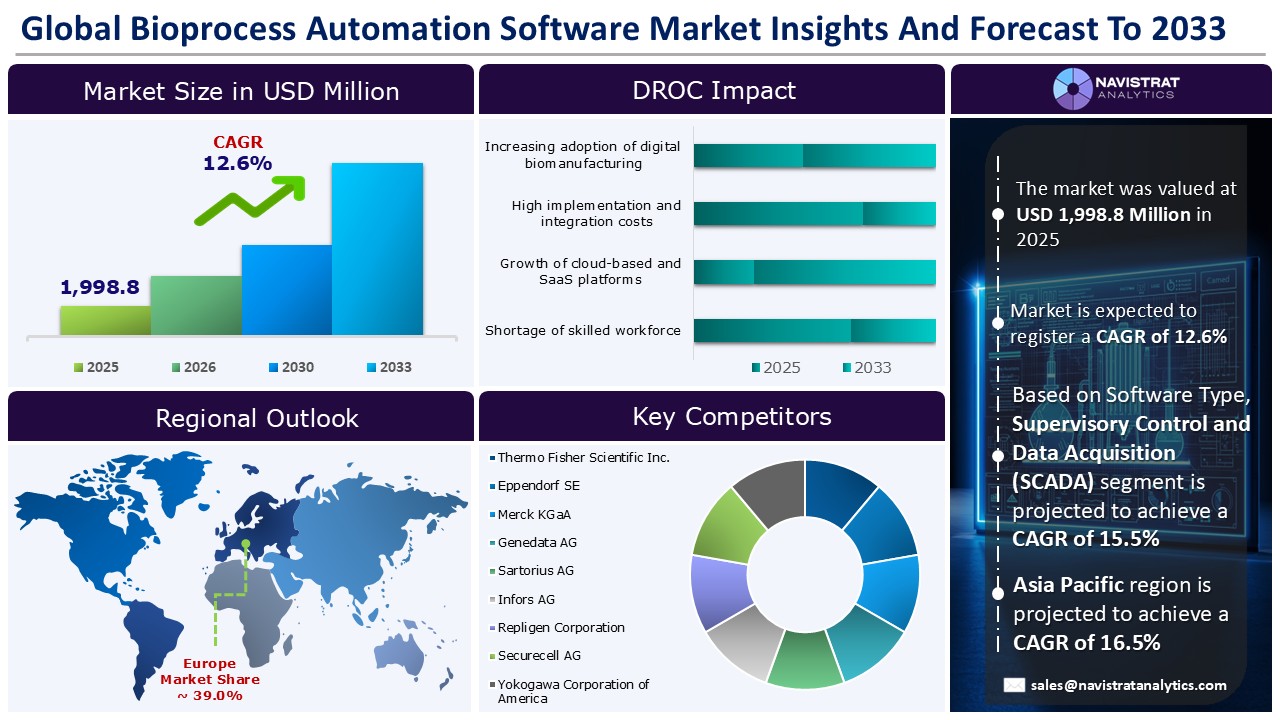
Bioprocess automation software market size reached USD 1,998.8 Million in 2025 and is expected to register a revenue CAGR of 12.6% during the forecast period. The bioprocess automation is a transformative innovation in biotechnology. It goes beyond regular chores, transforming how design, plan, and implement bioprocesses. This automation uses cutting-edge technologies such as robotics, sensors, and data analytics to manage the complexities of bioproduction. Furthermore, bioprocess automation enables researchers and businesses to move innovations from the lab to commercial production, hastening discoveries and time-to-market.
Market Drivers:
Increasing adoption of digital biomanufacturing is a key driver driving the market revenue growth. As demand for biologics and personalized medicine continues to rise, biomanufacturers are increasingly adopting digital technologies to boost efficiency, enhance product quality, and streamline operations. Digital transformation in biomanufacturing involves a broad range of technologies and approaches designed to optimize production processes, improve consistency and quality, and ensure compliance with strict regulatory requirements.
Advancements in data analytics are enabling proactive and predictive capabilities, improving process understanding and providing deeper insights into deviations. This helps minimize variability and batch failures while enhancing efficiency and product consistency. Automation systems are also reducing the need for manual intervention, improving operational safety, and lowering the risk of contamination.
In addition, large organizations are increasingly investing in data management systems, cloud-based storage, advanced analytics, and AI and machine learning (ML) for drug discovery. They are also leveraging mechanistic modeling for process development, along with immersive training approaches such as augmented reality (AR) and virtual reality (VR). On October 2025, Invert, a pioneer in AI-driven bioprocess software solutions, announced the release of Invert Assist, an AI-powered analytical interface for bioprocess that allows users to undertake data analysis and process modeling using natural language prompts. Invert Assist builds on Invert’s core bioprocess software to provide a reliable basis of unified, harmonized, and contextualized data.
Market Opportunity:
Adoption of Artificial Intelligence (AI) and advanced analytics act as opportunity for bioprocess automation software market. These technologies have the potential to significantly increase efficiency, cut costs, and improve product quality in biomanufacturing operations. AI and machine learning can transform the design, control, and monitoring of bioprocesses by using massive datasets and smart algorithms.
AI-powered automation systems can monitor and alter process factors in real time, assuring optimal performance and reducing downtime. Machine learning algorithms can also be utilized to create intelligent control techniques that are responsive to changing process dynamics and disruptions. AI and machine learning can greatly enhance process efficiency and save operational costs by automating regular jobs and enhancing process control.
On November 2024, New Wave Biotech, based in London, has introduced AI bioprocess simulation software to assist alternative protein companies in expanding production more quickly and cost effectively. The Bioprocess Foresight platform uses AI-powered simulation to provide biomanufacturing innovators with a clear view of techno-economics, output, and environmental effect, all tailored to their process and data. It also gives actionable insights for identifying R&D hotspots, as well as the ability to realistically test endless options to determine the most likely outcome.
Recent Trends:
Emerging trends include integration of AI and Machine learning, digital twins in bioprocessing, advanced Process Analytical Technology (PAT), IoT and smart sensors, and cloud-based automation platforms.
Recent improvements in IoT and sensor technology have allowed for the creation of more integrated and automated bioreactor control systems. These technologies not only improve monitoring accuracy, but also provide greater scalability and flexibility in a variety of bioprocess applications. The integration of IoT in bioreactor systems has been demonstrated to improve data accessibility and process transparency, resulting in more informed decisions and better bioprocess outcomes.
Bioprocess monitoring is increasingly emphasizing noninvasive and cost-effective systems that allow for real-time analysis. Disposable 3D-printed flow cells with UV/VIS and fluorescence spectroscopy allow for versatile multi-path studies throughout bioreactors. Electrochemical aptamer sensors that target antibody fragments provide continuous pharmaceutical monitoring in complicated matrices, paving the way for more efficient therapeutic production systems.
On March 2025, Limula has introduced LimONE, a revolutionary cell therapy manufacturing technology that automates complicated and fragmented operations into a unified workflow. LimONE is intended for both hospitals and biopharmaceutical businesses, providing a versatile tool that supports the creation of a variety of cell therapies, including CAR-T and gene-edited hematopoietic stem cells. This strategy prioritizes a straightforward design for all product components, including a hardware device, a single-use consumable, and a software suite for protocol development.
Restraints & Challenges:
High implementation and integration costs is a significant challenge. Deploying bioprocess automation software requires significant investment in infrastructure, licencing, and system integration. Many facilities still operate on outdated equipment and software, making integration with modern automation platforms complex. This often leads to increased costs, delays, and operational disruptions.
Automation systems generate large volumes of data from multiple sources, leading to data silos. Lack of standardization can hinder seamless data exchange and limit real-time decision-making. Moreover, operating advanced automation systems requires expertise in both biotechnology and digital tools. There is a growing shortage of professionals with the necessary cross-functional skill sets. Scaling automation solutions across multiple production lines or facilities can be challenging.
Software Type Segment Insights and Analysis:
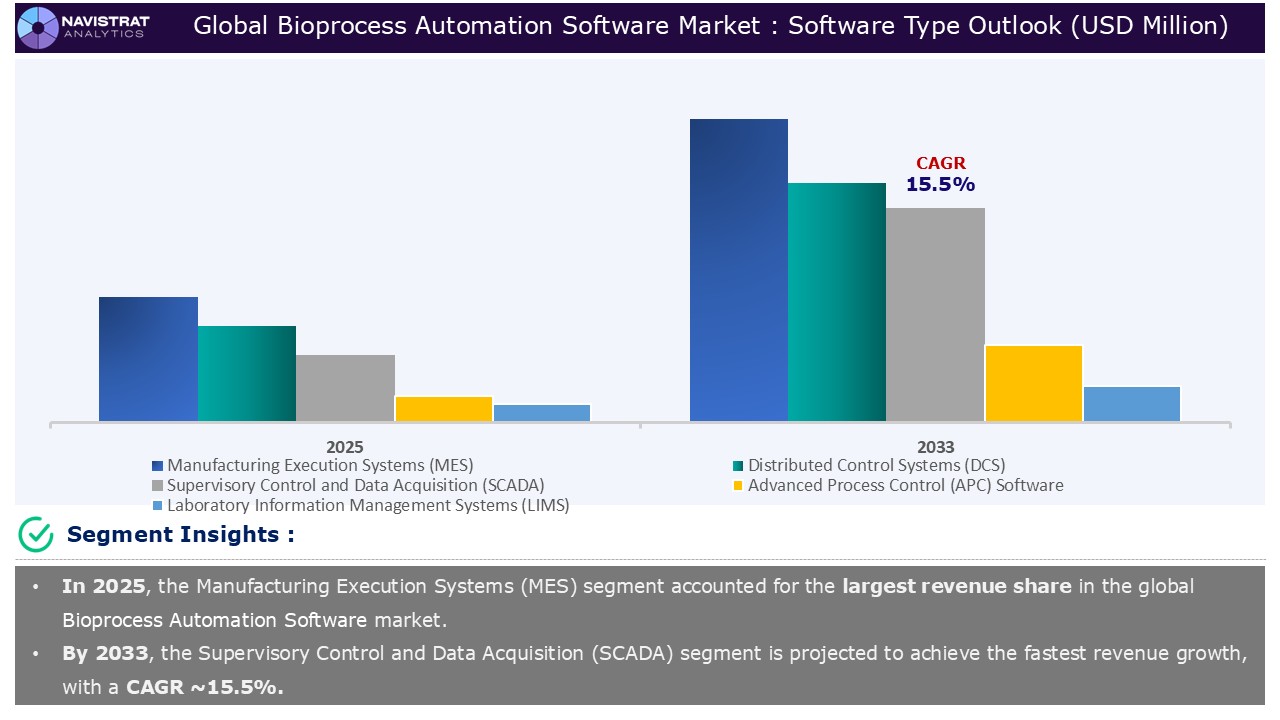
Based on the software type, bioprocess automation software market is segmented into Manufacturing Execution Systems (MES), Distributed Control Systems (DCS), Supervisory Control and Data Acquisition (SCADA), Advanced Process Control (APC) Software, and Laboratory Information Management Systems (LIMS).
Manufacturing Execution Systems (MES) segment contributed the largest market share in 2025. A manufacturing execution system (MES) is a digital technology that allows pharmaceutical producers to monitor, control, and optimize production processes in real time. By combining automation, data management, and process control, MES provides real-time visibility into production operations, assuring compliance with Good Manufacturing Practices (GMP) and regulatory standards. MES ensures electronic documentation of manufacturing operations, lowering the risks associated with manual record-keeping and maintaining compliance with FDA, EMA, and WHO requirements.
Real-time monitoring and automatic notifications assist producers in detecting deviations, faults, or quality defects before they affect finished products. MES systems use AI-powered analytics to improve predictive maintenance, process optimization, and anomaly detection. MES systems are using digital twins to generate virtual models of manufacturing processes, allowing for real-time simulation and optimization.
On September 2025, Körber has released a new version of its PAS-X Manufacturing Execution System. The new PAS-X MES 3.4 is distinguished by its web-based, scalable platform, easy user interface, AI support, and smart tools for deployment, monitoring, and long-term lifecycle management. A sophisticated cloud- and AI-powered platform that modernizes the shop floor by making operations faster, more flexible, and more efficient.
Application Segment Insights and Analysis:
Based on the application, bioprocess automation software market is segmented into upstream processing, downstream processing, process monitoring & control, and quality management & compliance.
Upstream processing segment contributed the largest market share in 2025. Automation methods for upstream bioprocessing have proven to be useful, saving both labor and time. Automating upstream bioprocesses can also create a tighter feedback loop for process control, reducing the problems that have traditionally existed at this level of biomanufacturing. Automation in upstream bioprocessing improves the cell culture environment within the bioreactor.
Advances in process control and monitoring have contributed to lower development costs and increased affordability. Recently, attempts have been undertaken to develop holistic process model-based controllers that provide a digital reproduction of the entire bioprocess. It entails integrating individual unit operations as well as monitoring and control, resulting in a better understanding of the influence of complicated correlations between CPPs and CQAs on coupled unit operations.
On September 2023, Waters Corporation has introduced new bioprocess walk-up solutions that simplify biologic sample preparation and analysis. By eliminating the requirement to transmit bioreactor samples to a central laboratory for analysis, the novel technologies make it possible to expedite upstream bioprocess development by up to six weeks compared to conventional approaches. Enabled by improvements to Waters OneLab laboratory automation software and new pre-developed analytical workflows.
End-Use Segment Insights and Analysis:
Based on the end-use, bioprocess automation software market is segmented into biopharmaceutical companies, Contract Development and Manufacturing Organizations (CDMOs), and research & academic institutions.
Biopharmaceutical companies segment contributed the largest market share in 2025. Biopharmaceutical businesses are rapidly leveraging digitalization, machine learning, and artificial intelligence (AI) to drive scientific and operational excellence from process development through manufacture. PAT also contributes to increased sustainability and margins by allowing businesses to obtain raw materials more extensively. It improves the product’s quality and uniformity while minimizing waste and rejects. Biopharmaceutical businesses have achieved productivity increases of up to threefold. Some companies have lowered batch process production times from 30 days to 30 hours. Other organizations that have switched from batch to continuous manufacturing have decreased production time from 30 days to 90 minutes.
On August 2024, Körber collaborates with Lisure to facilitate MES integration in biopharmaceuticals. Körber and Lisure have formed a new cooperation to facilitate the integration of the Werum PAS-X MES (Manufacturing Execution System) with Lisure’s innovative equipment. This automation reduces human error, improves process robustness, and increases GMP compliance. With the integration of PAS-X MES, CBMS provides on-demand buffer preparation, lowering storage requirements and enhancing efficiency via real-time monitoring and traceability.
Geographical Outlook:
Bioprocess automation software market is strategically segmented by geography to provide a comprehensive understanding of regional market dynamic. Discover demand analysis, emerging trends, and growth opportunities shaping market performance across different region and countries.
Europe Bioprocess Automation Software Market:
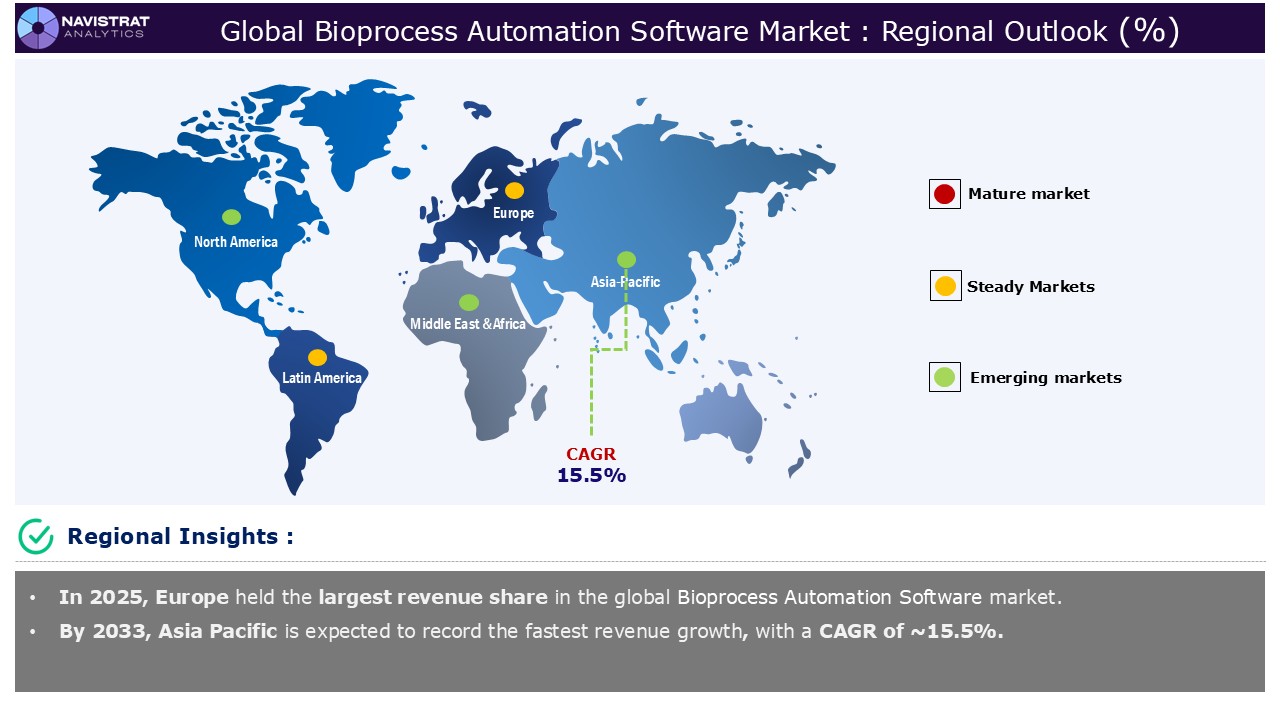
Europe is registered to have highest market share in bioprocess automation software market in 2025. This is mainly driven by advancements in biotechnology, increased demand for efficient manufacturing processes, and a growing emphasis on automation to improve productivity and compliance. This market is distinguished by technical innovation, increased applications in biopharmaceuticals, and an increasing use of integrated software solutions to streamline operations. As Europe continues to lead in bioprocessing research and development, demand for sophisticated automation software is projected to increase, creating significant potential for industry players. The combination of AI and data analytics accelerates market growth, establishing Europe as a key hub for bioprocess automation solutions.
On June 2024, Genedata announced a strategic cooperation with AGU. The collaboration offers a fully integrated and comprehensive laboratory digitalization solution that automates data collecting from instruments and streamlines data flow into the Genedata enterprise platform. Genedata and AGU work together to provide a comprehensive solution that offers high-quality data from devices in accordance with ISO 27001 and ISO 9001 requirements, as well as support for data consumers such as laboratory professionals, operators, process engineers, and data science groups.
Asia Pacific Bioprocess Automation Software Market:
Asia Pacific is expected to register the fastest growth rate during the forecasted period, driven by rising demand for biologics and cell & gene therapies and rising demand for real-time monitoring and process optimization. Furthermore, growth of cloud-based and SaaS platforms and emergence of continuous bioprocessing is also driving the revenue growth. The growing prevalence of chronic diseases, as well as the demand for tailored medication, are driving the need for scalable and dependable bioprocessing software solutions.
On September 2025, Yokogawa Corporation of America and Repligen have announced a collaboration to combine Yokogawa’s OpreX Bio Pilot with Repligen’s MAVERICK, which would improve automated regulation of glucose and lactate levels in cell cultures. The combination of these techniques enables scientists in process development to assess crucial bioprocessing parameters without the need for complex calibration models. This integration offers continuous, real-time analysis without the need for manual sampling and promotes optimal data management.
North America Bioprocess Automation Software Market:
North America is expected to register a considerable market share rate during the forecasted period, driven by technological developments, increased demand for bioprocess automation, and a growing awareness of the necessity of production efficiency. The increased implementation of automation in pharmaceutical manufacturing, biotechnology sectors, and biopharmaceuticals is a key driver of market growth. With the rise of precision medicine, biologics production, and tailored medicines, automation has become an essential tool for optimizing the complicated processes involved in bioprocessing these goods.
On March 2025, Prendio-BioProcure has announced the launch of its most comprehensive set of capabilities to date, providing cost reductions, more workflow automation, and supplier insight for R&D-driven enterprises. These advancements allow biotech businesses to extend their financial runway, decrease administrative costs, and make faster, data-driven decisions, all through a streamlined, AI-powered procurement platform. Prendio-BioProcure is reinventing biotech procurement with sophisticated automation, deep biotech understanding, and real-time information.
Competition Analysis:
Bioprocess automation software market is characterized by a fragmented structure, with several players competing across various segments and regions. List of major players included in bioprocess automation software market report are:
- Thermo Fisher Scientific Inc.
- Eppendorf SE
- Merck KGaA
- Genedata AG
- Sartorius AG
- Infors AG
- Repligen Corporation
- Securecell AG
- Yokogawa Corporation of America
- Invert, Inc.
- HEL Limited
- Rockwell Automation
- Waters Corporation
- Synthace
- Vimachem
- Benchling
Strategic Developments in Bioprocess Automation Software Market:
- In July 2025, Repligen Corporation, a life sciences business focused on bioprocessing technology leadership, announced that Novasign and Repligen have formed a strategic agreement to develop and integrate Novasign’s machine learning and modeling processes into Repligen filter systems. Repligen will invest in Novasign as part of the agreement to help it scale and expand its operations. This will not only accelerate Repligen’s digitization journey and strengthen its portfolio of process analytical technology (PAT)-enabled solutions, but will also pave the way for future sophisticated AI modeling within Repligen platforms.
- In December 2024, Eppendorf SE and DataHow AG announced a strategic partnership to advance bioprocess development. Through this collaboration, DataHow’s AI-powered analytics solution, DataHowLab, will be integrated with Eppendorf’s cloud-based BioNsight platform, enabling scientists to gain enhanced insights and more advanced analytical capabilities.
Key Advantages for Stakeholders:
Navistrat Analytics’ industry report provides an in-depth quantitative analysis of various market segments, historical and current trends, market forecasts, and dynamics within the global market. The historical years covered in this report are 2023 to 2024, with 2025 serving as the base year for market size calculations. The forecast period extends from 2026 to 2033.
The report includes an executive summary and a comprehensive overview of market drivers, restraints, opportunities, and challenges (DROC), along with insights into regulatory standards. It features detailed analyses such as PORTER’s Five Forces, SWOT, and PESTLE, as well as assessments of technological trends and the competitive landscape.
PORTER’s Five Forces analysis helps stakeholders evaluate the impact of new entrants, competitive rivalry, supplier power, buyer power, and substitution threats, enabling them to assess the level of competition and the attractiveness of the global market. The competitive landscape provides stakeholders with a clear understanding of the current market positions of key players, offering valuable insights into their competitive environment.
Scope And Key Highlights Of Bioprocess Automation Software Market Report:
| Report Features | Details |
| Market Size in 2025 | USD 1,998.8 Million |
| Market Growth Rate in CAGR (2026–2033) | 12.6% |
| Market Revenue forecast to 2033 | USD 5,189.4 Million |
| Base year | 2025 |
| Historical year | 2023-2024 |
| Forecast period | 2026-2033 |
| Report Pages | 450 |
| Segments covered |
|
| Regional scope |
|
| Country Scope |
|
| Key Market Players |
|
| Delivery Format | Reports are delivered in PDF format via email. |
| Customization scope | Request for Customization |
Bioprocess Automation Software market report offers a detailed analysis of market size, including historical revenue (in USD Million) data for 2023-2024 and revenue forecasts for 2026-2033 across the following segments:
- Software Type Outlook (Revenue, USD Million; 2023-2033)
- Manufacturing Execution Systems (MES)
- Distributed Control Systems (DCS)
- Supervisory Control and Data Acquisition (SCADA)
- Advanced Process Control (APC) Software
- Laboratory Information Management Systems (LIMS)
- Deployment Outlook (Revenue, USD Million; 2023-2033)
- On Premise
- Cloud
- Hybrid
- Application Outlook (Revenue, USD Million; 2023-2033)
- Upstream Processing
- Downstream Processing
- Process Monitoring & Control
- Quality Management & Compliance
- End-Use Outlook (Revenue, USD Million; 2023-2033)
- Biopharmaceutical Companies
- Contract Development and Manufacturing Organizations (CDMOs)
- Research & Academic Institutions
- Regional Outlook (Revenue, USD Million; 2023-2033)
- North America
- U.S.
- Canada
- Mexico
- Europe
- Germany
- France
- U.K.
- Italy
- Spain
- Benelux
- Nordic Countries
- Rest of Europe
- Asia Pacific
- China
- India
- Japan
- South Korea
- Oceania
- ASEAN Countries
- Rest of APAC
- Latin America
- Brazil
- Rest of LATAM
- Middle East & Africa
- GCC Countries
- South Africa
- Israel
- Turkey
- Rest of MEA
- North America
Frequently Asked Questions (FAQ) about Bioprocess Automation Software Market report
The market size of bioprocess automation software market was 1,998.8 million in 2025.
The market size of bioprocess automation software market is expected to register compound annual growth rate (CAGR) of 12.6% over the forecast period.
Increasing adoption of digital biomanufacturing, rising demand for biologics and cell & gene therapies, and rising demand for real-time monitoring and process optimization are major key factors driving the market revenue growth of bioprocess automation software market.
High implementation and integration costs and complex integration with legacy systems are key limiting factors driving the market.
Asia Pacific account for fastest revenue growth of 12.6%.
Manufacturing Execution Systems (MES) is the major leading segment of bioprocess automation software market in terms of software type.
- Market Definition
- Research Objective
- Research Methodology
- Research Design
- Data Collection Methods
- Primary
- Secondary
- Market Size Estimation
- Top-down Model Method
- Bottom-up Model Method
- Forecasting Methodology
- Tools and Models Used
- Market Overview and Trends
- Market Size and Forecast
- Industry Analysis
- Market Driver, Restraints, Opportunity, and Challenges (DROC) Analysis
- Market Drivers
- Increasing adoption of digital biomanufacturing
- Rising demand for biologics and cell & gene therapies
- Rising demand for real-time monitoring and process optimization
- Market Restraints
- High implementation and integration costs
- Complex integration with legacy systems
- Data security and privacy concerns
- Market Opportunities
- Growth of cloud-based and SaaS platforms
- Adoption of AI and advanced analytics
- Emergence of continuous bioprocessing
- Market Challenges
- Shortage of skilled workforce
- System validation and compliance complexity
- Regulatory Landscape
- North America
- Europe
- Asia Pacific
- Latin America
- Middle East and Africa
- Strategic Insights
- Porter’s Five Forces Analysis
- PESTLE Analysis
- Price Trend Analysis
- Value Chain Analysis
- Technological Trends
- Integration of AI and Machine Learning
- Digital Twins in Bioprocessing
- Advanced Process Analytical Technology (PAT)
- IoT and Smart Sensors
- Cloud-Based Automation Platforms
- Recent Developments
- Funding
- Merger and Acquisition
- Expansion
- Partnership and Collaboration
- Product/ Service Launch
- Software Type Market Revenue Estimates and Forecasts, 2023-2033
- Manufacturing Execution Systems (MES)
- Distributed Control Systems (DCS)
- Supervisory Control and Data Acquisition (SCADA)
- Advanced Process Control (APC) Software
- Laboratory Information Management Systems (LIMS)
- Deployment Market Revenue Estimates and Forecasts, 2023-2033
- On Premise
- Cloud
- Hybrid
- Application Market Revenue Estimates and Forecasts, 2023-2033
- Upstream Processing
- Downstream Processing
- Process Monitoring & Control
- Quality Management & Compliance
- End-Use Market Revenue Estimates and Forecasts, 2023-2033
- Biopharmaceutical Companies
- Contract Development and Manufacturing Organizations (CDMOs)
- Research & Academic Institutions
- Bioprocess Automation Software Market Revenue Estimates and Forecasts by Region, 2023-2033, USD Million
- North America
- North America Bioprocess Automation Software Market By Software Type, Market Revenue Estimates and Forecasts, 2023-2033, USD Million
- Manufacturing Execution Systems (MES)
- Distributed Control Systems (DCS)
- Supervisory Control and Data Acquisition (SCADA)
- Advanced Process Control (APC) Software
- Laboratory Information Management Systems (LIMS)
- North America Bioprocess Automation Software Market By Deployment, Market Revenue Estimates and Forecasts, 2023-2033, USD Million
- On Premise
- Cloud
- Hybrid
- North America Bioprocess Automation Software Market By Application, Market Revenue Estimates and Forecasts, 2023-2033, USD Million
- Upstream Processing
- Downstream Processing
- Process Monitoring & Control
- Quality Management & Compliance
- North America Bioprocess Automation Software Market By End-Use, Market Revenue Estimates and Forecasts, 2023-2033, USD Million
- Biopharmaceutical Companies
- Contract Development and Manufacturing Organizations (CDMOs)
- Research & Academic Institutions
- North America Bioprocess Automation Software Market Revenue Estimates and Forecasts by Country, 2023-2033, USD Million
- United States
- Canada
- Mexico
- North America Bioprocess Automation Software Market By Software Type, Market Revenue Estimates and Forecasts, 2023-2033, USD Million
- Europe
- Europe Bioprocess Automation Software Market By Software Type, Market Revenue Estimates and Forecasts, 2023-2033, USD Million
- Manufacturing Execution Systems (MES)
- Distributed Control Systems (DCS)
- Supervisory Control and Data Acquisition (SCADA)
- Advanced Process Control (APC) Software
- Laboratory Information Management Systems (LIMS)
- Europe Bioprocess Automation Software Market By Deployment, Market Revenue Estimates and Forecasts, 2023-2033, USD Million
- On Premise
- Cloud
- Hybrid
- Europe Bioprocess Automation Software Market By Application, Market Revenue Estimates and Forecasts, 2023-2033, USD Million
- Upstream Processing
- Downstream Processing
- Process Monitoring & Control
- Quality Management & Compliance
- Europe Bioprocess Automation Software Market By End-Use, Market Revenue Estimates and Forecasts, 2023-2033, USD Million
- Biopharmaceutical Companies
- Contract Development and Manufacturing Organizations (CDMOs)
- Research & Academic Institutions
- Europe Bioprocess Automation Software Market Revenue Estimates and Forecasts by Country, 2023-2033, USD Million
- Germany
- United Kingdom
- France
- Italy
- Spain
- Benelux
- Nordic Countries
- Rest of Europe
- Europe Bioprocess Automation Software Market By Software Type, Market Revenue Estimates and Forecasts, 2023-2033, USD Million
- Asia Pacific
- Asia Pacific Bioprocess Automation Software Market By Software Type, Market Revenue Estimates and Forecasts, 2023-2033, USD Million
- Manufacturing Execution Systems (MES)
- Distributed Control Systems (DCS)
- Supervisory Control and Data Acquisition (SCADA)
- Advanced Process Control (APC) Software
- Laboratory Information Management Systems (LIMS)
- Asia Pacific Bioprocess Automation Software Market By Deployment, Market Revenue Estimates and Forecasts, 2023-2033, USD Million
- On Premise
- Cloud
- Hybrid
- Asia Pacific Bioprocess Automation Software Market By Application, Market Revenue Estimates and Forecasts, 2023-2033, USD Million
- Upstream Processing
- Downstream Processing
- Process Monitoring & Control
- Quality Management & Compliance
- Asia Pacific Bioprocess Automation Software Market By End-Use, Market Revenue Estimates and Forecasts, 2023-2033, USD Million
- Biopharmaceutical Companies
- Contract Development and Manufacturing Organizations (CDMOs)
- Research & Academic Institutions
- Asia Pacific Bioprocess Automation Software Market Revenue Estimates and Forecasts by Country, 2023-2033, USD Million
- China
- India
- Japan
- South Korea
- Oceania
- ASEAN Countries
- Rest of Asia-Pacific
- Asia Pacific Bioprocess Automation Software Market By Software Type, Market Revenue Estimates and Forecasts, 2023-2033, USD Million
- Latin America
- Latin America Bioprocess Automation Software Market By Software Type, Market Revenue Estimates and Forecasts, 2023-2033, USD Million
- Manufacturing Execution Systems (MES)
- Distributed Control Systems (DCS)
- Supervisory Control and Data Acquisition (SCADA)
- Advanced Process Control (APC) Software
- Laboratory Information Management Systems (LIMS)
- Latin America Bioprocess Automation Software Market By Deployment, Market Revenue Estimates and Forecasts, 2023-2033, USD Million
- On Premise
- Cloud
- Hybrid
- Latin America Bioprocess Automation Software Market By Application, Market Revenue Estimates and Forecasts, 2023-2033, USD Million
- Upstream Processing
- Downstream Processing
- Process Monitoring & Control
- Quality Management & Compliance
- Latin America Bioprocess Automation Software Market By End-Use, Market Revenue Estimates and Forecasts, 2023-2033, USD Million
- Biopharmaceutical Companies
- Contract Development and Manufacturing Organizations (CDMOs)
- Research & Academic Institutions
- Latin America Bioprocess Automation Software Market Revenue Estimates and Forecasts by Country, 2023-2033, USD Million
- Brazil
- Rest of Latin America
- Latin America Bioprocess Automation Software Market By Software Type, Market Revenue Estimates and Forecasts, 2023-2033, USD Million
- Middle East and Africa
- Middle East and Africa Bioprocess Automation Software Market By Software Type, Market Revenue Estimates and Forecasts, 2023-2033, USD Million
- Manufacturing Execution Systems (MES)
- Distributed Control Systems (DCS)
- Supervisory Control and Data Acquisition (SCADA)
- Advanced Process Control (APC) Software
- Laboratory Information Management Systems (LIMS)
- Middle East and Africa Bioprocess Automation Software Market By Deployment, Market Revenue Estimates and Forecasts, 2023-2033, USD Million
- On Premise
- Cloud
- Hybrid
- Middle East and Africa Bioprocess Automation Software Market By Application, Market Revenue Estimates and Forecasts, 2023-2033, USD Million
- Upstream Processing
- Downstream Processing
- Process Monitoring & Control
- Quality Management & Compliance
- Middle East and Africa Bioprocess Automation Software Market By End-Use, Market Revenue Estimates and Forecasts, 2023-2033, USD Million
- Biopharmaceutical Companies
- Contract Development and Manufacturing Organizations (CDMOs)
- Research & Academic Institutions
- Middle East and Africa Bioprocess Automation Software Market Revenue Estimates and Forecasts by Country, 2023-2033, USD Million
- GCC Countries
- South Africa
- Israel
- Turkey
- Rest of Middle East & Africa
- Middle East and Africa Bioprocess Automation Software Market By Software Type, Market Revenue Estimates and Forecasts, 2023-2033, USD Million
- North America
- Market Share Analysis
- Revenue Market Share by Key Players (2024-2025)
- Analysis of Top Players by Market Presence
- Competitive Matrix
- Competitive Strategies
- Mergers and Acquisitions
- Partnerships and Collaboration
- Investment and Fundings
- Agreement
- Expansion
- New Product/ Services Launches
- Technological Innovations
- Thermo Fisher Scientific Inc.
- Company Overview
- Financial Insights
- Product/ Services Offerings
- Strategic Developments
- SWOT Analysis
- Eppendorf SE
- Company Overview
- Financial Insights
- Product / Services Offerings
- Strategic Developments
- SWOT Analysis
- Merck KGaA
- Company Overview
- Financial Insights
- Product/ Services Offerings
- Strategic Developments
- SWOT Analysis
- Genedata AG
- Company Overview
- Financial Insights
- Product / Services Offerings
- Strategic Developments
- SWOT Analysis
- Sartorius AG
- Company Overview
- Financial Insights
- Product / Services Offerings
- Strategic Developments
- SWOT Analysis
- Infors AG
- Company Overview
- Financial Insights
- Product / Services Offerings
- Strategic Developments
- SWOT Analysis
- Repligen Corporation
- Company Overview
- Financial Insights
- Product / Services Offerings
- Strategic Developments
- SWOT Analysis
- Securecell AG
- Company Overview
- Financial Insights
- Product / Services Offerings
- Strategic Developments
- SWOT Analysis
- Yokogawa Corporation of America
- Company Overview
- Financial Insights
- Product / Services Offerings
- Strategic Developments
- SWOT Analysis
- Invert, Inc.
- Company Overview
- Financial Insights
- Product / Services Offerings
- Strategic Developments
- SWOT Analysis
- HEL Limited
- Company Overview
- Financial Insights
- Product / Services Offerings
- Strategic Developments
- SWOT Analysis
- Rockwell Automation
- Company Overview
- Financial Insights
- Product / Services Offerings
- Strategic Developments
- SWOT Analysis
- Waters Corporation
- Company Overview
- Financial Insights
- Product / Services Offerings
- Strategic Developments
- SWOT Analysis
- Synthace
- Company Overview
- Financial Insights
- Product / Services Offerings
- Strategic Developments
- SWOT Analysis
- Vimachem
- Company Overview
- Financial Insights
- Product / Services Offerings
- Strategic Developments
- SWOT Analysis
- Benchling
- Company Overview
- Financial Insights
- Product / Services Offerings
- Strategic Developments
- SWOT Analysis