

Global Blockchain in Energy Market Overview and Key Insights:
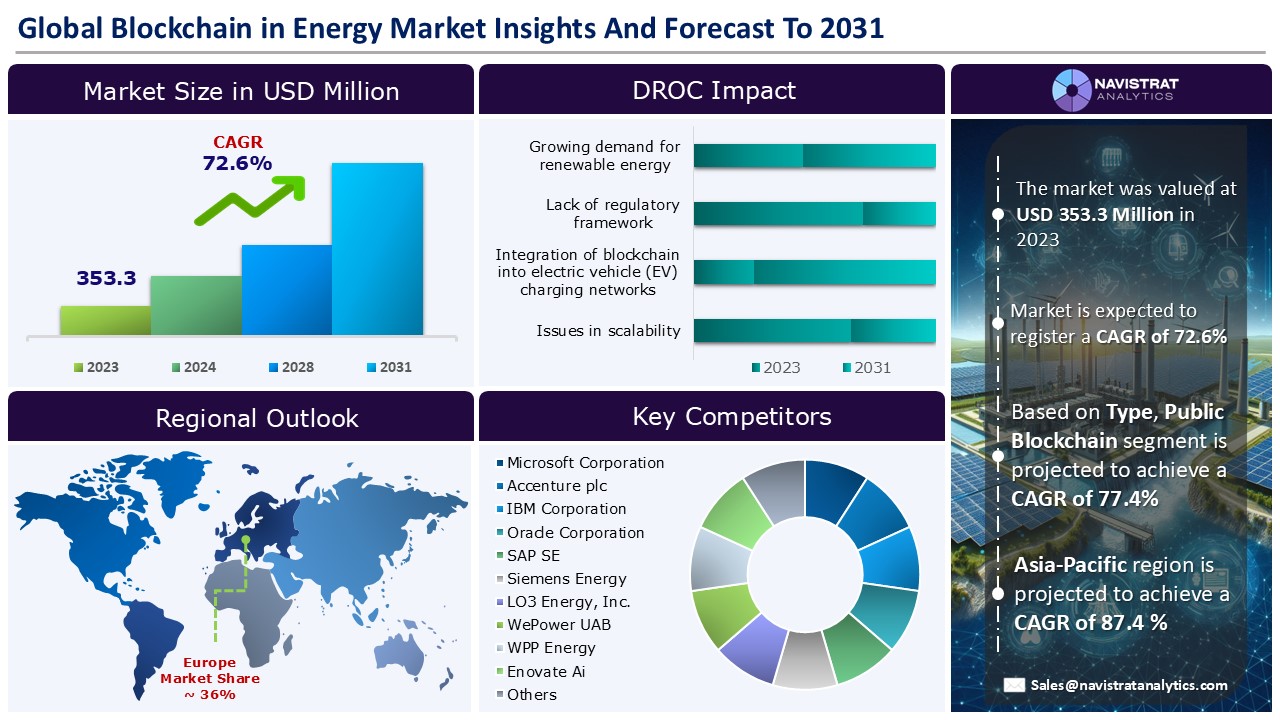
The global blockchain in energy market size reached USD 353.3 Million in 2023 and is expected to register a revenue CAGR of 72.6% during the forecast period.The energy sector may embrace decentralization and move away from traditional centralized control using blockchain technology. This increases autonomy and allows diverse stakeholders, including consumers, producers, and grid operators, to actively participate in energy transactions and decision-making.
Market Drivers:
Increase in demand for renewable energy is a key driver of revenue growth in the blockchain in energy market. According to the International Energy Agency (IEA), renewable electricity capacity additions are expected to reach 507 GW in 2023, over 50% more than in 2022, due to ongoing policy support in more than 130 countries, driving a substantial shift in the worldwide growth trend. Solar PV and wind additions are expected to more than quadruple by 2028 compared to 2022, smashing records throughout the projected period to reach almost 710 GW.
Furthermore, increase in demand for blockchain in energy sectors also another key driver driving the market growth. On November 2024, Energy Plug Technologies Corp. introduced its Energy-as-a-Service (EaaS) model, which combines a sophisticated battery storage system, blockchain technology, and a cryptocurrency ecosystem. This transformational method ensures energy stability, cost efficiency, and financial optimization, and represents the Company’s latest advancement in decentralized energy solutions.
The Energy Plug EaaS paradigm combines energy savings, blackout/brownout prevention, and a cryptocurrency-based treasury system to provide a smooth, scalable, and transparent energy platform. This invention can provide clients with a steady power supply while also opening new revenue potential for commercial, industrial, and residential users via blockchain-enabled efficiency.
Market Opportunity:
Integration of blockchain into electric vehicle (EV) charging networks acts as an opportunity for the global Blockchain in Energy market. Blockchain has impacted a wide range of application areas beyond cryptocurrency, including electric vehicle (EV) charging, document verification, art and craft copyright protection, and counterfeit goods detection. On July 2022, Energy Web, a non-profit that develops operating systems for energy grids, has collaborated with Volkswagen Group Innovation and Elli to create a new smart charging solution that allows EV owners to charge their vehicles with renewable electricity that is directly proportional to the vehicle’s real-time electricity consumption. The system is based on a “24/7” matching algorithm that optimises charging to maximise the usage of clean, locally supplied electricity while also providing consumers with unprecedented levels of control and granularity over electric vehicle charging.
Recent Trends:
Recent trends include the decentralized energy trading, adoption of electric vehicles, and Energy-as-a-Service (EaaS).
Adoption of electric vehicles is a recent trend in blockchain in energy market. According to the International Energy Agency (IEA), almost 14 million new electric vehicles were registered globally in 2023, bringing the total number on the road to 40 million. In 2023, there were over 250 000 new registrations every week, higher than the annual total in 2013, ten years before. Electric vehicles accounted for approximately 18% of all cars sold in 2023, up from 14% in 2022 and only 2% five years ago in 2018.
On November 2024, ACCIONA Energía has partnered with IKEA in Spain to provide renewable energy, self-consumption, and energy saving solutions for Spanish households. IKEA expands its Energy Services with this arrangement, allowing the installation of solar panels for self-consumption and charging spots for electric vehicles via its website and physical stores in Spain. The installation of solar panels can be supplemented by batteries, allowing users to utilize excess energy accumulated during the day at night and become completely self-sufficient by not relying entirely on solar generating.
Restraints & Challenges:
Complex regulatory frameworks in energy production and delivery across multiple nations pose a significant hurdle to the implementation of blockchain in the energy sector. As the blockchain in the energy market is still in its early stages, many governments and energy authorities have yet to set clear guidelines for blockchain operations in the energy sector, posing a substantial barrier. Furthermore, low end-user awareness is a major barrier to industry expansion.
Type Segment Insights and Analysis:
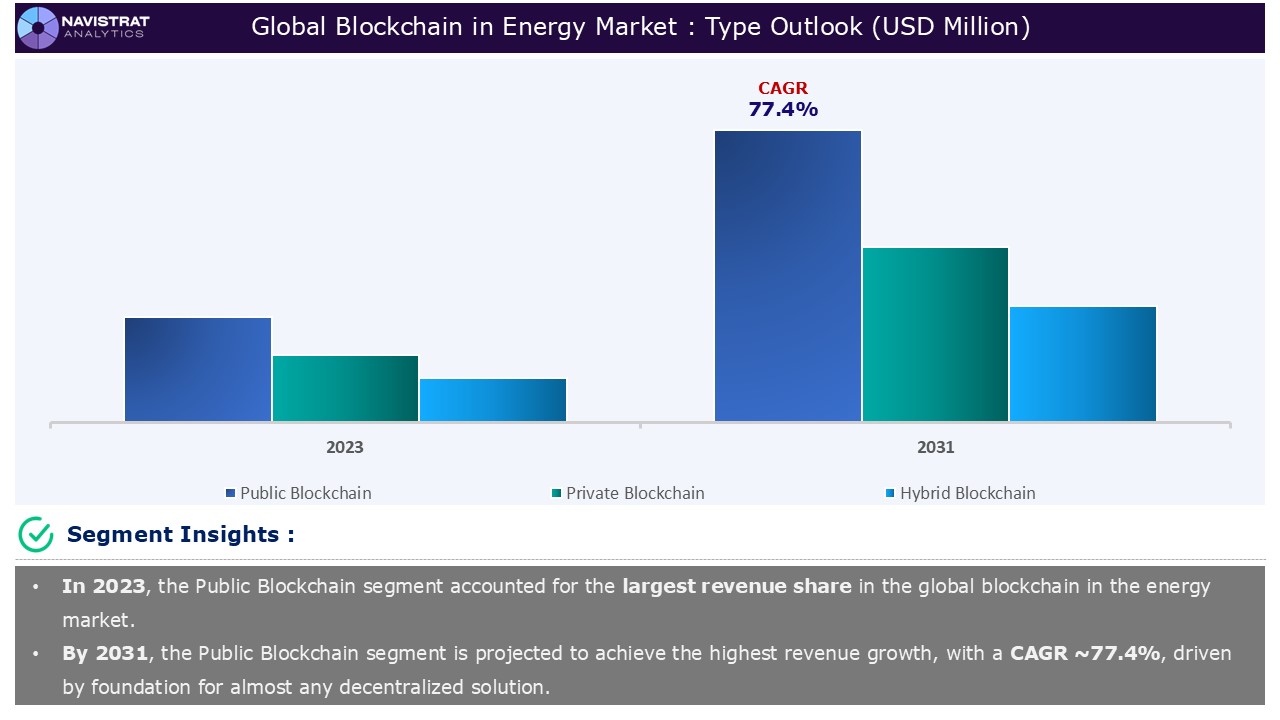
Based on the type, the blockchain in energy market is segmented into public, private, and hybrid.
Public segment contributed largest share and highest revenue growth in 2023. Public blockchains are accessible to anyone; private blockchains are restricted to specific or approved users; and permissioned blockchains contain varying levels of user permissions or responsibilities. A public blockchain uses an incentive mechanism to entice additional users to join. Public blockchains are a particularly effective alternative for genuinely decentralized, democratized, and authority-free operations. Public blockchains are employed in cryptocurrencies and decentralized finance because they may function as the foundation for almost any decentralized solution.
On October 2024, Energy Web has published a beta version of the AutoGreenCharge smartphone app to decarbonize electric vehicle charging. AutoGreenCharge, which is built on the Polkadot blockchain, aims to provide EV drivers and fleet owners with a simple and verifiable solution for ensuring that their vehicles are charging with green energy. By incorporating renewable energy certificates (RECs), the software automatically links EV charging sessions to clean energy, resulting in certified green charging in real time.
Hybrid segment is expected to have a significant share throughout the forecasted period. A hybrid blockchain is a combination of the private and public blockchain. It uses the features of both types of blockchains that is one can have a private permission-based system as well as a public permission-less system. With such a hybrid network, users can control who gets access to which data stored in the blockchain. Only a selected section of data or records from the blockchain can be allowed to go public keeping the rest as confidential in the private network. The hybrid system of blockchain is flexible so that users can easily join a private blockchain with multiple public blockchains. A transaction in a private network of a hybrid blockchain is usually verified within that network.
Application Segment Insights and Analysis:
Based on the application, the blockchain in energy market is segmented into peer-to-peer (P2P) energy trading, renewable energy credits, grid management and optimization, carbon credit trading, electric vehicle, and others.
Peer-to-Peer (P2P) Energy Trading segment contributed largest share in 2023. Peer-to-Peer (P2P) trading of energy has emerged as a next generation system in energy management that enables prosumers to trade their surplus electricity. This creates opportunities for power system markets and transforms the way consumers use their energy, allowing them to trade energy with their peers. Furthermore, companies are heavily investing and partnering with others in providing P2P energy trading services.
For instance, on September 2024, TRENDE Inc., a renewable energy company that develops and delivers renewable energy solutions to Japanese residential customers, has announced the launch of a commercial peer-to-peer (P2P) energy trading service in collaboration with the National Federation of Agricultural Cooperative Associations (JA Group) and ITOCHU Corporation. The P2P energy trading service uses AI-powered demand forecasting and blockchain technology to facilitate direct energy transactions between prosumers (producers and consumers) equipped with solar PV and storage systems. This unique strategy deviates from the typical one-way electricity transfer from utilities to consumers.
Electric Vehicle segment accounted for the fastest growth rate during the forecasted period. According to the Environmental Defense Fund (EDF), over the last nine years, the electric vehicle (EV) industry in the United States has seen a significant increase in investment and job creation, owing primarily to recent federal legislation such as the Inflation Reduction Act (IRA) and the Bipartisan Infrastructure Law (BIL). Private investments into the EV manufacturing ecosystem in the United States have totalled almost USD 199 billion.
On March 2024, Egoras Technology, a Nigerian energy firm, has launched blockchain-powered electric vehicle (EV) charging stations in Rivers State, Nigeria. The incorporation of its blockchain, Egochain, into the Egostation operating model marked a paradigm shift in the electric vehicle charging landscape.
End-Use Segment Insights and Analysis:
Based on the end-use, the blockchain in energy market is segmented into energy consumers, power plants, grid operators, and others.
Power plants segment contributed largest share in 2023.The future grid will be distinguished by energy independence, democratization of the energy market, and exceptional reliability and resilience. Virtual Power Plants (VPPs) have emerged as a critical bridging technology, combining dispersed, small-scale energy resources such as rooftop solar, battery storage, and even electric vehicles to operate as a single dispatchable entity. This enables distributed energy resources (DERs) to engage in energy markets and deliver grid services, bringing us one step closer to a more democratic energy system.
On August 2021, Alectra’s Green Energy & Technology Centre (GRE&T Centre) has launched GridExchange, a transactive energy platform, as another pioneering step toward providing clean energy options. GridExchange, funded by Natural Resources Canada and developed in collaboration with Sunverge, Savage Data, and FLO, is a blockchain-based software platform that allows customers with distributed energy resources (DERs) like solar panels, battery storage, and electric vehicles to participate in an energy marketplace with Alectra.
Energy Consumers segment accounted for the fastest growth rate during the forecasted period. Blockchain technology is revolutionizing the use of smart meters by allowing for direct exchange of energy usage data between consumers and utility providers, eliminating the need for intermediaries. It creates new efficiencies in the tracking of renewable energy credits and certificates, provides provenance to businesses that want to demonstrate their support for sustainable energy initiatives, and enables direct trade settlements between energy companies and their customers without the use of costly intermediaries.
Geographical Outlook:
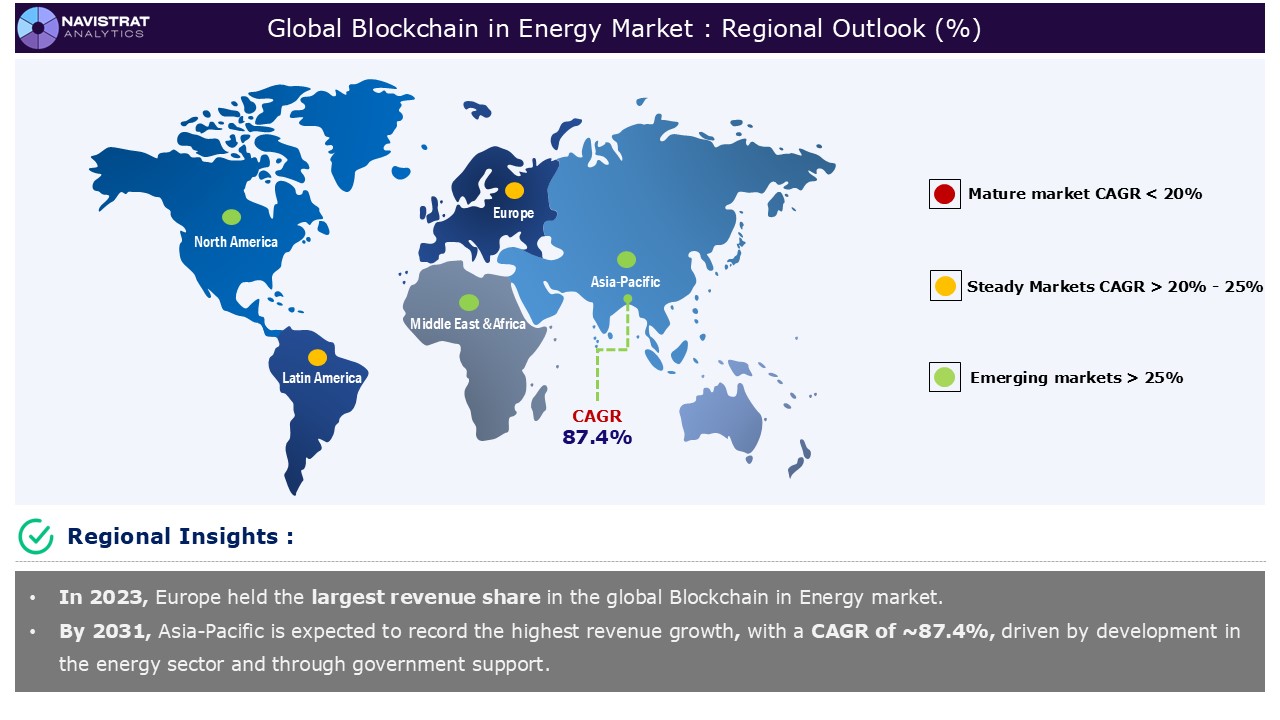
Europe is registered highest market share in blockchain in energy market in 2023.The regional market is driven by significant investment in energy utilities. Furthermore, advancements of blockchain in energy sector is further augmenting the growth of the market. On September 2024, the European Blockchain Sandbox effort (EBSI) announced that 41 authorities and regulators from 22 European Union and European Economic Area nations have joined the effort. The initiative’s key components include testing blockchain-based solutions in a safe environment, cross-border collaboration, regulatory advice, and public-private sector partnerships. The EBSI will also help 20 projects with valid use cases for blockchain technology. These will be chosen based on the criteria it has established, which include legality, business maturity, and compatibility with EU policy aims.
Germany is expected to have the highest market share in Europe blockchain in energy market. Government funding in blockchain in energy sector is driving the market in the region. On February 2021, The German Ministry of Economic Affairs and Energy has financed a three-year initiative to investigate the application of blockchain in energy trading. The project BEST (Blockchain-based decentralised energy market design and management structures) is aimed to investigate how blockchain technology can best be used for trading in a decentralised energy system. The initiative, led by the non-profit energy research Reiner Lemoine Institute, aims to create an electrical market bidding mechanism using blockchain technology as open-source software.
Asia Pacific is registered the fastest growth rate during the forecasted period. Asia Pacific is developing as a major region growth in Blockchain in Energy due to the development in the energy sector and through government support. The Institute for Energy Economics & Financial Analysis reports that from 2004, Asian investment in renewable energy has increased at an average annual growth rate of 23%, reaching USD 345 billion in 2022. China is primarily responsible for this rise, accounting for 80% of the total.
India is expected to have the highest share in Asia Pacific blockchain in energy market. On September 2022, Voltreum, based in India, plans to build the Volt-X blockchain-based peer-to-peer energy trading platform. Its first service, Volt-X, like other P2P networks, is intended to facilitate transparent energy trade between producers and consumers, hence supporting more renewables and other dispersed resources. Volt-X is based on the Ethereum protocol and uses energy-efficient proof-of-stake on the Global Digital Cluster Coin platform. It is designed with a microgrid architecture to connect small neighbourhoods and residential communities in local distribution networks.
North America is to register a considerable market share in blockchain in energy market in 2023. The demand for renewable energy and technological advancements in blockchain technology are key driving factors for region growth. On November 2024, Clean Energy Technologies, Inc., a clean energy manufacturing and engineering, procurement, and construction (EPC) services provider, has formed a strategic alliance with METIS Power to develop sophisticated microgrid solutions for AI data centers and cryptocurrency mining operations. METIS Power’s expertise in power generation and energy storage, combined with CETY’s microgrid solutions, will result in customized microgrid solutions that optimize energy use, improve efficiency, reduce operational costs, increase uptime, and significantly reduce carbon footprints.
Competition Analysis:
The blockchain in energy market is characterized by a fragmented structure, with several players competing across various segments and regions. List of major players included in the blockchain in energy market report are:
- Microsoft Corporation
- Accenture plc
- IBM Corporation
- Oracle Corporation
- SAP SE
- LO3 Energy, Inc.
- WePower UAB
- Infosys Limited
- Shell
- Siemens Energy
- GRID+
- WPP Energy
- Enovate Ai
- Acciona SA
- Other companies
Strategic Developments in Global Blockchain in Energy Market:
- In October 2024, Blockchain for Energy (B4E), the consortium that drives technological innovation in the energy sector, is pleased to announce the successful launch of its substantially upgraded B4E Logistics solution. B4E Logistics is now in active production with a renowned Independent Exploration and Production business. The platform has now been redesigned and upgraded to match the changing needs of the energy business, including new capabilities that improve logistics, procurement, and real-time tracking.
- In July 2024, Powerledger, an energy software technology business, and Energie Steiermark, one of Austria’s largest energy suppliers, have teamed to launch smartCOMMUNITY, a new energy trading platform that enables users to control the distribution of energy generated by their solar assets. The smartCOMMUNITY platform, which was released in July 2023, allows Energie Steiermark’s residential and corporate clients to manage surplus solar electricity. The platform enables prosumers to share their clean energy with family and friends, as well as other consumers on the platform, allowing them to purchase renewable energy produced in Austria at an optimal price.
Key Advantages for Stakeholders:
Navistrat Analytics’ industry report provides an in-depth quantitative analysis of various market segments, historical and current trends, market forecasts, and dynamics within the global market. The historical years covered in this report are 2021 to 2022, with 2023 serving as the base year for market size calculations. The forecast period extends from 2024 to 2031.
The report includes an executive summary and a comprehensive overview of market drivers, restraints, opportunities, and challenges (DROC), along with insights into regulatory standards. It features detailed analyses such as PORTER’s Five Forces, SWOT, and PESTLE, as well as assessments of technological trends and the competitive landscape.
PORTER’s Five Forces analysis helps stakeholders evaluate the impact of new entrants, competitive rivalry, supplier power, buyer power, and substitution threats, enabling them to assess the level of competition and the attractiveness of the global market.The competitive landscape provides stakeholders with a clear understanding of the current market positions of key players, offering valuable insights into their competitive environment.
Scope And Key Highlights Of The Blockchain in Energy Market Report:
| Report Features | Details |
| Market Size in 2023 | USD 353.3 Million |
| Market Growth Rate in CAGR (2024–2031) | 72.6% |
| Market Revenue forecast to 2031 | USD 27,913.0 Million |
| Base year | 2023 |
| Historical year | 2021–2022 |
| Forecast period | 2024–2031 |
| Report Pages | 500 |
| Segments covered |
|
| Regional scope |
|
| Country Scope |
|
| Key Market Players |
|
| Delivery Format | Reports are delivered in PDF format via email. |
| Customization scope | Request for Customization |
The blockchain in energy market report offers a detailed analysis of market size, including historical revenue (in USD Million) data for 2021-2022 and revenue forecasts for 2024-2031 across the following segments:
- Component Outlook (Revenue, USD Million; 2021-2031)
- Services
- Platform
- Type Module Outlook (Revenue, USD Million; 2021-2031)
- Public
- Private
- Hybrid
- Application Outlook (Revenue, USD Million; 2021-2031)
- Peer-to-Peer (P2P) Energy Trading
- Renewable Energy Credits
- Grid Management and Optimization
- Carbon Credit Trading
- Electric Vehicle
- Others
- End-Use Outlook (Revenue, USD Million; 2021-2031)
- Energy Consumers
- Residential
- Commercial
- Industrial
- Power plants
- Grid Operators
- Others
- Energy Consumers
- Regional Outlook (Revenue, USD Million; 2021-2031)
- North America
- U.S.
- Canada
- Mexico
- Europe
- Germany
- France
- U.K.
- Italy
- Spain
- Benelux
- Nordic Countries
- Rest of Europe
- Asia Pacific
- China
- India
- Japan
- South Korea
- Oceania
- ASEAN Countries
- Rest of APAC
- Latin America
- Brazil
- Rest of LATAM
- Middle East & Africa
- GCC Countries
- South Africa
- Israel
- Turkey
- Rest of MEA
- North America
Frequently Asked Questions (FAQ) about the blockchain in energy market report
The market size of blockchain in energy market was 353.3 Million in 2023.
The market size of blockchain in energy market is expected to register compound annual growth rate (CAGR) of 72.6% over the forecast period.
Growing demand for renewable energy, increase in demand for blockchain technology in energy sector are major key factors driving the market revenue growth of the blockchain in energy market.
Complex regulatory frameworks in energy production and distribution across different countries are key limiting factors driving the market.
Asia-Pacific account for fastest revenue growth of 87.4%.
Public is the major leading segment of blockchain in energy market in terms of type.
- Market Definition
- Research Objective
- Research Methodology
- Research Design
- Data Collection Methods
- Primary
- Secondary
- Market Size Estimation
- Top-downmethod
- Bottom-upmethod
- Forecasting Methodology
- Tools and Models Used
- Market Overview and Trends
- Market Size and Forecast
- Industry Analysis
- Market Driver, Restraints, Opportunity, and Challenges (DROC) Analysis
- Market Drivers
- Growing demand for renewable energy
- Increase in demand for blockchain technology in energy sector
- Increase in automation of energy utilities
- Market Restraints
- Complex regulatory frameworks in energy production and distribution across different countries
- Lack of regulatory framework
- Market Opportunities
- Integration of blockchain into electric vehicle (EV) charging networks
- Rise of Energy-as-a-Service (EaaS) models
- Market Challenges
- Issues in scalability
- Integration with existing systems
- Regulatory Landscape
- North America
- Europe
- Asia Pacific
- Latin America
- Middle East and Africa
- Strategic Insights
- Porter’s Five Forces Analysis
- PESTLE Analysis
- Price Trend Analysis
- Value Chain Analysis
- Technological Trends
- Recent Developments
- Funding
- Merger and Acquisition
- Expansion
- Partnership and Collaboration
- Product/ Service Launch
- ComponentMarket Revenue Estimates and Forecasts, 2021-2031
- Services
- Application
- TypeMarket Revenue Estimates and Forecasts, 2021-2031
- Public
- Private
- Hybrid
- ApplicationMarket Revenue Estimates and Forecasts, 2021-2031
- Peer-to-Peer (P2P) Energy Trading
- Renewable Energy Credits
- Grid Management and Optimization
- Carbon Credit Trading
- Electric Vehicle
- Others
- End-UseMarket Revenue Estimates and Forecasts, 2021-2031
- Energy Consumers
- Residential
- Commercial
- Industrial
- Power plants
- Grid Operators
- Others
- Energy Consumers
Blockchain in Energy Market Revenue Estimates and Forecasts by Region, 2021-2031, USD Million
-
- North America
- North America Blockchain in Energy Market By Component, Market Revenue Estimates and Forecasts, 2021-2031, USD Million
- Services
- Application
- North America Blockchain in Energy Market By Type, Market Revenue Estimates and Forecasts, 2021-2031, USD Million
- Public
- Private
- Hybrid
- North America Blockchain in Energy Market By Application, Market Revenue Estimates and Forecasts, 2021-2031, USD Million
- Peer-to-Peer (P2P) Energy Trading
- Renewable Energy Credits
- Grid Management and Optimization
- Carbon Credit Trading
- Electric Vehicle
- Others
- North America Blockchain in Energy Market By End-Use Size, Market Revenue Estimates and Forecasts, 2021-2031, USD Million
- Energy Consumers
- Residential
- Commercial
- Industrial
- Power plants
- Grid Operators
- Others
- Energy Consumers
- North America Blockchain in Energy Market Revenue Estimates and Forecasts by Country, 2021-2031, USD Million
- United States
- Canada
- Mexico
- North America Blockchain in Energy Market By Component, Market Revenue Estimates and Forecasts, 2021-2031, USD Million
- North America
- Europe
- Europe Blockchain in Energy Market By Component, Market Revenue Estimates and Forecasts, 2021-2031, USD Million
- Services
- Application
- Europe Blockchain in Energy Market By Type, Market Revenue Estimates and Forecasts, 2021-2031, USD Million
- Public
- Private
- Hybrid
- Europe Blockchain in Energy Market By Application, Market Revenue Estimates and Forecasts, 2021-2031, USD Million
- Peer-to-Peer (P2P) Energy Trading
- Renewable Energy Credits
- Grid Management and Optimization
- Carbon Credit Trading
- Electric Vehicle
- Others
- EuropeBlockchain in Energy Market By End-Use Size, Market Revenue Estimates and Forecasts, 2021-2031, USD Million
- Energy Consumers
- Residential
- Commercial
- Industrial
- Power plants
- Grid Operators
- Others
- Energy Consumers
- EuropeBlockchain in Energy Market Revenue Estimates and Forecasts by Country, 2021-2031, USD Million
- Germany
- United Kingdom
- France
- Italy
- Spain
- Benelux
- Nordic Countries
- Rest of Europe
- Europe Blockchain in Energy Market By Component, Market Revenue Estimates and Forecasts, 2021-2031, USD Million
- Asia-Pacific
- Asia-PacificBlockchain in Energy Market By Component, Market Revenue Estimates and Forecasts, 2021-2031, USD Million
- Services
- Application
- Asia-Pacific Blockchain in Energy Market By Type, Market Revenue Estimates and Forecasts, 2021-2031, USD Million
- Public
- Private
- Hybrid
- Asia-Pacific Blockchain in Energy Market By Application, Market Revenue Estimates and Forecasts, 2021-2031, USD Million
- Peer-to-Peer (P2P) Energy Trading
- Renewable Energy Credits
- Grid Management and Optimization
- Carbon Credit Trading
- Electric Vehicle
- Others
- Asia-Pacific Blockchain in Energy Market By End-Use Size, Market Revenue Estimates and Forecasts, 2021-2031, USD Million
- Energy Consumers
- Residential
- Commercial
- Industrial
- Power plants
- Grid Operators
- Others
- Energy Consumers
- Asia-PacificBlockchain in Energy Market Revenue Estimates and Forecasts by Country, 2021-2031, USD Million
- China
- India
- Japan
- South Korea
- Oceania
- ASEAN Countries
- Rest of Asia-Pacific
- Asia-PacificBlockchain in Energy Market By Component, Market Revenue Estimates and Forecasts, 2021-2031, USD Million
- Latin America
- Latin AmericaBlockchain in Energy Market By Component, Market Revenue Estimates and Forecasts, 2021-2031, USD Million
- Services
- Application
- Latin America Blockchain in Energy Market By Type, Market Revenue Estimates and Forecasts, 2021-2031, USD Million
- Public
- Private
- Hybrid
- Latin America Blockchain in Energy Market By Application, Market Revenue Estimates and Forecasts, 2021-2031, USD Million
- Peer-to-Peer (P2P) Energy Trading
- Renewable Energy Credits
- Grid Management and Optimization
- Carbon Credit Trading
- Electric Vehicle
- Others
- Latin America Blockchain in Energy Market By End-Use Size, Market Revenue Estimates and Forecasts, 2021-2031, USD Million
- Energy Consumers
- Residential
- Commercial
- Industrial
- Power plants
- Grid Operators
- Others
- Energy Consumers
- Latin America Blockchain in Energy Market Revenue Estimates and Forecasts by Country, 2021-2031, USD Million
- Brazil
- Rest of Latin America
- Latin AmericaBlockchain in Energy Market By Component, Market Revenue Estimates and Forecasts, 2021-2031, USD Million
- Middle East & Africa
- Middle East & Africa Blockchain in Energy Market By Component, Market Revenue Estimates and Forecasts, 2021-2031, USD Million
- Services
- Application
- Middle East & Africa Blockchain in Energy Market By Type, Market Revenue Estimates and Forecasts, 2021-2031, USD Million
- Public
- Private
- Hybrid
- Middle East & Africa Blockchain in Energy Market By Application, Market Revenue Estimates and Forecasts, 2021-2031, USD Million
- Peer-to-Peer (P2P) Energy Trading
- Renewable Energy Credits
- Grid Management and Optimization
- Carbon Credit Trading
- Electric Vehicle
- Others
- Middle East & Africa Blockchain in Energy Market By End-Use Size, Market Revenue Estimates and Forecasts, 2021-2031, USD Million
- Energy Consumers
- Residential
- Commercial
- Industrial
- Power plants
- Grid Operators
- Others
- Energy Consumers
- Middle East & Africa Blockchain in Energy Market Revenue Estimates and Forecasts by Country, 2021-2031, USD Million
- GCC Countries
- South Africa
- Israel
- Turkey
- Rest of Middle East & Africa
- Middle East & Africa Blockchain in Energy Market By Component, Market Revenue Estimates and Forecasts, 2021-2031, USD Million
- Market Share Analysis
- Revenue Market Share by Key Players (2022-2023)
- Analysis of Top Players by Market Presence
- Competitive Matrix
- Competitive Strategies
- Mergers and Acquisitions
- Partnerships and Collaboration
- Investment and Fundings
- Agreement
- Expansion
- New Product/ Services Launches
- Technological Innovations
- Microsoft Corporation
- Company Overview
- Financial Insights
- Product/ Services Offerings
- Strategic Developments
- SWOT Analysis
- Accenture plc
- Company Overview
- Financial Insights
- Product/ Services Offerings
- Strategic Developments
- SWOT Analysis
- IBM Corporation
- Company Overview
- Financial Insights
- Product/ Services Offerings
- Strategic Developments
- SWOT Analysis
- Oracle Corporation
- Company Overview
- Financial Insights
- Product/ Services Offerings
- Strategic Developments
- SWOT Analysis
- SAP SE
- Company Overview
- Financial Insights
- Product/ Services Offerings
- Strategic Developments
- SWOT Analysis
- LO3 Energy, Inc.
- Company Overview
- Financial Insights
- Product/ Services Offerings
- Strategic Developments
- SWOT Analysis
- WePower UAB
- Company Overview
- Financial Insights
- Product/ Services Offerings
- Strategic Developments
- SWOT Analysis
- Infosys Limited
- Company Overview
- Financial Insights
- Product/ Services Offerings
- Strategic Developments
- SWOT Analysis
- Shell
- Company Overview
- Financial Insights
- Product/ Services Offerings
- Strategic Developments
- SWOT Analysis
- Siemens Energy
- Company Overview
- Financial Insights
- Product/ ServicesOfferings
- Strategic Developments
- SWOT Analysis
- GRID+
- Company Overview
- Financial Insights
- Product/ ServicesOfferings
- Strategic Developments
- SWOT Analysis
- WPP Energy
- Company Overview
- Financial Insights
- Product/ ServicesOfferings
- Strategic Developments
- SWOT Analysis
- Enovate Ai
- Company Overview
- Financial Insights
- Product/ ServicesOfferings
- Strategic Developments
- SWOT Analysis
- Acciona SA
- Company Overview
- Financial Insights
- Product/ ServicesOfferings
- Strategic Developments
- SWOT Analysis