

Connected Aircraft Market Overview and Key Insights:
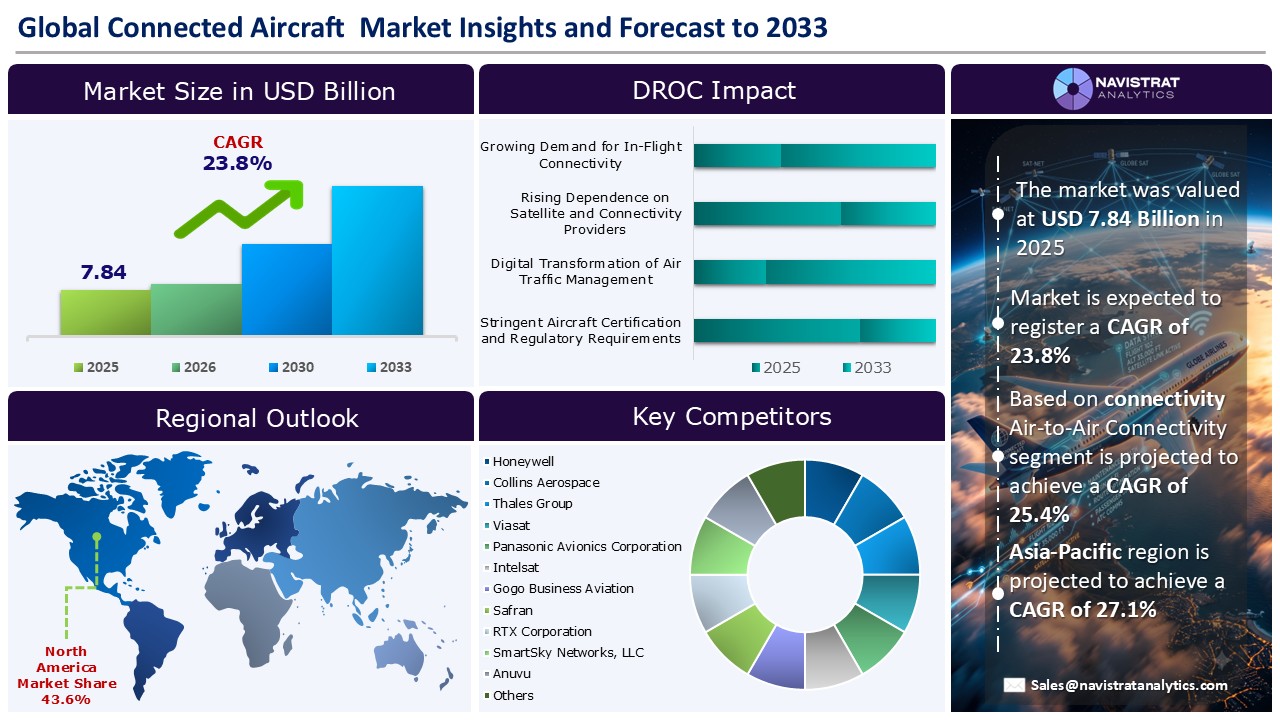
The global Connected Aircraft market reached USD 7.84 Billion in 2025 and is expected to register a revenue CAGR of 23.8% during the forecast period. Growing demand for in-flight connectivity, rapid adoption of satellite-based aircraft connectivity, rising need to improve airline operational efficiency, and increasing growth of connected aircraft data and analytics are expected to drive revenue growth of the market.
Market Drivers:
Surging passenger expectations for uninterrupted, high-speed, and low-latency in-flight connectivity (IFC) serve as a primary demand catalyst propelling revenue growth of the market. Commercial airline fliers increasingly view digital access as an indispensable utility rather than a discretionary cabin amenity, requiring uninterrupted capability to stream ultra-high-definition media, execute enterprise cloud applications, engage in corporate video conferencing, and operate multiple connected devices simultaneously across domestic and transoceanic flight corridors. According to the global Viasat Passenger Experience Survey, over 87% of surveyed travellers expressed a willingness to engage with ad-supported portals to access free high-quality in-flight Wi-Fi, while 75% stated that reliable onboard connectivity directly dictates their airline booking loyalty.
This structural shift in consumer expectations has prompted major commercial carriers to execute unprecedented fleetwide connectivity modernization contracts. In September 2024, United Airlines executed the aviation industry’s largest agreement of its kind with SpaceX to install Starlink satellite broadband across its entire mainline and regional operational fleet of more than 1,000 aircraft. The installation program, beginning with initial commercial passenger flights in early 2025 on regional Embraer E175 jets, delivers low-latency gate-to-gate connectivity with individual device download speeds exceeding 100 to 250 Mbps. Similarly, Air France announced in September 2024 that it is equipping its entire fleet with complimentary, high-speed Starlink connectivity across all travel cabins. As airlines leverage broadband connectivity to elevate Net Promoter Scores (NPS), monetize passenger e-commerce, and support connected seatback ecosystems, IFC infrastructure spending continues to drive substantial market expansion.
Market Opportunity:
The worldwide modernization and structural digitalization of air traffic management (ATM) frameworks present substantial commercial growth opportunities for the connected aircraft sector. Conventional airspace management architectures rely heavily on fragmented terrestrial radar, analogue VHF voice communications, and narrow-bandwidth datalinks that fail to support modern airspace density. This is contributing to airborne holding, route delays, and increased fuel consumption. Civil aviation authorities are systematically transitioning toward digital Trajectory-Based Operations (TBO), exemplified by the Federal Aviation Administration’s (FAA) NextGen program in the United States and the Single European Sky ATM Research (SESAR) deployment in Europe. These digital frameworks require four-dimensional (4D) trajectory profile synchronization—aligning aircraft latitude, longitude, altitude, and operational time in real time between onboard flight management systems (FMS) and terrestrial air traffic control networks.
A landmark development illustrating this opportunity occurred on September 3, 2025, when the European Space Agency (ESA), in partnership with satellite communications leader Viasat, completed the first operational commercial flight under the Iris program using a Transavia passenger aircraft flying from Paris Orly to Alicante. Operating through secure satcom datalinks certified under SESAR, the Iris network facilitates automated digital air-ground communications, continuous descent profiles, and optimal flight corridors, yielding measurable fuel burn reductions and mitigating aviation carbon dioxide emissions. This shift presents an expanding addressable market for avionics manufacturers and satellite network operators to provide safety-certified cockpit communication units, multi-link communication management units (CMUs), and secure satellite datalink subscriptions for retrofits and new aircraft assembly lines.
Recent Trends:
A defining technological trend transforming the connected aircraft landscape is the industrywide transition toward multi-orbit satellite communication architectures integrated with low-profile, electronically steered phased-array antennas (ESAs). Historically, aeronautical satcom systems relied upon geostationary Earth orbit (GEO) satellites, which, despite offering expansive regional coverage footprints, inherently introduce latency exceeding 600 milliseconds and suffer capacity constraints over polar transit routes and dense terminal areas. To overcome these operational constraints, aviation connectivity architectures are migrating toward hybrid models that integrate GEO, medium Earth orbit (MEO), and Low Earth Orbit (LEO) constellations into unified, resilient communications networks.
In addition, heavy mechanical gimbaled dual-dish antennas are being replaced by solid-state, aerodynamic ESA panels mounted flush to the aircraft fuselage. Phased-array systems electronically steer RF beams without physical mechanical actuation, eliminating mechanical wear-out points, minimizing aerodynamic drag penalties, curbing fuel consumption, and executing millisecond beam handoffs between satellites across different orbital planes.
Demonstrating this technological evolution, in October 2025, Gogo Business Aviation secured an inaugural Supplemental Type Certificate (STC) from the FAA for its Gogo Galileo FDX terminal on Boeing Business Jet (BBJ) platforms. Operating on the Eutelsat OneWeb LEO satellite constellation via a compact Hughes-engineered electronically steered antenna, the terminal provides global broadband speeds of up to 195 Mbps with low latency. The adoption of aerodynamic ESA hardware and multi-orbit interoperability has become an engineering baseline for commercial, corporate, and defense aviation platforms.
Restraints & Challenges:
Data privacy mandates, cross-border regulatory governance complexities, and heightened airborne cybersecurity vulnerabilities represent a substantial restraint restricting market expansion. Contemporary commercial aircraft function as highly digitized edge computing nodes, generating terabytes of operational telemetry, avionics sensor logs, maintenance records, and passenger web traffic on every flight segment.
The convergence of previously air-gapped flight-critical avionics control domains with passenger-facing internet routing and open ground-based maintenance networks expands the potential attack surface for hostile cyber threats, including GPS spoofing, wireless intrusion, denial-of-service (DDoS) vectors, and ransomware intrusions. Furthermore, navigating conflicting cross-border data sovereignty laws, such as the European Union’s General Data Protection Regulation (GDPR), introduces compliance liabilities when transmitting real-time passenger logs and crew communications across sovereign national airspaces.
To counter these systemic risks, aviation safety agencies have established rigorous, legally binding cybersecurity compliance mandates. The European Union Aviation Safety Agency (EASA) enforced its regulatory Part-IS (Information Security) framework, establishing October 16, 2025, as the mandatory compliance deadline for aerospace design and production organizations under Delegated Regulation (EU) 2022/1645, followed by a February 22, 2026, enforcement deadline for air operators and maintenance providers under Implementing Regulation (EU) 2023/203. Achieving compliance with Part-IS, alongside the FAA’s DO-326A/ED-202A airworthiness cybersecurity standards, requires airlines and equipment manufacturers to implement continuous vulnerability management, costly third-party security audits, and dedicated cryptographic hardware. These extensive compliance regimes prolong certification timelines, inflate engineering budgets, and impede the rapid commercialization of connected aircraft technologies.
Component Segment Insights and Analysis:
Based on the component segment, the Connected Aircraft market is segmented into systems and services. Systems segment is further sub-segmented into communication systems, navigation systems, surveillance systems, flight management systems, aircraft connectivity hardware, sensors and data acquisition systems, and others. Services segment is further sub-segmented into managed connectivity services, satellite bandwidth services, data analytics services, aircraft monitoring services, maintenance analytics services, installation & integration services, software & platform services, cybersecurity services and others.
Services segment contributed the largest share in 2025 due to the commercial aviation sector’s structural transition away from capital-intensive upfront hardware ownership toward predictable operating expenditure (OPEX) models, software-as-a-service (SaaS) fleet analytics, and long-term managed service agreements. Commercial airlines and corporate flight departments increasingly enter into multi-year operational contracts with connectivity providers to secure managed satellite bandwidth, automated passenger portal billing, continuous threat-monitoring intelligence, and cloud-based predictive maintenance pipelines without incurring massive upfront balance sheet liabilities
In May 2025, Viasat introduced JetXP, an advanced managed service platform for the business aviation sector that dynamically allocates satellite network bandwidth and integrates predictive terminal health monitoring into a single service bundle. Similarly, long-term fleet support contracts, such as Panasonic Avionics’ 10-year managed in-flight entertainment and connectivity support agreement with Riyadh Air, highlight the commercial value placed on recurring service lifecycle solutions. The revenue impact of the services segment is substantial due to its continuous, recurring cash-flow profile. While hardware sales represent a single capitalization event per airframe, managed connectivity packages, in-flight entertainment distribution licenses, and connected maintenance analytics yield high-margin, compounding monthly per-aircraft subscription billings across an aircraft’s operational lifespan.
Connectivity Segment Insights and Analysis:
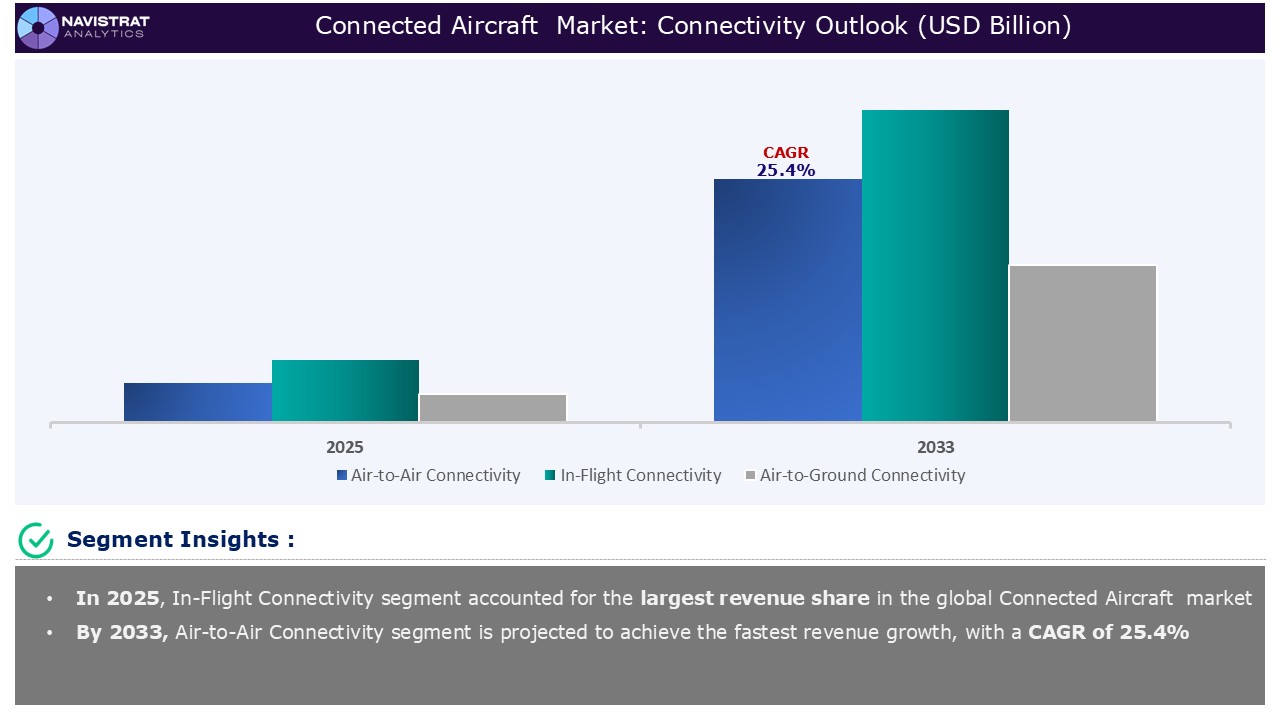
Based on connectivity, the connected aircraft market is segmented into in-flight connectivity, air-to-ground connectivity, and air-to-air connectivity.
The in-flight connectivity segment accounted for the largest revenue share in 2025 due to universal capital deployment from commercial airlines seeking to establish broadband passenger Wi-Fi as an essential brand standard and primary competitive differentiator. Unlike terrestrial-bound ATG networks, satellite-powered IFC platforms deliver uninterrupted broadband that crosses national boundaries, open oceans, and polar transit paths, making them indispensable for international widebody airliners and expanding continental narrowbody fleets
In September 2024, United Airlines executed a fleetwide connectivity agreement with SpaceX to implement Starlink IFC across more than 1,000 aircraft, initiating progressive passenger flight deployments in early 2025 to achieve speeds up to 250 Mbps per aircraft. Similar fleet commitments by major international operators, including Qatar Airways, Air France, and Delta Air Lines, have cemented satellite IFC as the foundational connectivity standard for modern air transport.
From a revenue perspective, IFC represents the primary expenditure driver within the aerospace sector; equipping an individual commercial airliner with satellite-tracking phased-array radomes, high-power transceivers, and gigabit cabin routing represents an upfront capital expenditure between USD 150,000 and USD 400,000 per airframe, followed by substantial recurring monthly bandwidth consumption fees. This dual hardware-plus-recurring-bandwidth structure drives revenue growth of this segment.
Frequency Band Segment Insights and Analysis:
Based on frequency band, the connected aircraft market is segmented into Ku-Band, Ka-Band, and L-Band.
Ku-band segment accounted for the largest revenue share in 2025 due to its extensive, mature global satellite footprint and an established worldwide manufacturing and maintenance infrastructure developed over more than two decades of commercial deployment. Most commercial airline retrofits, terminal antennas, and supplemental type certifications historically centered around Ku-band geostationary transponders, establishing a massive operational installed base across commercial mainline aircraft.
Ku-band market share was reinforced in 2025 by commercial aviation deployments of low Earth orbit constellations, most notably SpaceX Starlink, which operates primarily within Ku-band aeronautical frequencies (utilizing 10.7–12.7 GHz for downlink and 14.0–14.5 GHz for uplink transmissions). The integration of Starlink by carriers such as Hawaiian Airlines, airBaltic, and United Airlines, alongside mature Ku-band satellite networks from Panasonic Avionics and Intelsat, has solidified the segment’s dominant revenue position. In terms of revenue impact, the Ku-band ecosystem benefits from widespread economies of scale across terminal component production, keeping per-unit manufacturing costs low while generating continuous, high-volume data traffic billings. Although Ka-band is growing at a rapid pace due to high-capacity GEO launches and MEO networks, Ku-band remains the dominant revenue contributor across civil and commercial aviation.
Geographical Outlook:
Connected Aircraft market is strategically segmented by geography to provide a comprehensive understanding of regional market dynamic. Discover demand analysis, emerging trends, and growth opportunities shaping market performance across different region and countries.
North America Connected Aircraft Market:
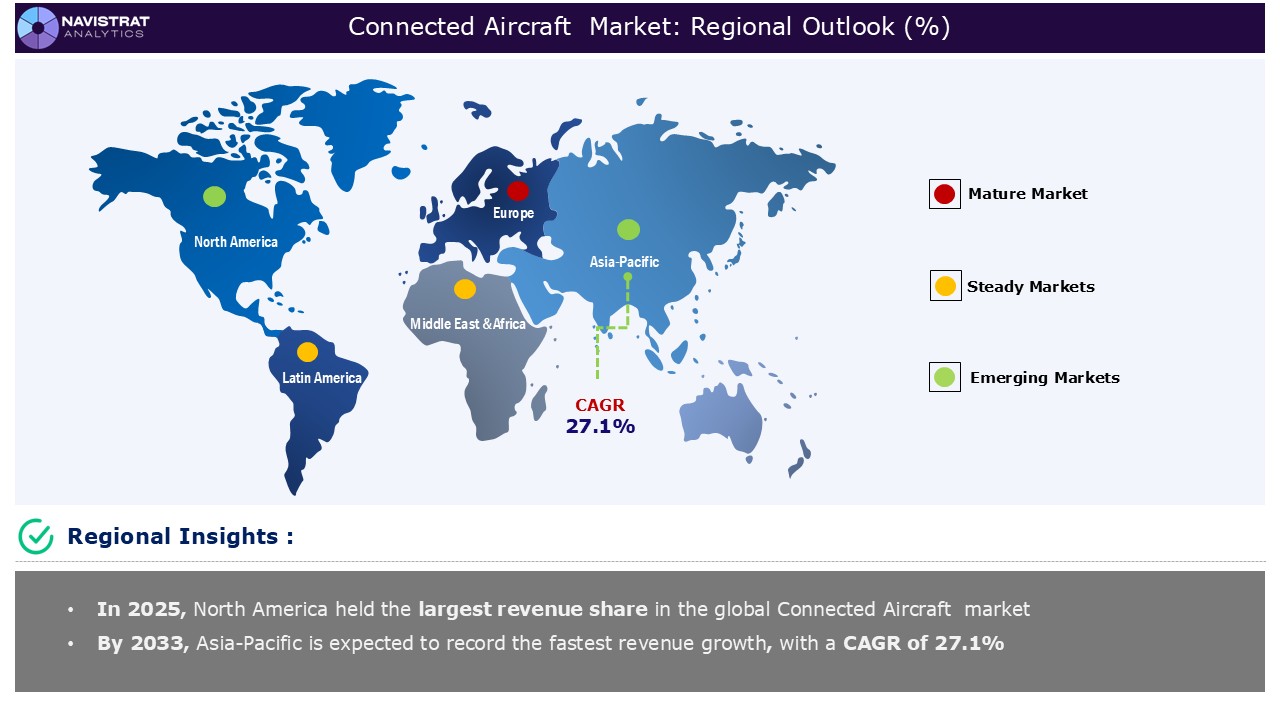
Market in North America accounted for largest revenue share in 2025. This market dominance is supported by the region possessing the world’s largest operational fleet of commercial transport aircraft, an extensive inventory of business jets, advanced aerospace electronics manufacturing capabilities, and widespread passenger adoption of digital cabin connectivity. More than 80% of passenger airframes operating in North American airspace are equipped with high-throughput IFC or ATG communications infrastructure. The regional industry is anchored by leading aerospace avionics and satcom systems providers, including Collins Aerospace (RTX), Honeywell International, Viasat, and Gogo Inc.
Revenue expansion across North America is also driven by fleetwide retrofits and federal regulatory mandates. In September 2024, United Airlines finalized a contract with SpaceX to install Starlink connectivity across more than 1,000 aircraft, launching flight installations on Embraer E175 regional jets in early 2025 under FAA oversight. Concurrently, Gogo Business Aviation expanded its business aviation presence, securing an FAA Supplemental Type Certificate in October 2025 for its Galileo FDX LEO satellite terminals on Boeing Business Jets. Furthermore, the FAA’s continuous investment in NextGen Data Communications (Data Comm) and Trajectory-Based Operations requires commercial airlines to integrate certified flight deck communication systems. These factors, paired with high private investment in multi-orbit satcom networks and 5G ATG infrastructure, ensure North America maintains its market-leading position.
Asia Pacific Connected Aircraft Market:
Asia Pacific is expected to register a fast revenue growth rate during the forecast period due to the strong passenger traffic growth, massive commercial aircraft order backlogs across China, India, and Southeast Asia, rising passenger disposable incomes, and state-backed investments in civil aviation infrastructure. Airlines throughout the region are procuring newly delivered aircraft configured with factory-installed, line-fit satellite connectivity solutions directly from Boeing and Airbus.
Market revenue growth is also accelerated by substantial fleet modernization initiatives among prominent regional carriers. In 2024 and 2025, Indian operators such as Air India and IndiGo implemented major digital fleet upgrade programs, integrating high-throughput Ka-band and Ku-band systems across hundreds of newly ordered Airbus A320neo and Boeing 737 MAX aircraft. Government initiatives strongly support this expansion; the Civil Aviation Administration of China (CAAC) established strategic policy mandates requiring the deployment of high-capacity satellite communications and 5G ATG connectivity across Chinese civil fleets under its smart civil aviation master plan. As regional regulatory authorities expand aeronautical spectrum allocations and domestic satellite operators deploy regional communications constellations, Asia Pacific is positioned as the primary long-term growth driver of the global connected aircraft market.
Europe Connected Aircraft Market:
Market in Europe accounted for a significant revenue share in 2025. European market dynamics are characterized by dense, highly congested airspace corridors, a stringent civil aviation safety oversight environment, robust aerospace research and development programs, and strong institutional commitments to flight decarbonization. Leading European aerospace organizations, such as Airbus, Thales Group, BAE Systems, and regional satellite operators, continue to advance flight deck communications management and passenger cabin digital experiences.
Competition Analysis:
The Connected Aircraft market is characterized by a consolidated structure, with few players competing across various segments and regions. List of major players included in the Connected Aircraft market report are:
- Honeywell International Inc.
- Thales Group
- Viasat Inc.
- Panasonic Avionics Corporation
- Intelsat
- Gogo Business Aviation
- Safran
- RTX Corporation
- SmartSky Networks, LLC
- Anuvu
- Hughes Network Systems
- Astronics Corporation
- Kontron AG
Strategic Developments in Connected Aircraft Market:
- In April 2026, Airbus is advancing its digital transformation through the establishment of Skywise. It is a wholly owned subsidiary that brings together Skywise digital solutions and Navblue capabilities under one organization. The initiative aims to respond more effectively to changing customer requirements while improving the efficiency of flight, technical, and ground operations across both Airbus and non-Airbus fleets. Skywise has significantly transformed the way aviation data is collected, managed, and utilized. The platform is now evolving beyond its role as a standalone digital tool into a comprehensive digital solutions business.
- In May 2025, Viasat launched JetXP, a managed in-flight connectivity service platform for business aviation that integrates dynamic bandwidth optimization and real-time terminal diagnostics. It is supported by retrofit incentive programs of up to USD 140,000 per aircraft to accelerate customer migration from legacy Ku-band terminals to modern Ka-band networks.
- In March 2025, United has installed Starlink on its first regional aircraft, highlighting the technology’s operational advantages. The airline also outlined the installation process, focusing on equipment size, weight, installation, and maintenance benefits. United plans to equip more than 40 regional aircraft each month from May through December 2025. The average Starlink installation takes approximately eight hours. This excludes existing equipment removal, testing, and required aircraft modifications. The installation process is roughly ten times faster than installing conventional non-Starlink connectivity equipment.
Key Advantages for Stakeholders:
Navistrat Analytics’ industry report provides an in-depth quantitative analysis of global market segments and industry dynamics. It covers historical trends, current developments, and market forecasts. The report covers historical years from 2023 to 2024. The year 2025 serves as the base year for market size calculations. The forecast period extends from 2026 to 2033.
The report includes an executive summary and a comprehensive analysis of market drivers, restraints, opportunities, and challenges (DROC). It also provides insights into relevant regulatory standards and requirements. The report features detailed PORTER’s Five Forces, SWOT, and PESTLE analyses. It also examines technological trends and the competitive landscape.
PORTER’s Five Forces analysis evaluates new entrants, competitive rivalry, supplier power, buyer power, and substitution threats. This analysis helps stakeholders understand market competition and overall industry attractiveness.
The competitive landscape evaluates the market positions of key industry players. It provides insights into competitive strategies, market presence, and the broader competitive environment.
Scope And Key Highlights of The Connected Aircraft Market Report:
| Report Features | Details |
| Market Size in 2025 | USD 7.84 Billion |
| Market Growth Rate in CAGR (2026–2033) | 23.8% |
| Market Revenue Forecast to 2033 | USD 42.59 Billion |
| Base year | 2025 |
| Historical year | 2023–2024 |
| Forecast period | 2026–2033 |
| Report Pages | 450 |
| Segments Covered |
|
| Regional scope |
|
| Country Scope |
|
| Key Market Players |
|
| Delivery Format | Reports are delivered in PDF format via email. |
| Customization scope | Request Customization |
The Connected Aircraft market report offers a detailed analysis of market size. It includes historical revenue (in USD Billion) data for 2023-2024 and revenue forecasts for 2026-2033 across the following segments:
- Component Outlook (Revenue, USD Billion; 2023-2033)
- Systems
- Communication Systems
- Navigation Systems
- Surveillance Systems
- Flight Management Systems
- Aircraft Connectivity Hardware
- Sensors and Data Acquisition Systems
- Others
- Services
- Managed Connectivity Services
- Satellite Bandwidth Services
- Data Analytics Services
- Aircraft Monitoring Services
- Maintenance Analytics Services
- Installation & Integration Services
- Software & Platform Services
- Cybersecurity Services
- Others
- Systems
- Connectivity Outlook, (Revenue, USD Billion; 2023-2033)
- In-Flight Connectivity
- Air-to-Ground Connectivity
- Air-to-Air Connectivity
- Frequency Band Outlook (Revenue, USD Billion; 2023-2033)
- Ku-Band
- Ka-Band
- L-Band
- Application Outlook (Revenue, USD Billion; 2023-2033)
- Commercial Aviation
- Narrow Body
- Wide Body
- Business Jet
- General Aviation Aircraft
- Military Aviation
- Fighter Aircraft
- Military Transport Aircraft
- Military Helicopter
- Business and General Aviation
- Private Aircraft
- Charter Aircraft
- Utility Aircraft
- Special-Mission Aircraft
- Commercial Aviation
- Installation Outlook (Revenue, USD Billion; 2023-2033)
- Line-Fit
- Retrofit
- Connectivity Retrofit
- Avionics Retrofit
- Cabin Retrofit
- Regional Outlook (Revenue, USD Billion; 2023-2033)
- North America
- U.S.
- Canada
- Mexico
- Europe
- Germany
- France
- U.K.
- Italy
- Spain
- Benelux
- Nordic Countries
- Rest of Europe
- Asia Pacific
- China
- India
- Japan
- South Korea
- Oceania
- ASEAN Countries
- Rest of APAC
- Latin America
- Brazil
- Rest of LATAM
- Middle East & Africa
- GCC Countries
- South Africa
- Israel
- Turkey
- Rest of MEA
- North America
Frequently Asked Questions (FAQ) about the Connected Aircraft Market Report
The Connected Aircraft market size was USD 7.84 billion in 2025.
The Connected Aircraft market revenue is expected to register a Compound Annual Growth Rate (CAGR) of 23.8% during the forecast period.
Growing demand for in-flight connectivity, rapid adoption of satellite-based aircraft connectivity, rising need to improve airline operational efficiency, and increasing growth of connected aircraft data and analytics are the key drivers of the connected aircraft market revenue growth.
High installation and retrofit costs, data privacy and data governance concerns, and rising dependence on satellite and connectivity providers are key factors restraining revenue growth of the market.
Asia Pacific is expected to account for the fastest revenue growth of 27.1%.
In-Flight connectivity segment is the leading segment of connected aircraft market in terms of connectivity.
- Market Definition
- Research Objective
- Research Methodology
- Research Design
- Data Collection Methods
- Primary
- Secondary
- Market Size Estimation
- Top-down method
- Bottom-up method
- Forecasting Methodology
- Tools and Models Used
- Market Overview and Trends
- Market Size and Forecast
- Industry Analysis
- Market Driver, Restraints, Opportunity and Challenges (DROC) Analysis
- Market Drivers
- Growing Demand for In-Flight Connectivity
- Rapid Adoption of Satellite-Based Aircraft Connectivity
- Rising Need to Improve Airline Operational Efficiency
- Increasing Growth of Connected Aircraft Data and Analytics
- Market Restraints
- High Installation and Retrofit Costs
- Data Privacy and Data Governance Concerns
- Rising Dependence on Satellite and Connectivity Providers
- Market Opportunities
- Increasing Adoption of Predictive Maintenance
- Digital Transformation of Air Traffic Management
- Expansion of Real-Time Aircraft-to-Ground Data Exchange
- Increasing Use of AI and Machine Learning in Aviation
- Market Challenges
- Stringent Aircraft Certification and Regulatory Requirements
- Connectivity Coverage and Reliability Limitations
- Interoperability and Technology Fragmentation
- Regulatory Landscape
- North America
- Europe
- Asia Pacific
- Latin America
- Middle East and Africa
- Strategic Insights
- Porter’s Five Forces Analysis
- PESTLE Analysis
- Price Trend Analysis
- Value Chain Analysis
- Technological Trends
- Transition toward Multi-Orbit Satellite Communication
- 5G Non-Terrestrial Networks (NTN) for Aircraft
- Software-Defined Aircraft Architecture
- AI-Driven Predictive Maintenance and Real-Time Analytics
- Integrated Air-Ground-Space Connectivity and Edge Processing
- Recent Developments
- Funding
- Merger and Acquisition
- Expansion
- Partnership and Collaboration
- Product/ Service Launch
- Type Market Revenue Estimates and Forecasts, 2023-2033
- Systems
- Communication Systems
- Navigation Systems
- Surveillance Systems
- Flight Management Systems
- Aircraft Connectivity Hardware
- Sensors and Data Acquisition Systems
- Others
- Services
- Managed Connectivity Services
- Satellite Bandwidth Services
- Data Analytics Services
- Aircraft Monitoring Services
- Maintenance Analytics Services
- Installation & Integration Services
- Software & Platform Services
- Cybersecurity Services
- Others
- Systems
- Connectivity Market Revenue Estimates and Forecasts, 2023-2033
- In-Flight Connectivity
- Air-to-Ground Connectivity
- Air-to-Air Connectivity
- Frequency Band Market Revenue Estimates and Forecasts, 2023-2033
- Ku-Band
- Ka-Band
- L-Band
- Application Market Revenue Estimates and Forecasts, 2023-2033
- Commercial Aviation
- Narrow Body
- Wide Body
- Business Jet
- General Aviation Aircraft
- Military Aviation
- Fighter Aircraft
- Military Transport Aircraft
- Military Helicopter
- Business and General Aviation
- Private Aircraft
- Charter Aircraft
- Utility Aircraft
- Special-Mission Aircraft
- Commercial Aviation
- Installation Market Revenue Estimates and Forecasts, 2023-2033
- Line-Fit
- Retrofit
- Connectivity Retrofit
- Avionics Retrofit
- Cabin Retrofit
- Connected Aircraft Market Revenue Estimates and Forecasts by Region, 2023-2033, USD Billion
- North America
- North America Connected Aircraft Market By Type, Market Revenue Estimates and Forecasts, 2023-2033, USD Billion
- Systems
- Communication Systems
- Navigation Systems
- Surveillance Systems
- Flight Management Systems
- Aircraft Connectivity Hardware
- Sensors and Data Acquisition Systems
- Others
- Services
- Managed Connectivity Services
- Satellite Bandwidth Services
- Data Analytics Services
- Aircraft Monitoring Services
- Maintenance Analytics Services
- Installation & Integration Services
- Software & Platform Services
- Cybersecurity Services
- Others
- Systems
- North America Connected Aircraft Market By Connectivity, Market Revenue Estimates and Forecasts, 2023-2033, USD Billion
- In-Flight Connectivity
- Air-to-Ground Connectivity
- Air-to-Air Connectivity
- North America Connected Aircraft Market By Frequency Band, Market Revenue Estimates and Forecasts, 2023-2033, USD Billion
- Ku-Band
- Ka-Band
- L-Band
- North America Connected Aircraft Market By Application, Market Revenue Estimates and Forecasts, 2023-2033, USD Billion
- Commercial Aviation
- Narrow Body
- Wide Body
- Business Jet
- General Aviation Aircraft
- Military Aviation
- Fighter Aircraft
- Military Transport Aircraft
- Military Helicopter
- Business and General Aviation
- Private Aircraft
- Charter Aircraft
- Utility Aircraft
- Special-Mission Aircraft
- Commercial Aviation
- North America Connected Aircraft Market By Installation, Market Revenue Estimates and Forecasts, 2023-2033, USD Billion
- Line-Fit
- Retrofit
- Connectivity Retrofit
- Avionics Retrofit
- Cabin Retrofit
- North America Connected Aircraft Market Revenue Estimates and Forecasts by Country, 2023-2033, USD Billion
- United States
- Canada
- Mexico
- North America Connected Aircraft Market By Type, Market Revenue Estimates and Forecasts, 2023-2033, USD Billion
- Europe
- Europe Connected Aircraft Market By Type, Market Revenue Estimates and Forecasts, 2023-2033, USD Billion
- Systems
- Communication Systems
- Navigation Systems
- Surveillance Systems
- Flight Management Systems
- Aircraft Connectivity Hardware
- Sensors and Data Acquisition Systems
- Others
- Services
- Managed Connectivity Services
- Satellite Bandwidth Services
- Data Analytics Services
- Aircraft Monitoring Services
- Maintenance Analytics Services
- Installation & Integration Services
- Software & Platform Services
- Cybersecurity Services
- Others
- Systems
- Europe Connected Aircraft Market By Connectivity, Market Revenue Estimates and Forecasts, 2023-2033, USD Billion
- In-Flight Connectivity
- Air-to-Ground Connectivity
- Air-to-Air Connectivity
- Europe Connected Aircraft Market By Frequency Band, Market Revenue Estimates and Forecasts, 2023-2033, USD Billion
- Ku-Band
- Ka-Band
- L-Band
- Europe Connected Aircraft Market By Application, Market Revenue Estimates and Forecasts, 2023-2033, USD Billion
- Commercial Aviation
- Narrow Body
- Wide Body
- Business Jet
- General Aviation Aircraft
- Military Aviation
- Fighter Aircraft
- Military Transport Aircraft
- Military Helicopter
- Business and General Aviation
- Private Aircraft
- Charter Aircraft
- Utility Aircraft
- Special-Mission Aircraft
- Commercial Aviation
- Europe Connected Aircraft Market By Installation, Market Revenue Estimates and Forecasts, 2023-2033, USD Billion
- Line-Fit
- Retrofit
- Connectivity Retrofit
- Avionics Retrofit
- Cabin Retrofit
- Europe Connected Aircraft Market Revenue Estimates and Forecasts by Country, 2023-2033, USD Billion
- Germany
- United Kingdom
- France
- Italy
- Spain
- Benelux
- Nordic Countries
- Rest of Europe
- Europe Connected Aircraft Market By Type, Market Revenue Estimates and Forecasts, 2023-2033, USD Billion
- Asia-Pacific
- Asia-Pacific Connected Aircraft Market By Type, Market Revenue Estimates and Forecasts, 2023-2033, USD Billion
- Systems
- Communication Systems
- Navigation Systems
- Surveillance Systems
- Flight Management Systems
- Aircraft Connectivity Hardware
- Sensors and Data Acquisition Systems
- Others
- Services
- Managed Connectivity Services
- Satellite Bandwidth Services
- Data Analytics Services
- Aircraft Monitoring Services
- Maintenance Analytics Services
- Installation & Integration Services
- Software & Platform Services
- Cybersecurity Services
- Others
- Systems
- Asia-Pacific Connected Aircraft Market By Connectivity, Market Revenue Estimates and Forecasts, 2023-2033, USD Billion
- In-Flight Connectivity
- Air-to-Ground Connectivity
- Air-to-Air Connectivity
- Asia-Pacific Connected Aircraft Market By Frequency Band, Market Revenue Estimates and Forecasts, 2023-2033, USD Billion
- Ku-Band
- Ka-Band
- L-Band
- Asia-Pacific Connected Aircraft Market By Application, Market Revenue Estimates and Forecasts, 2023-2033, USD Billion
- Commercial Aviation
- Narrow Body
- Wide Body
- Business Jet
- General Aviation Aircraft
- Military Aviation
- Fighter Aircraft
- Military Transport Aircraft
- Military Helicopter
- Business and General Aviation
- Private Aircraft
- Charter Aircraft
- Utility Aircraft
- Special-Mission Aircraft
- Commercial Aviation
- Asia-Pacific Connected Aircraft Market By Installation, Market Revenue Estimates and Forecasts, 2023-2033, USD Billion
- Line-Fit
- Retrofit
- Connectivity Retrofit
- Avionics Retrofit
- Cabin Retrofit
- Asia-Pacific Connected Aircraft Market Revenue Estimates and Forecasts by Country, 2023-2033, USD Billion
- China
- India
- Japan
- South Korea
- Oceania
- ASEAN Countries
- Rest of Asia-Pacific
- Asia-Pacific Connected Aircraft Market By Type, Market Revenue Estimates and Forecasts, 2023-2033, USD Billion
- Latin America
- Latin America Connected Aircraft Market By Type, Market Revenue Estimates and Forecasts, 2023-2033, USD Billion
- Systems
- Communication Systems
- Navigation Systems
- Surveillance Systems
- Flight Management Systems
- Aircraft Connectivity Hardware
- Sensors and Data Acquisition Systems
- Others
- Services
- Managed Connectivity Services
- Satellite Bandwidth Services
- Data Analytics Services
- Aircraft Monitoring Services
- Maintenance Analytics Services
- Installation & Integration Services
- Software & Platform Services
- Cybersecurity Services
- Others
- Systems
- Latin America Connected Aircraft Market By Connectivity, Market Revenue Estimates and Forecasts, 2023-2033, USD Billion
- In-Flight Connectivity
- Air-to-Ground Connectivity
- Air-to-Air Connectivity
- Latin America Connected Aircraft Market By Frequency Band, Market Revenue Estimates and Forecasts, 2023-2033, USD Billion
- Ku-Band
- Ka-Band
- L-Band
- Latin America Connected Aircraft Market By Application, Market Revenue Estimates and Forecasts, 2023-2033, USD Billion
- Commercial Aviation
- Narrow Body
- Wide Body
- Business Jet
- General Aviation Aircraft
- Military Aviation
- Fighter Aircraft
- Military Transport Aircraft
- Military Helicopter
- Business and General Aviation
- Private Aircraft
- Charter Aircraft
- Utility Aircraft
- Special-Mission Aircraft
- Commercial Aviation
- Latin America Connected Aircraft Market By Installation, Market Revenue Estimates and Forecasts, 2023-2033, USD Billion
- Line-Fit
- Retrofit
- Connectivity Retrofit
- Avionics Retrofit
- Cabin Retrofit
- Latin America Connected Aircraft Market Revenue Estimates and Forecasts by Country, 2023-2033, USD Billion
- Brazil
- Rest of Latin America
- Latin America Connected Aircraft Market By Type, Market Revenue Estimates and Forecasts, 2023-2033, USD Billion
- Middle East & Africa
- Middle East & Africa Connected Aircraft Market By Type, Market Revenue Estimates and Forecasts, 2023-2033, USD Billion
- Systems
- Communication Systems
- Navigation Systems
- Surveillance Systems
- Flight Management Systems
- Aircraft Connectivity Hardware
- Sensors and Data Acquisition Systems
- Others
- Services
- Managed Connectivity Services
- Satellite Bandwidth Services
- Data Analytics Services
- Aircraft Monitoring Services
- Maintenance Analytics Services
- Installation & Integration Services
- Software & Platform Services
- Cybersecurity Services
- Others
- Systems
- Middle East & Africa Connected Aircraft Market By Connectivity, Market Revenue Estimates and Forecasts, 2023-2033, USD Billion
- In-Flight Connectivity
- Air-to-Ground Connectivity
- Air-to-Air Connectivity
- Middle East & Africa Connected Aircraft Market By Frequency Band, Market Revenue Estimates and Forecasts, 2023-2033, USD Billion
- Ku-Band
- Ka-Band
- L-Band
- Middle East & Africa Connected Aircraft Market By Application, Market Revenue Estimates and Forecasts, 2023-2033, USD Billion
- Commercial Aviation
- Narrow Body
- Wide Body
- Business Jet
- General Aviation Aircraft
- Military Aviation
- Fighter Aircraft
- Military Transport Aircraft
- Military Helicopter
- Business and General Aviation
- Private Aircraft
- Charter Aircraft
- Utility Aircraft
- Special-Mission Aircraft
- Commercial Aviation
- Middle East & Africa Connected Aircraft Market By Installation, Market Revenue Estimates and Forecasts, 2023-2033, USD Billion
- Line-Fit
- Retrofit
- Connectivity Retrofit
- Avionics Retrofit
- Cabin Retrofit
- Middle East & Africa Connected Aircraft Market Revenue Estimates and Forecasts by Country, 2023-2033, USD Billion
- GCC Countries
- South Africa
- Israel
- Turkey
- Rest of Middle East & Africa
- Middle East & Africa Connected Aircraft Market By Type, Market Revenue Estimates and Forecasts, 2023-2033, USD Billion
- Market Share Analysis
- Revenue Market Share by Key Players (2025-2026)
- Analysis of Top Players by Market Presence
- Competitive Matrix
- Competitive Strategies
- Mergers and Acquisitions
- Partnerships and Collaboration
- Investment and Fundings
- Agreement
- Expansion
- New Product/ Services Launches
- Technological Innovations
- Honeywell
- Company Overview
- Financial Insights
- Product/ Services Type
- Strategic Developments
- SWOT Analysis
- Collins Aerospace
- Company Overview
- Financial Insights
- Product/ Services Type
- Strategic Developments
- SWOT Analysis
- Thales Group
- Company Overview
- Financial Insights
- Product/ Services Type
- Strategic Developments
- SWOT Analysis
- Viasat
- Company Overview
- Financial Insights
- Product/ Services Type
- Strategic Developments
- SWOT Analysis
- Panasonic Avionics Corporation
- Company Overview
- Financial Insights
- Product/ Services Type
- Strategic Developments
- SWOT Analysis
- Intelsat
- Company Overview
- Financial Insights
- Product/ Services Type
- Strategic Developments
- SWOT Analysis
- Gogo Business Aviation
- Company Overview
- Financial Insights
- Product/ Services Type
- Strategic Developments
- SWOT Analysis
- Safran
- Company Overview
- Financial Insights
- Product/ Services Type
- Strategic Developments
- SWOT Analysis
- RTX Corporation
- Company Overview
- Financial Insights
- Product/ Services Type
- Strategic Developments
- SWOT Analysis
- SmartSky Networks, LLC
- Company Overview
- Financial Insights
- Product/ Services Type
- Strategic Developments
- SWOT Analysis
- Anuvu
- Company Overview
- Financial Insights
- Product/ Services Type
- Strategic Developments
- SWOT Analysis
- Hughes Network Systems
- Company Overview
- Financial Insights
- Product/ Services Type
- Strategic Developments
- SWOT Analysis
- Astronics Corporation
- Company Overview
- Financial Insights
- Product/ Services Type
- Strategic Developments
- SWOT Analysis
- Astronics Corporation
- Company Overview
- Financial Insights
- Product/ Services Type
- Strategic Developments
- SWOT Analysis