

Neuromorphic Chip Market Overview and Key Insights:
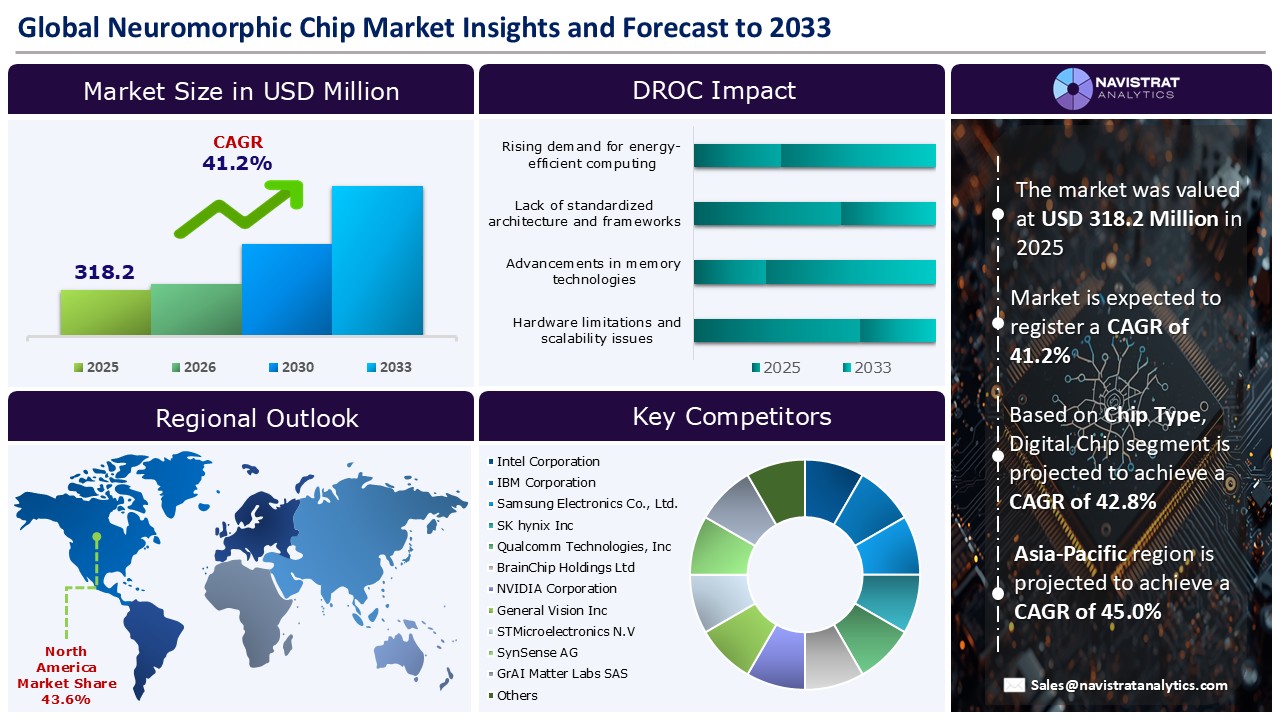
The global neuromorphic chip market reached USD 318.2 million in 2025 and is expected to register a revenue CAGR of 41.2% during the forecast period. Rising demand for energy-efficient computing, growing adoption of edge AI and IoT devices, increasing adoption in autonomous and smart mobility and rising focus on edge computing are expected to drive revenue growth of the market.
Market Drivers:
Growing adoption of edge AI and IoT devices is driving strong revenue growth of the market. Industries now seek computing capabilities that deliver intelligence directly at the data point rather than relying on distant servers. Traditional AI architectures depend heavily on cloud infrastructure, leading to delays, higher energy use, and privacy issues. Neuromorphic chips imitate the brain’s event-driven, parallel processing style, addressing these limitations by supporting real-time, ultra-efficient edge computation. Their suitability for autonomous systems, smart sensors, and connected devices lies in their ability to make instant decisions without constant cloud access.
The rapid expansion of IoT ecosystems across smart homes, industrial automation, healthcare, and autonomous mobility is fuelling demand for compact and energy-efficient on-device AI hardware. In October 2024, for instance, Mercedes-Benz formed a collaboration with the Ontario Vehicle Innovation Network (OVIN), the province’s leading automotive and mobility program. The automaker also announced a research partnership with the University of Waterloo in Ontario, targeting advances in neuromorphic computing for autonomous driving development.
Market Opportunity:
Rising expansion of neuromorphic R&D and Government funding are creating significant opportunities for the market. Countries are recognizing their strategic value for defense, healthcare, robotics, energy efficiency, and national innovation goals. Funding programs, public–private collaborations, and dedicated research labs are accelerating breakthroughs in materials, chip design, and real-world use cases. Universities and research institutes are driving prototype creation and patent generation. Government-backed pilot projects also validate applications in autonomous mobility, smart infrastructure, and next-generation computing.
Academic institutions were among the first to showcase neuromorphic systems. Stanford University’s Neurogrid project demonstrated a hybrid analog–digital architecture capable of simulating a million neurons and billions of synapses in real time. Research center IMEC also developed a neuromorphic processor capable of learning autonomously. Public agencies contributed as well through major research initiatives. The European Union’s Human Brain Project, for instance, is a decade-long program concluded in 2023 that focused on improving understanding of the human brain, advancing therapies for neurological disorders, and fostering brain-inspired computing innovations.
Recent Trends:
Emergence of neuromorphic photonic (optoelectronic) chips has emerged as a key technological trend of the market. These chips use light to perform spiking neural processing, which delivers ultra-low latency, high bandwidth, and very low power demand compared to conventional electronic designs. Their ability to process signals at gigahertz speeds while supporting event-driven learning makes them attractive for dynamic vision tasks, robotics, and autonomous navigation. Innovators are exploring optoelectronic architectures that combine photonics for fast computation and electronics for control logic, paving the way for scalable systems capable of real-time decision-making.
In December 2024, a team at the Massachusetts Institute of Technology showcased a fully integrated photonic processor capable of executing every major operation of a deep neural network directly on-chip using light. This breakthrough promises significantly faster and more energy-efficient deep learning, particularly for high-demand applications such as lidar systems and ultra-fast telecommunications. Industries such as autonomous mobility, advanced sensing, and high-speed communications are now exploring these chips to improve performance and efficiency. This rising adoption encourages greater investment, accelerates product development, and expands application opportunities, which collectively contribute to revenue growth in the neuromorphic chip market.
Restraints & Challenges:
Lack of standardized architecture and frameworks is a significant factor restraining the revenue growth of the market. Vendors continue to depend on proprietary designs, and available software tools for building and training neuromorphic systems are still fragmented and underdeveloped. This inconsistency drives up integration complexity, lengthens development cycles, and makes organizations hesitant to scale implementations. Industries also face challenges in migrating applications or comparing performance across platforms, which delays commercialization and weakens buyer confidence. Until mature standards, toolchains, and interoperability guidelines emerge, wider market adoption will remain limited, tempering the overall growth potential.
Chip Type Segment Insights and Analysis:
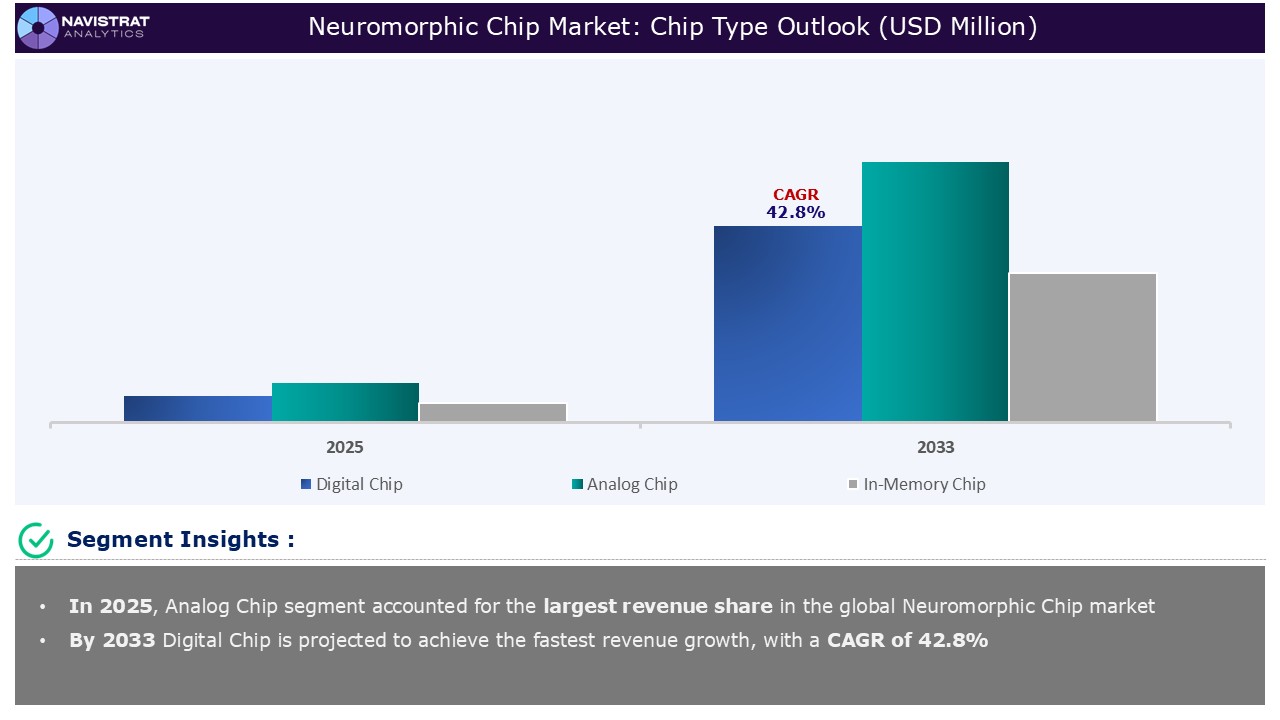
Based on the chip type segment, the neuromorphic chip market is segmented into digital chip, analog chip and in-memory chip.
Digital Chip segment is expected to register a fast revenue growth rate during the forecast period due to the rising adoption of this chip, owing to its mature, scalable, and commercially ready pathway compared to analog alternatives. These chips align well with existing CMOS manufacturing processes, making them easier and cheaper to mass-produce. They integrate smoothly with current digital computing infrastructure, which reduces adoption barriers for industries developing AI applications. Developers also benefit from clearer programming models, better software tool support, and higher reliability for deployment in edge devices, robotics, autonomous systems, and data-center accelerators.
In January 2025, BrainChip Holdings Ltd, the company that commercially delivers fully digital, ultra-low-power event-based neuromorphic AI, announced that its Akida neural processing technology is now offered in an M.2 module format. This release provides a cost-efficient, fast, and energy-saving option for developers building their own edge AI hardware solutions. This practical, plug-and-play approach encourages wider use across consumer, industrial, and IoT applications. It increases demand and directly supports revenue growth of this segment.
Deployment Segment Insights and Analysis:
Based on deployment, the neuromorphic chip market is segmented into edge devices, on-premise and datacenter/cloud.
Edge devices segment contributed the largest share in 2025 due to the high adoption of edge devices owing to its real-time intelligence and ultra-low power consumption. Devices such as smart sensors, wearables, autonomous robots, and industrial controllers benefit from the ability to process data locally, improving responsiveness, privacy, and battery performance. Growing IoT deployments, rising demand for autonomous decision-making, and expansion of smart mobility solutions are further accelerating adoption. The widening range of commercial applications is translating into higher shipments and revenue growth of this segment.
In May 2025, Innatera, a neuromorphic processor developer, recently introduced Pulsar. It is the first commercially released microcontroller aimed at enabling brain-like intelligence in edge devices. Neuromorphic processors replicate the architecture and behavior of biological neural networks, especially the human brain. Instead of relying on the von Neumann model where memory and processing are separated, these chips merge storage and computation in the same locations, much like the cooperative function of neurons and synapses in the brain.
End-Use Segment Insights and Analysis:
Based on end-use, the neuromorphic chip market is segmented into automotive, consumer electronics, healthcare, aerospace and defense, IT and telecommunications, industrial & manufacturing and others.
Consumer electronics segment contributed the largest share in 2025 due to the rising demand for smarter, energy-efficient, and context-aware devices. Smartphones, wearables, AR/VR headsets, smart home products, and personal assistants increasingly require on-device intelligence for voice recognition, gesture control, vision processing, and personalized user experiences. Neuromorphic chips support these capabilities while extending battery life and improving privacy by reducing cloud dependence. Manufacturers are integrating these processors to offer premium features and differentiation, driving adoption in mid-range and high-end products.
In December 2025, Innatera, a leader in neuromorphic processors, entered a strategic partnership with UK firm 42 Technology (42T) to accelerate edge AI innovation. The alliance targets low-power, brain-inspired AI for industrial systems, IoT infrastructure, and smart products. The collaboration aims to create edge AI solutions for use cases such as anomaly detection, condition monitoring, and predictive maintenance. The partnership is focused on high-value edge AI opportunities, such as low-power intelligence for consumer electronics, wearables, and smart home systems. It provides responsive and energy-efficient operation in these devices.
Geographical Outlook:
Neuromorphic Chip market is strategically segmented by geography to provide a comprehensive understanding of regional market dynamic. Discover demand analysis, emerging trends, and growth opportunities shaping market performance across different region and countries.
North America Neuromorphic Chip Market:
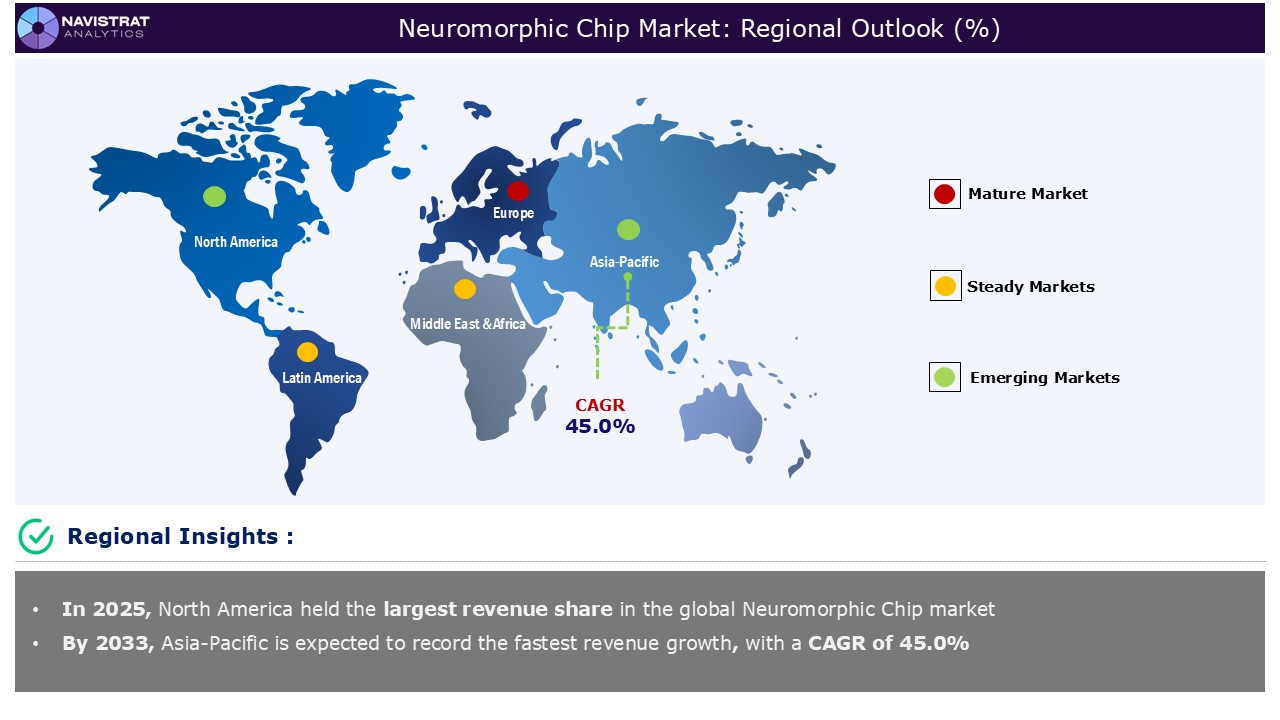
Market in North America accounted for largest revenue share in 2025 due to advanced innovation ecosystem, early technology adoption, and strong presence of leading semiconductor and AI companies in the region. Research institutions, defense agencies, and government programs actively fund brain-inspired computing, accelerating prototype development and commercialization. Tech giants and startups in the region are integrating neuromorphic processors into autonomous systems, robotics, consumer electronics, and industrial automation, creating steady demand.
Leading U.S. players in neuromorphic chip development include Intel, IBM, and an expanding base of startups. In October 2024, for instance, IBM advanced its brain-inspired hardware portfolio by introducing the TrueNorth architecture and its successor, NorthPole. Earlier, in April 2024, Intel revealed Hala Point. It is the world’s largest neuromorphic computing system—deployed at Sandia National Laboratories. Built using 1,152 Loihi 2 processors and capable of supporting 1.15 billion neurons, the system is designed to address energy efficiency and sustainability challenges in today’s AI workloads. These factors, supported by venture capital activity and strategic partnerships between academia and industry, are boosting revenue growth of the market in this region.
Asia Pacific Neuromorphic Chip Market:
Asia Pacific is expected to register a fast revenue growth rate during the forecast period due to the rapid expansion of electronics manufacturing, increasing investment in AI innovation, and rising adoption of edge intelligence across sectors. Countries such as China, Japan, South Korea, and India are advancing national AI programs, investing in semiconductor R&D, and supporting university–industry collaborations focused on brain-inspired computing. The region’s large consumer electronics base, strong robotics ecosystem, and accelerating deployment of smart factories and autonomous mobility solutions are driving demand for low-power cognitive processing hardware.
In August 2025, Researchers at Zhejiang University in China have unveiled a brain-inspired computing system known as Darwin Monkey. It incorporates more than 2 billion artificial neurons. The platform uses 960 Darwin 3 neuromorphic chips to form over 100 billion synaptic connections—roughly matching the neural density of a macaque. Designed to advance brain-like AI research, the system has already demonstrated capabilities in areas such as content generation, logical reasoning, and mathematics, powered by a large AI model developed by Chinese firm DeepSeek
Europe Neuromorphic Chip Market:
Market in Europe accounted for a significant revenue share in 2025 due to strong research leadership, coordinated government support, and active participation from academic and industrial players. Initiatives such as the Human Brain Project have built foundational expertise, infrastructure, and collaborations that continue to drive innovation beyond its completion. European companies and research centers are advancing neuromorphic hardware, photonic processors, and brain-inspired AI for applications in automotive systems, robotics, healthcare, and smart manufacturing.
In October 2025, U.K.-based semiconductor firm POLYN Technology, a leader in ultra-low-power neuromorphic computing, announced the successful fabrication and validation of the world’s first silicon-proven implementation of its proprietary NASP (Neuromorphic Analog Signal Processing) technology. This breakthrough strengthens Europe’s position in neuromorphic innovation and boosts industry confidence, encouraging investment and commercialization.
Competition Analysis:
The neuromorphic chip market is characterized by a consolidated structure, with few players competing across various segments and regions. List of major players included in the Neuromorphic Chip market report are:
- Intel Corporation
- IBM Corporation
- Samsung Electronics Co., Ltd.
- SK hynix Inc
- Qualcomm Technologies, Inc
- BrainChip Holdings Ltd
- NVIDIA Corporation
- General Vision Inc
- STMicroelectronics N.V
- SynSense AG
- GrAI Matter Labs SAS
- MemryX Inc.
- Syntiant Corp
- Prophesee SA
- Polyn Technology Ltd.
- Infinera Corporation
Strategic Developments in Neuromorphic Chip Market:
- In June 2025, Innatera, a firm focused on neuromorphic processor technology, unveiled Pulsar—its first commercially released microcontroller built to bring brain-like intelligence to edge devices. Neuromorphic processors emulate the structure and behavior of biological neural networks, especially those found in the human brain. Rather than relying on the traditional von Neumann model that separates memory from processing, these chips integrate both functions within the same architecture, similar to how neurons and synapses jointly handle information in the brain.
- In April 2024, Intel revealed the development of Hala Point, the world’s largest neuromorphic computing system. Installed initially at Sandia National Laboratories, it is powered by Intel’s Loihi 2 processors and is designed to support research in next-generation brain-inspired AI while addressing efficiency and sustainability challenges in current AI models. Hala Point builds on Intel’s earlier large-scale platform, Pohoiki Springs, delivering more than ten times the neuron capacity and up to twelve times higher performance through significant architectural enhancements.
Key Advantages for Stakeholders:
Navistrat Analytics’ industry report provides an in-depth quantitative analysis of various market segments, historical and current trends, market forecasts, and dynamics within the global market. The historical years covered in this report are 2023 to 2024, with 2025 serving as the base year for market size calculations. The forecast period extends from 2026 to 2033.
The report includes an executive summary and a comprehensive overview of market drivers, restraints, opportunities, and challenges (DROC), along with insights into regulatory standards. It features detailed analyses such as PORTER’s Five Forces, SWOT, and PESTLE, as well as assessments of technological trends and the competitive landscape.
PORTER’s Five Forces analysis helps stakeholders evaluate the impact of new entrants, competitive rivalry, supplier power, buyer power, and substitution threats, enabling them to assess the level of competition and the attractiveness of the global market. The competitive landscape provides stakeholders with a clear understanding of the current market positions of key players, offering valuable insights into their competitive environment.
Scope And Key Highlights of The Neuromorphic Chip Market Report:
| Report Features | Details |
| Market Size in 2024 | USD 318.2 Million |
| Market Growth Rate in CAGR (2025–2032) | 41.2% |
| Market Revenue Forecast to 2032 | USD 4,817.4 Million |
| Base year | 2025 |
| Historical year | 2023–2024 |
| Forecast period | 2026–2033 |
| Report Pages | 450 |
| Segments Covered |
|
| Regional scope |
|
| Country Scope |
|
| Key Market Players |
|
| Delivery Format | Reports are delivered in PDF format via email. |
| Customization scope | Request Customization |
The Neuromorphic Chip market report offers a detailed analysis of market size, including historical revenue (in USD Million) data for 2023-2024 and revenue forecasts for 2026-2033 across the following segments:
- Chip Type Outlook (Revenue, USD Million; 2023-2033)
- Digital Chip
- Analog Chip
- In-Memory Chip
- Network Model Outlook (Revenue, USD Million; 2023-2033)
- Spiking Neural Networks (SNN)
- Leaky-Integrate-and-Fire (LIF)
- Hodgkin–Huxley Model
- ReRAM-based Architectures
- Phase-Change-Memory Architectures
- Spiking Neural Networks (SNN)
- Deployment Outlook (Revenue, USD Million; 2023-2033)
- Edge Devices
- On-Premise
- Datacenter/Cloud
- Integration Level Outlook (Revenue, USD Million; 2023-2033)
- Standalone Processor
- Coprocessor
- Sensor-Integrated
- Vision
- Audio
- Tactile
- Application (Revenue, USD Million; 2023-2033)
- Vision & Imaging
- Audio & Speech
- Time-Series & Signals
- Robotics and Automation
- NLP & Fusion
- Others
- End-Use (Revenue, USD Million; 2023-2033)
- Automotive
- Consumer Electronics
- Healthcare
- Aerospace and Defense
- IT and Telecommunications
- Industrial & Manufacturing
- Others
- Regional Outlook (Revenue, USD Million; 2023-2033)
- North America
- U.S.
- Canada
- Mexico
- Europe
- Germany
- France
- U.K.
- Italy
- Spain
- Benelux
- Nordic Countries
- Rest of Europe
- Asia Pacific
- China
- India
- Japan
- South Korea
- Oceania
- ASEAN Countries
- Rest of APAC
- Latin America
- Brazil
- Rest of LATAM
- Middle East & Africa
- GCC Countries
- South Africa
- Israel
- Turkey
- Rest of MEA
- North America
Frequently Asked Questions (FAQ) about the Neuromorphic Chip Market Report
The neuromorphic chip market size was USD 318.2 million in 2025.
The neuromorphic chip market revenue is expected to register a Compound Annual Growth Rate (CAGR) of 41.2% during the forecast period.
Rising demand for energy-efficient computing, growing adoption of edge AI and IoT devices, increasing adoption in autonomous and smart mobility and rising focus on edge computing are the key drivers of the Neuromorphic Chip market revenue growth.
Lack of standardized architecture and frameworks, limited availability of development tools and programming models, and high design complexity and production cost are key factors restraining revenue growth of the market.
Asia Pacific is expected to account for the fastest revenue growth of 45.0%.
Digital chip segment is the leading segment of neuromorphic chip market in terms of chip type.
- Market Definition
- Research Objective
- Research Methodology
- Research Design
- Data Collection Methods
- Primary
- Secondary
- Market Size Estimation
- Top-down method
- Bottom-up method
- Forecasting Methodology
- Tools and Models Used
- Market Overview and Trends
- Market Size and Forecast
- Industry Analysis
- Market Driver, Restraints, Opportunity and Challenges (DROC) Analysis
- Market Drivers
- Rising demand for energy-efficient computing
- Growing adoption of edge AI and IoT devices
- Increasing adoption in autonomous and smart mobility
- Rising focus on edge computing
- Market Restraints
- Lack of standardized architecture and frameworks
- Limited availability of development tools and programming models
- High design complexity and production cost
- Market Opportunities
- Advancements in memory technologies
- Rising expansion of neuromorphic R&D and Government funding
- Growing shift toward event-based sensing and processing
- Market Challenges
- Integration challenges with existing AI infrastructure
- Hardware limitations and scalability issues
- Rising dependence on emerging memory technologies
- Regulatory Landscape
- North America
- Europe
- Asia Pacific
- Latin America
- Middle East and Africa
- Strategic Insights
- Porter’s Five Forces Analysis
- PESTLE Analysis
- Price Trend Analysis
- Value Chain Analysis
- Technological Trends
- Integration of emerging memory devices
- Wafer-scale and high-density neuromorphic integration
- Emergence of neuromorphic photonic (optoelectronic) chips
- Neuromorphic computing for edge, real-time, low-power AI applications
- Investments in software, toolchains, and translation from neuroscience-based models
- Recent Developments
- Funding
- Merger and Acquisition
- Expansion
- Partnership and Collaboration
- Product/Service Launch
- Chip Type Market Revenue Estimates and Forecasts, 2023-2033
- Digital Chip
- Analog Chip
- In-Memory Chip
- Network Model Market Revenue Estimates and Forecasts, 2023-2033
- Spiking Neural Networks (SNN)
- Leaky-Integrate-and-Fire (LIF)
- Hodgkin–Huxley Model
- ReRAM-based Architectures
- Phase-Change-Memory Architectures
- Spiking Neural Networks (SNN)
- Deployment Market Revenue Estimates and Forecasts, 2023-2033
- Edge Devices
- On-Premise
- Datacenter/Cloud
- Integration Level Market Revenue Estimates and Forecasts, 2023-2033
- Standalone Processor
- Coprocessor
- Sensor-Integrated
- Vision
- Audio
- Tactile
- Application Market Revenue Estimates and Forecasts, 2023-2033
- Vision & Imaging
- Audio & Speech
- Time-Series & Signals
- Robotics and Automation
- NLP & Fusion
- Others
- End-Use Market Revenue Estimates and Forecasts, 2023-2033
- Automotive
- Consumer Electronics
- Healthcare
- Aerospace and Defense
- IT and Telecommunications
- Industrial & Manufacturing
- Others
- Neuromorphic Chip Market Revenue Estimates and Forecasts by Region, 2023-2033, USD Million
- North America
- North America Neuromorphic Chip Market By Chip Type, Market Revenue Estimates and Forecasts, 2023-2033, USD Million
- Digital Chip
- Analog Chip
- In-Memory Chip
- North America Neuromorphic Chip Market By Network Model, Market Revenue Estimates and Forecasts, 2023-2033, USD Million
- Spiking Neural Networks (SNN)
- Leaky-Integrate-and-Fire (LIF)
- Hodgkin–Huxley Model
- ReRAM-based Architectures
- Phase-Change-Memory Architectures
- Spiking Neural Networks (SNN)
- North America Neuromorphic Chip Market By Deployment, Market Revenue Estimates and Forecasts, 2023-2033, USD Million
- Edge Devices
- On-Premise
- Datacenter/Cloud
- North America Neuromorphic Chip Market By Integration Level, Market Revenue Estimates and Forecasts, 2023-2033, USD Million
- Standalone Processor
- Coprocessor
- Sensor-Integrated
- Vision
- Audio
- Tactile
- North America Neuromorphic Chip Market By Application, Market Revenue Estimates and Forecasts, 2023-2033, USD Million
- Vision & Imaging
- Audio & Speech
- Time-Series & Signals
- Robotics and Automation
- NLP & Fusion
- Others
- North America Neuromorphic Chip Market By End-Use, Market Revenue Estimates and Forecasts, 2023-2033, USD Million
- Automotive
- Consumer Electronics
- Healthcare
- Aerospace and Defense
- IT and Telecommunications
- Industrial & Manufacturing
- Others
- North America Neuromorphic Chip Market Revenue Estimates and Forecasts by Country, 2023-2033, USD Million
- United States
- Canada
- Mexico
- North America Neuromorphic Chip Market By Chip Type, Market Revenue Estimates and Forecasts, 2023-2033, USD Million
- Europe
- Europe Neuromorphic Chip Market By Chip Type, Market Revenue Estimates and Forecasts, 2023-2033, USD Million
- Digital Chip
- Analog Chip
- In-Memory Chip
- Europe Neuromorphic Chip Market By Network Model, Market Revenue Estimates and Forecasts, 2023-2033, USD Million
- Spiking Neural Networks (SNN)
- Leaky-Integrate-and-Fire (LIF)
- Hodgkin–Huxley Model
- ReRAM-based Architectures
- Phase-Change-Memory Architectures
- Spiking Neural Networks (SNN)
- Europe Neuromorphic Chip Market By Deployment, Market Revenue Estimates and Forecasts, 2023-2033, USD Million
- Edge Devices
- On-Premise
- Datacenter/Cloud
- Europe Neuromorphic Chip Market By Integration Level, Market Revenue Estimates and Forecasts, 2023-2033, USD Million
- Standalone Processor
- Coprocessor
- Sensor-Integrated
- Vision
- Audio
- Tactile
- Europe Neuromorphic Chip Market By Application, Market Revenue Estimates and Forecasts, 2023-2033, USD Million
- Vision & Imaging
- Audio & Speech
- Time-Series & Signals
- Robotics and Automation
- NLP & Fusion
- Others
- Europe Neuromorphic Chip Market By End-Use, Market Revenue Estimates and Forecasts, 2023-2033, USD Million
- Automotive
- Consumer Electronics
- Healthcare
- Aerospace and Defense
- IT and Telecommunications
- Industrial & Manufacturing
- Others
- Europe Neuromorphic Chip Market Revenue Estimates and Forecasts by Country, 2023-2033, USD Million
- Germany
- United Kingdom
- France
- Italy
- Spain
- Benelux
- Nordic Countries
- Rest of Europe
- Europe Neuromorphic Chip Market By Chip Type, Market Revenue Estimates and Forecasts, 2023-2033, USD Million
- Asia-Pacific
- Asia-Pacific Neuromorphic Chip Market By Chip Type, Market Revenue Estimates and Forecasts, 2023-2033, USD Million
- Digital Chip
- Analog Chip
- In-Memory Chip
- Asia-Pacific Neuromorphic Chip Market By Network Model, Market Revenue Estimates and Forecasts, 2023-2033, USD Million
- Spiking Neural Networks (SNN)
- Leaky-Integrate-and-Fire (LIF)
- Hodgkin–Huxley Model
- ReRAM-based Architectures
- Phase-Change-Memory Architectures
- Spiking Neural Networks (SNN)
- Asia-Pacific Neuromorphic Chip Market By Deployment, Market Revenue Estimates and Forecasts, 2023-2033, USD Million
- Edge Devices
- On-Premise
- Datacenter/Cloud
- Asia-Pacific Neuromorphic Chip Market By Integration Level, Market Revenue Estimates and Forecasts, 2023-2033, USD Million
- Standalone Processor
- Coprocessor
- Sensor-Integrated
- Vision
- Audio
- Tactile
- Asia-Pacific Neuromorphic Chip Market By Application, Market Revenue Estimates and Forecasts, 2023-2033, USD Million
- Vision & Imaging
- Audio & Speech
- Time-Series & Signals
- Robotics and Automation
- NLP & Fusion
- Others
- Asia-Pacific Neuromorphic Chip Market By End-Use, Market Revenue Estimates and Forecasts, 2023-2033, USD Million
- Automotive
- Consumer Electronics
- Healthcare
- Aerospace and Defense
- IT and Telecommunications
- Industrial & Manufacturing
- Others
- Asia-Pacific Neuromorphic Chip Market Revenue Estimates and Forecasts by Country, 2023-2033, USD Million
- China
- India
- Japan
- South Korea
- Oceania
- ASEAN Countries
- Rest of Asia-Pacific
- Asia-Pacific Neuromorphic Chip Market By Chip Type, Market Revenue Estimates and Forecasts, 2023-2033, USD Million
- Latin America
- Latin America Neuromorphic Chip Market By Chip Type, Market Revenue Estimates and Forecasts, 2023-2033, USD Million
- Digital Chip
- Analog Chip
- In-Memory Chip
- Latin America Neuromorphic Chip Market By Network Model, Market Revenue Estimates and Forecasts, 2023-2033, USD Million
- Spiking Neural Networks (SNN)
- Leaky-Integrate-and-Fire (LIF)
- Hodgkin–Huxley Model
- ReRAM-based Architectures
- Phase-Change-Memory Architectures
- Spiking Neural Networks (SNN)
- Latin America Neuromorphic Chip Market By Deployment, Market Revenue Estimates and Forecasts, 2023-2033, USD Million
- Edge Devices
- On-Premise
- Datacenter/Cloud
- Latin America Neuromorphic Chip Market By Integration Level, Market Revenue Estimates and Forecasts, 2023-2033, USD Million
- Standalone Processor
- Coprocessor
- Sensor-Integrated
- Vision
- Audio
- Tactile
- Latin America Neuromorphic Chip Market By Application, Market Revenue Estimates and Forecasts, 2023-2033, USD Million
- Vision & Imaging
- Audio & Speech
- Time-Series & Signals
- Robotics and Automation
- NLP & Fusion
- Others
- Latin America Neuromorphic Chip Market By End-Use, Market Revenue Estimates and Forecasts, 2023-2033, USD Million
- Automotive
- Consumer Electronics
- Healthcare
- Aerospace and Defense
- IT and Telecommunications
- Industrial & Manufacturing
- Others
- Latin America Neuromorphic Chip Market Revenue Estimates and Forecasts by Country, 2023-2033, USD Million
- Brazil
- Rest of Latin America
- Latin America Neuromorphic Chip Market By Chip Type, Market Revenue Estimates and Forecasts, 2023-2033, USD Million
- Middle East & Africa
- Middle East & Africa Neuromorphic Chip Market By Chip Type, Market Revenue Estimates and Forecasts, 2023-2033, USD Million
- Digital Chip
- Analog Chip
- In-Memory Chip
- Middle East & Africa Neuromorphic Chip Market By Network Model, Market Revenue Estimates and Forecasts, 2023-2033, USD Million
- Spiking Neural Networks (SNN)
- Leaky-Integrate-and-Fire (LIF)
- Hodgkin–Huxley Model
- ReRAM-based Architectures
- Phase-Change-Memory Architectures
- Spiking Neural Networks (SNN)
- Middle East & Africa Neuromorphic Chip Market By Deployment, Market Revenue Estimates and Forecasts, 2023-2033, USD Million
- Edge Devices
- On-Premise
- Datacenter/Cloud
- Middle East & Africa Neuromorphic Chip Market By Integration Level, Market Revenue Estimates and Forecasts, 2023-2033, USD Million
- Standalone Processor
- Coprocessor
- Sensor-Integrated
- Vision
- Audio
- Tactile
- Middle East & Africa Neuromorphic Chip Market By Application, Market Revenue Estimates and Forecasts, 2023-2033, USD Million
- Vision & Imaging
- Audio & Speech
- Time-Series & Signals
- Robotics and Automation
- NLP & Fusion
- Others
- Middle East & Africa Neuromorphic Chip Market By End-Use, Market Revenue Estimates and Forecasts, 2023-2033, USD Million
- Automotive
- Consumer Electronics
- Healthcare
- Aerospace and Defense
- IT and Telecommunications
- Industrial & Manufacturing
- Others
- Middle East & Africa Neuromorphic Chip Market Revenue Estimates and Forecasts by Country, 2023-2033, USD Million
- GCC Countries
- South Africa
- Israel
- Turkey
- Rest of Middle East & Africa
- Middle East & Africa Neuromorphic Chip Market By Chip Type, Market Revenue Estimates and Forecasts, 2023-2033, USD Million
- Market Share Analysis
- Revenue Market Share by Key Players (2025-2026)
- Analysis of Top Players by Market Presence
- Competitive Matrix
- Competitive Strategies
- Mergers and Acquisitions
- Partnerships and Collaboration
- Investment and Funding
- Agreement
- Expansion
- New Product/Service Launches
- Technological Innovations
- Intel Corporation
- Company Overview
- Financial Insights
- Product/ Services Offerings
- Strategic Developments
- SWOT Analysis
- IBM Corporation
- Company Overview
- Financial Insights
- Product/ Services Offerings
- Strategic Developments
- SWOT Analysis
- Samsung Electronics Co., Ltd.
- Company Overview
- Financial Insights
- Product/ Services Offerings
- Strategic Developments
- SWOT Analysis
- SK Hynix Inc
- Company Overview
- Financial Insights
- Product/ Services Offerings
- Strategic Developments
- SWOT Analysis
- Qualcomm Technologies, Inc
- Company Overview
- Financial Insights
- Product/ Services Offerings
- Strategic Developments
- SWOT Analysis
- BrainChip Holdings Ltd
- Company Overview
- Financial Insights
- Product/ Services Offerings
- Strategic Developments
- SWOT Analysis
- NVIDIA Corporation
- Company Overview
- Financial Insights
- Product/ Services Offerings
- Strategic Developments
- SWOT Analysis
- General Vision Inc
- Company Overview
- Financial Insights
- Product/ Services Offerings
- Strategic Developments
- SWOT Analysis
- STMicroelectronics N.V
- Company Overview
- Financial Insights
- Product/ Services Offerings
- Strategic Developments
- SWOT Analysis
- SynSense AG
- Company Overview
- Financial Insights
- Product/ Services Offerings
- Strategic Developments
- SWOT Analysis
- GrAI Matter Labs SAS
- Company Overview
- Financial Insights
- Product/ Services Offerings
- Strategic Developments
- SWOT Analysis
- MemryX Inc.
- Company Overview
- Financial Insights
- Product/ Services Offerings
- Strategic Developments
- SWOT Analysis
- Syntiant Corp
- Company Overview
- Financial Insights
- Product/ Services Offerings
- Strategic Developments
- SWOT Analysis
- Prophesee SA
- Company Overview
- Financial Insights
- Product/ Services Offerings
- Strategic Developments
- SWOT Analysis
- Polyn Technology Ltd.
- Company Overview
- Financial Insights
- Product/ Services Offerings
- Strategic Developments
- SWOT Analysis
- Infinera Corporation
- Company Overview
- Financial Insights
- Product/ Services Offerings
- Strategic Developments
- SWOT Analysis