

Quantum Warfare Market Overview and Key Insights:
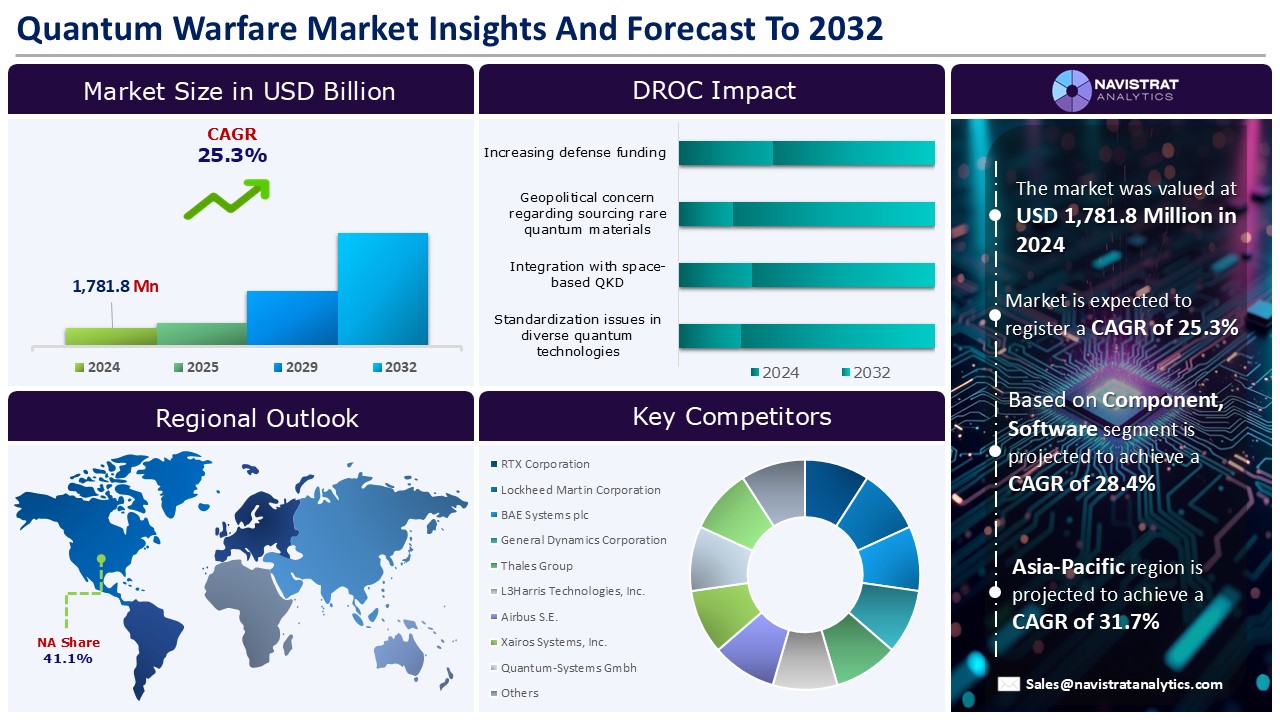
The global quantum warfare market size reached USD 1,781.8 Million in 2024 and is expected to register a revenue CAGR of 25.3% during the forecast period. Rising risk of cybersecurity threats targeting critical infrastructure is driving the market revenue growth of the quantum warfare market.
Defense department and government organizations are increasingly deploying quantum warfare technologies in order to mitigate the risk of potential data breaches. Conventional cybersecurity systems are inadequate to handle threats and can break encryption standards. Additionally, quantum-enhanced cybersecurity tools are being significantly incorporated into command-and-control infrastructure to offer real-time threat detection and response.
Market Drivers:
Increasing defense and military expenditure to strengthen military and defense to strengthen cybersecurity, communication systems, and command & control systems, is driving revenue growth of the market. According to the Stockholm International Peace Research Institute (SIPRI), globally, military expenditure reached USD 2,718 billion in 2024. The value increased by 9.4% compared to 2023. The top five defense spenders were the United States, China, Russia, Germany, and India, accounting for 60% of worldwide military expenditure, or over USD 1,635 billion. Furthermore, In June 27th 2024, by 2035, NATO Allies will allocate 5% of their annual Gross Domestic Product (GDP) towards overall defense and security priorities.
Several global military spending countries are prioritizing quantum warfare technologies such as the Quantum Key Distribution (QKD), Post-Quantum Cryptography (PQC), Quantum Cryptography, and Quantum PNT to ensure operational resilience, secure data exchange, and real-time decision-making capabilities. These technologies are highly utilized in areas such as quantum encryption for secure communications, advanced sensing for situational awareness, rapid data processing, and threat assessment. Defense departments and intelligence agencies are entering into strategic partnerships with technology providers to accelerate quantum warfare innovation and deployment, which are substantially driving revenue growth of the market.
Market Opportunity:
Quantum technologies are becoming crucial to future military and economic power, spanning cyber defense, quantum sensing, and secure communications. According to the World Economic Forum (WEF), 17 countries have already invested in national quantum, and more than 150 countries do not have a quantum strategy. Major economies in the world are investing heavily in various R&D programs to strengthen their technological sovereignty across critical sectors.
For instance, the U.S. Department of Homeland Security warns that by 2030, fault-tolerant quantum computers may have the capability to break existing encryption methods used in Public Key Cryptography. This could compromise a wide range of sensitive data, from personal information to critical military and intelligence communications.
Moreover, rising geopolitical conflicts and the vulnerabilities of satellite-based navigation systems are accelerating the deployment of quantum warfare. Several worldwide intelligence organizations have noticed an increase in electronic interference through Positioning, Navigation, and Timing (PNT) systems in the South China Sea and Malacca Strait.
Traditional reliance on GPS leaves assets like ships, submarines, and aircraft exposed to signal jamming or spoofing, significantly impairing mission effectiveness. In response, military forces are rapidly integrating quantum sensing to enhance inertial navigation accuracy without the requirement of traditional GPS recalibration.
Technology Trends:
Rapid development of atomic clocks is emerging as a major trend in the Quantum Warfare Market. Major global military powers are increasingly transitioning toward indigenous atomic clock systems to reduce their strategic dependence on foreign Global Navigation Satellite Systems (GNSS) such as the United States-led Global Positioning Systems (GPS), Russia’s GLONASS, and Europe’s Galileo. Accurate and precise timing is fundamental to synchronizing communication networks, it also maintaining navigation integrity, and enabling high-precision electronic warfare (EW) capabilities.
Quantum-enhanced atomic clocks benefit military and defence organizations to deliver unprecedented frequency stability, by maintaining the accuracy of satellite-based communications, and encrypted signal integrity. Moreover, the integration of quantum sensors with atomic clocks enables wide-range detection of electromagnetic signals, which enhances EW systems’ ability to detect, intercept, and neutralize adversarial threats with advanced precision. On 3rd January 2025, the U.K. Ministry of Defence (MoD) will develop a cutting-edge atomic clock to enhance the security of military and defence through the application of experimental quantum technology.
Restraints & Challenges:
Stringent export control regulations on quantum computing technologies could hinder the revenue growth of quantum warfare. Major global powers are putting restrictions on the transfer of quantum technology owing to its dual-use nature and significant potential for misuse. If these technologies were transferred to any highly conflict-affected country, it might create instability in the region. As a result, quantum technologies are categorized under strict export control regulations of the U.S. State Department.
On 6th September 2025, the U.S. Department of Commerce’s Bureau of Industry and Security (BIS) issued an interim final rule establishing global export controls on a range of advanced technologies. Quantum computing-related items include quantum computers, associated equipment, components, materials, software, and technologies essential for the development and maintenance of quantum computing systems.
Moreover, China has restricted the supply of critical minerals for military use. The development of quantum warfare hardware sensors, processors require several critical rare earth minerals such as gallium and germanium. On 4th December 2024, China imposed strict export restrictions on critical metals such as antimony, gallium, and germanium to the U.S. for both civilian and military applications.
Component Segment Insights and Analysis:
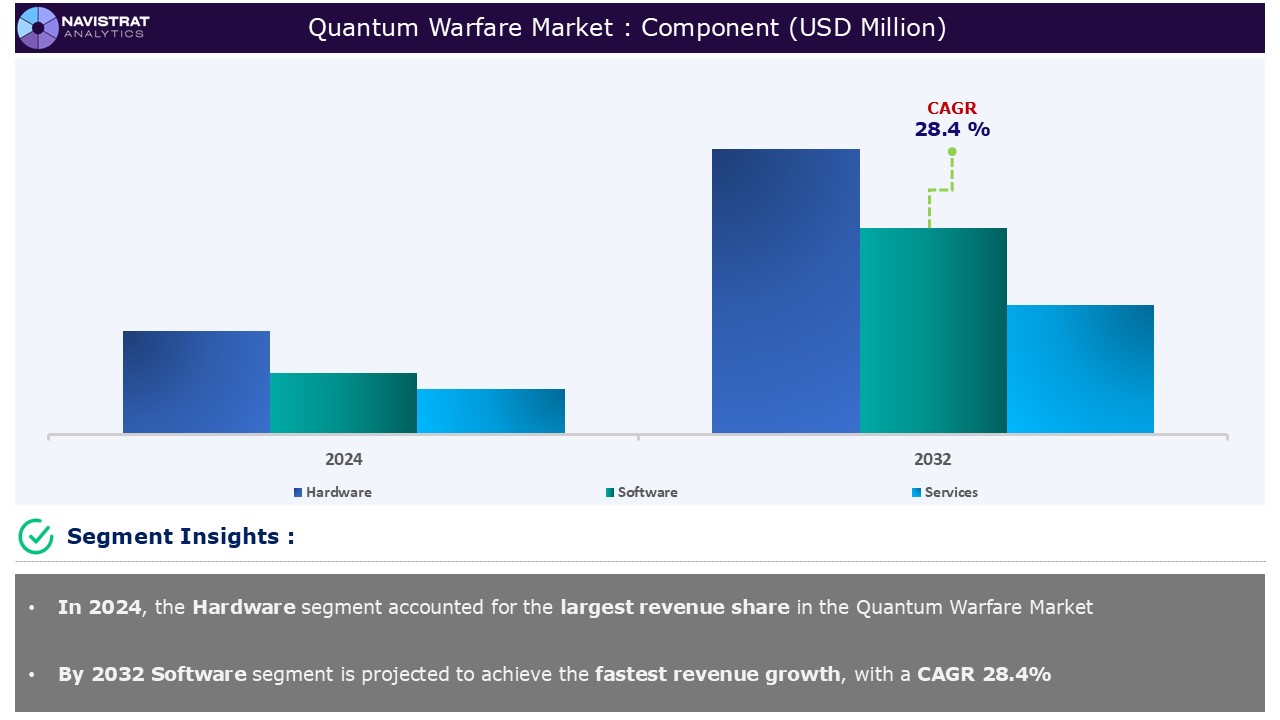
Based on the component, the quantum warfare market is segmented into hardware, software, and services.
Software is expected to register the fastest revenue growth of 28.4% by 2032. The growing deployment of quantum software algorithms in critical defense infrastructures is projected to drive substantial demand over the forecast period. The software segment will be further segmented into the key areas of operating systems, simulation & emulation software and others. Globally, major defense organizations are adopting advanced quantum cryptographic protocols, quantum-enhanced AI models, and simulation tools which can compatible with current-generation computing architectures to derive strategic advantages in surveillance, decryption, and secure communications.
As a result, major key defense industry players are partnering with quantum computing and networking companies in order to accelerate the deployment of quantum computing in defense sectors. For instance, on 10th February 2025, IonQ entered into a strategic partnership with General Dynamics to develop next-generation quantum processing and networking solutions such as quantum-powered AI enhancements, advanced resource optimization, and anomaly detection systems.
Application Segment Insights and Analysis:
Based on the Application, the Quantum Warfare Market is segmented into Cybersecurity, Secure Communication Systems, Command & Control Systems, Intelligence, Surveillance, and Reconnaissance (ISR), Navigation & Timing, and Others.
Cybersecurity contributed a significant revenue share in 2024. The rising incidence of cyberattacks in critical infrastructure fueled the need for quantum cybersecurity. According to research, globally, cyberattacks targeting critical infrastructure have surged by 30% in 2024, with an average of 13 incidents every second. Government organizations globally are implementing cryptographic algorithms to secure their systems. On 20th October 2024, the U.S. Department of Defense’s prioritize cryptographic advancement in cybersecurity by transitioning its entire infrastructure to post-quantum cryptographic standards. This strategic shift will drive new opportunities and investment in the quantum warfare market.
End-Use Segment Insights and Analysis:
Based on the End-Use, the Quantum Warfare Market is segmented into Defence Forces, Homeland Security, Government Bodies, and Defence Research & Testing Agencies.
The Defense Forces segment contributed a significant revenue share in 2024. The Defense force segment will be sub-segmented into the key areas of the army, navy, and air force. Globally, defense agencies are substantially investing in quantum computing technologies in order to strengthen the privacy and security of the communication protocols. Additionally, rising geopolitical tensions and asymmetric warfare are encouraging countries’ military policies to spend extensively in quantum technology, such as quantum key distribution (QKD), quantum cryptography, and post-quantum cryptography (PQC).
Geographical Outlook:
Quantum Warfare Market is strategically segmented by geography to provide a comprehensive understanding of regional market dynamics. Discover demand analysis, emerging trends, and growth opportunities shaping market performance across different regions and countries.
North America Quantum Warfare Market:
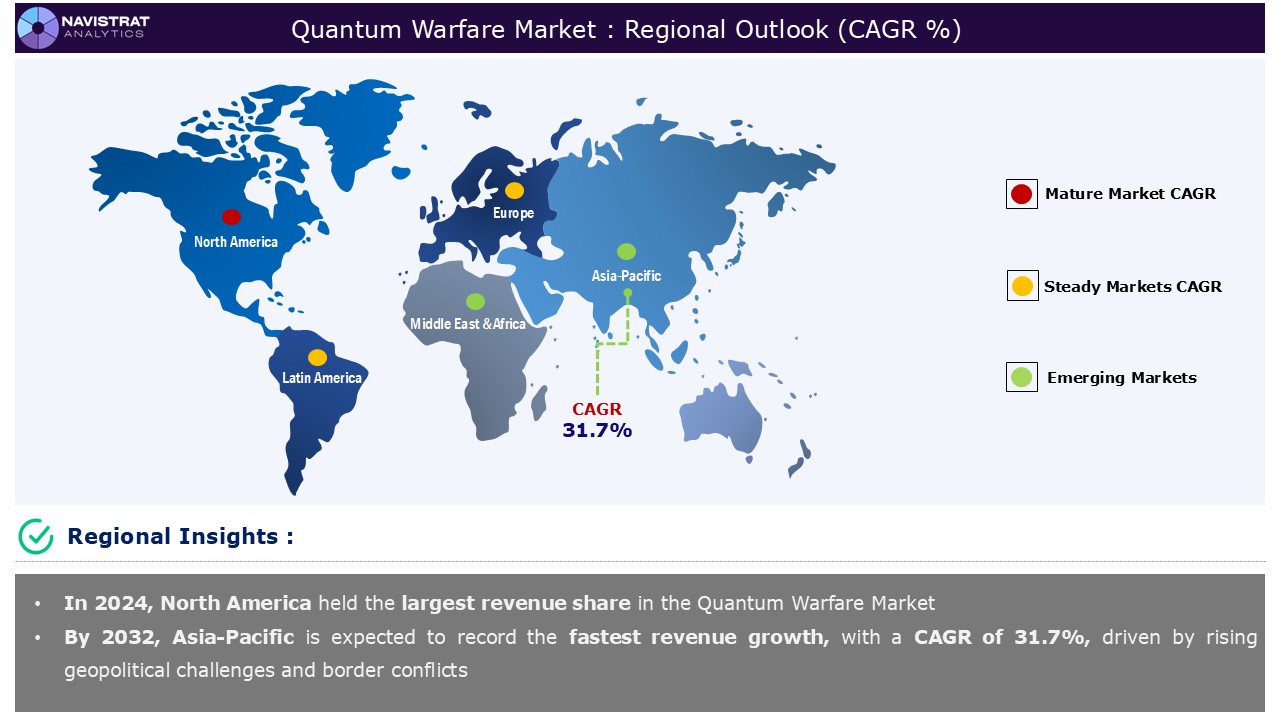
North America registered the highest market share in the quantum warfare market. Increasing the U.S. Department of Defense (DoD) budget on Research, Development, Test, and Evaluation (RDT&E) contributed significantly to the revenue share in 2024. In fiscal year 2024, the U.S. DoD allocated USD 145 billion under RDT&E, and the budget increased by 4% compared to F.Y. 2023. The U.S. DoD is significantly deploying quantum warfare hardware and software in next-generation cybersecurity architecture to combat cyber-related risk.
For instance, In F.Y. 2024, the Department of Defense is implementing a program called NSM-8 to accelerate Zero Trust Architecture (ZTA) advancements in cryptographic modernization to support the transition toward quantum-resistant algorithms and enhancements in threat detection. Cyberspace Operations (CO) budget request included USD 7.4 billion to strengthen capabilities in cyber intelligence and joint cyber exercises.
Government collaboration in the research and development of quantum computing prototypes for national security is further expected to propel revenue growth of the quantum warfare market over the forecast period. In 28th April 2025, the Defense Advanced Research Projects Agency (DARPA) partnered with the State of Maryland to build a Capital Quantum Benchmarking Hub. Under the initiative the DARPA and the State of Maryland have agreed to fund USD 100 million each over four years.
In addition, on 10th May 2025, the U.S. legislation makers introduced the Quantum Sandbox for Near-Term Applications Act to accelerate the commercial development of quantum technologies by establishing a quantum sandbox program. These initiatives open substantial investment opportunities from both government agencies and private industry to jointly develop and deploy quantum and quantum-hybrid solutions.
Moreover, the Defense Innovation Unit (DIU) is working on the development of the operational potential of quantum sensors through its Transition of Quantum Sensing (TQS) program. Under the program, several major key competitors received contracts, which will fuel revenue growth of the market. For instance, on 12th March 2025, Lockheed Martin Corporation signed a contract from the U.S. DoD Innovation Unit (DIU) to develop a prototype of a quantum-enhanced Inertial Navigation System (INS).
Asia Pacific Quantum Warfare Market:
Asia Pacific is expected to register the fastest revenue growth by 2032. Increasing cyberattacks on defense networks are propelling the deployment of quantum warfare. Several countries in Asia-Pacific are witnessing incidents related to cyber-attacks such as advanced persistent threats (APTs), ransomware, phishing, GPS spoofing and navigation signal interference, and various other cyber-attacks.
For instance, in February 2025, according to a report from the Chinese government, foreign Advanced Persistent Threat (APT) groups carried out more than 1,300 cyberattacks to extract sensitive information in 2024. This attack targeted 14 critical sectors across including defense. Also, in May 2024, the Indian government reported that Pakistani cyber espionage actors allegedly targeted India’s government, aerospace, and defense sectors using malware.
Asia-Pacific is emerging as a new global powerhouse with China’s and India’s growing economies. This region includes long-standing territorial disputes, historical rivalries, and the presence of nuclear-armed powers, which accelerates the region’s dominance in quantum warfare. In response, major countries in this region are working on quantum warfare technology in order to mitigate cybersecurity threats in critical infrastructures.
Rising geopolitical tension in the South China Sea has escalated the need for precise navigation and position systems that could track magnetic anomalies across the ocean through unmanned aerial systems. The South China Sea is playing a critical role in the maritime corridor for global trade and strategic transport. According to the U.S. Energy Information Administration (EIA), the South China Sea accounts for maritime transportation of 10 billion barrels of oil and 6.7 trillion cubic feet (Tcf) of liquefied natural gas (LNG) in 2023. Around 80% of energy imports and 40% trade volume of China pass through this route.
On 24th April 2025, China completed a trial of drone-mounted quantum sensor system to detect magnetic anomalies and map seabed features, owing to the growing tensions between the United States and China in the South China Sea. Moreover, on 18th January 2025, China’s Institute of Measurement and Testing Technology and the Advanced Tracking Technology Innovation Center developed a compact cesium atomic clock to reduce the dependency of the United States-developed GPS/ Global Navigation Satellite Systems (GNSS).
Furthermore, government budgets to accelerate advancements in quantum technologies are anticipated to accelerate the growth of the quantum warfare market in this region. For instance, on 3rd December 2024, the Australian Government will allocate USD 39 million to advance quantum technologies and counter-disinformation capabilities through 21 new contracts under the Advanced Strategic Capabilities Accelerator’s (ASCA) Emerging and Disruptive Technologies (EDT) program.
Europe Quantum Warfare Market:
Europe contributed a substantial revenue share in 2024. Government support in artificial intelligence (AI) and quantum technologies substantially contributed to the European quantum warfare market. The European Commission (EC) is investing USD 119.84 million to boost research and innovation. In addition, on June 23rd, 2025, the U.K. government announced it to invest over USD 672 million over the next four years to advance quantum computing technologies to enhance national security.
The ongoing conflict between Russia and Ukraine highlighted the need for emerging technologies on the battlefield. Finland proposed to start a project on Quantum Enablers for Strategic Advantage (QUEST) as part of the sixth wave of initiatives under the Permanent Structured Cooperation (PESCO) framework on 30th May 2025. The project will concentrate on leveraging quantum technologies for defense, specifically in positioning systems, territorial monitoring, and air and missile defense operations.
Moreover, the European Union (EU) requested its member states to adopt quantum-resistant encryption by 2030. The strategy advocates the use of Post-Quantum Cryptography (PQC) across the critical infrastructure sector, while considering Quantum Key Distribution (QKD) for highly sensitive environments. These factors will generate significant opportunities over the forecast period.
Competition Analysis:
The Quantum Warfare Market is characterized by numerous players, with major players competing across segments and regions. The list of major players included in the Quantum Warfare Market report are:
- RTX Corporation (U.S.)
- Lockheed Martin Corporation (U.S.)
- BAE Systems plc (U.K.)
- General Dynamics Corporation (U.S.)
- Thales Group (France)
- L3Harris Technologies, Inc. (U.S.)
- Airbus S.E. (Netherlands)
- Xairos Systems, Inc. (U.S.)
- Quantum-Systems GmbH (Germany)
- Nokia Corporation (Finland)
- QuSecure, Inc. (U.S.)
- Quantinuum, Ltd. (U.K.)
- Arqit Limited (U.K.)
- Classiq Technologies Ltd. (Israel)
- Infleqtion, Inc. (U.S.)
- Synergy Quantum India Private Limited (India)
Strategic Developments in Quantum Warfare Market:
- On 7th February 2025, Synergy Quantum entered into a sales and distribution agreement with Gulf Cooperation Council (GCC), MP3 International Trading Agencies Sole Proprietorship LLC to deploy military-grade quantum cybersecurity and next-generation defense technologies across the GCC region, including the UAE, Saudi Arabia, Kuwait, Qatar, Bahrain, and Oman. The collaboration will address the growing threat posed by advanced cyberattacks and future quantum-based intrusions of critical infrastructure, defense systems, and governmental institutions.
- On 8th January 2025, QuSecure Inc. received a contract of USD 1.23 million Phase II Small Business Innovation Research (SBIR) contract from AFWERX. This contract focuses on advancing quantum-resilient encryption solutions to address critical cybersecurity challenges faced by the Department of the Air Force (DAF). In collaboration with the Air Force Research Laboratory, AFWERX has optimized the SBIR and Small Business Technology Transfer (STTR) programs by reducing proposal-to-award timelines, broadening participation among small businesses, and streamlining contract execution through continuous process improvements.
Key Advantages for Stakeholders:
Navistrat Analytics’ industry report provides an in-depth quantitative analysis of various market segments, historical and current trends, market forecasts, and dynamics within the global market. The historical years covered in this report are 2022 to 2023, with 2024 serving as the base year for market size calculations. The forecast period extends from 2025 to 2032.
The report includes an executive summary and a comprehensive overview of market drivers, restraints, opportunities, and challenges (DROC), along with insights into regulatory standards. It features detailed analyses such as PORTER’s Five Forces, SWOT, and PESTLE, as well as assessments of technological trends and the competitive landscape.
PORTER’s Five Forces analysis helps stakeholders evaluate the impact of new entrants, competitive rivalry, supplier power, buyer power, and substitution threats, enabling them to assess the level of competition and the attractiveness of the global market. The competitive landscape provides stakeholders with a clear understanding of the current market positions of key players, offering valuable insights into their competitive environment.
Scope And Key Highlights of The Quantum Warfare Market Report:
| Report Features | Details |
| Market Size in 2024 | USD 1,781.8 Million (1.78 billion) |
| Market Growth Rate in CAGR (2025–2032) | 25.3% |
| Market Revenue forecast to 2032 | USD 10,632.5 Million (10.63 billion) |
| Base year | 2024 |
| Historical year | 2022–2023 |
| Forecast period | 2025–2032 |
| Report Pages | 450 |
| Segments covered |
|
| Regional scope |
|
| Country Scope |
|
| Key Market Players |
|
| Delivery Format | Reports are delivered in PDF format via email. |
| Customization scope | Request for Customization |
The Quantum Warfare Market report offers a detailed analysis of market size, including historical revenue (in USD Million) data for 2022-2023 and revenue forecasts for 2025-2032 across the following segments:
- Type Outlook (Revenue, USD Million; 2022-2032)
- Digital Quantum Computer
- Analog Quantum Computer
- Component Outlook (Revenue, USD Million; 2022-2032)
- Hardware
- Processors
- Sensors
- Radar Systems and Detectors
- Network Devices
- Quantum Clock
- Others
- Software
- Operating Systems
- Simulation & Emulation Software
- Others
- Services
- Installation & Integration
- Maintenance & Support
- Hardware
- Technology Outlook (Revenue, USD Million; 2022-2032)
- Quantum Key Distribution (QKD)
- Fiber-Optic QKD
- Satellite-Based QKD
- Post-Quantum Cryptography (PQC)
- Quantum Cryptography
- Quantum Random Number Generators (QRNG)
- Quantum PNT
- Others
- Quantum Key Distribution (QKD)
- Application Outlook (Revenue, USD Million; 2022-2032)
- Secure Communication Systems
- Command & Control Systems
- Intelligence, Surveillance, and Reconnaissance (ISR)
- Navigation & Timing
- Others
- End-Use Outlook (Revenue, USD Million; 2022-2032)
- Defense Forces
- Army
- Navy
- Air Force
- Homeland Security
- Border Security
- Critical Infrastructure Protection
- Law Enforcement Agencies
- Government Bodies
- Defense Research & Testing Agencies
- Defense Forces
- Regional Outlook (Revenue, USD Million; 2022-2032)
- North America
- U.S.
- Canada
- Mexico
- Europe
- Germany
- France
- U.K.
- Italy
- Spain
- Russia
- Benelux
- Nordic Countries
- Rest of Europe
- Asia Pacific
- China
- India
- Japan
- South Korea
- Singapore
- Oceania
- ASEAN Countries
- Rest of APAC
- Latin America
- Brazil
- Rest of LATAM
- Middle East & Africa
- GCC Countries
- South Africa
- Israel
- Turkey
- Rest of MEA
- North America
Frequently Asked Questions (FAQ) About the Quantum Warfare Market Report
The market size of the quantum warfare market was 1,781.8 million in 2024.
The growth of quantum warfare market is expected to register a compound annual growth rate (CAGR) of 25.3% over the forecast period.
Increasing defense spending on quantum radar and sensing systems are a major factor driving the revenue growth of the quantum warfare market.
Geopolitical concern regarding sourcing rare quantum materials and cold atom systems are a major restraint of the quantum warfare market.
Asia Pacific accounts for the fastest revenue growth of 31.7%.
Hardware is the leading segment of the Quantum Warfare Market in terms of Component.
- Market Definition
- Research Objective
- Research Methodology
- Research Design
- Data Collection Methods
- Primary
- Secondary
- Market Size Estimation
- Top-down method
- Bottom-up method
- Forecasting Methodology
- Tools and Models Used
- Market Overview and Trends
- Market Size and Forecast
- Industry Analysis
- Market Driver, Restraints, Opportunity, and Challenges (DROC) Analysis
- Market Drivers
- Rising deployment of quantum communication networks for secure communications
- Increasing defense funding for quantum radar and sensing systems
- Market Restraints
- High capital expenditure and cryogenic infrastructure requirements
- Geopolitical concern regarding sourcing rare quantum materials and cold atom systems
- Market Opportunities
- Rising geopolitical tensions and global security threats
- Integration of space-based quantum key distribution (QKD) for military satellites
- Market Challenges
- Vulnerability of quantum components to electromagnetic interference
- Standardization and interoperability issues among diverse quantum technologies and platforms
- Regulatory, Trade, and Tariff Landscape
- Overview of Global Regulatory Framework
- Country-Specific Regulatory, Export, Import, and Tariff Policies
- North America (USA, Canada, Mexico)
- Europe (Germany, UK, France)
- Asia-Pacific (China, Japan, South Korea, India)
- Middle East & Africa (UAE, Israel, Saudi Arabia, South Africa)
- Latin America (Brazil)
- Strategic Insights
- Porter’s Five Forces Analysis
- PESTLE Analysis
- Price Trend Analysis
- Geopolitical Analysis
- Market/ Technology Trends of Quantum Warfare Market
- Integration of quantum machine learning in cyber threat hunting within defense-grade SOCs (Security Operations Centers)
- Integration of quantum annealers in real-time battlefield optimization
- Quantum electromagnetic pulse (QEMP) resilience frameworks for hardening quantum systems against directed energy attacks
- Multi-node military QKD mesh networks
- Quantum inertial navigation systems (Q-INS)
- Recent Developments
- Contracts and Orders
- Delivery and Testing
- Funding and Investments
- Merger and Acquisition
- Expansion
- Partnership and Collaboration
- Product/ Service Launch
- Technological developments
- Type Market Revenue Estimates and Forecasts, 2022-2032
- Digital Quantum Computer
- Analog Quantum Computer
- Component Market Revenue Estimates and Forecasts, 2022-2032
- Hardware
- Processors
- Sensors
- Radar Systems and Detectors
- Network Devices
- Quantum Clock
- Others
- Software
- Operating Systems
- Simulation & Emulation Software
- Others
- Services
- Installation & Integration
- Maintenance & Support
- Hardware
- Technology Market Revenue Estimates and Forecasts, 2022-2032
- Quantum Key Distribution (QKD)
- Fiber-Optic QKD
- Satellite-Based QKD
- Post-Quantum Cryptography (PQC)
- Quantum Cryptography
- Quantum Random Number Generators (QRNG)
- Quantum PNT
- Others
- Quantum Key Distribution (QKD)
- Application Market Revenue Estimates and Forecasts, 2022-2032
- Cybersecurity
- Secure Communication Systems
- Command & Control Systems
- Intelligence, Surveillance, and Reconnaissance (ISR)
- Navigation & Timing
- Others
- End-Use Market Revenue Estimates and Forecasts, 2022-2032
- Defense Forces
- Army
- Navy
- Air Force
- Homeland Security
- Border Security
- Critical Infrastructure Protection
- Law Enforcement Agencies
- Government Bodies
- Defense Research & Testing Agencies
- Defense Forces
- Quantum Warfare Market Revenue Estimates and Forecasts by Region, 2022-2032, USD Million
- North America
- North America Quantum Warfare Market By Type, Market Revenue Estimates and Forecasts, 2022-2032, USD Million
- Digital Quantum Computer
- Analog Quantum Computer
- North America Quantum Warfare Market By Component, Market Revenue Estimates and Forecasts, 2022-2032, USD Million
- Hardware
- Processors
- Sensors
- Radar Systems and Detectors
- Network Devices
- Quantum Clock
- Others
- Software
- Operating Systems
- Simulation & Emulation Software
- Others
- Services
- Installation & Integration
- Maintenance & Support
- Hardware
- North America Quantum Warfare Market By Technology, Market Revenue Estimates and Forecasts, 2022-2032, USD Million
- Quantum Key Distribution (QKD)
- Fiber-Optic QKD
- Satellite-Based QKD
- Post-Quantum Cryptography (PQC)
- Quantum Cryptography
- Quantum Random Number Generators (QRNG)
- Quantum PNT
- Others
- Quantum Key Distribution (QKD)
- North America Quantum Warfare Market By Application, Market Revenue Estimates and Forecasts, 2022-2032, USD Million
- Cybersecurity
- Secure Communication Systems
- Command & Control Systems
- Intelligence, Surveillance, and Reconnaissance (ISR)
- Navigation & Timing
- Others
- North America Quantum Warfare Market By End-Use, Market Revenue Estimates and Forecasts, 2022-2032, USD Million
- Defense Forces
- Army
- Navy
- Air Force
- Homeland Security
- Border Security
- Critical Infrastructure Protection
- Law Enforcement Agencies
- Government Bodies
- Defense Research & Testing Agencies
- Defense Forces
- North America Quantum Warfare Market Revenue Estimates and Forecasts by Country, 2022-2032, USD Million
- United States
- Canada
- Mexico
- North America Quantum Warfare Market By Type, Market Revenue Estimates and Forecasts, 2022-2032, USD Million
- Europe
- Europe Quantum Warfare Market By Type, Market Revenue Estimates and Forecasts, 2022-2032, USD Million
- Digital Quantum Computer
- Analog Quantum Computer
- Europe Quantum Warfare Market By Component, Market Revenue Estimates and Forecasts, 2022-2032, USD Million
- Hardware
- Processors
- Sensors
- Radar Systems and Detectors
- Network Devices
- Quantum Clock
- Others
- Software
- Operating Systems
- Simulation & Emulation Software
- Others
- Services
- Installation & Integration
- Maintenance & Support
- Hardware
- Europe Quantum Warfare Market By Technology, Market Revenue Estimates and Forecasts, 2022-2032, USD Million
- Quantum Key Distribution (QKD)
- Fiber-Optic QKD
- Satellite-Based QKD
- Post-Quantum Cryptography (PQC)
- Quantum Cryptography
- Quantum Random Number Generators (QRNG)
- Quantum PNT
- Others
- Quantum Key Distribution (QKD)
- Europe Quantum Warfare Market By Application, Market Revenue Estimates and Forecasts, 2022-2032, USD Million
- Cybersecurity
- Secure Communication Systems
- Command & Control Systems
- Intelligence, Surveillance, and Reconnaissance (ISR)
- Navigation & Timing
- Others
- Europe Quantum Warfare Market By End-Use, Market Revenue Estimates and Forecasts, 2022-2032, USD Million
- Defense Forces
- Army
- Navy
- Air Force
- Homeland Security
- Border Security
- Critical Infrastructure Protection
- Law Enforcement Agencies
- Government Bodies
- Defense Research & Testing Agencies
- Defense Forces
- Europe Quantum Warfare Market Revenue Estimates and Forecasts by Country, 2022-2032, USD Million
- Germany
- United Kingdom
- France
- Italy
- Spain
- Russia
- Benelux
- Nordic Countries
- Rest of Europe
- Europe Quantum Warfare Market By Type, Market Revenue Estimates and Forecasts, 2022-2032, USD Million
- Asia-Pacifc
- Asia-Pacifc Quantum Warfare Market By Type, Market Revenue Estimates and Forecasts, 2022-2032, USD Million
- Digital Quantum Computer
- Analog Quantum Computer
- Asia-Pacifc Quantum Warfare Market By Component, Market Revenue Estimates and Forecasts, 2022-2032, USD Million
- Hardware
- Processors
- Sensors
- Radar Systems and Detectors
- Network Devices
- Quantum Clock
- Others
- Software
- Operating Systems
- Simulation & Emulation Software
- Others
- Services
- Installation & Integration
- Maintenance & Support
- Hardware
- Asia-Pacifc Quantum Warfare Market By Technology, Market Revenue Estimates and Forecasts, 2022-2032, USD Million
- Quantum Key Distribution (QKD)
- Fiber-Optic QKD
- Satellite-Based QKD
- Post-Quantum Cryptography (PQC)
- Quantum Cryptography
- Quantum Random Number Generators (QRNG)
- Quantum PNT
- Others
- Quantum Key Distribution (QKD)
- Asia-Pacifc Quantum Warfare Market By Application, Market Revenue Estimates and Forecasts, 2022-2032, USD Million
- Cybersecurity
- Secure Communication Systems
- Command & Control Systems
- Intelligence, Surveillance, and Reconnaissance (ISR)
- Navigation & Timing
- Others
- Asia-Pacifc Quantum Warfare Market By End-Use, Market Revenue Estimates and Forecasts, 2022-2032, USD Million
- Defense Forces
- Army
- Navy
- Air Force
- Homeland Security
- Border Security
- Critical Infrastructure Protection
- Law Enforcement Agencies
- Government Bodies
- Defense Research & Testing Agencies
- Defense Forces
- Asia-Pacifc Quantum Warfare Market Revenue Estimates and Forecasts by Country, 2022-2032, USD Million
- China
- India
- Japan
- South Korea
- Singapore
- Oceania
- ASEAN Countries
- Rest of Asia-Pacific
- Asia-Pacifc Quantum Warfare Market By Type, Market Revenue Estimates and Forecasts, 2022-2032, USD Million
- Middle East & Africa
- Latin America Quantum Warfare Market By Type, Market Revenue Estimates and Forecasts, 2022-2032, USD Million
- Digital Quantum Computer
- Analog Quantum Computer
- Latin America Quantum Warfare Market By Component, Market Revenue Estimates and Forecasts, 2022-2032, USD Million
- Hardware
- Processors
- Sensors
- Radar Systems and Detectors
- Network Devices
- Quantum Clock
- Others
- Software
- Operating Systems
- Simulation & Emulation Software
- Others
- Services
- Installation & Integration
- Maintenance & Support
- Hardware
- Latin America Quantum Warfare Market By Technology, Market Revenue Estimates and Forecasts, 2022-2032, USD Million
- Quantum Key Distribution (QKD)
- Fiber-Optic QKD
- Satellite-Based QKD
- Post-Quantum Cryptography (PQC)
- Quantum Cryptography
- Quantum Random Number Generators (QRNG)
- Quantum PNT
- Others
- Quantum Key Distribution (QKD)
- Latin America Quantum Warfare Market By Application, Market Revenue Estimates and Forecasts, 2022-2032, USD Million
- Cybersecurity
- Secure Communication Systems
- Command & Control Systems
- Intelligence, Surveillance, and Reconnaissance (ISR)
- Navigation & Timing
- Others
- Latin America Quantum Warfare Market By End-Use, Market Revenue Estimates and Forecasts, 2022-2032, USD Million
- Defense Forces
- Army
- Navy
- Air Force
- Homeland Security
- Border Security
- Critical Infrastructure Protection
- Law Enforcement Agencies
- Government Bodies
- Defense Research & Testing Agencies
- Defense Forces
- Latin America Quantum Warfare Market Revenue Estimates and Forecasts by Country, 2022-2032, USD Million
- Brazil
- Rest of LATAM
- Latin America Quantum Warfare Market By Type, Market Revenue Estimates and Forecasts, 2022-2032, USD Million
- Middle East & Africa
- Middle East & Africa Quantum Warfare Market By Type, Market Revenue Estimates and Forecasts, 2022-2032, USD Million
- Digital Quantum Computer
- Analog Quantum Computer
- Middle East & Africa Quantum Warfare Market By Component, Market Revenue Estimates and Forecasts, 2022-2032, USD Million
- Hardware
- Processors
- Sensors
- Radar Systems and Detectors
- Network Devices
- Quantum Clock
- Others
- Software
- Operating Systems
- Simulation & Emulation Software
- Others
- Services
- Installation & Integration
- Maintenance & Support
- Hardware
- Middle East & Africa Quantum Warfare Market By Technology, Market Revenue Estimates and Forecasts, 2022-2032, USD Million
- Quantum Key Distribution (QKD)
- Fiber-Optic QKD
- Satellite-Based QKD
- Post-Quantum Cryptography (PQC)
- Quantum Cryptography
- Quantum Random Number Generators (QRNG)
- Quantum PNT
- Others
- Quantum Key Distribution (QKD)
- Middle East & Africa Quantum Warfare Market By Application, Market Revenue Estimates and Forecasts, 2022-2032, USD Million
- Cybersecurity
- Secure Communication Systems
- Command & Control Systems
- Intelligence, Surveillance, and Reconnaissance (ISR)
- Navigation & Timing
- Others
- Middle East & Africa Quantum Warfare Market By End-Use, Market Revenue Estimates and Forecasts, 2022-2032, USD Million
- Defense Forces
- Army
- Navy
- Air Force
- Homeland Security
- Border Security
- Critical Infrastructure Protection
- Law Enforcement Agencies
- Government Bodies
- Defense Research & Testing Agencies
- Defense Forces
- Middle East & Africa Quantum Warfare Market Revenue Estimates and Forecasts by Country, 2022-2032, USD Million
- GCC Countries
- South Africa
- Israel
- Turkey
- Rest of Middle East & Africa
- Middle East & Africa Quantum Warfare Market By Type, Market Revenue Estimates and Forecasts, 2022-2032, USD Million
- North America
- Market Share Analysis
- Revenue Market Share by Key Players (2023-2024)
- Analysis of Top Players by Market Presence
- Competitive Matrix
- Competitive Strategies
- Mergers and Acquisitions
- Partnerships and Collaboration
- Investment and Fundings
- Agreement
- Expansion
- New Product/ Services Launches
- Technological Innovations
- RTX Corporation
- Company Overview
- Financial Insights
- Product/ Services Offerings
- Strategic Developments
- SWOT Analysis
- Northrop Grumman Corporation
- Company Overview
- Financial Insights
- Product/ Services Offerings
- Strategic Developments
- SWOT Analysis
- General Dynamics Corporation
- Company Overview
- Financial Insights
- Product/ Services Offerings
- Strategic Developments
- SWOT Analysis
- Thales S.A.
- Company Overview
- Financial Insights
- Product/ Services Offerings
- Strategic Developments
- SWOT Analysis
- BAE Systems plc
- Company Overview
- Financial Insights
- Product/ Services Offerings
- Strategic Developments
- SWOT Analysis
- L3Harris Technologies, Inc.
- Company Overview
- Financial Insights
- Product/ Services Offerings
- Strategic Developments
- SWOT Analysis
- Airbus S.E.
- Company Overview
- Financial Insights
- Product/ Services Offerings
- Strategic Developments
- SWOT Analysis
- Xairos Systems, Inc.
- Company Overview
- Financial Insights
- Product/ Services Offerings
- Strategic Developments
- SWOT Analysis
- Quantum-Systems Gmbh
- Company Overview
- Financial Insights
- Product/ Services Offerings
- Strategic Developments
- SWOT Analysis
- Nokia Corporation
- Company Overview
- Financial Insights
- Product/ Services Offerings
- Strategic Developments
- QuSecure, Inc.
- Company Overview
- Financial Insights
- Product/ Services Offerings
- Strategic Developments
- SWOT Analysis
- Quantinuum, Ltd.
- Company Overview
- Financial Insights
- Product/ Services Offerings
- Strategic Developments
- SWOT Analysis
- Arqit Limited
- Company Overview
- Financial Insights
- Product/ Services Offerings
- Strategic Developments
- SWOT Analysis
- Classiq Technologies Ltd.
- Company Overview
- Financial Insights
- Product/ Services Offerings
- Strategic Developments
- SWOT Analysis
- Infleqtion, Inc.
- Company Overview
- Financial Insights
- Product/ Services Offerings
- Strategic Developments
- SWOT Analysis
- Synergy Quantum India Private Limited
- Company Overview
- Financial Insights
- Product/ Services Offerings
- Strategic Developments
- SWOT Analysis