

Railway Traction Battery Market Overview and Key Insights:
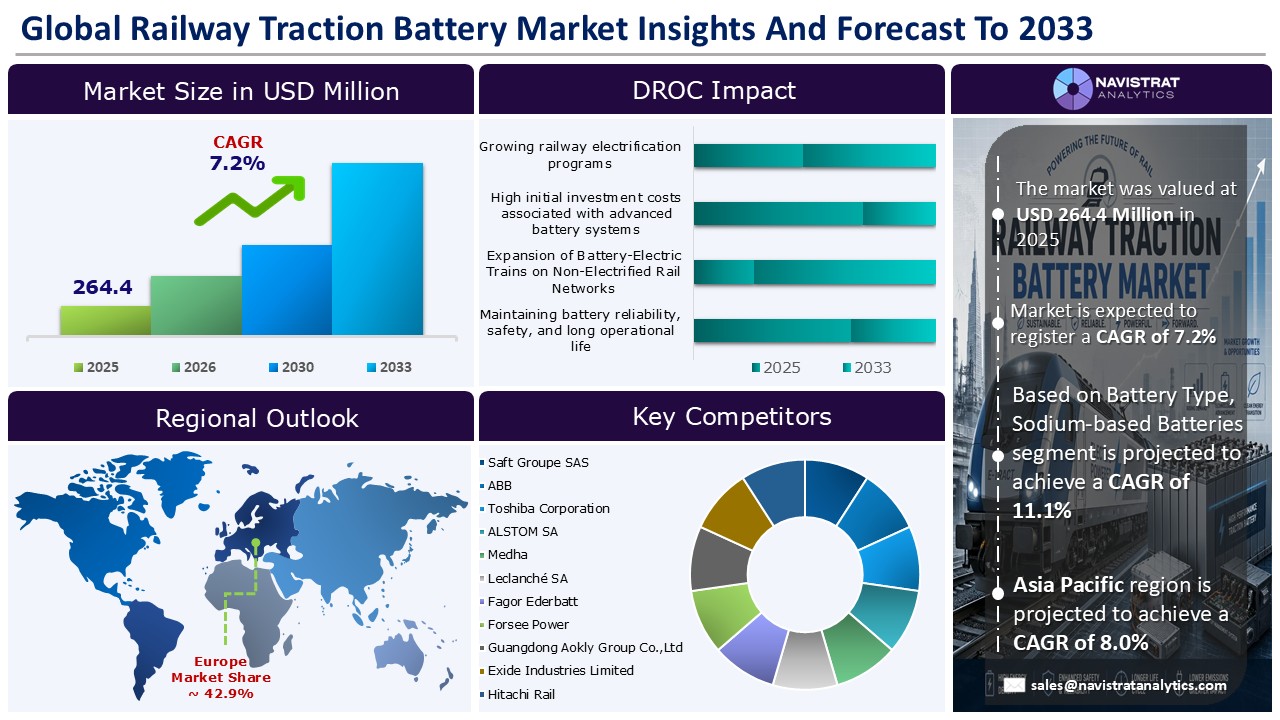
Railway traction battery market size reached USD 264.4 Million in 2025 and is expected to register a revenue CAGR of 7.2% during the forecast period. Traction batteries offer a novel solution to the long-standing issue of diesel-rail and are poised to become an important component of the clean transport toolset, propelling the future of sustainable rail transport. These enhancements provide a more comfortable and modern travel experience, in line with rising expectations for environmentally friendly rail travel.
Market Drivers:
Growing railway electrification programs is a key driver driving the market revenue growth. Electrified railways are critical in resolving a number of issues, including severe environmental rules, rising fossil fuel costs, and the demand for faster, more reliable train service. For example, while diesel-powered trains are approximately 30% efficient, electric trains are 95% efficient. The European Union has long been a leader in the global environmental movement. Railway electrification has been a critical component of their efforts. Currently, approximately 60% of Europe’s railway lines are electrified, resulting in improved energy efficiency, lower operational costs, and a considerable reduction in environmental impact across the continent.
The industry is also gaining speed as Li-ion battery technology advances, with systems now capable of achieving multiple megawatt hours (MWh) in constrained carriage areas. Battery electric locomotives, or BELs, now have systems capable of storing up to ~14MWh. In the future, rail’s massive energy requirements could result in some of the largest traction battery deployments across all electric vehicle markets, potentially exceeding 20MWh per train.
On March 2026, Siemens Mobility, a rail technology and sustainability leader, and Akiem have signed a framework agreement to purchase 80 Vectron locomotives, with a definite order of 50. The agreement includes the launch of the new Vectron Dual Mode Electric/Battery locomotives and an option for 30 more units. Siemens Mobility’s new locomotive builds on its established Vectron Dual Mode platform and expands the Vectron family with a battery-powered alternative. The locomotives can operate on both electrified and non-electrified sections, using traction batteries.
Market Opportunity:
Increasing adoption of hybrid locomotives act as opportunity for railway traction battery market. Hybrid train systems that incorporate lithium-ion traction batteries and regenerative braking technology can increase operational flexibility and reduce fuel consumption. Several countries in Europe and Asia-Pacific are substantially investing in battery-powered rolling stock to help achieve sustainable transportation goals. There are quantifiable economic and environmental benefits to hybrid trains. They can operate silently in cities, cut CO2 and other hazardous emissions, and reduce fuel usage by up to 70%. Hybrid trains provide operators with more operational flexibility to operate on both electrified and non-electrified lines, as well as cost benefits through lower fuel and maintenance requirements. The performance and efficiency of hybrid trains are being improved by innovations like regenerative braking, sophisticated energy storage systems, and more effective power management. These developments prolong the life of train components and increase fuel economy.
Recent Trends:
Emerging trends include High-Energy-Density Lithium-ion and LFP Batteries, Smart Battery Management Systems (BMS), Battery-Electric and Hybrid Rail Vehicles, AI-Based Predictive Battery Analytics, and Regenerative Braking Energy Recovery.
The growth of Lithium Iron Phosphate (LFP) batteries in the railway sector has been characterized by considerable technological improvements and increased use. Recent advancements have centered on merging LFP batteries with smart energy management systems and regenerative braking technology. These developments have increased the overall efficiency and sustainability of battery-powered trains.
As the need for rail electrification increases, so does the need for improved energy storage technologies like lithium iron phosphate batteries. These batteries have various advantages for railway applications, including as high energy density, long cycle life, and increased safety features. The use of lithium iron phosphate batteries in railway electrification systems can improve energy efficiency, offer backup power during outages, and allow for the recovery of braking energy, so increasing the overall performance and sustainability of electric railways.
Restraints & Challenges:
The deployment of railway traction batteries requires significant upfront investment in battery packs, power electronics, charging infrastructure, thermal management systems, and integration with existing rolling stock. Although battery-powered trains offer lower operating costs over time, the high initial capital expenditure discourages adoption, particularly among railway operators with limited modernization budgets and aging fleets.
Despite continuous improvements in battery technology, current lithium-ion and other commercial battery chemistries still provide lower energy density than diesel fuel. This limits the operating range of battery-powered trains, making them less suitable for long-haul freight and intercity routes that require continuous high-power operation without frequent charging opportunities.
Battery-electric railway systems require dedicated high-capacity charging stations, upgraded substations, and grid connectivity at depots or along rail corridors. Developing this infrastructure requires substantial investment and long implementation timelines, slowing market adoption in regions with limited electrical infrastructure.
Battery Type Segment Insights and Analysis:
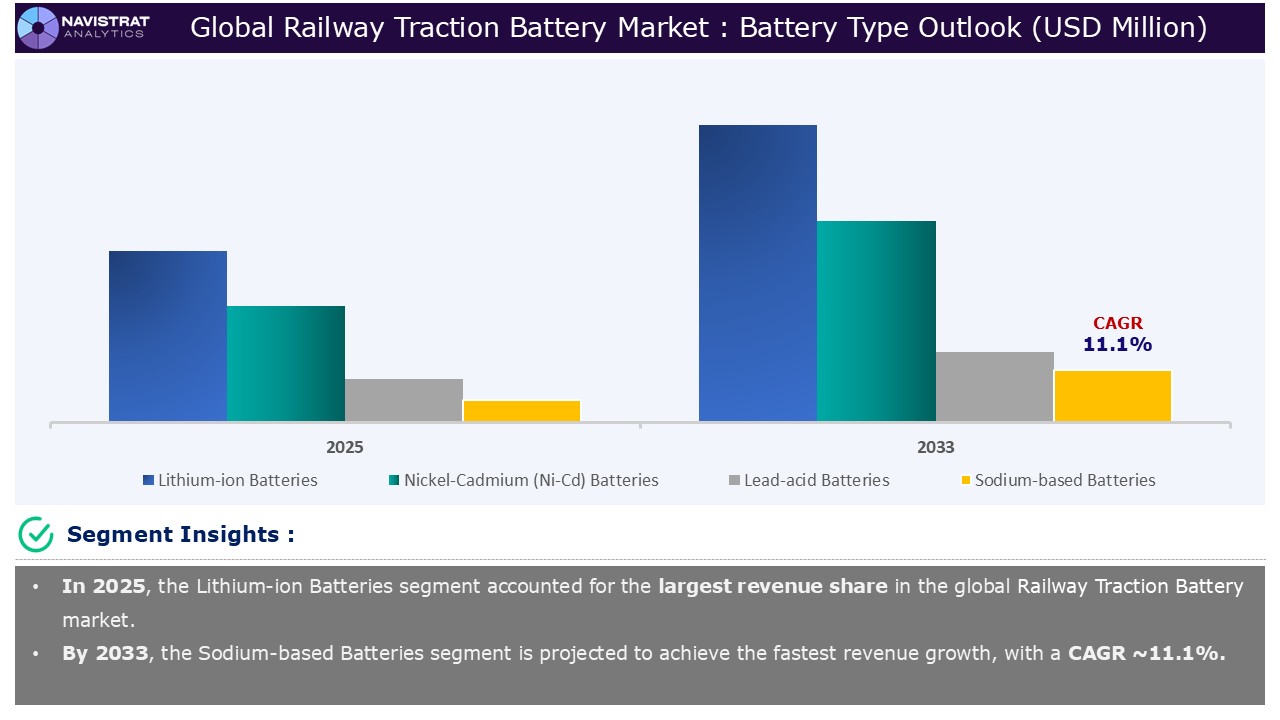
Based on the battery type, railway traction battery market is segmented into lithium-ion batteries, Nickel-Cadmium (Ni-Cd) batteries, lead-acid batteries, and sodium-based batteries.
Lithium-ion batteries segment contributed the largest market share in 2025. Lithium-ion batteries are the primary growth engine of the railway traction battery market because they offer the energy density, efficiency, and operational reliability required for battery-electric and hybrid rail vehicles, making large-scale railway electrification more commercially viable. Their high energy density enables longer operating ranges, allowing battery-powered trains to travel greater distances between charging cycles. This expands the feasibility of battery-electric trains on regional and partially non-electrified routes, increasing market demand. Fast-charging capability improves fleet utilization, as lithium-ion batteries can be recharged more quickly than conventional battery technologies. Shorter charging times reduce train downtime and improve operational efficiency for passenger and freight operators.
On September 2024, Leclanché SA, a global leader in energy storage solutions, has launched the INT-53 rail traction battery pack and a unique battery system, both of which are specifically intended for the rail industry. The INT-53 Energy has a modular and expandable architecture, allowing numerous packs to be smoothly integrated with the company’s proprietary multi-string manager technology. This design versatility guarantees that Leclanché’s battery systems are suitable for a wide range of rail applications, including trains, locomotives, and rail maintenance vehicles.
Application Segment Insights and Analysis:
Based on the application, railway traction battery market is segmented into locomotives, Electric Multiple Units (EMUs), metro & light rail vehicles, passenger coaches, freight wagons, and others.
Locomotives segment contributed the largest market share in 2025. Growing adoption of hybrid locomotives is a major growth driver, as railway operators increasingly combine diesel engines with traction batteries to reduce fuel consumption, improve energy efficiency, and lower emissions during acceleration and low-load operations. Battery-powered locomotives are expanding on non-electrified routes, particularly for regional, shunting, and short-distance freight operations where installing overhead catenary infrastructure can be economically challenging. This creates additional demand for high-capacity traction battery systems.
Battery retrofitting of existing locomotives presents a significant market opportunity, because operators can integrate battery systems into existing diesel-electric locomotives rather than replacing entire fleets, extending asset life while reducing emissions and fuel costs. Increasing freight transportation activity is supporting demand for battery-assisted locomotives, particularly for yard switching, port operations, mining, and short-haul freight applications where high torque and frequent acceleration make battery systems particularly beneficial.
On July 2026, Stadler has signed a contract with VIA Rail Canada to supply 45 hybrid locomotives, its first locomotive order in Canada. The transaction includes a 20-year Technical Support and Spare Supply Agreement (“TSSSA”). The new fleet will assist VIA Rail’s Long-Distance, Regional, and Remote Rail (LDRR) program and help to modernize and decarbonize passenger rail services across the country. The new locomotives are designed to run dependably in Canada’s harsh climate, with temperatures as low as -50°C. They combine proven diesel-electric technology with an innovative battery-assisted propulsion system.
Geographical Outlook:
Railway traction battery market is strategically segmented by geography to provide a comprehensive understanding of regional market dynamic. Discover demand analysis, emerging trends, and growth opportunities shaping market performance across different region and countries.
Europe Railway Traction Battery Market:
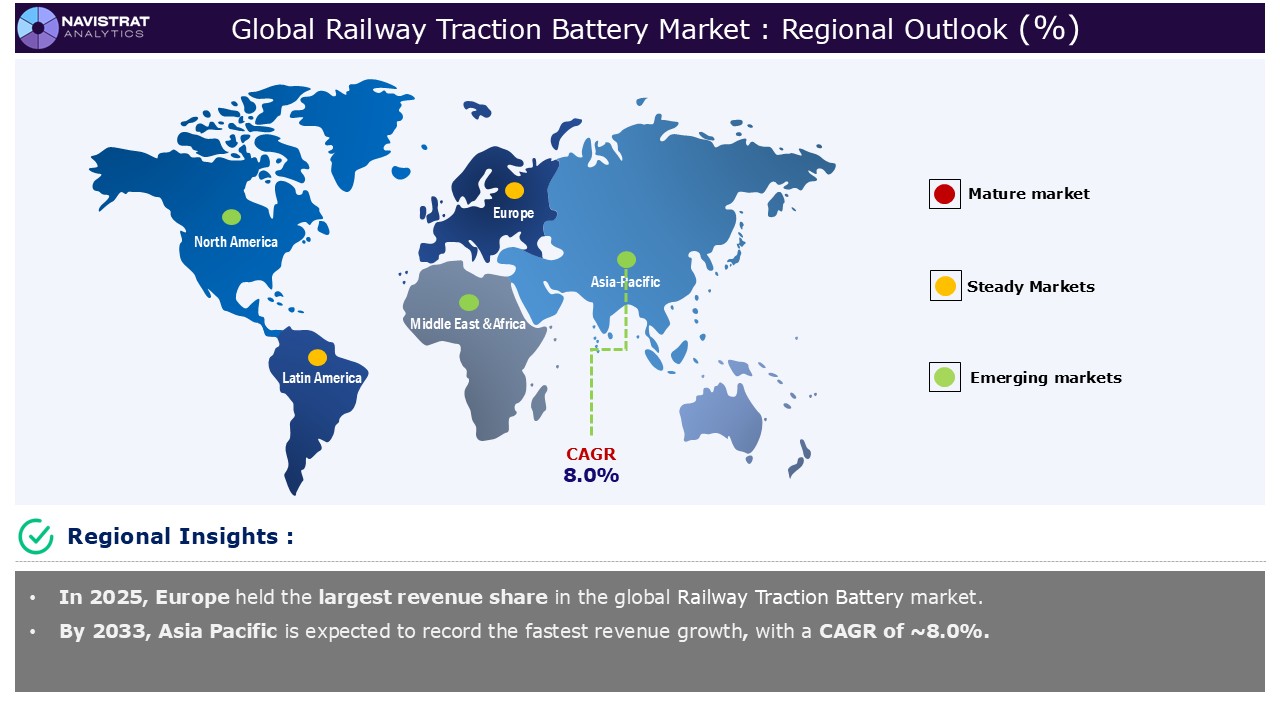
Europe is registered to have highest market share in railway traction battery market in 2025. Rail is currently Europe’s most electrified means of transportation. On main lines, 60% of the European rail network is already electrified. Furthermore, the EU rail ecosystem generates 247 billion euros in GDP for the EU economy. In November 2025, the European Commission will announce a comprehensive plan to accelerate the building of high-speed rail across the EU, offering passengers dramatically reduced journey times.
The plan promotes the EU’s dual aims of becoming carbon-neutral by 2050 and strengthening Europe’s global competitiveness by increasing the speed, comfort, safety, and reliability of rail transportation. A 2026 Europe’s Rail research call will help design next-generation high-speed rolling stock. It will support research and innovation to overcome technical constraints that currently hinder individual high-speed trainsets from running smoothly across Europe.
On September 2024, Forsee Power has introduced ZEN LFP RAIL 1500 V, a highly competitive high-energy rail traction battery system. This modular system, developed by Forsee Power engineers, is intended for locomotives used in service, freight, or passenger transit. Its substantial energy storage capacity allows for tremendous flexibility on segments of non-electrified tracks that lack catenaries. This battery system can be recharged using catenaries (in-motion charging), a fixed charger, or energy recovery during braking stages.
Asia Pacific Railway Traction Battery Market:
Asia Pacific is expected to register the fastest growth rate during the forecasted period, due to rapid railway infrastructure development, large-scale fleet modernization, expanding urban rail networks, and increasing government focus on railway electrification and decarbonization. China is a major contributor to regional demand because of its extensive high-speed rail, metro, urban transit, and conventional railway networks. Continuous investment in new rolling stock and modernization of existing fleets creates significant demand for advanced traction batteries. India represents a high-growth opportunity as railway electrification, fleet modernization, metro expansion, and the development of battery-electric and hybrid rolling stock increase the need for high-performance traction battery systems.
On December 2025, ABB Traction Australia launched its Traction Center of Excellence in Maryborough, Queensland, marking a watershed moment in Australia’s rail industry and sustainable mobility sector. The new 5,000-square-meter facility, which represents a USD 6 million investment, will serve as a strategic hub for producing traction converters, motors, and Mobile e-Power solutions. ABB has also created a Traction Battery Service Center in the same area to assist existing projects.
Competition Analysis:
Railway traction battery market is characterized by a consolidated structure, with few players competing across various segments and regions. List of major players included in railway traction battery market report are:
- Airbus
- Saft Groupe SAS
- ABB
- Toshiba Corporation
- ALSTOM SA
- Medha
- Leclanché SA
- Fagor Ederbatt
- Forsee Power
- Guangdong Aokly Group Co.,Ltd
- Exide Industries Limited
- Hitachi Rail
Strategic Developments in Railway Traction Battery Market:
- In January 2025, ABB and Škoda Group have entered into their first-ever partnership, representing a significant development in railway electrification. Under the agreement, ABB will supply its Traction Battery Pro Series, a compact and lightweight battery solution designed to enhance train performance while reducing maintenance requirements and operational downtime. The initial contract includes the supply of 195 Pro 8C-850 battery packs for 15 battery-electric multiple units (BEMUs), along with a comprehensive 15-year service agreement to support long-term system performance and reliability.
Key Advantages for Stakeholders:
Navistrat Analytics’ industry report provides an in-depth quantitative analysis of various market segments, historical and current trends, market forecasts, and dynamics within the global market. The historical years covered in this report are 2023 to 2024, with 2025 serving as the base year for market size calculations. The forecast period extends from 2026 to 2033.
The report includes an executive summary and a comprehensive overview of market drivers, restraints, opportunities, and challenges (DROC), along with insights into regulatory standards. It features detailed analyses such as PORTER’s Five Forces, SWOT, and PESTLE, as well as assessments of technological trends and the competitive landscape.
PORTER’s Five Forces analysis helps stakeholders evaluate the impact of new entrants, competitive rivalry, supplier power, buyer power, and substitution threats, enabling them to assess the level of competition and the attractiveness of the global market. The competitive landscape provides stakeholders with a clear understanding of the current market positions of key players, offering valuable insights into their competitive environment.
Scope And Key Highlights Of Railway Traction Battery Market Report:
| Report Features | Details |
| Market Size in 2025 | USD 264.4 Million |
| Market Growth Rate in CAGR (2026–2033) | 7.2% |
| Market Revenue forecast to 2033 | USD 463.4 Million |
| Base year | 2025 |
| Historical year | 2023-2024 |
| Forecast period | 2026-2033 |
| Report Pages | 450 |
| Segments covered |
|
| Regional scope |
|
| Country Scope |
|
| Key Market Players |
|
| Delivery Format | Reports are delivered in PDF format via email. |
| Customization scope | Request for Customization |
Railway Traction Battery market report offers a detailed analysis of market size, including historical revenue (in USD Million) data for 2023-2024 and revenue forecasts for 2026-2033 across the following segments:
- Battery Type Outlook (Revenue, USD Million; 2023-2033)
- Lithium-ion Batteries
- Nickel-Cadmium (Ni-Cd) Batteries
- Lead-acid Batteries
- Sodium-based Batteries
- Voltage Outlook (Revenue, USD Million; 2023-2033)
- Below 600 V
- 600–1500 V
- Above 1500 V
- Application Outlook (Revenue, USD Million; 2023-2033)
- Locomotives
- Electric Multiple Units (EMUs)
- Metro & Light Rail Vehicles
- Passenger Coaches
- Freight Wagons
- Others
- End-Use Outlook (Revenue, USD Million; 2023-2033)
- Passenger Rail Operators
- Freight Rail Operators
- Railway OEMs
- Railway Maintenance & Service Providers
- Regional Outlook (Revenue, USD Million; 2023-2033)
- North America
- U.S.
- Canada
- Mexico
- Europe
- Germany
- France
- U.K.
- Italy
- Spain
- Benelux
- Nordic Countries
- Rest of Europe
- Asia Pacific
- China
- India
- Japan
- South Korea
- Oceania
- ASEAN Countries
- Rest of APAC
- Latin America
- Brazil
- Rest of LATAM
- Middle East & Africa
- GCC Countries
- South Africa
- Israel
- Turkey
- Rest of MEA
- North America
Frequently Asked Questions (FAQ) about Railway Traction Battery Market report
The market size of railway traction battery market was 264.4 million in 2025.
The market size of railway traction battery market is expected to register compound annual growth rate (CAGR) of 7.2% over the forecast period.
Growing railway electrification programs, increasing demand for advanced railway traction batteries, and decarbonization initiatives are accelerating the adoption of battery-powered and hybrid rolling stock are major key factors driving the market revenue growth of railway traction battery market.
High initial investment costs associated with advanced battery systems and battery integration, and charging infrastructure limit adoption are key limiting factors driving the market.
Asia Pacific account for fastest revenue growth of 8.0%.
Lithium-ion batteries is the major leading segment of railway traction battery market in terms of battery type.
- Market Definition
- Research Objective
- Research Methodology
- Research Design
- Data Collection Methods
- Primary
- Secondary
- Market Size Estimation
- Top-down Model Method
- Bottom-up Model Method
- Forecasting Methodology
- Tools and Models Used
- Market Overview and Trends
- Market Size and Forecast
- Industry Analysis
- Market Driver, Restraints, Opportunity, and Challenges (DROC) Analysis
- Market Drivers
- Growing railway electrification programs
- Increasing demand for advanced railway traction batteries
- Decarbonization initiatives are accelerating the adoption of battery-powered and hybrid rolling stock
- Market Restraints
- High initial investment costs associated with advanced battery systems
- Battery integration, and charging infrastructure limit adoption
- Market Opportunities
- Expansion of battery-electric trains on non-electrified rail networks
- Growing investments in railway electrification and fleet modernization
- Increasing adoption of hybrid locomotives
- Market Challenges
- Maintaining battery reliability, safety, and long operational life
- Stringent railway safety standards
- Regulatory Landscape
- North America
- Europe
- Asia Pacific
- Latin America
- Middle East and Africa
- Strategic Insights
- Porter’s Five Forces Analysis
- PESTLE Analysis
- Price Trend Analysis
- Value Chain Analysis
- Technological Trends
- High-Energy-Density Lithium-ion and LFP Batteries
- Smart Battery Management Systems (BMS)
- Battery-Electric and Hybrid Rail Vehicles
- AI-Based Predictive Battery Analytics
- Regenerative Braking Energy Recovery
- Recent Developments
- Funding
- Merger and Acquisition
- Expansion
- Partnership and Collaboration
- Product/ Service Launch
- Battery Type Market Revenue Estimates and Forecasts, 2023-2033
- Lithium-ion Batteries
- Nickel-Cadmium (Ni-Cd) Batteries
- Lead-acid Batteries
- Sodium-based Batteriesa
- Voltage Market Revenue Estimates and Forecasts, 2023-2033
- Below 600 V
- 600–1500 V
- Above 1500 V
- Application Market Revenue Estimates and Forecasts, 2023-2033
- Locomotives
- Electric Multiple Units (EMUs)
- Metro & Light Rail Vehicles
- Passenger Coaches
- Freight Wagons
- Others
- End-Use Market Revenue Estimates and Forecasts, 2023-2033
- Passenger Rail Operators
- Freight Rail Operators
- Railway OEMs
- Railway Maintenance & Service Providers
- Railway Traction Battery Market Revenue Estimates and Forecasts by Region, 2023-2033, USD Million
- North America
- North America Railway Traction Battery Market By Battery Type, Market Revenue Estimates and Forecasts, 2023-2033, USD Million
- Lithium-ion Batteries
- Nickel-Cadmium (Ni-Cd) Batteries
- Lead-acid Batteries
- Sodium-based Batteries
- North America Railway Traction Battery Market By Voltage, Market Revenue Estimates and Forecasts, 2023-2033, USD Million
- Below 600 V
- 600–1500 V
- Above 1500 V
- North America Railway Traction Battery Market By Application, Market Revenue Estimates and Forecasts, 2023-2033, USD Million
- Locomotives
- Electric Multiple Units (EMUs)
- Metro & Light Rail Vehicles
- Passenger Coaches
- Freight Wagons
- Others
- North America Railway Traction Battery Market By End-Use, Market Revenue Estimates and Forecasts, 2023-2033, USD Million
- Passenger Rail Operators
- Freight Rail Operators
- Railway OEMs
- Railway Maintenance & Service Providers
- North America Railway Traction Battery Market Revenue Estimates and Forecasts by Country, 2023-2033, USD Million
- United States
- Canada
- Mexico
- North America Railway Traction Battery Market By Battery Type, Market Revenue Estimates and Forecasts, 2023-2033, USD Million
- Europe
- Europe Railway Traction Battery Market By Battery Type, Market Revenue Estimates and Forecasts, 2023-2033, USD Million
- Lithium-ion Batteries
- Nickel-Cadmium (Ni-Cd) Batteries
- Lead-acid Batteries
- Sodium-based Batteries
- Europe Railway Traction Battery Market By Voltage, Market Revenue Estimates and Forecasts, 2023-2033, USD Million
- Below 600 V
- 600–1500 V
- Above 1500 V
- Europe Railway Traction Battery Market By Application, Market Revenue Estimates and Forecasts, 2023-2033, USD Million
- Locomotives
- Electric Multiple Units (EMUs)
- Metro & Light Rail Vehicles
- Passenger Coaches
- Freight Wagons
- Others
- Europe Railway Traction Battery Market By End-Use, Market Revenue Estimates and Forecasts, 2023-2033, USD Million
- Passenger Rail Operators
- Freight Rail Operators
- Railway OEMs
- Railway Maintenance & Service Providers
- Europe Railway Traction Battery Market Revenue Estimates and Forecasts by Country, 2023-2033, USD Million
- Germany
- United Kingdom
- France
- Italy
- Spain
- Benelux
- Nordic Countries
- Rest of Europe
- Europe Railway Traction Battery Market By Battery Type, Market Revenue Estimates and Forecasts, 2023-2033, USD Million
- Asia Pacific
- Asia Pacific Railway Traction Battery Market By Battery Type, Market Revenue Estimates and Forecasts, 2023-2033, USD Million
- Lithium-ion Batteries
- Nickel-Cadmium (Ni-Cd) Batteries
- Lead-acid Batteries
- Sodium-based Batteries
- Asia Pacific Railway Traction Battery Market By Voltage, Market Revenue Estimates and Forecasts, 2023-2033, USD Million
- Below 600 V
- 600–1500 V
- Above 1500 V
- Asia Pacific Railway Traction Battery Market By Application, Market Revenue Estimates and Forecasts, 2023-2033, USD Million
- Locomotives
- Electric Multiple Units (EMUs)
- Metro & Light Rail Vehicles
- Passenger Coaches
- Freight Wagons
- Others
- Asia Pacific Railway Traction Battery Market By End-Use, Market Revenue Estimates and Forecasts, 2023-2033, USD Million
- Passenger Rail Operators
- Freight Rail Operators
- Railway OEMs
- Railway Maintenance & Service Providers
- Asia Pacific Railway Traction Battery Market Revenue Estimates and Forecasts by Country, 2023-2033, USD Million
- China
- India
- Japan
- South Korea
- Oceania
- ASEAN Countries
- Rest of Asia-Pacific
- Asia Pacific Railway Traction Battery Market By Battery Type, Market Revenue Estimates and Forecasts, 2023-2033, USD Million
- Latin America
- Latin America Railway Traction Battery Market By Battery Type, Market Revenue Estimates and Forecasts, 2023-2033, USD Million
- Lithium-ion Batteries
- Nickel-Cadmium (Ni-Cd) Batteries
- Lead-acid Batteries
- Sodium-based Batteries
- Latin America Railway Traction Battery Market By Voltage, Market Revenue Estimates and Forecasts, 2023-2033, USD Million
- Below 600 V
- 600–1500 V
- Above 1500 V
- Latin America Railway Traction Battery Market By Application, Market Revenue Estimates and Forecasts, 2023-2033, USD Million
- Locomotives
- Electric Multiple Units (EMUs)
- Metro & Light Rail Vehicles
- Passenger Coaches
- Freight Wagons
- Others
- Latin America Railway Traction Battery Market By End-Use, Market Revenue Estimates and Forecasts, 2023-2033, USD Million
- Passenger Rail Operators
- Freight Rail Operators
- Railway OEMs
- Railway Maintenance & Service Providers
- Latin America Railway Traction Battery Market Revenue Estimates and Forecasts by Country, 2023-2033, USD Million
- Brazil
- Rest of Latin America
- Latin America Railway Traction Battery Market By Battery Type, Market Revenue Estimates and Forecasts, 2023-2033, USD Million
- Middle East and Africa
- Middle East and Africa Railway Traction Battery Market By Battery Type, Market Revenue Estimates and Forecasts, 2023-2033, USD Million
- Lithium-ion Batteries
- Nickel-Cadmium (Ni-Cd) Batteries
- Lead-acid Batteries
- Sodium-based Batteries
- Middle East and Africa Railway Traction Battery Market By Voltage, Market Revenue Estimates and Forecasts, 2023-2033, USD Million
- Below 600 V
- 600–1500 V
- Above 1500 V
- Middle East and Africa Railway Traction Battery Market By Application, Market Revenue Estimates and Forecasts, 2023-2033, USD Million
- Locomotives
- Electric Multiple Units (EMUs)
- Metro & Light Rail Vehicles
- Passenger Coaches
- Freight Wagons
- Others
- Middle East and Africa Railway Traction Battery Market By End-Use, Market Revenue Estimates and Forecasts, 2023-2033, USD Million
- Passenger Rail Operators
- Freight Rail Operators
- Railway OEMs
- Railway Maintenance & Service Providers
- Middle East and Africa Railway Traction Battery Market Revenue Estimates and Forecasts by Country, 2023-2033, USD Million
- GCC Countries
- South Africa
- Israel
- Turkey
- Rest of Middle East & Africa
- Middle East and Africa Railway Traction Battery Market By Battery Type, Market Revenue Estimates and Forecasts, 2023-2033, USD Million
- North America
- Market Share Analysis
- Revenue Market Share by Key Players (2024-2025)
- Analysis of Top Players by Market Presence
- Competitive Matrix
- Competitive Strategies
- Mergers and Acquisitions
- Partnerships and Collaboration
- Investment and Fundings
- Agreement
- Expansion
- New Product/ Services Launches
- Technological Innovations
- Saft Groupe SAS
- Company Overview
- Financial Insights
- Product/ Services Offerings
- Strategic Developments
- SWOT Analysis
- ABB
- Company Overview
- Financial Insights
- Product / Services Offerings
- Strategic Developments
- SWOT Analysis
- Toshiba Corporation
- Company Overview
- Financial Insights
- Product/ Services Offerings
- Strategic Developments
- SWOT Analysis
- ALSTOM SA
- Company Overview
- Financial Insights
- Product / Services Offerings
- Strategic Developments
- SWOT Analysis
- Medha
- Company Overview
- Financial Insights
- Product / Services Offerings
- Strategic Developments
- SWOT Analysis
- Leclanché SA
- Company Overview
- Financial Insights
- Product / Services Offerings
- Strategic Developments
- SWOT Analysis
- Fagor Ederbatt
- Company Overview
- Financial Insights
- Product / Services Offerings
- Strategic Developments
- SWOT Analysis
- Forsee Power
- Company Overview
- Financial Insights
- Product / Services Offerings
- Strategic Developments
- SWOT Analysis
- Guangdong Aokly Group Co.,Ltd
- Company Overview
- Financial Insights
- Product / Services Offerings
- Strategic Developments
- SWOT Analysis
- Exide Industries Limited
- Company Overview
- Financial Insights
- Product / Services Offerings
- Strategic Developments
- SWOT Analysis
- Hitachi Rail
- Company Overview
- Financial Insights
- Product / Services Offerings
- Strategic Developments
- SWOT Analysis