

Rare Cell Isolation Market Overview and Key Insights:
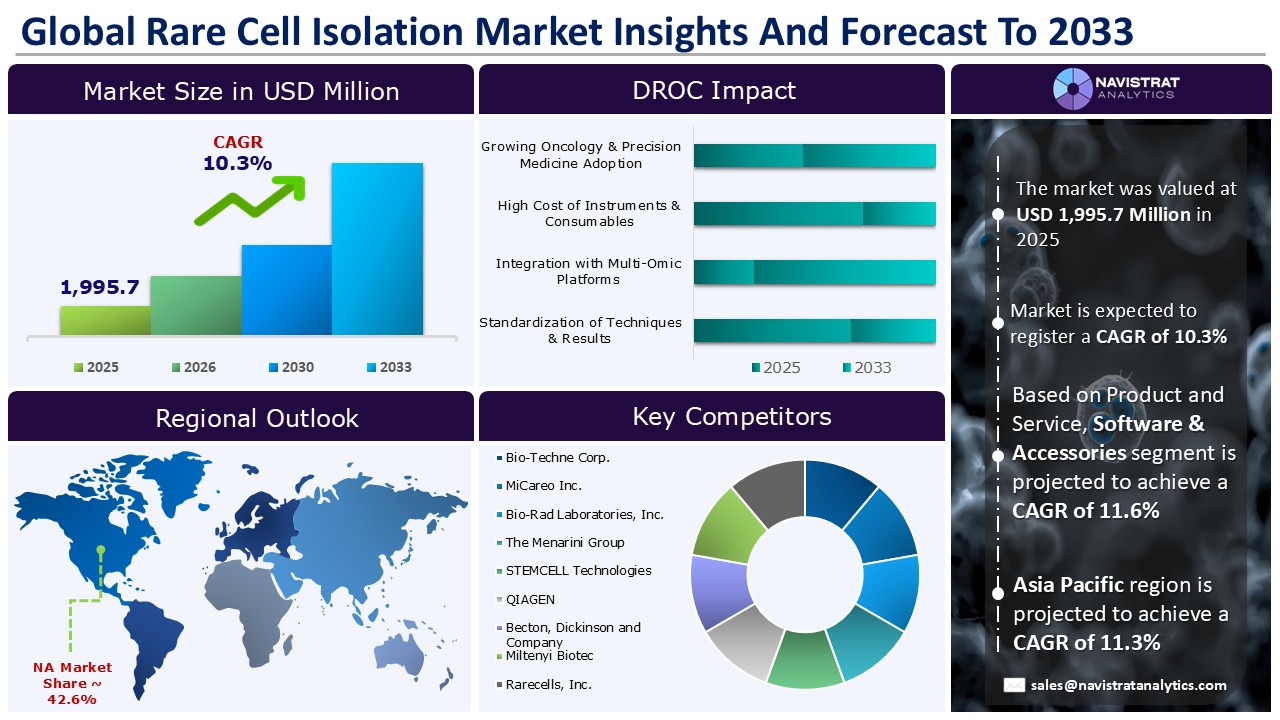
Rare cell isolation market size reached USD 1,995.7 Million in 2025 and is expected to register a revenue CAGR of 10.3% during the forecast period. Cells those that exist in small numbers among a much larger population of background cells. These cells have a significant role in a variety of applications, including cancer diagnosis and prognosis, prenatal diagnostics, and viral infection diagnosis. They are in blood samples include circulating tumor cells (CTCs), circulating fetal cells, stem cells, and cells infected with a virus or parasite.</span>
Market Drivers:
Growing oncology & precision medicine adoption is a key driver driving the market revenue growth. Isolation and identification of circulating tumour cells (CTCs) is a promising non-invasive diagnostic method in cancer research. Recent research has indicated that CTCs undergo biological alterations, such as an epithelial-mesenchymal transition (EMT), as the disease progresses and metastasizes, reflecting tumour cell heterogeneity in circulation.
Recent rapid improvements in microfluidics have provided viable answers to the issues of isolating and analysing uncommon cells. In addition to the obvious performance improvements that result in improved efficiencies and sensitivity levels, microfluidics also offers advanced characteristics such as easier handling of small sample amounts and multiplexing capabilities for high-throughput processing. All these characteristics make microfluidics an ideal platform for transporting, isolating, and analysing uncommon cells.
The examination of these isolated cells would be extremely useful, for example, in cancer research. Drug screening is a significant niche area for rare cell isolation devices. Captured target cells can be transferred to an on-chip cell culture device and subjected to potential drugs. These devices would hasten the process of drug screening and development. More crucially, drug screening on a chip would enable the development of highly tailored therapy options for cancer patients.
On June 2024, Bio-Rad Laboratories, Inc., a global leader in life science research and clinical diagnostics products, has launched Celselect Slides 2.0 to improve rare cell and circulating tumor cell (CTC) capture. The current version of Celselect Slides, which is compatible with Bio-Rad’s Genesis Cell Isolation System, allows for the processing of larger volumes of liquid biopsy samples while also capturing and recovering a greater number of CTCs for enumeration or usage in downstream applications.
Market Opportunity:
Integration with multi-omic platforms act as opportunity for rare cell isolation market. Single-cell omics approaches have changed biological study by providing unparalleled insights into cellular complexity. Single-cell study using high-throughput sequencing and mass spectrometry delivers high-resolution information about genomes, transcriptomes, proteomes, and epigenetics. However, biological systems are complicated and rely on interactions between omics layers. To address this, the growing area of single-cell multimodal omics has arisen, which integrates information across several molecular dimensions within a single cell.
Single-cell multi-omics analysis allows for accurate identification and detailed profiling of rare cellular subclones. This capability enhances the understanding of disease relapse mechanisms, improves detection of minimal residual disease (MRD), and supports the development of targeted therapies aimed at eliminating these hard-to-detect subpopulations, ultimately contributing to longer-lasting treatment responses. Additionally, integrating single-cell multi-omics facilitates patient stratification by enabling more precise selection of personalized treatment strategies tailored to individual patient profiles.
On April 2025, 1Cell.Ai has formed a partnership with BioSkryb Genomics, This partnership will enable researchers and physicians to discover and characterize uncommon mutations in single cells with unparalleled accuracy, paving the way for cancer research breakthroughs and allowing for earlier detection and targeted medication development. This collaboration brings together BioSkryb’s single-cell amplification and multi-omics chemistry with 1Cell.Ai’s OncoIncytes platform has resulted in a ground-breaking solution for evaluating uncommon cell types including circulating tumor cells (CTCs).
Recent Trends:
Emerging trends include microfluidics & lab-on-chip platforms, immunomagnetic & affinity-based separation, automated and high-throughput systems, ArtificiaI Intelligence (AI)/ML and advanced data analytics, and enhanced imaging & optical sorting.
Microfluidic devices are becoming increasingly popular for cellular manipulation and analysis, these technologies are now used in drug screening and cellular characterization. Microfluidic isolation of cells and clusters, including label-free and immunoselection approaches using either passive or active methods, has improved in efficiency and throughput, paving the way for liquid biopsy as a relatively simple and minimally invasive method of obtaining primary cells for disease monitoring. Furthermore, microfluidics has the benefits of low sample consumption, high throughput, and low cost. Because of the limited distance between the biological material in the device and the microscope objective, these devices allow for high-resolution cell observation.
On March 2025, Microlight3D has teamed with Eden Tech, a microfluidics solution provider. This cooperation seeks to give sophisticated microfluidic design tools to academics and developers in the healthcare, diagnostics, and research fields. The collaboration combines Microlight3D’s Smart Print UV maskless lithography equipment, which produces micron-resolution 2D shapes, with Eden Tech’s Flui’device, a quick and easy-to-use application.
Restraints & Challenges:
Cell isolation and separation present substantial technological problems, such as obtaining specificity, purity, and survival of target cells while avoiding contamination and damage during processing. Isolating endogenous rare cells, such as hematopoietic stem cells (HSCs) and circulating endothelial cells (CECs), is especially difficult due to sensitivity constraints. Stem cell separation is especially difficult since undifferentiated cells must be eliminated to prevent teratoma formation following implantation. The lack of precise biomarkers for certain target cell types complicates the separation process and makes it difficult to assess the purity of separated cells. Standardizing protocols and scaling techniques for clinical applications makes them more reliable and widely used.
Product and Service Segment Insights and Analysis:
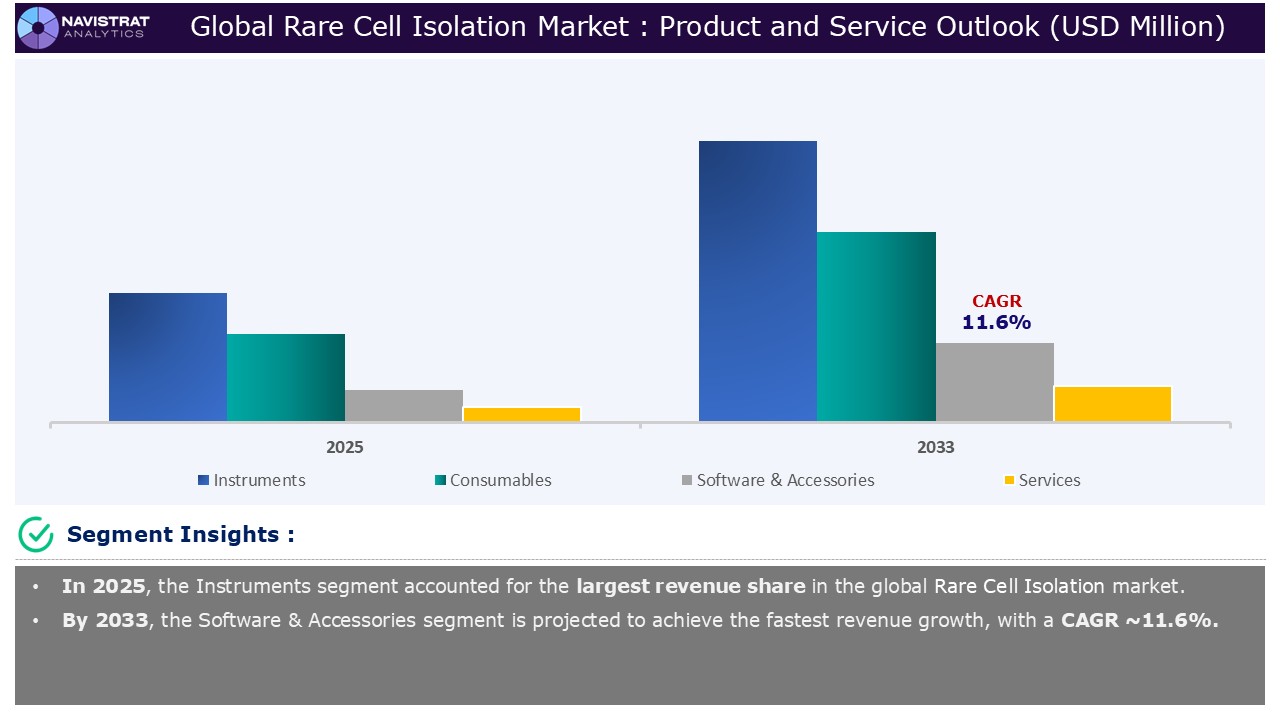
Based on the product and service, rare cell isolation market is segmented into instruments, consumables, software & accessories, and services.
Instruments segment contributed the largest market share in 2025. Technological advancements in precision, automation, and integration with downstream analytical tools. Increasing clinical applications, high-throughput requirements, and continuous innovation in cell sorting platforms are accelerating adoption across research and diagnostic settings. As rare cell analysis expands with minimal residual disease detection, liquid biopsy, and personalized medicine demand for reliable and standardized isolation instruments continues to grow, particularly in hospitals and diagnostic laboratories.
On November 2025, STEMCELL Technologies and Immudex have introduced a new procedure that combines EasySep Release positive selection with Immudex Dextramer reagents. This breakthrough enables researchers to isolate rare antigen-specific T cells, MAIT cells, and iNKT cells with unprecedented simplicity, speed, and purity. This novel approach provides an appealing alternative to standard fluorescence-activated cell sorting (FACS), which is frequently expensive, time-consuming, and technically demanding. This joint protocol empowers immunology and cell therapy researchers to accelerate discovery while maintaining the highest standards of cell quality and specificity.
Cell Type Segment Insights and Analysis:
Based on the cell type, rare cell isolation market is segmented into Circulating Tumor Cells (CTCs), stem cells, immune cells, fetal cells, and others.
Circulating Tumor Cells (CTCs) segment contributed the largest market share in 2025. CTCs are cancer cells that have detached from the main tumor and entered the bloodstream, making them an important target for early cancer detection and monitoring of metastases. CTCs have recently been used in a variety of cancer-related applications, including stage screening, recurrence monitoring, efficacy assessment, and therapy recommendations. According to the American Society of Clinical Oncology’s biomarker guidelines, CTCs can be utilized to monitor metastatic cancers during and after treatment. A decrease in CTC count after one cycle of chemotherapy can indicate tumor response, progression-free survival, and overall survival in stage III-IV cancer.
The advancement of single-cell analysis technology allows researchers to thoroughly characterize CTCs, analyzing their gene mutations, copy number variations, transcriptome, and proteomic expression characteristics, revealing their potential stemness, chemotherapy resistance, and metastatic potential. Furthermore, the integration of artificial intelligence, big data analytics, and multi-omics technologies is accelerating the development of advanced categorization systems.
On September 2025, CTCELLS, a Korean liquid biopsy firm, stated that it has inked a research service agreement with the international pharmaceutical company Daiichi Sankyo to conduct protein expression investigations on circulating tumor cells (CTCs). The study will use CTCELLS’ unique platform, ‘CTCeptor,’ to evaluate the expression of certain proteins in rare circulating tumor cells in the circulation and track changes after drug therapy. CTCELLS is known for its capacity to isolate extremely minute numbers of tumor cells from blood samples with high purity utilizing its unique microfluidic continuous centrifugation (CCM) technique.
Technology Segment Insights and Analysis:
Based on the technology, rare cell isolation market is segmented into flow cytometry/FACS, microfluidics, immunomagnetic separation, PCR-based isolation, microbeads and affinity-based methods, and others.
Microfluidics segment contributed the largest market share in 2025. Researchers have extensively employed microfluidics to isolate and process rare cells because it offers capabilities not available in traditional systems. Additionally, microfluidic technologies enable novel cell separation approaches by relying on non-traditional biomarkers and intrinsic cellular properties. This approach allows scientists to isolate cell populations that conventional methods would not typically target. These compact microdevices also enable fully integrated parallel processing, increasing efficiency and throughput, which is especially important for rare cell events.
Microfluidic platforms have proven an effective tool for studying uncommon cells in continuous flow or microfluidic cytometry. Because the system operates at single-cell resolution, it allows rare cell samples to pass through without separating or purifying them. Researchers conduct rare cell studies using microfluidics in either stationary fluids or continuous flow systems. Each approach supports different applications. Scientists typically prefer stationary fluid systems for molecular-level cell research.
On November 2024, Parallel Fluidics, the world’s fastest microfluidic device manufacturer, announced the closing of a USD 7 million seed round led by J2 Ventures, with participation from 8VC and Praxis. The funds will be used to enhance the company’s on-demand design and manufacturing platform, extend its hardware and software solutions, and commercialize its new product, MV-2.
Geographical Outlook:
Rare cell isolation market is strategically segmented by geography to provide a comprehensive understanding of regional market dynamic. Discover demand analysis, emerging trends, and growth opportunities shaping market performance across different region and countries.
North America Rare Cell Isolation Market:
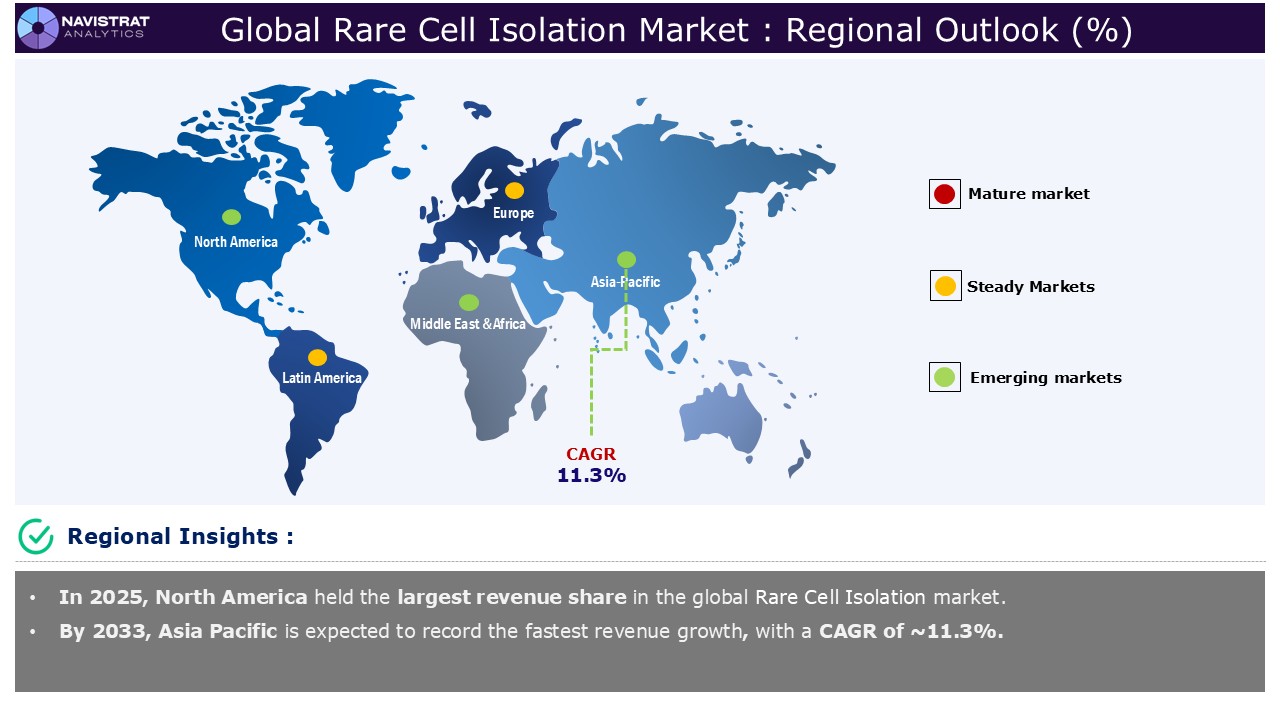
North America is registered to have highest market share in rare cell isolation market in 2025. This is mainly driven by rising prevalence of chronic diseases and expanding research in immunotherapy & cell therapy. According to the American Cancer Society, excluding non-melanoma skin cancer, at least 40% of newly diagnosed malignancies in US adults – approximately 850,000 cases in 2026 are possibly preventable, including 19% of cancers related with cigarette smoking, 8% associated with excess body weight, and 5% associated with alcohol usage. In 2026, a projected 9,680 children (ages 0 to 14) and 5,660 adolescents (ages 15 to 19) would be diagnosed with cancer, with 1,090 children and 730 adolescents dying as a result.
On February 2026, Parse Biosciences, a QIAGEN company and the leading provider of scalable and accessible single-cell sequencing solutions, has announced the release of the new Evercode Whole Transcriptome v4 product line, which provides increased scalability, higher sensitivity, and a streamlined workflow for single-cell RNA sequencing. Evercode v4 reduces off-target reads, allowing for more gene detection per cell even at lower sequencing depths and lower costs than previous systems. Evercode v4 offers researchers researching rare cell types or lowly expressed genes greater biological detail due to its increased sensitivity.
Asia Pacific Rare Cell Isolation Market:
Asia Pacific is expected to register the fastest growth rate during the forecasted period, driven by expanding healthcare infrastructure, rising cancer incidence, increasing biotechnology investments and strong research activity. Countries such as China, Japan, India, South Korea are strengthening their drug discovery activities, clinical trials, and immunotherapy research are driving demand for high performance cell isolation platforms. Furthermore, rapid modernization of hospitals and healthcare institutions is increasing the demand for technological advanced instruments.
On August 2024, Shinobi Therapeutics, a biotechnology startup researching a novel class of immune evasive iPS cell therapeutics, has been given up to USD 59 million in non-dilutive grant financing by the Japanese Agency for Medical Research and Development (AMED). The award will be utilized to advance Shinobi’s lead initiative, an iPS-T cell treatment for GPC3+ solid tumor malignancies.
Competition Analysis:
Rare cell isolation market is characterized by a consolidated structure, with few players competing across various segments and regions. List of major players included in rare cell isolation market report are:
- Bio-Techne Corp.
- MiCareo Inc.
- Bio-Rad Laboratories, Inc.
- The Menarini Group
- STEMCELL Technologies
- QIAGEN
- Becton, Dickinson and Company
- Miltenyi Biotec
- Rarecells, Inc.
- Molecular Machines & Industries (MMI)
- Thermo Fisher Scientific Inc.
- SCIENION
- Akadeum Life Sciences
- BioFluidica
Strategic Developments in Rare Cell Isolation Market:
- In September 2025, Cayman Chemical, a global producer of life science research instruments, and Akadeum Life Sciences, a pioneer in buoyancy-based cell separation technology, have announced a distribution agreement that will increase access to Akadeum’s next-generation cell isolation technology for cell and gene therapy development. Cayman will distribute Akadeum’s buoyant microbubble cell separation kits as part of the deal, incorporating this ground-breaking platform into their comprehensive array of goods and services that support life science research and discovery.
- In June 2024, RareCyte, Inc., a Life Sciences firm that provides advanced Precision Biology platforms such as instruments, reagents, software, and services, announced the completion of a USD 20 million fundraising round from new and existing investors. The company intends to use the funding to expand its successful Orion Spatial Biology platform by commercializing new multiplex assays, reagent supplies, and software applications. The global scientific community has embraced and recognized the RareCyte Orion platform as the only spatial biology platform that meets translational market requirements, ranging from discovery applications to clinical trial support.
Key Advantages for Stakeholders:
Navistrat Analytics’ industry report provides an in-depth quantitative analysis of various market segments, historical and current trends, market forecasts, and dynamics within the global market. The historical years covered in this report are 2023 to 2024, with 2025 serving as the base year for market size calculations. The forecast period extends from 2026 to 2033.
The report includes an executive summary and a comprehensive overview of market drivers, restraints, opportunities, and challenges (DROC), along with insights into regulatory standards. It features detailed analyses such as PORTER’s Five Forces, SWOT, and PESTLE, as well as assessments of technological trends and the competitive landscape.
PORTER’s Five Forces analysis helps stakeholders evaluate the impact of new entrants, competitive rivalry, supplier power, buyer power, and substitution threats, enabling them to assess the level of competition and the attractiveness of the global market. The competitive landscape provides stakeholders with a clear understanding of the current market positions of key players, offering valuable insights into their competitive environment.
Scope And Key Highlights Of Rare Cell Isolation Market Report:
| Report Features | Details |
| Market Size in 2025 | USD 1,995.7 Million |
| Market Growth Rate in CAGR (2026–2033) | 10.3% |
| Market Revenue forecast to 2033 | USD 4,393.2 Million |
| Base year | 2025 |
| Historical year | 2023-2024 |
| Forecast period | 2026-2033 |
| Report Pages | 450 |
| Segments covered |
|
| Regional scope |
|
| Country Scope |
|
| Key Market Players |
|
| Delivery Format | Reports are delivered in PDF format via email. |
| Customization scope | Request for Customization |
Rare Cell Isolation market report offers a detailed analysis of market size, including historical revenue (in USD Million) data for 2023-2024 and revenue forecasts for 2026-2033 across the following segments:
- Product and Service Outlook (Revenue, USD Million; 2023-2033)
- Instruments
- Consumables
- Software & Accessories
- Services
- Cell Type Outlook (Revenue, USD Million; 2023-2033)
- Circulating Tumor Cells (CTCs)
- Stem Cells
- Immune Cells
- Fetal Cells
- Others
- Technology Outlook (Revenue, USD Million; 2023-2033)
- Flow Cytometry/FACS
- Microfluidics
- Immunomagnetic Separation
- PCR-Based Isolation
- Microbeads and Affinity-Based Methods
- Others
- Application Outlook (Revenue, USD Million; 2023-2033)
- Oncology
- Stem Cell Research
- Prenatal & Genetic Testing
- Drug Discovery & Development
- Others
- End-Use Outlook (Revenue, USD Million; 2023-2033)
- Hospitals & Diagnostic Laboratories
- Pharmaceutical & Biotech Companies
- Academic & Research Institutes
- Industrial and Manufacturing
- Regional Outlook (Revenue, USD Million; 2023-2033)
- North America
- U.S.
- Canada
- Mexico
- Europe
- Germany
- France
- U.K.
- Italy
- Spain
- Benelux
- Nordic Countries
- Rest of Europe
- Asia Pacific
- China
- India
- Japan
- South Korea
- Oceania
- ASEAN Countries
- Rest of APAC
- Latin America
- Brazil
- Rest of LATAM
- Middle East & Africa
- GCC Countries
- South Africa
- Israel
- Turkey
- Rest of MEA
- North America
Frequently Asked Questions (FAQ) about Rare Cell Isolation market report
The market size of rare cell isolation market was 1,995.7 million in 2025.
The market size of rare cell isolation market is expected to register compound annual growth rate (CAGR) of 10.3% over the forecast period.
Growing oncology & precision medicine adoption, expanding research in immunotherapy & cell therapy, and advancements in single-cell analysis technologies are major key factors driving the market revenue growth of rare cell isolation market.
High cost of instruments & consumables and technical complexity & expertise requirement are key limiting factors driving the market.
Asia Pacific account for fastest revenue growth of 11.3%.
Instruments is the major leading segment of rare cell isolation market in terms of product and service.
- Market Definition
- Research Objective
- Research Methodology
- Research Design
- Data Collection Methods
- Primary
- Secondary
- Market Size Estimation
- Top-down Method
- Bottom-up Method
- Forecasting Methodology
- Tools and Models Used
- Market Overview and Trends
- Market Size and Forecast
- Industry Analysis
- Market Driver, Restraints, Opportunity, and Challenges (DROC) Analysis
- Market Drivers
- Growing oncology & precision medicine adoption
- Expanding Research in Immunotherapy & Cell Therapy
- Advancements in Single-Cell Analysis Technologies
- Market Restraints
- High Cost of Instruments & Consumables
- Technical Complexity & Expertise Requirement
- Market Opportunities
- Integration with Multi-Omic Platforms
- Point-of-Care and Automated Systems
- Market Challenges
- Standardization of Techniques & Results
- Sample Variability & Low Abundance
- Competition from Alternative Technologies
- Regulatory Landscape
- North America
- Europe
- Asia Pacific
- Latin America
- Middle East and Africa
- Strategic Insights
- Porter’s Five Forces Analysis
- PESTLE Analysis
- Price Trend Analysis
- Value Chain Analysis
- Technological Trends
- Microfluidics & Lab-on-Chip Platforms
- Immunomagnetic & Affinity-Based Separation
- Automated and High-Throughput Systems
- AI/ML and Advanced Data Analytics
- Enhanced Imaging & Optical Sorting
- Recent Developments
- Funding
- Merger and Acquisition
- Expansion
- Partnership and Collaboration
- Product/ Service Launcha
- Product and Service Market Revenue Estimates and Forecasts, 2023-2033
- Instruments
- Consumables
- Software & Accessories
- Services
- Cell Type Market Revenue Estimates and Forecasts, 2023-2033
- Circulating Tumor Cells (CTCs)
- Stem Cells
- Immune Cells
- Fetal Cells
- Others
- Technology Market Revenue Estimates and Forecasts, 2023-2033
- Flow Cytometry/FACS
- Microfluidics
- Immunomagnetic Separation
- PCR-Based Isolation
- Microbeads and Affinity-Based Methods
- Others
- Application Market Revenue Estimates and Forecasts, 2023-2033
- Oncology
- Stem Cell Research
- Prenatal & Genetic Testing
- Drug Discovery & Development
- Others
- End-Use Market Revenue Estimates and Forecasts, 2023-2033
- Hospitals & Diagnostic Laboratories
- Pharmaceutical & Biotech Companies
- Academic & Research Institutes
- Industrial and Manufacturing
- Rare Cell Isolation Market Revenue Estimates and Forecasts by Region, 2023-2033, USD Million
- North America
- North America Rare Cell Isolation Market By Product and Service, Market Revenue Estimates and Forecasts, 2023-2033, USD Million
- Instruments
- Consumables
- Software & Accessories
- Services
- North America Rare Cell Isolation Market By Cell Type, Market Revenue Estimates and Forecasts, 2023-2033, USD Million
- Circulating Tumor Cells (CTCs)
- Stem Cells
- Immune Cells
- Fetal Cells
- Others
- North America Rare Cell Isolation Market By Technology, Market Revenue Estimates and Forecasts, 2023-2033, USD Million
- Flow Cytometry/FACS
- Microfluidics
- Immunomagnetic Separation
- PCR-Based Isolation
- Microbeads and Affinity-Based Methods
- Others
- North America Rare Cell Isolation Market By Application, Market Revenue Estimates and Forecasts, 2023-2033, USD Million
- Oncology
- Stem Cell Research
- Prenatal & Genetic Testing
- Drug Discovery & Development
- Others
- North America Rare Cell Isolation Market By End-Use, Market Revenue Estimates and Forecasts, 2023-2033, USD Million
- Hospitals & Diagnostic Laboratories
- Pharmaceutical & Biotech Companies
- Academic & Research Institutes
- Industrial and Manufacturing
- North America Rare Cell Isolation Market Revenue Estimates and Forecasts by Country, 2023-2033, USD Million
- United States
- Canada
- Mexico
- North America Rare Cell Isolation Market By Product and Service, Market Revenue Estimates and Forecasts, 2023-2033, USD Million
- Europe
- Europe Rare Cell Isolation Market By Product and Service, Market Revenue Estimates and Forecasts, 2023-2033, USD Million
- Instruments
- Consumables
- Software & Accessories
- Services
- Europe Rare Cell Isolation Market By Cell Type, Market Revenue Estimates and Forecasts, 2023-2033, USD Million
- Circulating Tumor Cells (CTCs)
- Stem Cells
- Immune Cells
- Fetal Cells
- Others
- Europe Rare Cell Isolation Market By Technology, Market Revenue Estimates and Forecasts, 2023-2033, USD Million
- Flow Cytometry/FACS
- Microfluidics
- Immunomagnetic Separation
- PCR-Based Isolation
- Microbeads and Affinity-Based Methods
- Others
- Europe Rare Cell Isolation Market By Application, Market Revenue Estimates and Forecasts, 2023-2033, USD Million
- Oncology
- Stem Cell Research
- Prenatal & Genetic Testing
- Drug Discovery & Development
- Others
- Europe Rare Cell Isolation Market By End-Use, Market Revenue Estimates and Forecasts, 2023-2033, USD Million
- Hospitals & Diagnostic Laboratories
- Pharmaceutical & Biotech Companies
- Academic & Research Institutes
- Industrial and Manufacturing
- Europe Rare Cell Isolation Market Revenue Estimates and Forecasts by Country, 2023-2033, USD Million
- Germany
- United Kingdom
- France
- Italy
- Spain
- Benelux
- Nordic Countries
- Rest of Europe
- Europe Rare Cell Isolation Market By Product and Service, Market Revenue Estimates and Forecasts, 2023-2033, USD Million
- Asia Pacific
- Asia Pacific Rare Cell Isolation Market By Product and Service, Market Revenue Estimates and Forecasts, 2023-2033, USD Million
- Instruments
- Consumables
- Software & Accessories
- Services
- Asia Pacific Rare Cell Isolation Market By Cell Type, Market Revenue Estimates and Forecasts, 2023-2033, USD Million
- Circulating Tumor Cells (CTCs)
- Stem Cells
- Immune Cells
- Fetal Cells
- Others
- Asia Pacific Rare Cell Isolation Market By Technology, Market Revenue Estimates and Forecasts, 2023-2033, USD Million
- Flow Cytometry/FACS
- Microfluidics
- Immunomagnetic Separation
- PCR-Based Isolation
- Microbeads and Affinity-Based Methods
- Others
- Asia Pacific Rare Cell Isolation Market By Application, Market Revenue Estimates and Forecasts, 2023-2033, USD Million
- Oncology
- Stem Cell Research
- Prenatal & Genetic Testing
- Drug Discovery & Development
- Others
- Asia Pacific Rare Cell Isolation Market By End-Use, Market Revenue Estimates and Forecasts, 2023-2033, USD Million
- Hospitals & Diagnostic Laboratories
- Pharmaceutical & Biotech Companies
- Academic & Research Institutes
- Industrial and Manufacturing
- Asia Pacific Rare Cell Isolation Market Revenue Estimates and Forecasts by Country, 2023-2033, USD Million
- China
- India
- Japan
- South Korea
- Oceania
- ASEAN Countries
- Rest of Asia-Pacific
- Asia Pacific Rare Cell Isolation Market By Product and Service, Market Revenue Estimates and Forecasts, 2023-2033, USD Million
- Latin America
- Latin America Rare Cell Isolation Market By Product and Service, Market Revenue Estimates and Forecasts, 2023-2033, USD Million
- Instruments
- Consumables
- Software & Accessories
- Services
- Latin America Rare Cell Isolation Market By Cell Type, Market Revenue Estimates and Forecasts, 2023-2033, USD Million
- Circulating Tumor Cells (CTCs)
- Stem Cells
- Immune Cells
- Fetal Cells
- Others
- Latin America Rare Cell Isolation Market By Technology, Market Revenue Estimates and Forecasts, 2023-2033, USD Million
- Flow Cytometry/FACS
- Microfluidics
- Immunomagnetic Separation
- PCR-Based Isolation
- Microbeads and Affinity-Based Methods
- Others
- Latin America Rare Cell Isolation Market By Application, Market Revenue Estimates and Forecasts, 2023-2033, USD Million
- Oncology
- Stem Cell Research
- Prenatal & Genetic Testing
- Drug Discovery & Development
- Others
- Latin America Rare Cell Isolation Market By End-Use, Market Revenue Estimates and Forecasts, 2023-2033, USD Million
- Hospitals & Diagnostic Laboratories
- Pharmaceutical & Biotech Companies
- Academic & Research Institutes
- Industrial and Manufacturing
- Latin America Rare Cell Isolation Market Revenue Estimates and Forecasts by Country, 2023-2033, USD Million
- Brazil
- Rest of Latin America
- Latin America Rare Cell Isolation Market By Product and Service, Market Revenue Estimates and Forecasts, 2023-2033, USD Million
- Middle East and Africa
- Middle East and Africa Rare Cell Isolation Market By Product and Service, Market Revenue Estimates and Forecasts, 2023-2033, USD Million
- Instruments
- Consumables
- Software & Accessories
- Services
- Middle East and Africa Rare Cell Isolation Market By Cell Type, Market Revenue Estimates and Forecasts, 2023-2033, USD Million
- Circulating Tumor Cells (CTCs)
- Stem Cells
- Immune Cells
- Fetal Cells
- Others
- Middle East and Africa Rare Cell Isolation Market By Technology, Market Revenue Estimates and Forecasts, 2023-2033, USD Million
- Flow Cytometry/FACS
- Microfluidics
- Immunomagnetic Separation
- PCR-Based Isolation
- Microbeads and Affinity-Based Methods
- Others
- Middle East and Africa Rare Cell Isolation Market By Application, Market Revenue Estimates and Forecasts, 2023-2033, USD Million
- Oncology
- Stem Cell Research
- Prenatal & Genetic Testing
- Drug Discovery & Development
- Others
- Middle East and Africa Rare Cell Isolation Market By End-Use, Market Revenue Estimates and Forecasts, 2023-2033, USD Million
- Hospitals & Diagnostic Laboratories
- Pharmaceutical & Biotech Companies
- Academic & Research Institutes
- Industrial and Manufacturing
- Middle East and Africa Rare Cell Isolation Market Revenue Estimates and Forecasts by Country, 2023-2033, USD Million
- GCC Countries
- South Africa
- Israel
- Turkey
- Rest of Middle East & Africa
- Middle East and Africa Rare Cell Isolation Market By Product and Service, Market Revenue Estimates and Forecasts, 2023-2033, USD Million
- North America
- Market Share Analysis
- Revenue Market Share by Key Players (2024-2025)
- Analysis of Top Players by Market Presence
- Competitive Matrix
- Competitive Strategies
- Mergers and Acquisitions
- Partnerships and Collaboration
- Investment and Fundings
- Agreement
- Expansion
- New Product/ Services Launches
- Technological Innovations
- Bio-Techne Corp.
- Company Overview
- Financial Insights
- Product/ Services Offerings
- Strategic Developments
- SWOT Analysis
- MiCareo Inc.
- Company Overview
- Financial Insights
- Product / Services Offerings
- Strategic Developments
- SWOT Analysis
- Bio-Rad Laboratories, Inc.
- Company Overview
- Financial Insights
- Product/ Services Offerings
- Strategic Developments
- SWOT Analysis
- The Menarini Group
- Company Overview
- Financial Insights
- Product / Services Offerings
- Strategic Developments
- SWOT Analysis
- STEMCELL Technologies
- Company Overview
- Financial Insights
- Product / Services Offerings
- Strategic Developments
- SWOT Analysis
- QIAGEN
- Company Overview
- Financial Insights
- Product / Services Offerings
- Strategic Developments
- SWOT Analysis
- Becton, Dickinson and Company
- Company Overview
- Financial Insights
- Product / Services Offerings
- Strategic Developments
- SWOT Analysis
- Miltenyi Biotec
- Company Overview
- Financial Insights
- Product / Services Offerings
- Strategic Developments
- SWOT Analysis
- Rarecells, Inc.
- Company Overview
- Financial Insights
- Product / Services Offerings
- Strategic Developments
- SWOT Analysis
- Molecular Machines & Industries (MMI)
- Company Overview
- Financial Insights
- Product / Services Offerings
- Strategic Developments
- SWOT Analysis
- Thermo Fisher Scientific Inc.
- Company Overview
- Financial Insights
- Product / Services Offerings
- Strategic Developments
- SWOT Analysis
- SCIENION
- Company Overview
- Financial Insights
- Product / Services Offerings
- Strategic Developments
- SWOT Analysis
- Akadeum Life Sciences
- Company Overview
- Financial Insights
- Product / Services Offerings
- Strategic Developments
- SWOT Analysis
- BioFluidica
- Company Overview
- Financial Insights
- Product / Services Offerings
- Strategic Developments
- SWOT Analysis