

Global Small Launch Vehicle Market Overview and Key Insights:
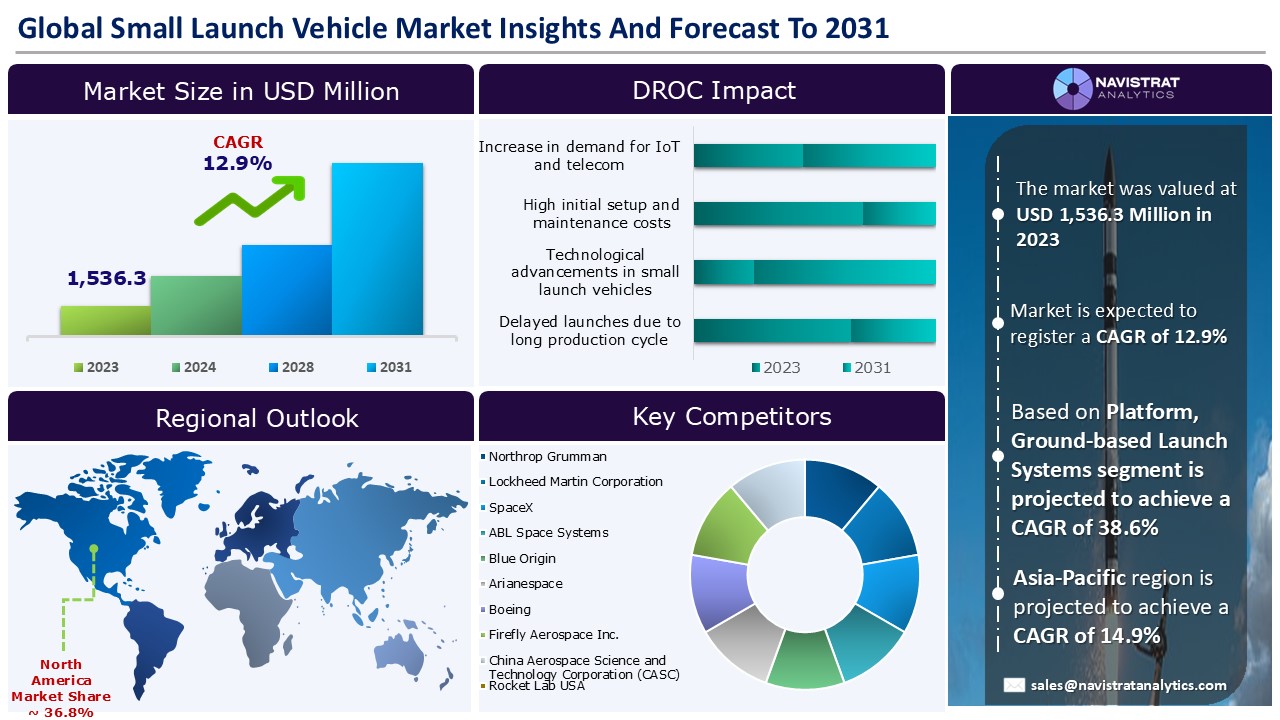
The global small launch vehicle market size reached USD 1,536.3 Million in 2023 and is expected to register a revenue CAGR of 12.9% during the forecast period. Small (or small-lift) launchers are space launch vehicles designed to transport and place tiny satellites into orbit. Small launchers are often described as those capable of delivering payloads up to 2000 kg to LEO.
Market Drivers:
Increase in demand for IoT and telecom is a key driver of revenue growth in the global small launch vehicle market. The deployment of 5G has increased mobile internet traffic. By 2025, the world is predicted to have more than 1 billion 5G connections. There are upwards of 10.47 billion IoT connections worldwide and China has the most smartphone users in the world. Internet users continue to expand, with the most recent data showing that the world’s connected population increased by 151 million users in the year ending October 2024. Social media use is also increasing, with an estimated 5.22 billion active social media user “identities” by October 2024.
Furthermore, increase in demand for launch vehicles for small satellites is also another key driver driving the market growth. On August 2024, The Indian Space Research Organisation (ISRO) launched the EOS-08 Earth Observation Satellite using the Small Satellite Launch Vehicle (SSLV)-D3. EOS-08 is a first-of-its-kind mission constructed on a typical ISRO Microsat/IMS-1 bus, featuring a suite of advanced payloads for IR observation, a unique GNSS-R payload, and a SiC UV dosimeter. The satellite contains three payloads: the Electro Optical Infrared Payload (EOIR), SAC; the Global Navigation Satellite System- Reflectometry payload (GNSS-R), SAC; and the SiC UV Dosimeter, LEOS. The spacecraft’s mission configuration is scheduled to fly in a Circular Low Earth Orbit (LEO) at an altitude of 475 km and an inclination of 37.4° for a mission life of one year.
Market Opportunity:
Technological advancements in small launch vehicles acts as an opportunity for the global Small Launch Vehicle market. On September 2024, Space Machines Company, an Australian-Indian space services company, has announced two key agreements with industry heavyweights Ananth Technologies and Digantara. These agreements are expected to play a critical role in furthering the Space MAITRI mission and launching Space Machines Company’s second Optimus satellite. The Space MAITRI (Mission for Australia-India’s Technology, Research, and Innovation) mission is set for 2026, with the Optimus satellite launching on NewSpace India Limited’s (NSIL) Small Satellite Launch Vehicle (SSLV). These relationships demonstrate Space Machines Company’s expanding commitment to promoting international space cooperation, notably between Australia and India.
Recent Trends:
Recent trends include the development of reusable launch vehicles, private investments, and its applications in defence sectors.
Reusable launch systems, also known as reusable launch vehicles, are designed to recover some of the launch system’s primary components. The reusability of these systems has sparked a lot of curiosity and accelerated technological development in this field. These technologies have a large future commercial potential since they can significantly cut the cost of space launch and exploration. Furthermore, advancements in engine technology are having a significant impact on the reusable launch mechanism. Engines built using 3D printing have reduced the number of components, production costs, and unit development time.
On November 2024, Rocket Lab USA, Inc., a global leader in launch services and space technologies, successfully launched its 54th Electron mission, which placed a single satellite in Low Earth Orbit for a confidential commercial customer. Electron is still the world’s third most frequently launched rocket by vehicle type and the second most launched rocket in the United States each year. Rocket Lab’s Electron rocket transformed this by allowing clients to book and launch in a matter of weeks, allowing them to test innovations faster, generate income from constellations earlier, and acquire urgent data from orbit on near-on-demand terms.
Restraints & Challenges:
Delayed launches due to long production cycle represent a significant challenge that could constrain revenue growth in the Small Launch Vehicle market. Delays cause problems for space missions of all sizes. Even with the best planning and documentation, there may be issues leading up to launch. For example, weather conditions may have an impact on the launch. Furthermore, launch vehicles or other delayed payloads may experience mechanical issues after being moved to the head of the queue for launch. Design engineers fail to communicate effectively with production engineers when assessing manufacturability, resulting in items being “sent back to the drawing board” late in the manufacturing process. Excessive design iterations waste time and money.
Propulsion Type Segment Insights and Analysis:
Based on the propulsion type, the small launch vehicle market is segmented into the solid, liquid, hybrid, and electric.
Liquid segment contributed largest share in 2023. Liquid propellant engines have higher performance, meaning they produce more thrust per unit weight of propellant used. Because liquid engines can be tested numerous times before flight, they are more reliable, and their ability to be turned off once started adds an extra layer of safety. Liquid propellant engines can also be constructed with restart capabilities for orbital movement.
On May 2024, the Swedish Space Corporation (SSC) and Perigee Aerospace Inc. have announced plans to launch satellites from Sweden’s Esrange Space Center beginning in 2025, using Perigee’s two-stage rocket. The maximum weight that can be launched into a Sun-Synchronous Orbit (SSO) at a 500 km altitude is 200 kilograms. BW1 is a two-stage rocket capable of lifting to 200 kg into Sun-Synchronous Orbit (SSO). It is powered by innovative liquid methane engines and built with lightweight carbon fiber composites, ensuring cost-effective global launches and reliable flight control systems.
Hybrid segment is expected to have the fastest CAGR throughout the forecasted period. The increased need for smallsat launch capabilities has fueled the search for low-cost launch vehicles. Hybrid rocket technology has advanced in recent years, and it is now equipped to meet the demand for low-cost rocket development. With intrinsic safety and reliability, hybrid rocket engines can be developed and produced at a lower cost than bi-liquid propulsion systems. On April 2023, Space Zone India, based in Kelambakkam, Chennai, is building the RHUMI-1. This rocket, developed as a demonstration, will carry three cube satellites and features reusable mechanisms. The hybrid propulsion system, which combines solid fuel and liquid oxidizer technologies, intends to lower the cost of hybrid rocket operations while maintaining environmental safety.
Platform Segment Insights and Analysis:
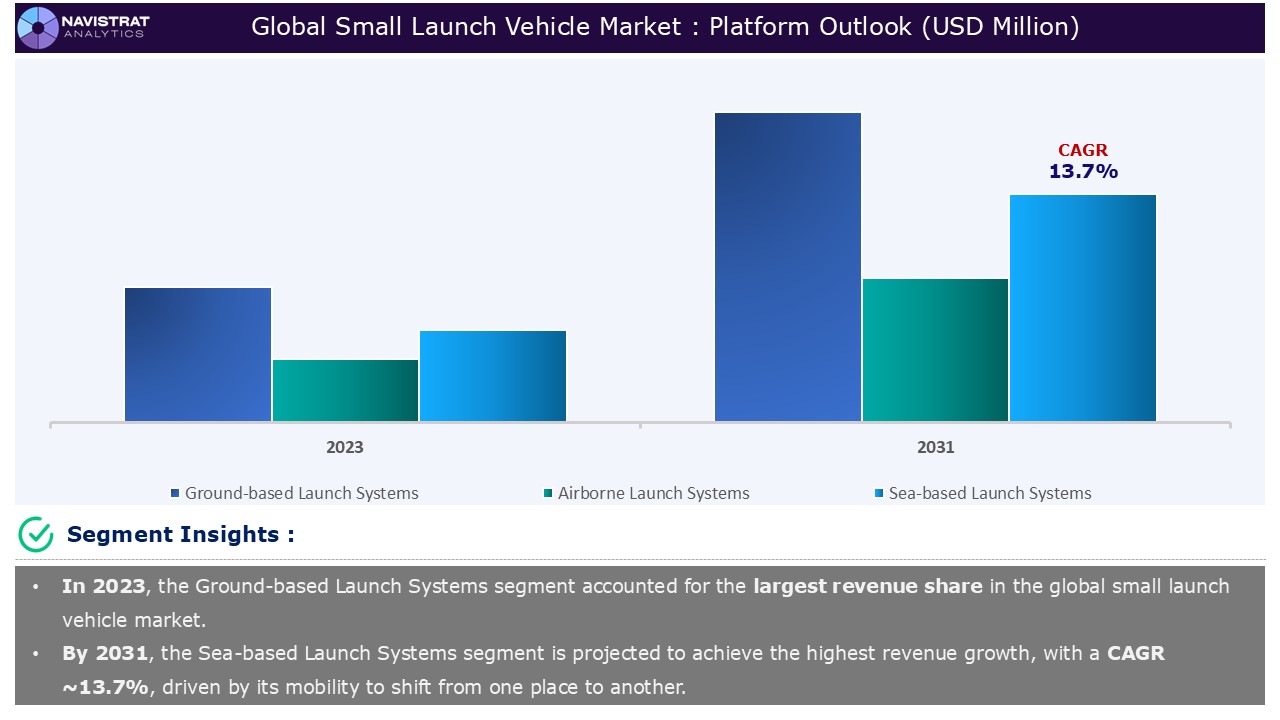
Based on the platform, the small launch vehicle market is segmented into ground-based launch systems, airborne launch systems, and sea-based launch systems.
Ground-based launch systems segment contributed largest share in 2023. Ground-based platforms collect extensive information on surface items and features. These are designed to advance scientific understanding of signal-object and signal-sensor interactions. Ground observation, which involves both laboratory and field studies, is used to design sensors and identify ground characteristics. Remote sensing uses several ground-based platforms. On August 2024, Rocket Lab USA, Inc., a global leader in launch services and space systems, has partnered with Kongsberg Satellite Services (KSAT), a world-leading provider of communication services for spacecraft and launch vehicles, to develop a new global ground station service for its operations and customers, enabling efficient and reliable communications for future Neutron launches.
Sea-based launch systems segment accounted for the fastest growth rate during the forecasted period. It is a launchpad positioned near a shoreline but at sea, with no hazard to humans, other animals, or the land environment. And it is transportable, operating from either an open-ended barge akin to cargo ships or a liftboat (also known as a jack-up platform) like an oil rig. Offshore spaceports are moveable and may move if weather conditions change, allowing a launch to proceed. Sea launches do not require exhaust trenches, which makes them more mobile.
On September 2023, Galactic Energy, a Chinese carrier rocket manufacturer, completes its first sea launch in the Yellow Sea off the coast of East China’s Shandong Province, successfully launching four satellites into pre-set orbits and becoming the first private enterprise in China to achieve this milestone. Furthermore, the launch represented the world’s first unsupported land and sea universal mobile platform launch and the first unguided hot launch of a solid rocket at sea, adding up to several accomplishments in China’s commercial launch sector.
End-Use Segment Insights and Analysis:
Based on the end-use, the small launch vehicle market is segmented into commercial, government, and academic & research institutions.
Commercial segment contributed largest share in 2023. Applications for satellites are many. There were 5,000 communications-serving satellites as of March 2023, and since 2017, the number of communications launches has increased by almost 15% annually. There are roughly 1,500 satellites in operation for technology development, research, and other purposes, and 1,000 spacecraft for Earth observation. Lower overall costs, made possible, for instance, by increased capabilities in small satellites like microsats, which weigh less than 100 kilograms, and cubesats, which are constructed from ten-by-ten-by-ten-centimeter modules, are a major factor in the proliferation of satellites. Applications for these include in-orbit demonstrations of miniature technologies and Earth observation.
Government segment accounted for the fastest growth rate during the forecasted period. Satellites are being used in the fields of defence and national security to provide communications, surveillance, and reconnaissance capabilities that are essential for securing borders, keeping an eye on possible threats, and guaranteeing strategic readiness. Advanced armies are not the only nations using space for national security; several are investing in their own space capabilities to strengthen their defences. In June 2022, the House Armed Services Committee’s strategic forces subcommittee approved drafts of the National defence Authorization Act for Fiscal Year 2023. The strategic forces panel, which discusses nuclear weapons policy and programs, missile defence, and military space, pushed for more use of commercial satellite data and space technologies.
Geographical Outlook:
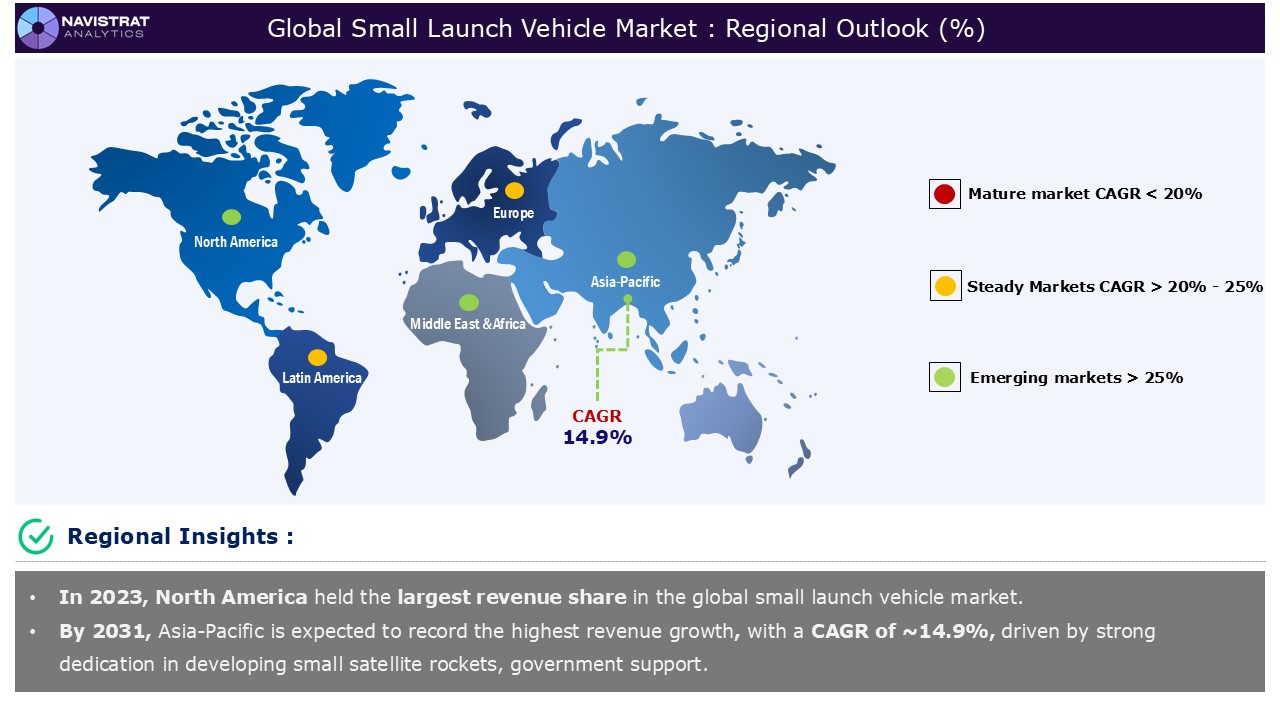
North America is registered highest market share in Small Launch Vehicle market in 2023. The regional market is driven by increasing space budget, internet usage, and weather monitoring for commercial applications. On March 2024, the Biden-Harris Administration has issued the President’s Budget of USD 30 billion for Fiscal Year 2025, which contains resources to invest in America and the American people, as well as financing for NASA to continue improving our understanding of Earth and space while inspiring the world through discovery. The budget allocates USD 2.4 billion to the Earth science program for missions and programs that enhance Earth system science and increase access to information to prevent natural hazards, promote climate action, and manage natural resources.
On August 2022, Northrop Grumman and Firefly Aerospace known as a leading provider of composites-intensive launch and in-space vehicles, have joined forces to provide an American-built first-stage upgrade for the Antares rocket and a new medium launch vehicle to serve commercial, civil, and national security space launch markets. Through the collaboration, they will first develop a fully domestic version of their Antares rocket, the Antares 330, for Cygnus space station commercial resupply services, followed by an entirely new medium-class launch vehicle.
Asia Pacific is registered the fastest growth rate during the forecasted period. Asia Pacific is developing as a major player in small launch vehicle because of its strong dedication in developing small satellite rockets, government support. Countries such as China, Japan, and South Korea have made significant investments in R&D, attracting top scientists and engineers, and establishing world-class research facilities. On September 2022, NSIL undertook the activity of Production of five (5) nos. of Polar Satellite Launch Vehicle (PSLV-XL) via Indian Industry and selected HAL and L&T consortia for the same as part of its mandate of productionizing ISRO’s launch vehicles. According to the agreement, the first fully industrially made PSLV-XL would be released after 24 months, and the remaining 04 vehicles would then be delivered every 6 months.
Europe is to register a considerable market share in Small Launch Vehicle market in 2023. European Union invests heavily in designing and launching small launch vehicle majorly supported by Government organizations. On December 2021, a contract to improve VEGA C competitiveness was signed by ESA and Avio. The ESA-Avio deal has a two-and-a-half-year value of Euro 51 million. In accordance with the terms of the contract, Avio, the ESA’s primary contractor for the Vega and Vega C launcher systems, will collaborate with commercial partners to implement several modifications that will allow Vega C to satisfy a wider range of market demands.
Furthermore, on February 2021, Lockheed Martin has contracted with ABL Space Systems of El Segundo, California, a manufacturer of low-cost launch vehicles and launch systems for the small satellite market, to provide a rocket and launch services for the company’s first UK vertical satellite launch. The UK Pathfinder Launch project aims to launch the first vertical small satellite from UK soil, from Scotland, in 2022. It will also be the first UK commercial launch of ABL Space Systems’ new RS1 rocket, which is based in the United States.
Competition Analysis:
The small launch vehicle market is characterized by a consolidated structure, with few players competing across various segments and regions. List of major players included in the small launch vehicle market report are:
- Northrop Grumman
- Lockheed Martin Corporation
- NSIL Corporation Limited
- ABL Space Systems
- Blue Origin
- Arianespace
- Boeing
- Firefly Aerospace Inc.
- China Aerospace Science and Technology Corporation (CASC)
- Rocket Lab USA
- IHI Corporation
- Spacefleet Ltd.
- Interorbital Systems Corporation
- Astra Space, Inc.
- Other companies
Strategic Developments in Global Small Launch Vehicle Market:
- In December 2023, European Space Agency’s (ESA) awarded the new contract with HyImpulse is focused on forthcoming technological milestones in the development of the company’s SL1 ‘Small Launcher’. The lightweight rocket is meant to launch small satellites weighing up to 500 kg into low-Earth orbit, propelled by a green, hybrid engine driven by paraffin and liquid oxygen. This new agreement sees ESA providing Euro 6.5 million in co-funding for the next steps, which will be a European effort bringing together HyImpulse’s German and UK offices, in collaboration with the SaxaVord Spaceport in Scotland, and a new joint venture, Carbon Launch Systems Ltd, recently formed by HyImpulse and Greek manufacturer Adamant Composites.
- In August 2021, Japanese company IHI Aerospace, the subsidiary of IHI Corporation plans to market a version of the little-used Epsilon small launch vehicle to commercial customers, although at prices significantly higher than similar vehicles in development. The company has six launches available from 2023 through 2026. Four other launches are already reserved for JAXA in that period, as well as two other Epsilon launches for JAXA scheduled through Japanese fiscal year 2022.
Key Advantages for Stakeholders:
Navistrat Analytics’ industry report provides an in-depth quantitative analysis of various market segments, historical and current trends, market forecasts, and dynamics within the market. The historical years covered in this report are 2021 to 2022, with 2023 serving as the base year for market size calculations. The forecast period extends from 2024 to 2031.
The report includes an executive summary and a comprehensive overview of market drivers, restraints, opportunities, and challenges (DROC), along with insights into regulatory standards. It features detailed analyses such as PORTER’s Five Forces, SWOT, and PESTLE, as well as assessments of technological trends and the competitive landscape.
PORTER’s Five Forces analysis helps stakeholders evaluate the impact of new entrants, competitive rivalry, supplier power, buyer power, and substitution threats, enabling them to assess the level of competition and the attractiveness of the global market. The competitive landscape provides stakeholders with a clear understanding of the current market positions of key players, offering valuable insights into their competitive environment.
Scope And Key Highlights Of The Global Small Launch Vehicle Market Report:
| Report Features | Details |
| Market Size in 2023 | USD 1,536.3 Million |
| Market Growth Rate in CAGR (2024–2031) | 12.9% |
| Market Revenue forecast to 2031 | USD 4,074.4 Million |
| Base year | 2023 |
| Historical year | 2021–2022 |
| Forecast period | 2024–2031 |
| Report Pages | 350 |
| Segments covered |
|
| Regional scope |
|
| Country Scope |
|
| Key Market Players |
|
| Delivery Format | Reports are delivered in PDF format via email. |
| Customization scope | Request for Customization |
The small launch vehicle market report offers a detailed analysis of market size, including historical revenue (in USD Million) data for 2021-2022 and revenue forecasts for 2024-2031 across the following segments:
- Propulsion Type Outlook (Revenue, USD Million; 2021-2031)
- Solid
- Liquid
- Hybrid
- Electric
- Payload Capacity Module Outlook (Revenue, USD Million; 2021-2031)
- Upto 100 kg
- 101-500 kg
- 501-1000 kg
- More than 1001 kg
- Platform Outlook (Revenue, USD Million; 2021-2031)
- Ground-based Launch Systems
- Airborne Launch Systems
- Sea-based Launch Systems
- End-Use Outlook (Revenue, USD Million; 2021-2031)
- Commercial
- Private satellite operators
- Communication services
- Earth observation data providers
- Government
- Defense agencies
- Space exploration programs
- Weather monitoring agencies
- Academic & Research Institutions
- Commercial
- Regional Outlook (Revenue, USD Million; 2021-2031)
- North America
- U.S.
- Canada
- Mexico
- Europe
- Germany
- France
- U.K.
- Italy
- Spain
- Benelux
- Nordic Countries
- Rest of Europe
- Asia Pacific
- China
- India
- Japan
- South Korea
- Oceania
- ASEAN Countries
- Rest of APAC
- Latin America
- Brazil
- Rest of LATAM
- Middle East & Africa
- GCC Countries
- South Africa
- Israel
- Turkey
- Rest of MEA
- North America
Frequently Asked Questions (FAQ) about the Small Launch Vehicle market report
The market size of small launch vehicle market was 1,536.3 Million in 2023.
The market size of small launch vehicle market is expected to register compound annual growth rate (CAGR) of 12.9% over the forecast period.
Increase in demand for IoT and telecom, growing demand for environment and weather monitoring applications are major key factors driving the market revenue growth of the small launch vehicle market.
High initial setup and maintenance costs and lack of government or private funding in emerging countries are key limiting factors driving the market.
Asia-Pacific account for fastest revenue growth of 14.9%.
Ground-based launch systems is the major leading segment of small launch vehicle market in terms of platform.
-
- Market Definition
- Research Objective
- Research Methodology
- Research Design
- Data Collection Methods
- Primary
- Secondary
- Market Size Estimation
- Top-down method
- Bottom-up method
- Forecasting Methodology
- Tools and Models Used
- Market Overview and Trends
- Market Size and Forecast
- Industry Analysis
- Market Driver, Restraints, Opportunity and Challenges (DROC) Analysis
- Market Drivers
- Increase in demand for IoT and telecom
- Increase in demand for launch vehicles for small satellites
- Growing demand for environment and weather monitoring applications
- Government funding and support in space research programmes
- Market Restraints
- High initial setup and maintenance costs
- Lack of government or private funding in emerging countries
- Market Opportunities
- Technological advancements in small launch vehicles
- Incorporation of small and smart satellites
- Market Challenges
- Supply chain disruption
- Delayed launches due to long production cycle
- Regulatory Landscape
- North America
- Europe
- Asia Pacific
- Latin America
- Middle East and Africa
- Strategic Insights
- Porter’s Five Forces Analysis
- PESTLE Analysis
- Price Trend Analysis
- Value Chain Analysis
- Technological Trends
- Recent Developments
- Funding
- Merger and Acquisition
- Expansion
- Partnership and Collaboration
- Product/ Service Launch
- Propulsion Type Market Revenue Estimates and Forecasts, 2021-2031
- Solid
- Liquid
- Hybrid
- Electric
- Payload Capacity Market Revenue Estimates and Forecasts, 2021-2031
- Upto 100 kg
- 101-500 kg
- 501-1000 kg
- More than 1001 kg
- Platform Market Revenue Estimates and Forecasts, 2021-2031
- Ground-based Launch Systems
- Airborne Launch Systems
- Sea-based Launch Systems
- End-Use Market Revenue Estimates and Forecasts, 2021-2031
- Commercial
- Private satellite operators
- Communication services
- Earth observation data providers
- Government
- Defense agencies
- Space exploration programs
- Weather monitoring agencies
- Academic & Research Institutions
- Commercial
- Small Launch Vehicle Market Revenue Estimates and Forecasts by Region, 2021-2031, USD Million
- North America
- North America Small Launch Vehicle Market By Propulsion Payload Capacity, Market Revenue Estimates and Forecasts, 2021-2031, USD Million
- Solid
- Liquid
- Hybrid
- Electric
- North America Small Launch Vehicle Market By Payload Capacity, Market Revenue Estimates and Forecasts, 2021-2031, USD Million
- Upto 100 kg
- 101-500 kg
- 501-1000 kg
- More than 1001 kg
- North America Small Launch Vehicle Market By Platform, Market Revenue Estimates and Forecasts, 2021-2031, USD Million
- Ground based Platform Systems
- Airborne based Platform Systems
- Sea based Platform Systems
- North America Small Launch Vehicle Market By End-Use Size, Market Revenue Estimates and Forecasts, 2021-2031, USD Million
- Commercial
- Private Satellite Operators
- Communication Service
- Earth Observation Data Providers
- Government
- Defense Agencies
- Space Exploration Programs
- Weather Monitoring Agencies
- Academic Research Institutions
- Commercial
- North America Small Launch Vehicle Market Revenue Estimates and Forecasts by Country, 2021-2031, USD Million
- United States
- Canada
- Mexico
- North America Small Launch Vehicle Market By Propulsion Payload Capacity, Market Revenue Estimates and Forecasts, 2021-2031, USD Million
- North America
- Europe
- Europe Small Launch Vehicle Market By Propulsion Payload Capacity, Market Revenue Estimates and Forecasts, 2021-2031, USD Million
- Solid
- Liquid
- Hybrid
- Electric
- Europe Small Launch Vehicle Market By Payload Capacity, Market Revenue Estimates and Forecasts, 2021-2031, USD Million
- Upto 100 kg
- 101-500 kg
- 501-1000 kg
- More than 1001 kg
- Europe Small Launch Vehicle Market By Platform, Market Revenue Estimates and Forecasts, 2021-2031, USD Million
- Ground based Platform Systems
- Airborne based Platform Systems
- Sea based Platform Systems
- Europe Small Launch Vehicle Market By End-Use Size, Market Revenue Estimates and Forecasts, 2021-2031, USD Million
- Commercial
- Private Satellite Operators
- Communication Service
- Earth Observation Data Providers
- Government
- Defense Agencies
- Space Exploration Programs
- Weather Monitoring Agencies
- Academic Research Institutions
- Commercial
- Europe Small Launch Vehicle Market Revenue Estimates and Forecasts by Country, 2021-2031, USD Million
- Germany
- United Kingdom
- France
- Italy
- Spain
- Benelux
- Nordic Countries
- Rest of Europe
- Europe Small Launch Vehicle Market By Propulsion Payload Capacity, Market Revenue Estimates and Forecasts, 2021-2031, USD Million
- Asia-Pacific
- Asia Pacific Small Launch Vehicle Market By Propulsion Payload Capacity, Market Revenue Estimates and Forecasts, 2021-2031, USD Million
- Solid
- Liquid
- Hybrid
- Electric
- Asia Pacific Small Launch Vehicle Market By Payload Capacity, Market Revenue Estimates and Forecasts, 2021-2031, USD Million
- Upto 100 kg
- 101-500 kg
- 501-1000 kg
- More than 1001 kg
- Asia Pacific Small Launch Vehicle Market By Platform, Market Revenue Estimates and Forecasts, 2021-2031, USD Million
- Ground based Platform Systems
- Airborne based Platform Systems
- Sea based Platform Systems
- Asia Pacific Small Launch Vehicle Market By End-Use Size, Market Revenue Estimates and Forecasts, 2021-2031, USD Million
- Commercial
- Private Satellite Operators
- Communication Service
- Earth Observation Data Providers
- Government
- Defense Agencies
- Space Exploration Programs
- Weather Monitoring Agencies
- Academic Research Institutions
- Commercial
- Asia-Pacific Small Launch Vehicle Market Revenue Estimates and Forecasts by Country, 2021-2031, USD Million
- China
- India
- Japan
- South Korea
- Oceania
- ASEAN Countries
- Rest of Asia-Pacific
- Asia Pacific Small Launch Vehicle Market By Propulsion Payload Capacity, Market Revenue Estimates and Forecasts, 2021-2031, USD Million
- Latin America
- Latin America Small Launch Vehicle Market By Propulsion Payload Capacity, Market Revenue Estimates and Forecasts, 2021-2031, USD Million
- Solid
- Liquid
- Hybrid
- Electric
- Latin America Small Launch Vehicle Market By Payload Capacity, Market Revenue Estimates and Forecasts, 2021-2031, USD Million
- Upto 100 kg
- 101-500 kg
- 501-1000 kg
- More than 1001 kg
- Latin America Small Launch Vehicle Market By Platform, Market Revenue Estimates and Forecasts, 2021-2031, USD Million
- Ground based Platform Systems
- Airborne based Platform Systems
- Sea based Platform Systems
- Latin America Small Launch Vehicle Market By End-Use Size, Market Revenue Estimates and Forecasts, 2021-2031, USD Million
- Commercial
- Private Satellite Operators
- Communication Service
- Earth Observation Data Providers
- Government
- Defense Agencies
- Space Exploration Programs
- Weather Monitoring Agencies
- Academic Research Institutions
- Commercial
- Latin America Small Launch Vehicle Market Revenue Estimates and Forecasts by Country, 2021-2031, USD Million
- Brazil
- Rest of Latin America
- Latin America Small Launch Vehicle Market By Propulsion Payload Capacity, Market Revenue Estimates and Forecasts, 2021-2031, USD Million
- Middle East & Africa
- Middle East & Africa Small Launch Vehicle Market By Propulsion Payload Capacity, Market Revenue Estimates and Forecasts, 2021-2031, USD Million
- Solid
- Liquid
- Hybrid
- Electric
- Middle East & Africa Small Launch Vehicle Market By Payload Capacity, Market Revenue Estimates and Forecasts, 2021-2031, USD Million
- Upto 100 kg
- 101-500 kg
- 501-1000 kg
- More than 1001 kg
- Middle East & Africa Small Launch Vehicle Market By Platform, Market Revenue Estimates and Forecasts, 2021-2031, USD Million
- Ground based Platform Systems
- Airborne based Platform Systems
- Sea based Platform Systems
- Middle East & Africa Small Launch Vehicle Market By End-Use Size, Market Revenue Estimates and Forecasts, 2021-2031, USD Million
- Commercial
- Private Satellite Operators
- Communication Service
- Earth Observation Data Providers
- Government
- Defense Agencies
- Space Exploration Programs
- Weather Monitoring Agencies
- Academic Research Institutions
- Commercial
- Middle East & Africa Small Launch Vehicle Market Revenue Estimates and Forecasts by Country, 2021-2031, USD Million
- GCC Countries
- South Africa
- Israel
- Turkey
- Rest of Middle East & Africa
- Middle East & Africa Small Launch Vehicle Market By Propulsion Payload Capacity, Market Revenue Estimates and Forecasts, 2021-2031, USD Million
- Market Share Analysis
- Revenue Market Share by Key Players (2022-2023)
- Analysis of Top Players by Market Presence
- Competitive Matrix
- Competitive Strategies
- Mergers and Acquisitions
- Partnerships and Collaboration
- Investment and Fundings
- Agreement
- Expansion
- New Product/ Services Launches
Technological Innovations
- Northrop Grumman
- Company Overview
- Financial Insights
- Product/ Services Offerings
- Strategic Developments
- SWOT Analysis
- Lockheed Martin Corporation
- Company Overview
- Financial Insights
- Product/ Services Offerings
- Strategic Developments
- SWOT Analysis
- NSIL Corporation Limited
- Company Overview
- Financial Insights
- Product/ Services Offerings
- Strategic Developments
- SWOT Analysis
- ABL Space Systems
- Company Overview
- Financial Insights
- Product/ Services Offerings
- Strategic Developments
- SWOT Analysis
- Blue Origin
- Company Overview
- Financial Insights
- Product/ Services Offerings
- Strategic Developments
- SWOT Analysis
- Arianespace
- Company Overview
- Financial Insights
- Product/ Services Offerings
- Strategic Developments
- SWOT Analysis
- Boeing
- Company Overview
- Financial Insights
- Product/ Services Offerings
- Strategic Developments
- SWOT Analysis
- Firefly Aerospace Inc.
- Company Overview
- Financial Insights
- Product/ Services Offerings
- Strategic Developments
- SWOT Analysis
- China Aerospace Science and Technology Corporation (CASC)
- Company Overview
- Financial Insights
- Product/ Services Offerings
- Strategic Developments
- SWOT Analysis
- Rocket Lab USA
- Company Overview
- Financial Insights
- Product/ Services Offerings
- Strategic Developments
- SWOT Analysis
- IHI Corporation
- Company Overview
- Financial Insights
- Product/ Services Offerings
- Strategic Developments
- SWOT Analysis
- Spacefleet Ltd.
- Company Overview
- Financial Insights
- Product/ Services Offerings
- Strategic Developments
- SWOT Analysis
- Interorbital Systems Corporation
- Company Overview
- Financial Insights
- Product/ Services Offerings
- Strategic Developments
- SWOT Analysis
- Astra Space, Inc.
- Company Overview
- Financial Insights
- Product/ Services Offerings
- Strategic Developments
- SWOT Analysis