

Smart Building Market Overview and Key Insights:
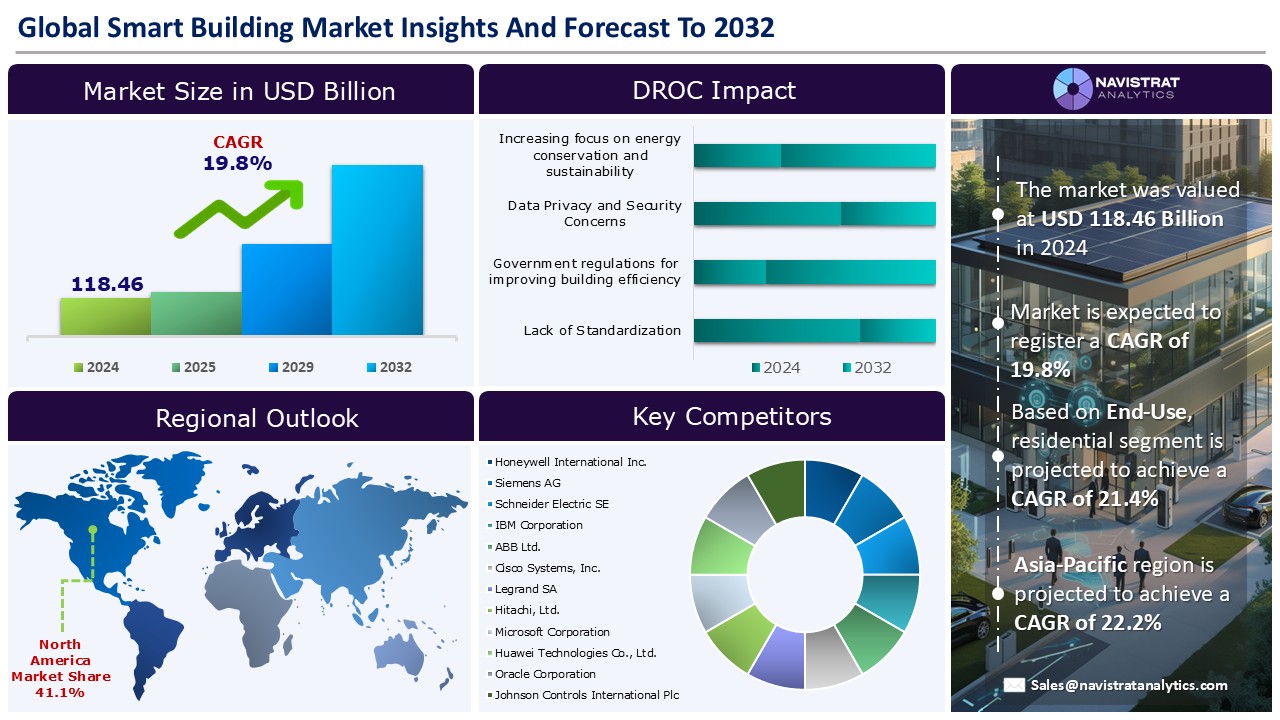
The global smart building market reached USD 118.46 billion in 2024 and is expected to register a revenue CAGR of 19.8% during the forecast period. Increasing focus on energy conservation and sustainability, rising demand for enhanced occupant experience, increasing urbanization and population growth, and advancements in IoT devices and connectivity solutions are expected to drive revenue growth of the market.
Market Drivers:
Increasing focus on energy conservation and sustainability is a major factor driving revenue growth of the market. Governments and regulatory bodies across the globe are implementing stringent energy efficiency standards and green building certifications. It is prompting developers and facility managers to adopt smart technologies. In December 2024, for instance, the Smart Buildings Division of ABB announced a new partnership with the World Green Building Council’s (WorldGBC) European Regional Network (ERN) to promote the adoption of sustainable and energy-efficient building solutions throughout Europe. Such collaborations are driving revenue growth in the smart building market by accelerating the adoption of energy-efficient technologies and sustainable building practices.
Organizations are increasingly aiming to reduce their carbon footprints and utility costs while improving building performance and occupant comfort. It is leading to a surge in demand for smart building solutions. According to a survey of over 500 U.S. facility decision-makers across various industries revealed that 78% have implemented smart building technologies. Among those who adopted these features, an equal 78% reported improvements in energy efficiency and reductions in operational costs. The widespread adoption of smart building technologies is encouraging more organizations to invest in these solutions.
Market Opportunity:
Rapid advancements in technologies such as Artificial Intelligence (AI) and machine learning are creating significant opportunities for the market. These technologies provide predictive maintenance, real-time energy optimization, intelligent lighting and HVAC control, and enhanced security systems through data-driven insights. In June 2022, for instance, ABB Smart Buildings introduced ABB Ability BE Sustainable with Efficiency AI, powered by BrainBox AI. It is an advanced technology and SaaS solution that transforms existing HVAC systems in commercial buildings into predictive, self-adaptive systems. The demand for these kinds of innovative solutions is rising as commercial buildings actively pursue smart retrofitting options to achieve sustainability targets and lower operational costs.
Recent Trends:
One recent trend in the smart building market is the growing adoption of IoT to optimize the management and operation of interconnected devices in smart buildings. IoT enables real-time data collection and communication between various building systems. It includes lighting, HVAC, security, and energy management. This connectivity allows facility managers to monitor and control operations remotely, automate routine tasks, and make data-driven decisions that increase energy efficiency and occupant comfort.
In March 2023, Siemens introduced Connect Box, a simple and open IoT solution aimed at managing small to medium-sized buildings. Part of the Siemens Xcelerator portfolio, Connect Box offers an intuitive way to monitor building performance. It is designed to enhance energy efficiency by up to 30% and significantly improve indoor air quality in settings such as schools, retail stores, apartments, and small offices.
Restraints & Challenges:
Data privacy and security concerns pose a significant challenge to the smart building market. As smart buildings rely heavily on interconnected systems, IoT devices, and cloud-based platforms, they become more vulnerable to cyber threats, unauthorized access, and data breaches. Sensitive information, such as occupant behavior, energy usage patterns, and building access logs, must be protected to comply with regulatory standards like GDPR and other data protection laws. Many building owners and facility managers are hesitant to adopt smart technologies due to concerns over potential cybersecurity risks and the complexity of implementing robust protection measures. This caution delays investment decisions and limits revenue growth of the market.
Component Segment Insights and Analysis:
Based on the component, the Smart Building market is segmented into hardware, software and services.
Hardware segment contributed the largest share in 2024 due to the increasing adoption of intelligent infrastructure solutions aimed at enhancing building efficiency, safety, and sustainability. Key components such as sensors, control systems, HVAC systems, smart meters, and access control devices are witnessing rising demand as commercial and residential buildings increasingly shift towards automation and data-driven management.
In addition, the rising construction of green buildings and the modernization of legacy infrastructure, especially in urban areas, are boosting investments in hardware installations. In September 2024, Hitachi, Ltd. introduced a newly developed model of its BuilMirai building IoT solution. It is specifically designed for small and medium-sized buildings. This solution aims to enhance the efficiency of building management, maintain and improve operational quality, and elevate user comfort. The need for integrated hardware components rises as more buildings adopt these types of solutions to improve efficiency and comfort. It boosts the revenue growth of the market in this segment.
Solutions Segment Insights and Analysis:
Based on solutions, the Smart Building market is segmented into Building Infrastructure Management (BIM), Security & Emergency Management (SEM), energy management, network management, Intelligent Works Management System (IWMS) and others.
Energy management segment is expected to register a fast revenue growth rate during the forecast period due to the growing need for energy efficiency, cost reduction, and regulatory compliance across commercial and residential infrastructure. As buildings account for a significant portion of global energy consumption, energy management solutions are increasingly adopted to monitor, analyze, and optimize energy usage in real time. These systems integrate smart meters, sensors, and analytics platforms to provide actionable insights. It is helping facility managers reduce energy waste and enhance operational efficiency.
The International Energy Agency (IEA) reported that global energy consumption rose by 2.2% in 2023, outpacing historical trends, with the increase primarily driven by BRICS countries. These countries collectively accounted for 42% of total energy use. China was the main contributor, recording a significant 6.6% rise. It is twice its typical annual growth rate. India also experienced a 5.1% increase, slightly above its long-term average. As energy demand rises, building owners are increasingly investing in advanced energy management systems to control costs, improve efficiency, and meet sustainability targets. It is boosting revenue growth of this segment.
End-use Segment Insights and Analysis:
Based on end-use, the smart building market is segmented into residential, commercial, and industrial.
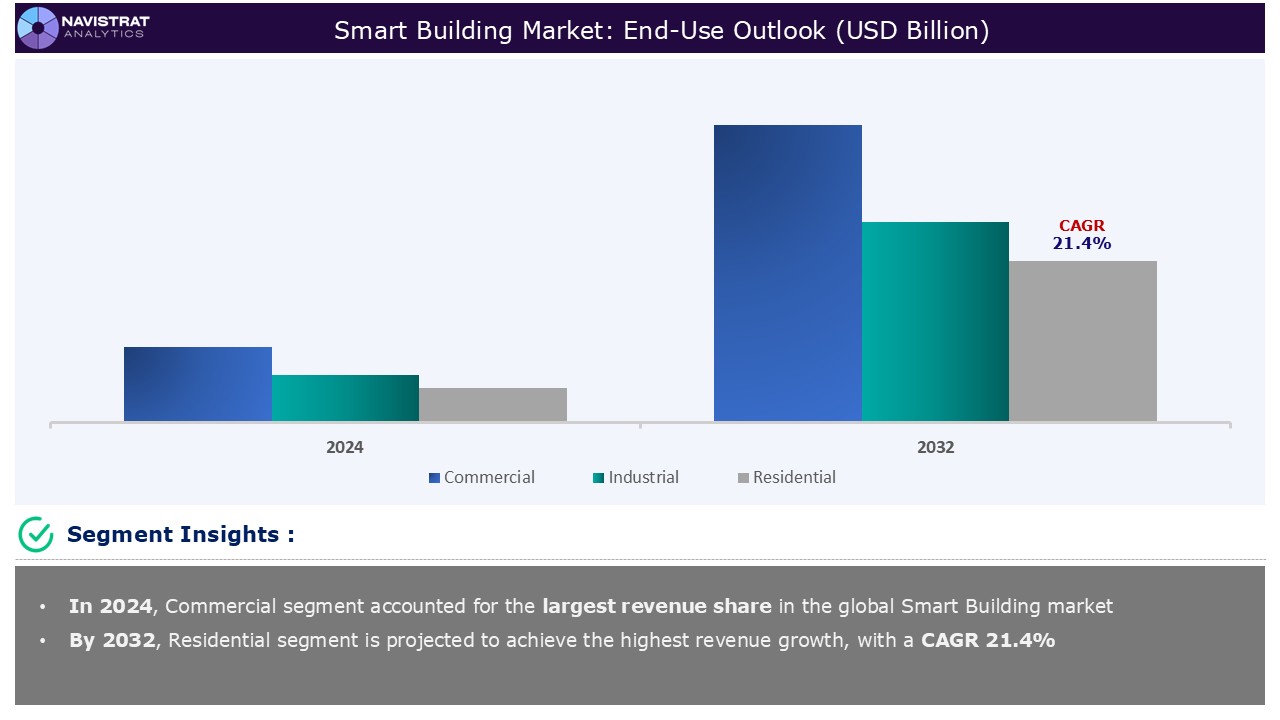
Commercial segment contributed the largest revenue share in 2024 due to the rising demand for intelligent infrastructure across office complexes, shopping malls, hotels, hospitals, and educational institutions. Businesses are increasingly adopting smart building technologies to reduce operational costs, enhance energy efficiency, and improve occupant comfort and safety. The integration of IoT-enabled devices, automated lighting, HVAC systems, and advanced security solutions allows commercial facilities to optimize performance and sustainability.
In January 2023, for instance, ABB introduced its ABB Cylon Smart Building Management Systems. It is a comprehensive product portfolio designed to deliver scalable automation and energy management solutions for commercial and industrial buildings of all sizes. These systems help automate building operations and lower energy expenses through efficient energy control. Additionally, they provide real-time monitoring and control of various building functions, enhancing overall operational efficiency.
Geographical Outlook:
Smart Building market is strategically segmented by geography to provide a comprehensive understanding of regional market dynamic. Discover demand analysis, emerging trends, and growth opportunities shaping market performance across different region and countries.
North America Smart Building Market:
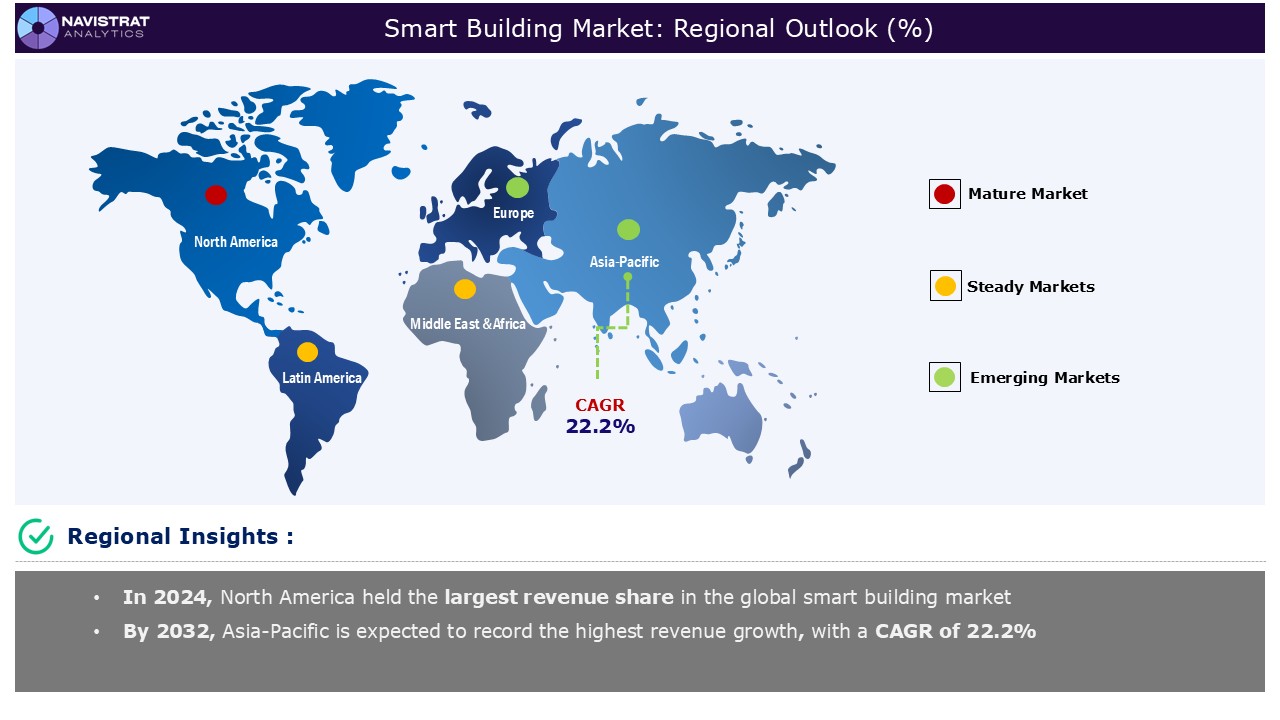
Market in North America accounted for largest revenue share in 2024 due to the increasing investments in energy-efficient infrastructure, widespread adoption of IoT and automation technologies, and supportive government policies promoting sustainability and smart city development. In April 2024, the U.S. Department of Energy (DOE) unveiled its USD 13 million VoltAIc initiative aimed at streamlining the siting and permitting process for critical clean energy infrastructure. It incentivizes building owners and developers to integrate renewable energy and grid-interactive technologies into their designs. This integration boosts demand for smart building systems in the region, including advanced energy management platforms, automated controls, sensors, and analytics tools that optimize energy usage and coordinate with the grid.
In addition, the strong presence of leading technology providers, rising demand for workplace automation, and the growing need for efficient space and resource utilization in corporate real estate are also contributing to the revenue growth of the market in this region. In February 2025, Delta is launching Delta Intelligent Building Technologies (DIBT) in North America. DIBT is a unified platform offering smart, energy-efficient solutions for intelligent and sustainable buildings. It brings together the advanced technologies and expertise of Delta’s brands—Amerlux for architectural LED lighting, and Delta Controls and LOYTEC for building automation.
Asia Pacific Smart Building Market:
Asia Pacific is expected to register a fast revenue growth rate during the forecast period due to the rapid urbanization, increasing infrastructure development, and a strong focus on sustainability. Key drivers include government-supported smart-city initiatives in countries like China, India, Japan, South Korea, and Singapore, which foster deployment of intelligent buildings through incentives, regulations, and public‑private partnerships. Smart cities accounted for approximately 50% of China’s GDP. The country has about 500 smart city pilot projects. These initiatives are increasing demand for intelligent infrastructure, energy-efficient systems, and advanced automation technologies in China. It is significantly boosting investments in smart building solutions across the region.
In addition, the advanced technologies such as IoT, AI, digital twins, and real‑time data analytics are enabling building systems in the region to optimize energy use, automate HVAC and lighting, and support predictive maintenance. In April 2023, Japanese firm Obayashi Corporation and Hitachi Solutions, Ltd. jointly established Oprizon, Ltd., a venture focused on delivering smart building services. Through their global corporate partnership, both companies have been early adopters of advanced IT products and services across sectors such as construction.
Europe Smart Building Market:
Market in Europe accounted for a significant revenue share in 2024 due to the regulatory frameworks, rapid technological adoption, and evolving sustainability goals. The European Union’s revised Energy Performance of Buildings Directive (2024/1275) mandates rigorous energy efficiency standards. It requires new and renovated buildings to meet near-zero energy benchmarks by 2030, which is driving adoption of smart controls and automation systems. The region also offers substantial financial support for energy-efficient building upgrades with initiatives such as the European Green Deal, Horizon 2020, and national renovation incentives.
In addition, rising energy prices across Europe and increasingly stringent carbon emission targets incentivize building owners and facility managers to invest in smart energy management technologies. It reduces energy expenditure by up to 30% and helps achieve green building certifications such as BREEAM and LEED. Countries like Germany, France, the UK, and the Nordics are leading in smart building implementation, combining policy-driven adoption and private-sector innovation to sustain strong revenue growth of the market in this region.
Competition Analysis:
The Smart Building market is characterized by a fragmented structure, with numerous players competing across various segments and regions. List of major players included in the Smart Building market report are:
- Honeywell International Inc.
- Siemens AG
- Schneider Electric SE
- IBM Corporation
- ABB Ltd.
- Cisco Systems, Inc.
- Legrand SA
- Hitachi, Ltd.
- Microsoft Corporation
- Huawei Technologies Co., Ltd.
- Robert Bosch GmbH
- Mitsubishi Electric Corporation
- Oracle Corporation
- Trane Technologies Plc
- Johnson Controls International Plc
- Automated Logic Corporation (Carrier)
Strategic Developments in Smart Building Market:
- On 03 March 2025, Ameresco, Inc., a leading energy solutions provider committed to supporting clients through the energy transition, announced the successful acquisition of ASA Controls, a Cincinnati-based regional controls contractor and systems integrator. This acquisition enhances Ameresco’s solution portfolio and strengthens its presence in the smart building sector.
- On 08 October 2024, Global technology company ABB and Austria-based Zumtobel Group, a leading provider of professional lighting solutions, announced a strategic partnership to drive the development of smart building technologies and direct current (DC) industrial applications. This collaboration aims to deliver integrated, intelligent solutions that add substantial value for customers across commercial, industrial, and institutional sectors, supporting the creation of sustainable buildings.
- On 05 September 2024, UnaBiz, a leading provider and integrator of Massive IoT services, introduced three new solutions focused on the smart building sector. These IoT-based innovations aim to automate monitoring, streamline operations, and support building owners in achieving sustainability targets by reducing waste, improving efficiency, and lowering operational and maintenance expenses.
Key Advantages for Stakeholders:
Navistrat Analytics’ industry report provides an in-depth quantitative analysis of various market segments, historical and current trends, market forecasts, and dynamics within the global market. The historical years covered in this report are 2022 to 2023, with 2024 serving as the base year for market size calculations. The forecast period extends from 2025 to 2032.
The report includes an executive summary and a comprehensive overview of market drivers, restraints, opportunities, and challenges (DROC), along with insights into regulatory standards. It features detailed analyses such as PORTER’s Five Forces, SWOT, and PESTLE, as well as assessments of technological trends and the competitive landscape.
PORTER’s Five Forces analysis helps stakeholders evaluate the impact of new entrants, competitive rivalry, supplier power, buyer power, and substitution threats, enabling them to assess the level of competition and the attractiveness of the global market. The competitive landscape provides stakeholders with a clear understanding of the current market positions of key players, offering valuable insights into their competitive environment.
Scope And Key Highlights of The Smart Building Market Report:
| Report Features | Details |
| Market Size in 2024 | USD 118.46 Billion |
| Market Growth Rate in CAGR (2025–2032) | 19.8% |
| Market Revenue Forecast to 2032 | USD 490.75 Billion |
| Base year | 2024 |
| Historical year | 2022–2023 |
| Forecast period | 2025–2032 |
| Report Pages | 450 |
| Segments Covered |
|
| Regional scope |
|
| Country Scope |
|
| Key Market Players |
|
| Delivery Format | Reports are delivered in PDF format via email. |
| Customization scope | Request Customization |
The Smart Building market report offers a detailed analysis of market size, including historical revenue (in USD Billion) data for 2022-2023 and revenue forecasts for 2025-2032 across the following segments:
- Component (Revenue, USD Billion; 2022-2032)
- Hardware
- Sensors
- Controllers
- Smart Meters
- Actuators
- Others
- Software/Platform
- Cloud-Based
- On-Premise
- Services
- Consulting Services
- Implementation Services
- Support & Maintenance Services
- Hardware
- Solutions Outlook (Revenue, USD Billion; 2022-2032)
- Building Infrastructure Management (BIM)
- Parking Management Systems
- Smart Water Management Systems
- Elevator and Escalator Management Systems
- Others
- Security & Emergency Management (SEM)
- Access Control Systems
- Video Surveillance Systems
- Fire and Life Safety Systems
- Others
- Energy Management
- HVAC Control Systems
- Lighting Management Systems
- Others
- Intelligent Works Management System (IWMS)
- Real Estate Management
- Capital Project Management
- Facility Management
- Operations and Services Management
- Environment Management
- Others
- Building Infrastructure Management (BIM)
- Technology Outlook (Revenue, USD Billion; 2022-2032)
- Internet of Things (IoT)
- Building Automation Systems (BAS)
- Artificial Intelligence (AI)
- Cloud Computing
- Big Data Analytics
- Others
- Connectivity Outlook (Revenue, USD Billion; 2022-2032)
- Wired
- Wireless
- Wi-Fi
- ZigBee / Z-Wave
- Bluetooth Low Energy
- 6LoWPAN
- Others
- End-Use (Revenue, USD Billion; 2022-2032)
- Residential
- Commercial
- Office buildings
- Retail stores
- Hotels
- Healthcare facilities
- Others
- Industrial
- Regional Outlook (Revenue, USD Billion; 2022-2032)
- North America
- U.S.
- Canada
- Mexico
- Europe
- Germany
- France
- U.K.
- Italy
- Spain
- Benelux
- Nordic Countries
- Rest of Europe
- Asia Pacific
- China
- India
- Japan
- South Korea
- Oceania
- ASEAN Countries
- Rest of APAC
- Latin America
- Brazil
- Rest of LATAM
- Middle East & Africa
- GCC Countries
- South Africa
- Israel
- Turkey
- Rest of MEA
- North America
Frequently Asked Questions (FAQ) about the Smart Building Market Report
The smart building market size was USD 118.46 billion in 2024.
The smart building market revenue is expected to register a Compound Annual Growth Rate (CAGR) of 19.8% during the forecast period.
Increasing focus on energy conservation and sustainability, rising demand for enhanced occupant experience, increasing urbanization and population growth, and advancements in IoT devices and connectivity solutions are the key drivers of the smart building market revenue growth.
Data privacy and security concerns high initial costs and complexity of integration are key factors restraining revenue growth of the market.
Asia Pacific is expected to account for the fastest revenue growth of 22.2%.
Commercial segment is the leading segment of smart building market in terms of end-use.
- Market Definition
- Research Objective
- Research Methodology
- Research Design
- Data Collection Methods
- Primary
- Secondary
- Market Size Estimation
- Top-down method
- Bottom-up method
- Forecasting Methodology
- Tools and Models Used
- Market Overview and Trends
- Market Size and Forecast
- Industry Analysis
- Market Driver, Restraints, Opportunity and Challenges (DROC) Analysis
- Market Drivers
- Increasing focus on energy conservation and sustainability
- Rising demand for enhanced occupant experience
- Increasing urbanization and population growth
- Advancements in IoT devices and connectivity solutions
- Market Restraints
- Data privacy and security concerns
- High initial costs
- Complexity of integration
- Market Opportunities
- Government regulations for improving building efficiency and sustainable development
- Rising awareness of cost savings and operational efficiency
- Rapid advancements in technologies such as AI and, machine learning
- Market Challenges
- Lack of standardization
- Low awareness and ROI skepticism
- Regulatory Landscape
- North America
- Europe
- Asia Pacific
- Latin America
- Middle East and Africa
- Strategic Insights
- Porter’s Five Forces Analysis
- PESTLE Analysis
- Price Trend Analysis
- Value Chain Analysis
- Technological Trends
- Recent Developments
- Funding
- Merger and Acquisition
- Expansion
- Partnership and Collaboration
- Product/Service Launch
- Component Market Revenue Estimates and Forecasts, 2022-2032
- Hardware
- Sensors
- Controllers
- Smart Meters
- Actuators
- Others
- Software/Platform
- Cloud-based
- On-premise
- Services
- Consulting Services
- Implementation Services
- Support & Maintenance Services
- Hardware
- Solutions Market Revenue Estimates and Forecasts, 2022-2032
- Building Infrastructure Management (BIM)
- Parking Management Systems
- Smart Water Management Systems
- Elevator and Escalator Management Systems
- Others
- Security & Emergency Management (SEM)
- Access Control Systems
- Video Surveillance Systems
- Fire and Life Safety Systems
- Others
- Energy Management
- HVAC Control Systems
- Lighting Management Systems
- Others
- Intelligent Works Management System (IWMS)
- Real Estate Management
- Capital Project Management
- Facility Management
- Operations and Services Management
- Environmental Management
- Others
- Building Infrastructure Management (BIM)
- Technology Market Revenue Estimates and Forecasts, 2022-2032
- Internet of Things (IoT)
- Building Automation Systems (BAS)
- Artificial Intelligence (AI)
- Cloud Computing
- Big Data Analytics
- Others
- Connectivity Market Revenue Estimates and Forecasts, 2022-2032
- Wired
- Wireless
- Wi-Fi
- ZigBee / Z-Wave
- Bluetooth Low Energy
- 6LoWPAN
- Others
- End-Use Market Revenue Estimates and Forecasts, 2022-2032
- Residential
- Commercial
- Office Buildings
- Retail Stores
- Hotels
- Healthcare Facilities
- Others
- Industrial
- Smart Building Market Revenue Estimates and Forecasts by Region, 2022-2032, USD Billion
- North America
- North America Smart Building Market By Component, Market Revenue Estimates and Forecasts, 2022-2032, USD Billion
- Hardware
- Sensors
- Controllers
- Smart Meters
- Actuators
- Others
- Software
- Cloud-based
- On-premise
- Services
- Consulting Services
- Implementation Services
- Support & Maintenance Services
- Hardware
- North America Smart Building Market By Solutions, Market Revenue Estimates and Forecasts, 2022-2032, USD Billion
- Building Infrastructure Management (BIM)
- Parking Management Systems
- Smart Water Management Systems
- Elevator and Escalator Management Systems
- Others
- Security & Emergency Management (SEM)
- Access Control Systems
- Video Surveillance Systems
- Fire and Life Safety Systems
- Others
- Energy Management
- HVAC Control Systems
- Lighting Management Systems
- Others
- Intelligent Works Management System (IWMS)
- Real Estate Management
- Capital Project Management
- Facility Management
- Operations and Services Management
- Environmental Management
- Others
- Building Infrastructure Management (BIM)
- North America Smart Building Market By Technology, Market Revenue Estimates and Forecasts, 2022-2032, USD Billion
- Internet of Things (IoT)
- Building Automation Systems (BAS)
- Artificial Intelligence (AI)
- Cloud Computing
- Big Data Analytics
- Others
- North America Smart Building Market By Connectivity, Market Revenue Estimates and Forecasts, 2022-2032, USD Billion
- Wired
- Wireless
- Wi-Fi
- ZigBee / Z-Wave
- Bluetooth Low Energy
- 6LoWPAN
- Others
- North America Smart Building Market By End-Use, Market Revenue Estimates and Forecasts, 2022-2032, USD Billion
- Residential
- Commercial
- Office Buildings
- Retail Stores
- Hotels
- Healthcare Facilities
- Others
- Industrial
- North America Smart Building Market Revenue Estimates and Forecasts by Country, 2022-2032, USD Billion
- United States
- Canada
- Mexico
- North America Smart Building Market By Component, Market Revenue Estimates and Forecasts, 2022-2032, USD Billion
- Europe
- Europe Smart Building Market By Component, Market Revenue Estimates and Forecasts, 2022-2032, USD Billion
- Hardware
- Sensors
- Controllers
- Smart Meters
- Actuators
- Others
- Software
- Cloud-based
- On-premise
- Services
- Consulting Services
- Implementation Services
- Support & Maintenance Services
- Hardware
- Europe Smart Building Market By Solutions, Market Revenue Estimates and Forecasts, 2022-2032, USD Billion
- Building Infrastructure Management (BIM)
- Parking Management Systems
- Smart Water Management Systems
- Elevator and Escalator Management Systems
- Others
- Security & Emergency Management (SEM)
- Access Control Systems
- Video Surveillance Systems
- Fire and Life Safety Systems
- Others
- Energy Management
- HVAC Control Systems
- Lighting Management Systems
- Others
- Intelligent Works Management System (IWMS)
- Real Estate Management
- Capital Project Management
- Facility Management
- Operations and Services Management
- Environmental Management
- Others
- Building Infrastructure Management (BIM)
- Europe Smart Building Market By Technology, Market Revenue Estimates and Forecasts, 2022-2032, USD Billion
- Internet of Things (IoT)
- Building Automation Systems (BAS)
- Artificial Intelligence (AI)
- Cloud Computing
- Big Data Analytics
- Others
- Europe Smart Building Market By Connectivity, Market Revenue Estimates and Forecasts, 2022-2032, USD Billion
- Wired
- Wireless
- Wi-Fi
- ZigBee / Z-Wave
- Bluetooth Low Energy
- 6LoWPAN
- Others
- Europe Smart Building Market By End-Use, Market Revenue Estimates and Forecasts, 2022-2032, USD Billion
- Residential
- Commercial
- Office Buildings
- Retail Stores
- Hotels
- Healthcare Facilities
- Others
- Industrial
- Europe Smart Building Market Revenue Estimates and Forecasts by Country, 2022-2032, USD Billion
- Germany
- United Kingdom
- France
- Italy
- Spain
- Benelux
- Nordic Countries
- Rest of Europe
- Europe Smart Building Market By Component, Market Revenue Estimates and Forecasts, 2022-2032, USD Billion
- Asia-Pacific
- Asia-Pacific Smart Building Market By Component, Market Revenue Estimates and Forecasts, 2022-2032, USD Billion
- Hardware
- Sensors
- Controllers
- Smart Meters
- Actuators
- Others
- Software
- Cloud-based
- On-premise
- Services
- Consulting Services
- Implementation Services
- Support & Maintenance Services
- Hardware
- Asia-Pacific Smart Building Market By Solutions, Market Revenue Estimates and Forecasts, 2022-2032, USD Billion
- Building Infrastructure Management (BIM)
- Parking Management Systems
- Smart Water Management Systems
- Elevator and Escalator Management Systems
- Others
- Security & Emergency Management (SEM)
- Access Control Systems
- Video Surveillance Systems
- Fire and Life Safety Systems
- Others
- Energy Management
- HVAC Control Systems
- Lighting Management Systems
- Others
- Intelligent Works Management System (IWMS)
- Real Estate Management
- Capital Project Management
- Facility Management
- Operations and Services Management
- Environmental Management
- Others
- Building Infrastructure Management (BIM)
- Asia-Pacific Smart Building Market By Technology, Market Revenue Estimates and Forecasts, 2022-2032, USD Billion
- Internet of Things (IoT)
- Building Automation Systems (BAS)
- Artificial Intelligence (AI)
- Cloud Computing
- Big Data Analytics
- Others
- Asia-Pacific Smart Building Market By Connectivity, Market Revenue Estimates and Forecasts, 2022-2032, USD Billion
- Wired
- Wireless
- Wi-Fi
- ZigBee / Z-Wave
- Bluetooth Low Energy
- 6LoWPAN
- Others
- Asia-Pacific Smart Building Market By End-Use, Market Revenue Estimates and Forecasts, 2022-2032, USD Billion
- Residential
- Commercial
- Office buildings
- Retail stores
- Hotels
- Healthcare facilities
- Others
- Industrial
- Asia-Pacific Smart Building Market Revenue Estimates and Forecasts by Country, 2022-2032, USD Billion
- China
- India
- Japan
- South Korea
- Oceania
- ASEAN Countries
- Rest of Asia-Pacific
- Asia-Pacific Smart Building Market By Component, Market Revenue Estimates and Forecasts, 2022-2032, USD Billion
- Latin America
- Latin America Smart Building Market By Component, Market Revenue Estimates and Forecasts, 2022-2032, USD Billion
- Hardware
- Sensors
- Controllers
- Smart Meters
- Actuators
- Others
- Software
- Cloud-based
- On-premise
- Services
- Consulting Services
- Implementation Services
- Support & Maintenance Services
- Hardware
- Latin America Smart Building Market By Solutions, Market Revenue Estimates and Forecasts, 2022-2032, USD Billion
- Building Infrastructure Management (BIM)
- Parking Management Systems
- Smart Water Management Systems
- Elevator and Escalator Management Systems
- Others
- Security & Emergency Management (SEM)
- Access Control Systems
- Video Surveillance Systems
- Fire and Life Safety Systems
- Others
- Energy Management
- HVAC Control Systems
- Lighting Management Systems
- Others
- Intelligent Works Management System (IWMS)
- Real Estate Management
- Capital Project Management
- Facility Management
- Operations and Services Management
- Environmental Management
- Others
- Building Infrastructure Management (BIM)
- Latin America Smart Building Market By Technology, Market Revenue Estimates and Forecasts, 2022-2032, USD Billion
- Internet of Things (IoT)
- Building Automation Systems (BAS)
- Artificial Intelligence (AI)
- Cloud Computing
- Big Data Analytics
- Others
- Latin America Smart Building Market By Connectivity, Market Revenue Estimates and Forecasts, 2022-2032, USD Billion
- Wired
- Wireless
- Wi-Fi
- ZigBee / Z-Wave
- Bluetooth Low Energy
- 6LoWPAN
- Others
- Latin America Smart Building Market By End-Use, Market Revenue Estimates and Forecasts, 2022-2032, USD Billion
- Residential
- Commercial
- Office Buildings
- Retail Stores
- Hotels
- Healthcare Facilities
- Others
- Industrial
- Latin America Smart Building Market Revenue Estimates and Forecasts by Country, 2022-2032, USD Billion
- Brazil
- Rest of Latin America
- Latin America Smart Building Market By Component, Market Revenue Estimates and Forecasts, 2022-2032, USD Billion
- Middle East & Africa
- Middle East & Africa Smart Building Market By Component, Market Revenue Estimates and Forecasts, 2022-2032, USD Billion
- Hardware
- Sensors
- Controllers
- Smart Meters
- Actuators
- Others
- Software
- Cloud-based
- On-premise
- Services
- Consulting Services
- Implementation Services
- Support & Maintenance Services
- Hardware
- Middle East & Africa Smart Building Market By Solutions, Market Revenue Estimates and Forecasts, 2022-2032, USD Billion
- Building Infrastructure Management (BIM)
- Parking Management Systems
- Smart Water Management Systems
- Elevator and Escalator Management Systems
- Others
- Security & Emergency Management (SEM)
- Access Control Systems
- Video Surveillance Systems
- Fire and Life Safety Systems
- Others
- Energy Management
- HVAC Control Systems
- Lighting Management Systems
- Others
- Intelligent Works Management System (IWMS)
- Real Estate Management
- Capital Project Management
- Facility Management
- Operations and Services Management
- Environmental Management
- Others
- Building Infrastructure Management (BIM)
- Middle East & Africa Smart Building Market By Technology, Market Revenue Estimates and Forecasts, 2022-2032, USD Billion
- Internet of Things (IoT)
- Building Automation Systems (BAS)
- Artificial Intelligence (AI)
- Cloud Computing
- Big Data Analytics
- Others
- Middle East & Africa Smart Building Market By Connectivity, Market Revenue Estimates and Forecasts, 2022-2032, USD Billion
- Wired
- Wireless
- Wi-Fi
- ZigBee / Z-Wave
- Bluetooth Low Energy
- 6LoWPAN
- Others
- Middle East & Africa Smart Building Market By End-Use, Market Revenue Estimates and Forecasts, 2022-2032, USD Billion
- Residential
- Commercial
- Office buildings
- Retail stores
- Hotels
- Healthcare facilities
- Others
- Industrial
- Middle East & Africa Smart Building Market Revenue Estimates and Forecasts by Country, 2022-2032, USD Billion
- GCC Countries
- South Africa
- Israel
- Turkey
- Rest of Middle East & Africa
- Middle East & Africa Smart Building Market By Component, Market Revenue Estimates and Forecasts, 2022-2032, USD Billion
- Market Share Analysis
- Revenue Market Share by Key Players (2023-2024)
- Analysis of Top Players by Market Presence
- Competitive Matrix
- Competitive Strategies
- Mergers and Acquisitions
- Partnerships and Collaboration
- Investment and Funding
- Agreement
- Expansion
- New Product/Service Launches
- Technological Innovations
- Honeywell International Inc.
- Company Overview
- Financial Insights
- Product/ Services Offerings
- Strategic Developments
- SWOT Analysis
- Siemens AG
- Company Overview
- Financial Insights
- Product/ Services Offerings
- Strategic Developments
- SWOT Analysis
- Schneider Electric SE
- Company Overview
- Financial Insights
- Product/ Services Offerings
- Strategic Developments
- SWOT Analysis
- IBM Corporation
- Company Overview
- Financial Insights
- Product/ Services Offerings
- Strategic Developments
- SWOT Analysis
- ABB Ltd.
- Company Overview
- Financial Insights
- Product/ Services Offerings
- Strategic Developments
- SWOT Analysis
- Cisco Systems, Inc.
- Company Overview
- Financial Insights
- Product/ Services Offerings
- Strategic Developments
- SWOT Analysis
- Legrand SA
- Company Overview
- Financial Insights
- Product/ Services Offerings
- Strategic Developments
- SWOT Analysis
- Hitachi, Ltd.
- Company Overview
- Financial Insights
- Product/ Services Offerings
- Strategic Developments
- SWOT Analysis
- Microsoft Corporation
- Company Overview
- Financial Insights
- Product/ Services Offerings
- Strategic Developments
- SWOT Analysis
- Huawei Technologies Co., Ltd.
- Company Overview
- Financial Insights
- Product/ Services Offerings
- Strategic Developments
- SWOT Analysis
- Oracle Corporation
- Company Overview
- Financial Insights
- Product/ Services Offerings
- Strategic Developments
- SWOT Analysis
- Mitsubishi Electric Corporation
- Company Overview
- Financial Insights
- Product/ Services Offerings
- Strategic Developments
- SWOT Analysis
- Robert Bosch GmbH
- Company Overview
- Financial Insights
- Product/ Services Offerings
- Strategic Developments
- SWOT Analysis
- Trane Technologies Plc
- Company Overview
- Financial Insights
- Product/ Services Offerings
- Strategic Developments
- SWOT Analysis
- Johnson Controls International Plc
- Company Overview
- Financial Insights
- Product/ Services Offerings
- Strategic Developments
- SWOT Analysis
- Automated Logic Corporation (Carrier)
- Company Overview
- Financial Insights
- Product/ Services Offerings
- Strategic Developments
- SWOT Analysis