

Virtual Influencer Market Overview and Key Insights:
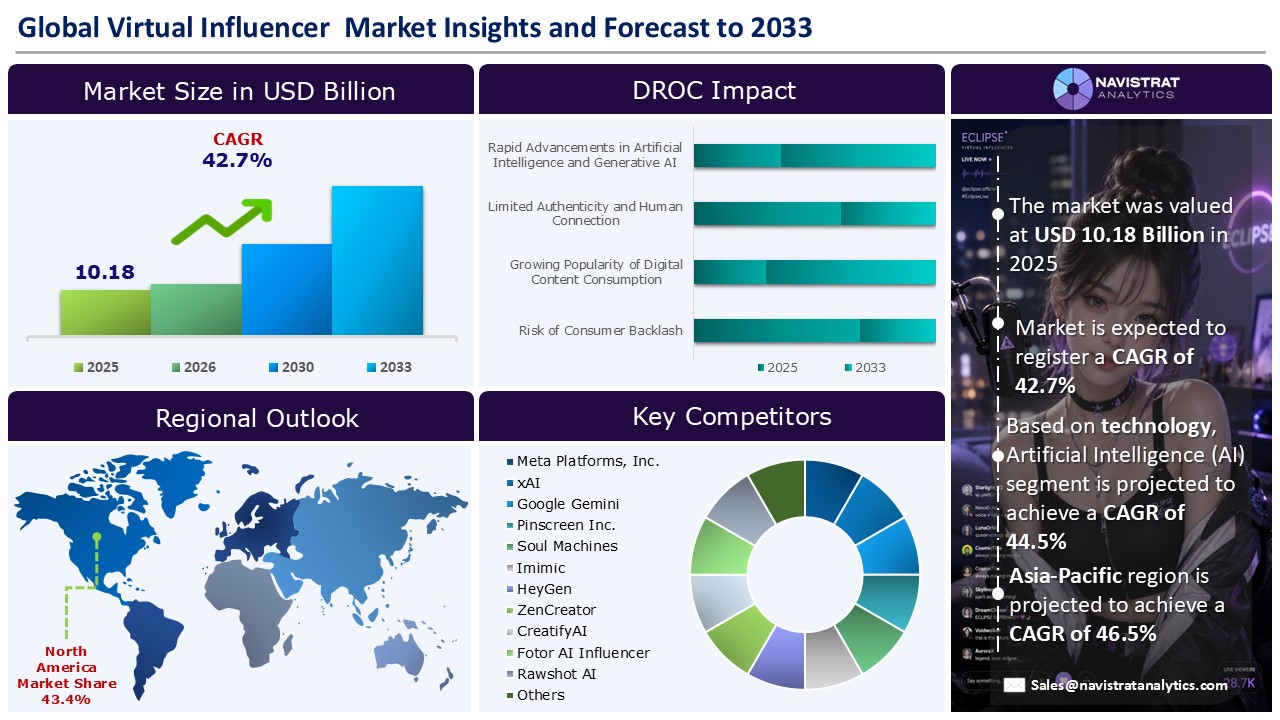
The global virtual influencer market reached USD 10.18 billion in 2025 and is expected to register a revenue CAGR of 42.7% during the forecast period. Growing demand for authentic and personalized digital engagement, rapid advancements in artificial intelligence and generative AI, increasing adoption of social media platforms, rising investment in metaverse and digital ecosystems, and growth of E-commerce and social commerce are expected to drive revenue growth of the market.
The virtual influencer market comprises computer-generated social media personas powered by advanced Computer-Generated Imagery (CGI) and Artificial Intelligence (AI) technologies. It is designed to engage audiences, promote products, and model apparel across digital environments. The virtual influencer ecosystem encompasses advanced 3D character engines, real-time natural language processing (NLP) models, automated campaign analytics, and localized virtual talent agencies.
Market Drivers:
Increasing adoption of social media platforms is driving strong revenue growth of the market. Globally, there are over 5.22 billion active social media users, representing approximately 63.8% of the world’s population. These users spend a large portion of their daily screen time on immersive, highly commercialised platforms such as TikTok, Instagram, Facebook, and YouTube, which serve as primary gateways for product discovery and consumer purchase decisions. Because social media algorithms actively reward continuous posting schedules and highly interactive formats, traditional human creators face physical constraints and burnout.
In addition, virtual influencers operate 24/7 without fatigue. It is the managing agencies to maintain continuous posting cadences and deploy hyper-personalized content at scale. Brands are recognizing that virtual creators consistently outperform human creators on impressions-to-interaction ratios. According to research, virtual influencers achieve average engagement rates between 5.67% and 5.9%, which is roughly three times higher than the 1.89% average achieved by equivalent human creators. This dramatic performance gap is incentivizing Chief Marketing Officers (CMOs) to allocate up to 30% of their creator budgets to virtual avatars to achieve measurable performance outcomes and protect brand safety.
Market Opportunity:
Growing popularity of digital content consumption is creating significant opportunities for the market. The massive global surge in digital content consumption, particularly among Gen Z and younger millennials, represents an immense expansion opportunity for the virtual influencer market. Over 71% of internet users consume creator-generated digital content daily through video streaming, live commerce, and virtual gaming environments.
Gen Z consumers, who represent the largest demographic of digital-first buyers, are particularly receptive to synthetic personas. Indeed, 75% of Gen Z consumers actively engage with virtual influencer content, and 35% report making a purchase directly based on a virtual creator’s recommendation. This generation sees very little difference between real people and virtual creators. They spend about 23 minutes every day interacting with virtual influencers, which is 38% more time than they spend with human creators.
This shifting attention span allows brands to transcend physical limitations by placing virtual influencers in persistent digital domains, immersive Augmented Reality (AR) campaigns, and virtual concerts. Real-world developments highlight how companies are capturing this opportunity. For example, in March 2025, virtual production startup Cover Corp. expanded its international VTuber agency “Hololive” with a series of multilingual digital character debuts and large-scale virtual concert programs designed specifically to capture overseas fan engagement.
Recent Trends:
The technological transformation of the virtual influencer market has accelerated significantly, moving away from statically rendered, manually animated CGI characters toward fully dynamic, AI-powered autonomous virtual influencers. Historically, the creation of virtual influencers relied entirely on manual 3D modeling and animation software. It required large creative teams and weeks of post-production to generate a single static image or short video. This manual pipeline resulted in high development costs and constrained the scalability of campaigns.
In April 2026, Amazon Japan introduced its first AI influencer campaign featuring MIRAI, marking a new approach to live commerce. During the New Life sales campaign, MIRAI conducted fully autonomous livestreams without any human involvement. Supported by a large language model (LLM) trained on product information, she showcases products, interacts with viewers in real time, and consistently directs audiences to her Amazon storefront, creating a seamless and continuous journey from customer engagement to purchase.
Restraints & Challenges:
The risk of consumer backlash and persistent public skepticism regarding the authenticity of virtual relationships represent significant restraints to the expansion of the virtual influencer market. Virtual influencers do not possess physical biology, sensory experiences, or real-world lives. They cannot genuinely taste food, evaluate skincare products through application, or physically experience a travel destination. As social media audiences become more digitally literate, they are showing signs of fatigue with synthetic content. If a brand attempts to portray a virtual influencer as a genuine, emotionally authentic advocate without highly transparent disclosures, it risks facing immediate consumer backlash, negative viral feedback, and long-term brand damage. Studies reveal that virtual influencers suffer from a 31% lower trust rating than human creators when making direct product recommendations, underscoring the trust deficit that brands must overcome.
This challenge is further amplified by rapidly evolving regulatory compliance burdens across major geographical regions. In March 2025, the US Federal Trade Commission (FTC) released updated Endorsement Guidelines, explicitly warning that virtual creators must clearly disclose their non-human nature and must not falsely imply sensory human experiences that they cannot physically have. Concurrently, the EU AI Act’s Article 50 transparency obligations, which officially take effect on August 2, 2026, enforce strict mandatory labeling requirements for all deepfakes and AI-generated commercial videos. Non-compliance with the EU AI Act carries severe financial penalties of up to EUR 15 million or 3% of worldwide annual turnover. It is forcing brands to implement complex, transparent audit trails that can slow down highly creative, rapid-fire global marketing campaigns.
Type Segment Insights and Analysis:
Based on the component segment, the virtual influencer market is segmented into human-like virtual influencers, and non-human virtual influencers. Human-like virtual influencers segment is further sub-segmented into fashion models, lifestyle influencers, celebrity-style influencers, fitness influencers, beauty influencers and others. Non-human virtual influencers segment is further sub-segmented into anime characters, gaming characters, mascot-based influencers, fantasy characters, animal-based characters, metaverse avatars and others.
Human-like virtual influencers segment contributed the largest share in 2025 due to the continuing demand among premium lifestyle, beauty, and fashion brands for highly realistic, emotionally relatable digital personas capable of mimicking human traits, expressions, and aesthetic styles to build deep parasocial relationships with consumers. These avatars utilize hyper-realistic 3D rendering, face-swapping algorithms, and deep learning neural networks to deliver highly polished, brand-safe marketing campaigns. They can represent diverse racial backgrounds, wear complex digital clothing designs, and appear in simulated luxury settings. These entirely eliminate physical shoot logistics, model fees, and travel expenses for brands.
A strategic example of this segment’s success is “Imma,” a photorealistic virtual model created by Japan’s Aww Inc., which has modelled for premium brands such as Porsche, IKEA, and Vogue, demonstrating how human avatars function as flawless, controversy-free brand trendsetters. Another one is “Shibani Roy”, an emerging AI-generated influencer from India who positions herself as a digital creator and storyteller. The revenue impact of this segment is substantial by replacing physical photo shoots and human models. Human-like virtual campaigns deliver a 58% reduction in content production costs, encouraging major consumer enterprises to establish dedicated in-house virtual influencer divisions to capture higher margins.
Technology Segment Insights and Analysis:
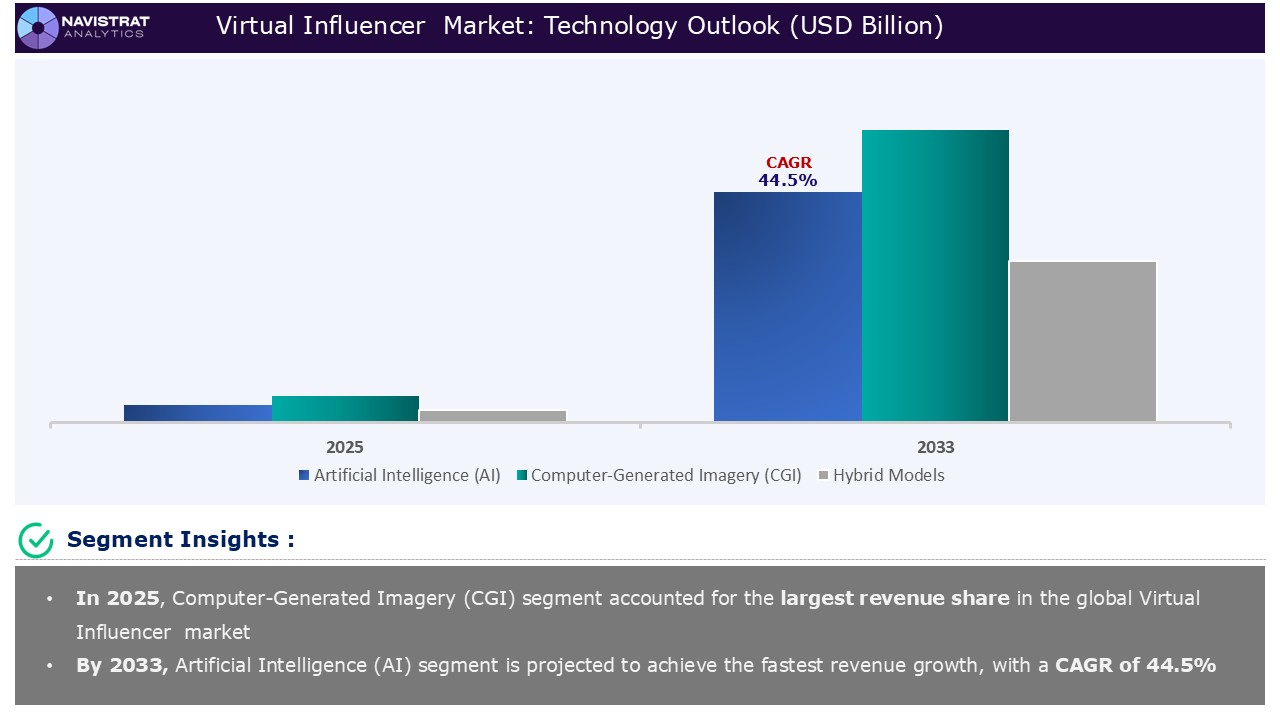
Based on technology, the virtual influencer market is segmented into Artificial Intelligence (AI), Computer-Generated Imagery (CGI) and hybrid models.
Computer-Generated Imagery (CGI) segment accounted for the largest revenue share in 2025. This technology serves as the visual and structural foundation of the virtual creator industry, particularly in luxury fashion, premium gaming, and entertainment applications where visual perfection is critical. CGI-rendered characters allow designers to meticulously construct every skin pore, lighting angle, fabric drape, and pose with absolute precision. It ensures complete compliance with strict luxury brand guidelines and visual standards. A prominent strategic example of this segment is “Lil Miquela,” a CGI-based virtual creator developed by Brud and owned by Dapper Labs, who has generated approximately USD 11 million in career brand-deal revenue through meticulously pre-rendered CGI campaigns for global brands like Prada, Calvin Klein, and Samsung.
For, Instance, South Korean virtual influencer Rozy has amassed more than 130,000 followers on Instagram. She regularly shares content featuring her travels around the world and is also known for singing, dancing, and modeling. The CGI (computer-generated imagery) technology that powers Rozy is not an innovation. It has long been widely used across the entertainment industry to create lifelike non-human characters for films, video games, and music videos.
Application Segment Insights and Analysis:
Based on application, the virtual influencer market is segmented into brand promotion & advertising, entertainment, customer engagement, education & awareness, virtual shopping, and others.
Brand promotion & advertising segment accounted for the largest revenue share in 2025 due to the rapid commercialization of the creator economy and a fundamental shift in corporate marketing budgets toward ROI-driven, performance-based digital campaigns. Virtual influencers provide advertisers with complete control over messaging, zero risk of public scandals or off-brand behavior, and the capability to run always-on promotional campaigns scaled across multiple platforms simultaneously. Brand adoption has surged, with 73% of companies actively deploying virtual creators in 2026, led by beauty and gaming brands.
A strategic example of this application is “Lu do Magalu,” the virtual retail mascot owned by Magazine Luiza, who earned approximately USD 2.5 million in 2024 across 74 brand collaborations. She is acting as a highly profitable promotional agent. The revenue impact of brand promotion is the primary catalyst for the revenue growth of this segment. Brands utilizing virtual-led marketing strategies report a 41% higher campaign ROI when allocating more than 25% of their creator budgets to virtual personas.
Geographical Outlook:
Virtual Influencer market is strategically segmented by geography to provide a comprehensive understanding of regional market dynamic. Discover demand analysis, emerging trends, and growth opportunities shaping market performance across different region and countries.
North America Virtual Influencer Market:
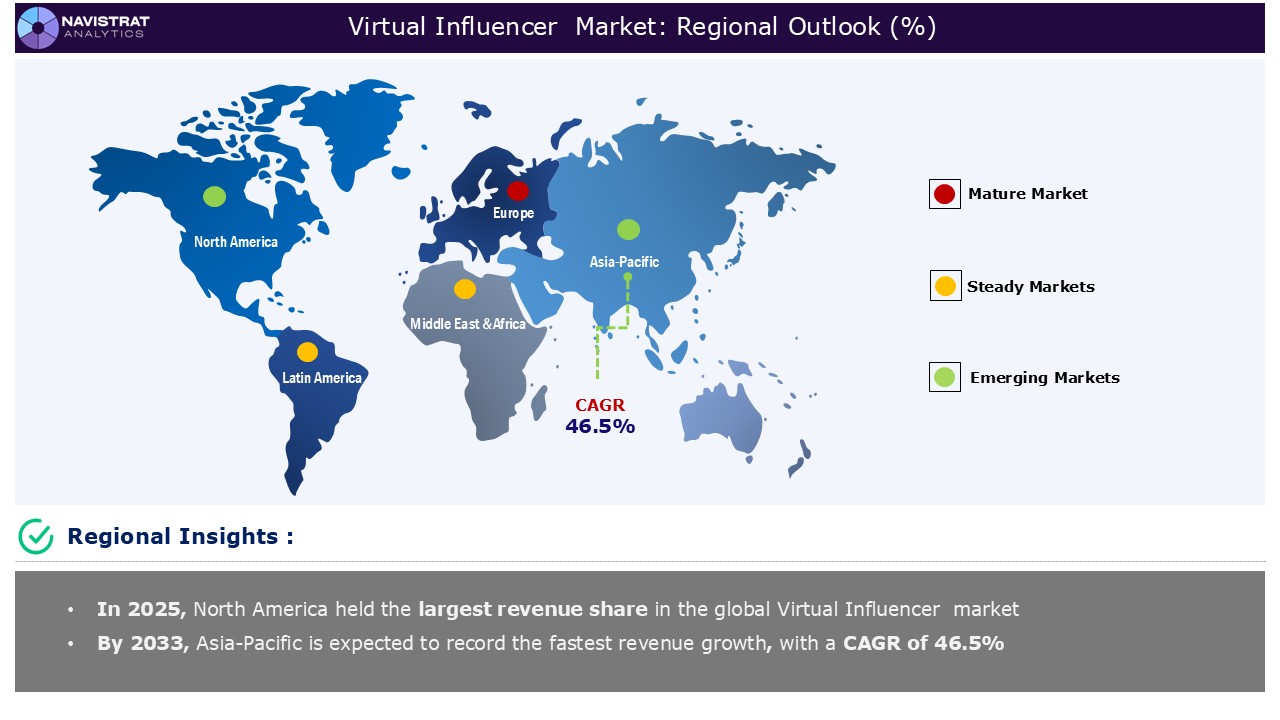
Market in North America accounted for largest revenue share in 2025 due to the highly advanced digital marketing infrastructure, a world-class technology ecosystem, and heavy capital investments in generative AI and real-time rendering software by technology giants in Silicon Valley and media hubs in Los Angeles. Over 58% of U.S. consumers follow at least one virtual influencer, with followership rising to 81% among Gen Z consumers. It provides an exceptionally monetizable audience base. In October 2025, American tech companies xAI and Google Gemini rolled out major multimodal updates for digital humans, enabling real-time conversational interactivity for virtual brand representatives.
Government initiatives in North America are highly focused on regulatory transparency. The Federal Trade Commission (FTC) released updated Endorsement Guides in March 2025 and final Consumer Reviews Rules in October 2024, enforcing strict penalties of up to USD 51,744 per violation for undisclosed AI-generated marketing content. Additionally, in February 2026, Sumsub published its AI Deepfakes and Creator Economy Fraud Detection Guide, estimating USD 4.8 billion in 2026 influencer fraud losses, which has accelerated investment in secure verification platforms across North America.
Asia Pacific Virtual Influencer Market:
Asia Pacific is expected to register a fast revenue growth rate during the forecast period due to the massive social media user base representing 60% of the global population in this region. A highly developed live-streaming culture, and deep cultural acceptance of virtual idols, anime avatars, and digital assistants in China, Japan, and South Korea. South Korea, Japan, and China collectively launched 1,840 new brand-affiliated virtual accounts in 2025 alone. In China, virtual hosts on Taobao Live drove over USD 9.4 billion in product sales in 2025.
Government initiatives have played a vital role in organizing this rapid growth. In September 2025, China’s Cyberspace Administration (CAC) implemented strict new labeling rules requiring conspicuous watermarks on all synthetic media to protect consumer rights. Regional investment trends are dominated by technology conglomerates like Naver (Zepeto), Baidu, and Tencent, which are investing heavily in virtual human software. A strategic example of regional monetization is Cover Corp. (Hololive) and Anycolor, which have scaled virtual idol streaming into a multi-million-dollar global entertainment segment.
Europe Virtual Influencer Market:
Market in Europe accounted for a significant revenue share in 2025. Western Europe, specifically Germany, France, the UK, and the Netherlands, functions as the primary regional hub. European market growth is driven by the region’s highly sophisticated luxury fashion industry, mature consumer awareness around climate change, and a strong corporate emphasis on the circular economy and sustainable marketing. European brands are actively adopting virtual influencers to champion environmental citizenship, using 3D digital garments to showcase luxury summer and winter collections while eliminating the environmental externalities associated with physical product sampling and international photo shoots.
In October 2025, the London-based creators of digital supermodel “Shudu” collaborated with high-profile European fashion publications, including Vogue and Cosmopolitan, to run sustainable digital fashion features, highlighting Shudu’s role as a green ambassador. Government initiatives in Europe represent the strictest regulatory landscape worldwide; the European Union is set to enforce its landmark EU AI Act, with Article 50 transparency obligations taking effect on August 2, 2026. This law enforces strict labeling of AI-generated content and deepfakes, carrying penalties of up to EUR 15 million or 3% of global turnover, which forces European brands to prioritize transparency-driven campaigns.
Competition Analysis:
The Virtual Influencer market is characterized by a a fragmented structure, with a diverse array of hyper-realistic digital avatar agencies, generative AI startups, and software platforms competing across regional boundaries. List of major players included in the Virtual Influencer market report are:
- Meta Platforms, Inc.
- xAI
- Google Gemini
- Pinscreen Inc.
- Soul Machines
- Imimic
- HeyGen
- ZenCreator
- CreatifyAI
- Fotor AI Influencer
- Rawshot AI
- Dapper Labs, Inc.
- UneeQ Limited
- Didimo Inc.
- Spatial Systems, Inc.
- DeepBrain AI Inc.
- Virtual Humans Inc.
- Reblika Labs
Strategic Developments in Virtual Influencer Market:
- In October 2025, xAI launched an advanced real-time conversational upgrade for its virtual characters, enabling them to engage in continuous two-way live streaming. Strategic Significance. This initiative allows digital personas to transition from static image posting to dynamic live sales. Market Impact. This development has driven significant revenue growth in the platform and software segment by accelerating the deployment of autonomous e-commerce hosts on major social networks.
- In May 2023, Myntra introduced its first virtual influencer, Maya, marking a significant milestone in the e-commerce industry. As a pioneering AI-powered fashion influencer, Maya joined Myntra’s exclusive Style Squad of content creators and became the face of FWD, the platform’s shopping destination designed specifically for the preferences and lifestyles of Gen Z consumers.
Key Advantages for Stakeholders:
Navistrat Analytics’ industry report provides an in-depth quantitative analysis of various market segments, historical and current trends, market forecasts, and dynamics within the global market. The historical years covered in this report are 2023 to 2024, with 2025 serving as the base year for market size calculations. The forecast period extends from 2026 to 2033.
The report includes an executive summary and a comprehensive overview of market drivers, restraints, opportunities, and challenges (DROC), along with insights into regulatory standards. It features detailed analyses such as PORTER’s Five Forces, SWOT, and PESTLE, as well as assessments of technological trends and the competitive landscape.
PORTER’s Five Forces analysis helps stakeholders evaluate the impact of new entrants, competitive rivalry, supplier power, buyer power, and substitution threats, enabling them to assess the level of competition and the attractiveness of the global market. The competitive landscape provides stakeholders with a clear understanding of the current market positions of key players, offering valuable insights into their competitive environment.
Scope And Key Highlights of The Virtual Influencer Market Report:
| Report Features | Details |
| Market Size in 2025 | USD 10.18 Billion |
| Market Growth Rate in CAGR (2026–2033) | 42.7% |
| Market Revenue Forecast to 2033 | USD 163.17 Billion |
| Base year | 2025 |
| Historical year | 2023–2024 |
| Forecast period | 2026–2033 |
| Report Pages | 450 |
| Segments Covered |
|
| Regional scope |
|
| Country Scope |
|
| Key Market Players |
|
| Delivery Format | Reports are delivered in PDF format via email. |
| Customization scope | Request Customization |
The Virtual Influencer market report offers a detailed analysis of market size, including historical revenue (in USD Billion) data for 2023-2024 and revenue forecasts for 2026-2033 across the following segments:
- Component Outlook (Revenue, USD Billion; 2023-2033)
- Human-like Virtual Influencers
- Fashion Models
- Lifestyle Influencers
- Celebrity-style Influencers
- Fitness Influencers
- Beauty Influencers
- Others
- Non-Human Virtual Influencers
- Anime Characters
- Gaming Characters
- Mascot-based Influencers
- Fantasy Characters
- Animal-Based Characters
- Metaverse Avatars
- Others
- Human-like Virtual Influencers
- Technology, (Revenue, USD Billion; 2023-2033)
- Artificial Intelligence (AI)
- Computer-Generated Imagery (CGI)
- Hybrid Models
- Platform Outlook (Revenue, USD Billion; 2023-2033)
- Social Media Platforms
- Video Streaming Platforms
- Metaverse Platforms
- Others
- Application Outlook (Revenue, USD Billion; 2023-2033)
- Brand Promotion & Advertising
- Entertainment
- Customer Engagement
- Education & Awareness
- Virtual Shopping
- Others
- End-Use Outlook (Revenue, USD Billion; 2023-2033)
- Food & Beverage
- Sports & Fitness
- Banking & Finance
- Travel & Hospitality
- Fashion & Lifestyle
- Others
- Regional Outlook (Revenue, USD Billion; 2023-2033)
- North America
- U.S.
- Canada
- Mexico
- Europe
- Germany
- France
- U.K.
- Italy
- Spain
- Benelux
- Nordic Countries
- Rest of Europe
- Asia Pacific
- China
- India
- Japan
- South Korea
- Oceania
- ASEAN Countries
- Rest of APAC
- Latin America
- Brazil
- Rest of LATAM
- Middle East & Africa
- GCC Countries
- South Africa
- Israel
- Turkey
- Rest of MEA
- North America
Frequently Asked Questions (FAQ) about the Virtual Influencer Market Report
- Market Definition
- Research Objective
- Research Methodology
- Research Design
- Data Collection Methods
- Primary
- Secondary
- Market Size Estimation
- Top-down method
- Bottom-up method
- Forecasting Methodology
- Tools and Models Use
- Market Overview and Trends
- Market Size and Forecast
- Industry Analysis
- Market Driver, Restraints, Opportunity and Challenges (DROC) Analysis
- Market Drivers
- Growing Demand for Authentic and Personalized Digital Engagement
- Rapid Advancements in Artificial Intelligence and Generative AI
- Increasing Adoption of Social Media Platforms
- Rising Investment in Metaverse and Digital Ecosystems
- Growth of E-commerce and Social Commerce
- Market Restraints
- Limited Authenticity and Human Connection
- Ethical and Transparency Concerns
- Dependence on Social Media Algorithms
- Market Opportunities
- Growing Popularity of Digital Content Consumption
- Cost Efficiency and Scalability for Brands
- Rising Expansion of Influencer Marketing Budgets
- Advancements in CGI and Real-Time Rendering Technologies
- Market Challenges
- Risk of Consumer Backlash
- Technical Complexity and Talent Shortages
- Deepfake and Misinformation Concerns
- Regulatory Landscape
- North America
- Europe
- Asia Pacific
- Latin America
- Middle East and Africa
- Strategic Insights
- Porter’s Five Forces Analysis
- PESTLE Analysis
- Price Trend Analysis
- Value Chain Analysis
- Technological Trends
- Shift from CGI Characters to AI-Powered Autonomous Influencers
- Rise of Hyper-Realistic Digital Humans
- Integration with Social Commerce and E-Commerce
- Expansion into Metaverse, Gaming, and Immersive Experiences
- Growing Focus on Transparency, Ethics, and AI Disclosure
- Recent Developments
- Funding
- Merger and Acquisition
- Expansion
- Partnership and Collaboration
- Product/ Service Launch
- Type Market Revenue Estimates and Forecasts, 2023-2033
- Human-like Virtual Influencers
- Fashion Models
- Lifestyle Influencers
- Celebrity-style Influencers
- Fitness Influencers
- Beauty Influencers
- Others
- Non-Human Virtual Influencers
- Anime Characters
- Gaming Characters
- Mascot-based Influencers
- Fantasy Characters
- Animal-Based Characters
- Metaverse Avatars
- Others
- Human-like Virtual Influencers
- Technology Market Revenue Estimates and Forecasts, 2023-2033
- Artificial Intelligence (AI)
- Computer-Generated Imagery (CGI)
- Hybrid Models
- Platform Market Revenue Estimates and Forecasts, 2023-2033
- Social Media Platforms
- Video Streaming Platforms
- Metaverse Platforms
- Others
- Application Market Revenue Estimates and Forecasts, 2023-2033
- Brand Promotion & Advertising
- Entertainment
- Customer Engagement
- Education & Awareness
- Virtual Shopping
- Others
- End-Use Market Revenue Estimates and Forecasts, 2023-2033
- Food & Beverage
- Sports & Fitness
- Banking & Finance
- Travel & Hospitality
- Fashion & Lifestyle
- Others
- Virtual Influencer Market Revenue Estimates and Forecasts by Region, 2023-2033, USD Billion
- North America
- North America Virtual Influencer Market By Type, Market Revenue Estimates and Forecasts, 2023-2033, USD Billion
- Human-like Virtual Influencers
- Fashion Models
- Lifestyle Influencers
- Celebrity-style Influencers
- Fitness Influencers
- Beauty Influencers
- Others
- Non-Human Virtual Influencers
- Anime Characters
- Gaming Characters
- Mascot-based Influencers
- Fantasy Characters
- Animal-Based Characters
- Metaverse Avatars
- Others
- Human-like Virtual Influencers
- North America Virtual Influencer Market By Technology, Market Revenue Estimates and Forecasts, 2023-2033, USD Billion
- Artificial Intelligence (AI)
- Computer-Generated Imagery (CGI)
- Hybrid Models
- North America Virtual Influencer Market By Platform, Market Revenue Estimates and Forecasts, 2023-2033, USD Billion
- Social Media Platforms
- Video Streaming Platforms
- Metaverse Platforms
- Others
- North America Virtual Influencer Market By Application, Market Revenue Estimates and Forecasts, 2023-2033, USD Billion
- Brand Promotion & Advertising
- Entertainment
- Customer Engagement
- Education & Awareness
- Virtual Shopping
- Others
- North America Virtual Influencer Market By End-Use, Market Revenue Estimates and Forecasts, 2023-2033, USD Billion
- Food & Beverage
- Sports & Fitness
- Banking & Finance
- Travel & Hospitality
- Fashion & Lifestyle
- Others
- North America Virtual Influencer Market Revenue Estimates and Forecasts by Country, 2023-2033, USD Billion
- United States
- Canada
- Mexico
- North America Virtual Influencer Market By Type, Market Revenue Estimates and Forecasts, 2023-2033, USD Billion
- Europe
- Europe Virtual Influencer Market By Type, Market Revenue Estimates and Forecasts, 2023-2033, USD Billion
- Human-like Virtual Influencers
- Fashion Models
- Lifestyle Influencers
- Celebrity-style Influencers
- Fitness Influencers
- Beauty Influencers
- Others
- Non-Human Virtual Influencers
- Anime Characters
- Gaming Characters
- Mascot-based Influencers
- Fantasy Characters
- Animal-Based Characters
- Metaverse Avatars
- Others
- Human-like Virtual Influencers
- Europe Virtual Influencer Market By Technology, Market Revenue Estimates and Forecasts, 2023-2033, USD Billion
- Artificial Intelligence (AI)
- Computer-Generated Imagery (CGI)
- Hybrid Models
- Europe Virtual Influencer Market By Platform, Market Revenue Estimates and Forecasts, 2023-2033, USD Billion
- Social Media Platforms
- Video Streaming Platforms
- Metaverse Platforms
- Others
- Europe Virtual Influencer Market By Application, Market Revenue Estimates and Forecasts, 2023-2033, USD Billion
- Brand Promotion & Advertising
- Entertainment
- Customer Engagement
- Education & Awareness
- Virtual Shopping
- Others
- Europe Virtual Influencer Market By End-Use, Market Revenue Estimates and Forecasts, 2023-2033, USD Billion
- Food & Beverage
- Sports & Fitness
- Banking & Finance
- Travel & Hospitality
- Fashion & Lifestyle
- Others
- Europe Virtual Influencer Market Revenue Estimates and Forecasts by Country, 2023-2033, USD Billion
- Germany
- United Kingdom
- France
- Italy
- Spain
- Benelux
- Nordic Countries
- Rest of Europe
- Europe Virtual Influencer Market By Type, Market Revenue Estimates and Forecasts, 2023-2033, USD Billion
- Asia-Pacific
- Asia-Pacific Virtual Influencer Market By Type, Market Revenue Estimates and Forecasts, 2023-2033, USD Billion
- Human-like Virtual Influencers
- Fashion Models
- Lifestyle Influencers
- Celebrity-style Influencers
- Fitness Influencers
- Beauty Influencers
- Others
- Non-Human Virtual Influencers
- Anime Characters
- Gaming Characters
- Mascot-based Influencers
- Fantasy Characters
- Animal-Based Characters
- Metaverse Avatars
- Others
- Human-like Virtual Influencers
- Asia-Pacific Virtual Influencer Market By Technology, Market Revenue Estimates and Forecasts, 2023-2033, USD Billion
- Artificial Intelligence (AI)
- Computer-Generated Imagery (CGI)
- Hybrid Models
- Asia-Pacific Virtual Influencer Market By Platform, Market Revenue Estimates and Forecasts, 2023-2033, USD Billion
- Social Media Platforms
- Video Streaming Platforms
- Metaverse Platforms
- Others
- Asia-Pacific Virtual Influencer Market By Application, Market Revenue Estimates and Forecasts, 2023-2033, USD Billion
- Brand Promotion & Advertising
- Entertainment
- Customer Engagement
- Education & Awareness
- Virtual Shopping
- Others
- Asia-Pacific Virtual Influencer Market By End-Use, Market Revenue Estimates and Forecasts, 2023-2033, USD Billion
- Food & Beverage
- Sports & Fitness
- Banking & Finance
- Travel & Hospitality
- Fashion & Lifestyle
- Others
- Asia-Pacific Virtual Influencer Market Revenue Estimates and Forecasts by Country, 2023-2033, USD Billion
- China
- India
- Japan
- South Korea
- Oceania
- ASEAN Countries
- Rest of Asia-Pacific
- Asia-Pacific Virtual Influencer Market By Type, Market Revenue Estimates and Forecasts, 2023-2033, USD Billion
- Latin America
- Latin America Virtual Influencer Market By Type, Market Revenue Estimates and Forecasts, 2023-2033, USD Billion
- Human-like Virtual Influencers
- Fashion Models
- Lifestyle Influencers
- Celebrity-style Influencers
- Fitness Influencers
- Beauty Influencers
- Others
- Non-Human Virtual Influencers
- Anime Characters
- Gaming Characters
- Mascot-based Influencers
- Fantasy Characters
- Animal-Based Characters
- Metaverse Avatars
- Others
- Human-like Virtual Influencers
- Latin America Virtual Influencer Market By Technology, Market Revenue Estimates and Forecasts, 2023-2033, USD Billion
- Artificial Intelligence (AI)
- Computer-Generated Imagery (CGI)
- Hybrid Models
- Latin America Virtual Influencer Market By Platform, Market Revenue Estimates and Forecasts, 2023-2033, USD Billion
- Social Media Platforms
- Video Streaming Platforms
- Metaverse Platforms
- Others
- Latin America Virtual Influencer Market By Application, Market Revenue Estimates and Forecasts, 2023-2033, USD Billion
- Brand Promotion & Advertising
- Entertainment
- Customer Engagement
- Education & Awareness
- Virtual Shopping
- Others
- Latin America Virtual Influencer Market By End-Use, Market Revenue Estimates and Forecasts, 2023-2033, USD Billion
- Food & Beverage
- Sports & Fitness
- Banking & Finance
- Travel & Hospitality
- Fashion & Lifestyle
- Others
- Latin America Virtual Influencer Market Revenue Estimates and Forecasts by Country, 2023-2033, USD Billion
- Brazil
- Rest of Latin America
- Latin America Virtual Influencer Market By Type, Market Revenue Estimates and Forecasts, 2023-2033, USD Billion
- Middle East & Africa
- Middle East & Africa Virtual Influencer Market By Type, Market Revenue Estimates and Forecasts, 2023-2033, USD Billion
- Human-like Virtual Influencers
- Fashion Models
- Lifestyle Influencers
- Celebrity-style Influencers
- Fitness Influencers
- Beauty Influencers
- Others
- Non-Human Virtual Influencers
- Anime Characters
- Gaming Characters
- Mascot-based Influencers
- Fantasy Characters
- Animal-Based Characters
- Metaverse Avatars
- Others
- Human-like Virtual Influencers
- Middle East & Africa Virtual Influencer Market By Technology, Market Revenue Estimates and Forecasts, 2023-2033, USD Billion
- Artificial Intelligence (AI)
- Computer-Generated Imagery (CGI)
- Hybrid Models
- Middle East & Africa Virtual Influencer Market By Platform, Market Revenue Estimates and Forecasts, 2023-2033, USD Billion
- Social Media Platforms
- Video Streaming Platforms
- Metaverse Platforms
- Others
- Middle East & Africa Virtual Influencer Market By Application, Market Revenue Estimates and Forecasts, 2023-2033, USD Billion
- Brand Promotion & Advertising
- Entertainment
- Customer Engagement
- Education & Awareness
- Virtual Shopping
- Others
- Middle East & Africa Virtual Influencer Market By End-Use, Market Revenue Estimates and Forecasts, 2023-2033, USD Billion
- Food & Beverage
- Sports & Fitness
- Banking & Finance
- Travel & Hospitality
- Fashion & Lifestyle
- Others
- Middle East & Africa Virtual Influencer Market Revenue Estimates and Forecasts by Country, 2023-2033, USD Billion
- GCC Countries
- South Africa
- Israel
- Turkey
- Rest of Middle East & Africa
- Middle East & Africa Virtual Influencer Market By Type, Market Revenue Estimates and Forecasts, 2023-2033, USD Billion
- Market Share Analysis
- Revenue Market Share by Key Players (2025-2026)
- Analysis of Top Players by Market Presence
- Competitive Matrix
- Competitive Strategies
- Mergers and Acquisitions
- Partnerships and Collaboration
- Investment and Fundings
- Agreement
- Expansion
- New Product/ Services Launches
- Technological Innovations
- Meta Platforms, Inc.
- Company Overview
- Financial Insights
- Product/ Services Component
- Strategic Developments
- SWOT Analysis
- xAI
- Company Overview
- Financial Insights
- Product/ Services Component
- Strategic Developments
- SWOT Analysis
- Google Gemini
- Company Overview
- Financial Insights
- Product/ Services Component
- Strategic Developments
- SWOT Analysis
- Pinscreen Inc.
- Company Overview
- Financial Insights
- Product/ Services Component
- Strategic Developments
- SWOT Analysis
- Soul Machines
- Company Overview
- Financial Insights
- Product/ Services Component
- Strategic Developments
- SWOT Analysis
- Imimic
- Company Overview
- Financial Insights
- Product/ Services Component
- Strategic Developments
- SWOT Analysis
- HeyGen
- Company Overview
- Financial Insights
- Product/ Services Component
- Strategic Developments
- SWOT Analysis
- ZenCreator
- Company Overview
- Financial Insights
- Product/ Services Component
- Strategic Developments
- SWOT Analysis
- CreatifyAI
- Company Overview
- Financial Insights
- Product/ Services Component
- Strategic Developments
- SWOT Analysis
- Fotor AI Influencer
- Company Overview
- Financial Insights
- Product/ Services Component
- Strategic Developments
- SWOT Analysis
- Rawshot AI
- Company Overview
- Financial Insights
- Product/ Services Component
- Strategic Developments
- SWOT Analysis
- Dapper Labs, Inc.
- Company Overview
- Financial Insights
- Product/ Services Component
- Strategic Developments
- SWOT Analysis
- UneeQ Limited
- Company Overview
- Financial Insights
- Product/ Services Component
- Strategic Developments
- SWOT Analysis
- Didimo Inc.
- Company Overview
- Financial Insights
- Product/ Services Component
- Strategic Developments
- SWOT Analysis
- Spatial Systems, Inc.
- Company Overview
- Financial Insights
- Product/ Services Component
- Strategic Developments
- SWOT Analysis
- DeepBrain AI Inc.
- Company Overview
- Financial Insights
- Product/ Services Component
- Strategic Developments
- SWOT Analysis
- Virtual Humans Inc.
- Company Overview
- Financial Insights
- Product/ Services Component
- Strategic Developments
- SWOT Analysis
- Reblika Labs
- Company Overview
- Financial Insights
- Product/ Services Component
- Strategic Developments
- SWOT Analysis