

Renewable Energy-Powered USV Market Overview and Key Insights:
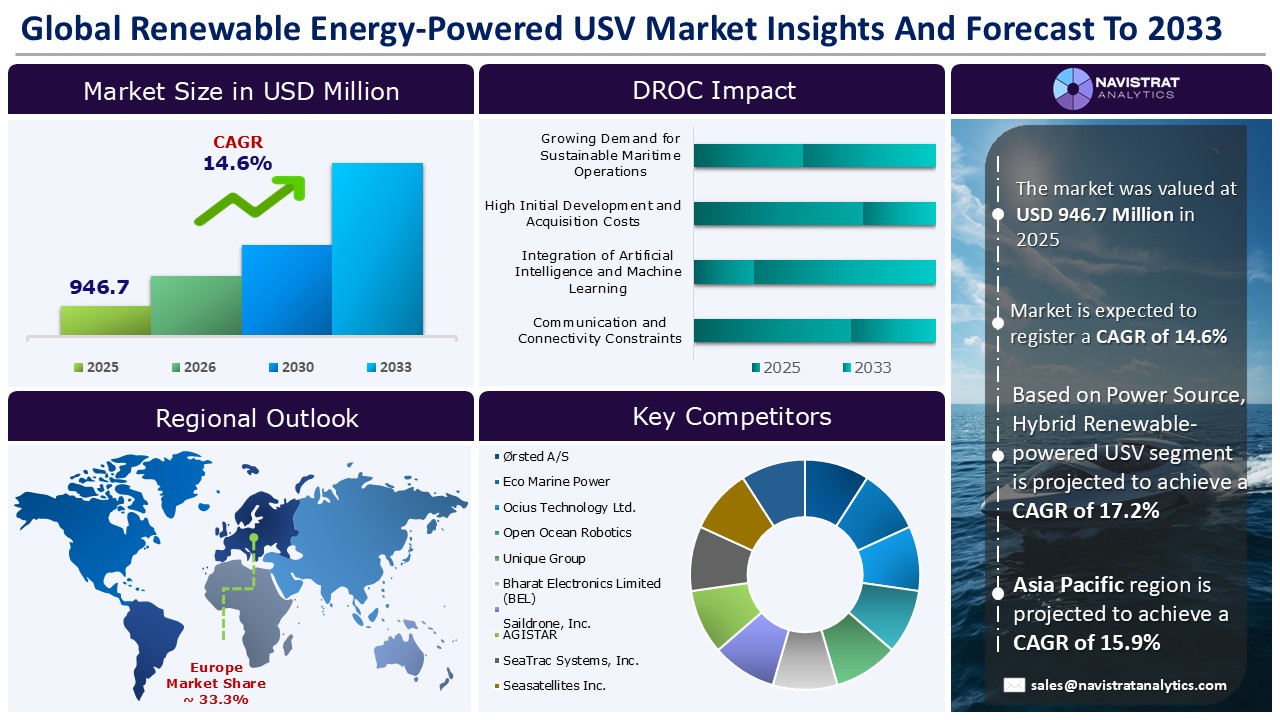
Renewable energy-powered USV market size reached USD 946.7 Million in 2025 and is expected to register a revenue CAGR of 14.6% during the forecast period. Uncrewed Surface Vessels (USVs), sometimes referred to as unmanned or autonomous surface vessels, are being utilized more and more for offshore activities, environmental monitoring, and oceanographic research. These vessels provide a low-risk, cost-effective, and environmentally friendly alternative to traditional crewed ships. USVs use alternative energy sources to stay at sea for extended periods of time. One popular method allows ships to run independently for weeks or months by combining solar and wind power.
Market Drivers:
Growing demand for sustainable maritime operations is a key driver driving the market revenue growth. The maritime sector has traditionally been an important hub for global security, trade, and exploration. As technology progresses, unmanned naval surface vehicles (USVs) emerge as transformative tools in naval operations, providing novel answers to conventional problems. These autonomous or remotely piloted warships are transforming how navies, coast guards, and commercial entities approach maritime operations ranging from surveillance to battle.
They reduce carbon emissions by 97% compared to typical boats while saving approximately 60% of the cost. As militaries throughout the world attempt to modernize their fleets and react to changing threats, the demand for USVs continues to rise. The US Navy’s strategic change to a distributed fleet architecture emphasizes the critical role that unmanned systems will play in future naval operations.
Navies are investigating the usage of USV swarms, which involve dozens or hundreds of vessels working together to achieve goals. This method has the potential to transform naval tactics by allowing for overwhelming force or distributed sensor capabilities. Countries such as the United States, China, and Israel are heavily investing in USV programs, but smaller states and commercial entities are increasingly embracing these technologies, broadening their worldwide reach.
On January 2025, a new alliance between marine technology specialists EIVA and Tuco Marine will deliver integrated autonomous systems for assessing subsea assets such as renewable energy cables. Tuco Marine’s ProZero 8m Naval Intelligence USV sails to an area of interest and launches EIVA’s remotely operated towed vehicle (ROTV), ViperFish. ViperFish is a sensor platform that uses high-resolution seabed imagery, depth mapping, and magnetic signals to monitor subsea assets.
Market Opportunity:
Integration of artificial intelligence and machine learning act as opportunity for renewable energy-powered USV market. The offshore energy sector is undergoing a rapid transformation because to artificial intelligence (AI), which is making operations safer, more effective, and more sustainable. Predictive maintenance is one of AI’s core applications. AI enhances decision-making in real time as well. It helps teams optimize drilling, maintenance, and transportation schedules by processing massive amounts of data from meteorological systems, ocean conditions, and equipment performance.
AI may be used in future offshore wind projects to keep an eye on the underwater habitats surrounding turbines. AI might identify changes in wildlife habits, noise levels, and water quality using underwater sensors and machine learning, giving operators real-time knowledge to lessen ecological damage and more successfully adhere to environmental standards.
On July 2025, Ocius Technology and UNSW Canberra are collaborating on a project to accelerate the manufacture of uncrewed surface vessels (USVs). The project, which is funded by Defence Trailblazer, is establishing an integrated production and maintenance facility as well as an AI-powered logistics support infrastructure. The Ocius Bluebottle USV fleet is powered by renewable energy, including solar, wind, and wave power, or a mix of these sources, and has economic and operational advantages over traditional methods
Recent Trends:
Emerging trends include advanced energy storage systems, digital twin technology, edge computing and real-time analytics, hydrogen fuel cell integration, and advanced sensor fusion technologies.
The maritime industry’s rising digitization has made it possible to collect significant amounts of operational and performance data from boats, opening up new potential for data-driven modelling, monitoring, and optimization. Among these improvements, Digital Twins (DTs) have emerged as an important tool for improving energy efficiency, condition monitoring, and predictive maintenance in complex marine systems.
The combination of DTs with sensor networks, satellite communications, and big data analytics enables real-time performance monitoring, adaptive trip planning, energy efficiency optimization, and predictive repair of vessels. These innovations not only save operational costs and improve safety, but they also help to comply with changing worldwide environmental regulations. As the maritime industry continues its transition to decarbonization and digitalization, adopting such technology is critical to sustaining competitiveness and long-term resilience in an increasingly turbulent global context.
Restraints & Challenges:
Harsh marine environments represent one of the most significant challenges because these vessels must operate autonomously for extended periods in unpredictable ocean conditions while relying on renewable energy sources that are directly influenced by the environment. USVs operating in open oceans are continuously exposed to high waves and rough sea states, strong ocean currents, high wind speeds, and repeated mechanical vibrations.
Furthermore, these environmental stresses increase maintenance requirements, operational costs, and the need for durable materials and protective technologies. Consequently, manufacturers must invest in advanced corrosion-resistant materials, anti-fouling coatings, ruggedized electronics, and sophisticated energy management systems to ensure reliable performance.
Energy Source Segment Insights and Analysis:
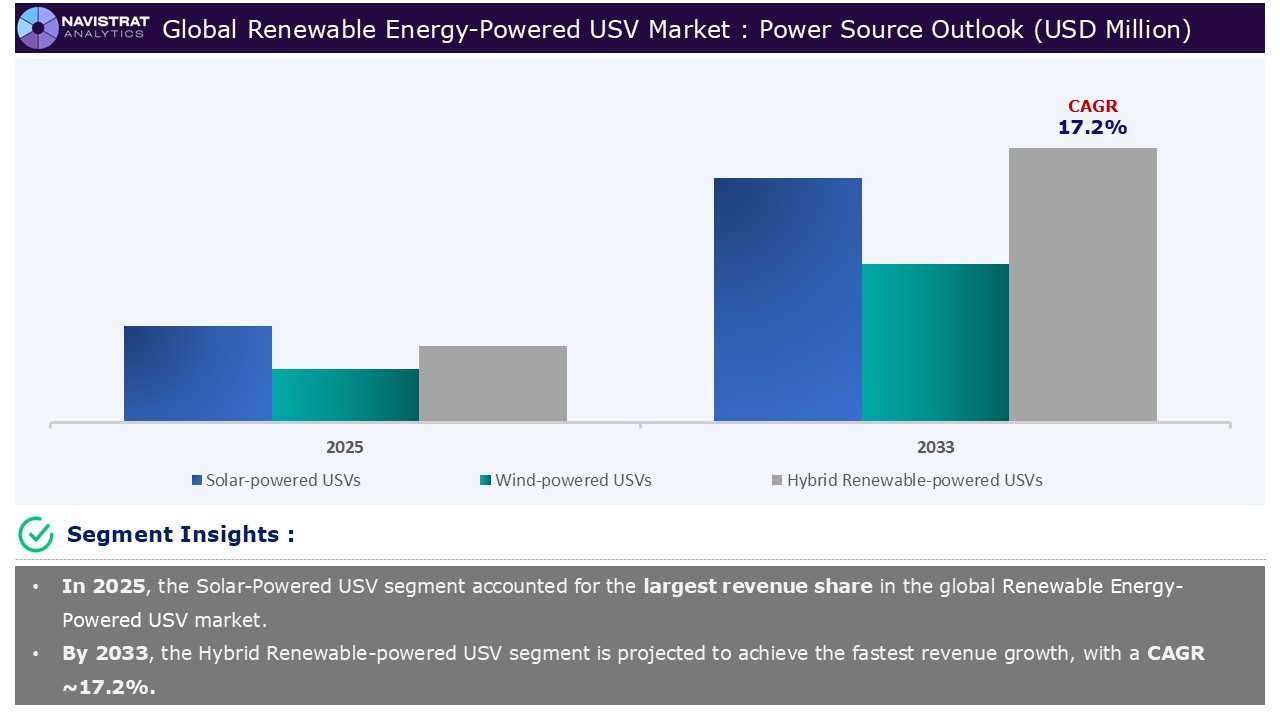
Based on the energy source, renewable energy-powered USV market is segmented into Solar-powered USVs, Wind-powered USVs, and Hybrid Renewable-powered USVs.
Solar-powered USVs segment contributed the largest market share in 2025. A Solar-Powered Unmanned Surface Vessel (USV) is an autonomous watercraft powered by solar energy and developed for a variety of uses including surveillance, research, and environmental monitoring. Solar-powered USVs have several advantages, including sustainability, cheap operating costs, and lower carbon emissions, all of which contribute to environmental conservation.
Their capacity to run constantly without requiring fuel allows for longer missions in remote places, making them appropriate for a wide range of nautical duties. Furthermore, government support for green technology and increased financing for maritime research programs are projected to improve the market landscape, establishing solar-powered USVs as key factors in determining the future of sustainable marine operations.
On April 2026, Sofar Ocean, the premier ocean intelligence platform, has introduced , a robust, solar-powered uncrewed surface vehicle (USV) that allows for continuous ocean sensing in distant and deep-water locales. The hardy USV maintains its place in deep water, moves between areas on command, and can return home after six or more months unattended. While installed, it collects the same surface and subsurface data that thousands of Spotter Platform customers worldwide rely on, and it communicates each observation in real time to the Spotter Dashboard and API.
Application Segment Insights and Analysis:
Based on the application, Renewable Energy-Powered USV market is segmented into oceanographic research, environmental monitoring, maritime surveillance and security, offshore energy support, and hydrographic and seabed mapping.
Oceanographic research segment contributed the largest market share in 2025. Ocean monitoring and observation are being revolutionized by the development of unmanned surface vehicle (USV) technology. The way scientists gather information on ocean currents, climate change, marine biodiversity, and environmental concerns is being revolutionized by these autonomous or remotely operated vessels. USVs offer an economical and effective substitute for conventional oceanic research techniques by incorporating cutting-edge sensors, AI-driven navigation systems, and sustainable energy sources.
USVs are essential to the Global Ocean Observing System (GOOS) because they enable long-term environmental monitoring with little assistance from humans. These robotic boats are capable of traveling over large oceanic areas while gathering data in real time on salinity, wave heights, sea surface temperatures, and atmospheric variables. They support earthquake and tsunami early warning systems by facilitating seafloor mapping and the detection of underwater geological activity through the use of sonar and LiDAR technology.
On June 2026, Open Ocean Robotics, a member of Team Orchard, has announced that it would deploy its solar-powered DataXplorer uncrewed surface vehicle, along with XplorerView, to support meteorological and oceanographic studies at NOAA Station 46012. The platform is collecting parameters in accordance with NOAA’s National Data Buoy Center (NDBC) measurement scope, with hourly datasets supplied via redundant cellular and satellite connections. The project demonstrates how uncrewed marine systems (UMS) can provide high-quality environmental intelligence while minimizing operational impact.
End-Use Segment Insights and Analysis:
Based on the end-use, renewable energy-powered USV market is segmented into government and defense organizations, research institutions and universities, offshore energy companies, environmental agencies, and commercial maritime operators.
Government and defense organizations segment contributed the fastest growth rate in 2025. Modern military USVs range from small, portable platforms deployed from shore or bigger boats to huge USVs capable of transoceanic operations. Hull shapes, propulsion systems, autonomy software, and payload integration approaches differ greatly, reflecting the variety of mission profiles between naval forces and research organizations.
Military USVs are commonly utilized for intelligence, surveillance, and reconnaissance tasks that necessitate ongoing maritime domain awareness. These systems, which include radar, electro-optical sensors, infrared sensors, and satellite communications, allow continuous surface activity monitoring while minimizing risk to crewed assets.
Naval USVs provide detection and tracking in anti-submarine warfare tasks by utilizing integrated sonar equipment and autonomous navigation. These devices improve sensor coverage and allow for distributed operations in both open ocean and littoral conditions. Military USVs are increasingly being used for hydrographic survey and seabed mapping missions that combine defense and research requirements. These platforms use sonar and positioning technologies to help in charting, infrastructure development, and environmental assessments.
On July 2024, Ocean Power Technologies, Inc. has partnered with Unique Group, a UAE-based global innovator in subsea technologies and engineering, to provide low-carbon marine power, data, and service solutions to customers across various industries. Unique has around 600 people and 20 operational bases worldwide. Unique Group and OPT will work together to deploy OPT’s existing WAM-V unmanned surface vehicles in the UAE and other Gulf Collaboration Council countries. Integrating OPT’s commercially available vehicles with Unique’s leading position in the offshore energy industry in the UAE will accelerate the adoption of USVs in the region.
Geographical Outlook:
Renewable energy-powered USV market is strategically segmented by geography to provide a comprehensive understanding of regional market dynamic. Discover demand analysis, emerging trends, and growth opportunities shaping market performance across different region and countries.
Europe Renewable Energy-Powered USV Market:
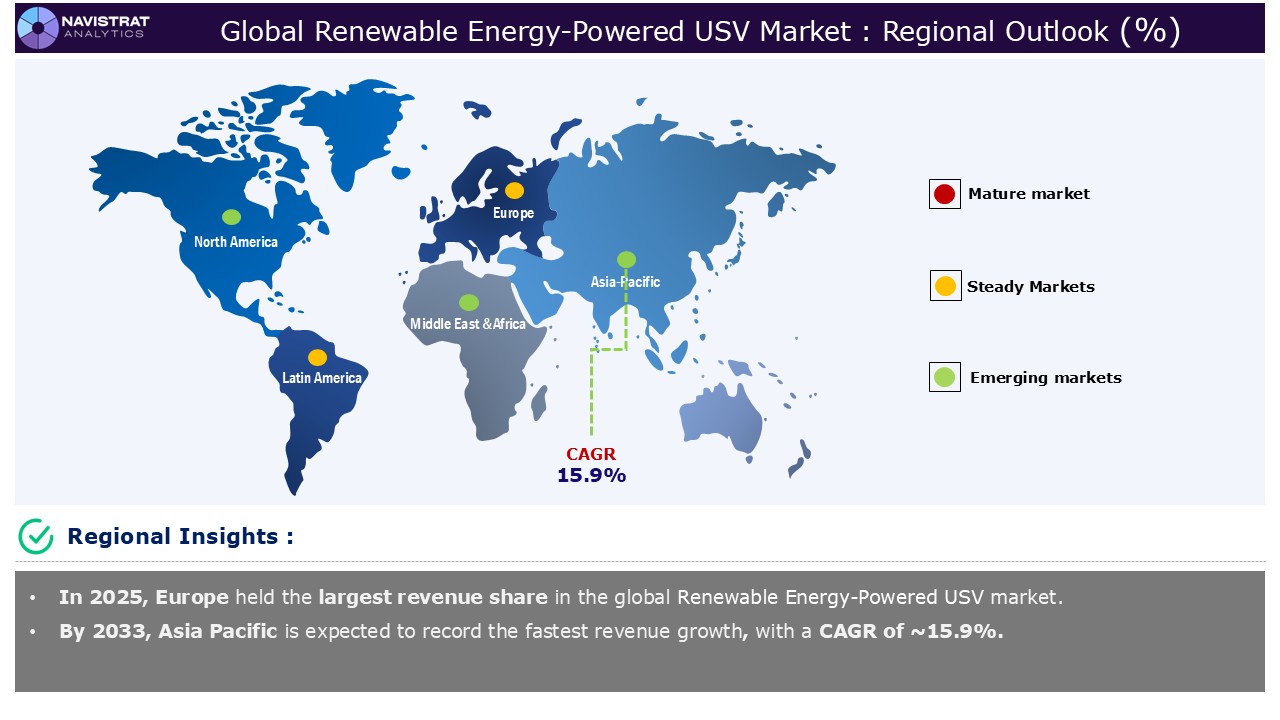
Europe is registered to have highest market share in renewable energy-powered USV market in 2025. The growing demand for water quality monitoring due to higher pollution levels, as well as ocean data mapping, which allows scientists to examine past climatic conditions, are driving the expansion of the European unmanned surface vehicles (USV) industry. Furthermore, increased marine security risks are forcing European navies to include autonomous surface vehicles (ASV) into their fleets, giving them an advantage and further boosting market growth. Their many applications in crisis management services, particularly in search and rescue and preventive maintenance, are ensuring the integrity of territorial and enclosed water regions.
On October 2024, SAFEEN Subsea, a member of AD Ports Group’s Maritime & Shipping Cluster, has launched “SAFEEN Green,” a cutting-edge remotely operated unmanned vessel (USV) designed to revolutionize marine surveys and inspections due to its ability to deliver geophysical data to commercial standards, operational efficiency, and environmental sustainability. SAFEEN Subsea, a member of AD Ports Group’s Maritime & Shipping Cluster, has launched “SAFEEN Green,” a cutting-edge remotely operated unmanned vessel (USV) designed to revolutionize marine surveys and inspections due to its ability to deliver geophysical data to commercial standards, operational efficiency, and environmental sustainability.
Asia Pacific Renewable Energy-Powered USV Market:
Asia Pacific is expected to register the fastest growth rate during the forecasted period. Geopolitical changes are projected to be the primary driving force behind Asia-Pacific growth. China is developing itself as a significant power by investing in cutting-edge military and naval capabilities, fueling the unmanned systems market. Recently, countries such as Japan and India have invested in USVs and related technology. In the Asia-Pacific area, USVs are employed to safeguard maritime assets such as economic zones, maritime borders, and territorial waters, as well as oil rigs and deep-sea mining activities.
On March 2026, the Albanese Government invested USD 176 million on 40 new Bluebottle uncrewed surface vessels (USVs) designed and built in Australia, making it one of the world’s largest sovereigns USV fleets. The Bluebottle, created in collaboration with the Navy and initially financed by the Defence Innovation Hub, is a long-range unmanned surface vehicle fueled by solar, wind, and wave energy. It can carry payloads, provides constant surface and subsurface monitoring, and functions as part of a combined, integrated marine force.
Competition Analysis:
Renewable energy-powered USV market is characterized by a consolidated structure, with few players competing across various segments and regions. List of major players included in renewable energy-powered USV market report are:
- Ørsted A/S
- Eco Marine Power
- Ocius Technology Ltd.
- Open Ocean Robotics
- Unique Group
- Bharat Electronics Limited (BEL)
- Saildrone, Inc.
- AGISTAR
- SeaTrac Systems, Inc.
- Seasatellites Inc.
- Ocean Power Technologies
- SAFEEN Subsea
Strategic Developments in Renewable Energy-Powered USV Market:</span>
- In October 2025, Fincantieri’s subsidiary IDS – Ingegneria dei Sistemi has signed a memorandum of understanding Next Geosolutions (NextGeo) to collaborate on the development of unmanned surface vessels (USVs) and related technologies for the oil and gas, and renewable energy industries. The collaboration intends to develop next-generation autonomous surface platforms that are ideal for open-sea operations, environmental monitoring, inspection, and offshore infrastructure integrity management.
- In June 2025, Nauticus Robotics, Inc., a pioneer in autonomous subsea robotics and software solutions, announced a strategic partnership with Open Ocean Robotics, a pioneer in uncrewed surface vehicles (USVs) for safe, cost-effective, and environmentally sustainable ocean monitoring. The collaboration combines Nauticus’ subsea robotics expertise, which includes autonomous systems such as the Aquanaut, with Open Ocean Robotics’ solar-powered USV, the DataXplorer. The alliance aims to drastically lower the high operational costs involved with subsea inspections, maintenance, and monitoring—while also providing a compelling environmental advantage.
Key Advantages for Stakeholders:
Navistrat Analytics’ industry report provides an in-depth quantitative analysis of various market segments, historical and current trends, market forecasts, and dynamics within the global market. The historical years covered in this report are 2023 to 2024, with 2025 serving as the base year for market size calculations. The forecast period extends from 2026 to 2033.
The report includes an executive summary and a comprehensive overview of market drivers, restraints, opportunities, and challenges (DROC), along with insights into regulatory standards. It features detailed analyses such as PORTER’s Five Forces, SWOT, and PESTLE, as well as assessments of technological trends and the competitive landscape.
PORTER’s Five Forces analysis helps stakeholders evaluate the impact of new entrants, competitive rivalry, supplier power, buyer power, and substitution threats, enabling them to assess the level of competition and the attractiveness of the global market. The competitive landscape provides stakeholders with a clear understanding of the current market positions of key players, offering valuable insights into their competitive environment.
Scope And Key Highlights Of Renewable Energy-Powered USV Market Report:
| Report Features | Details |
| Market Size in 2025 | USD 946.7 Million |
| Market Growth Rate in CAGR (2026–2033) | 14.6% |
| Market Revenue forecast to 2033 | USD 2,829.4 Million |
| Base year | 2025 |
| Historical year | 2023-2024 |
| Forecast period | 2026-2033 |
| Report Pages | 450 |
| Segments covered |
|
| Regional scope |
|
| Country Scope |
|
| Key Market Players |
|
| Delivery Format | Reports are delivered in PDF format via email. |
| Customization scope | Request for Customization |
Renewable Energy-Powered USV market report offers a detailed analysis of market size, including historical revenue (in USD Million) data for 2023-2024 and revenue forecasts for 2026-2033 across the following segments:
- Energy Source Outlook (Revenue, USD Million; 2023-2033)
- Wind-powered USVs
- Hybrid Renewable-powered USVs
- Vehicle Size Outlook (Revenue, USD Million; 2023-2033)
- Small USV
- Medium USV
- Large USV
- Application Outlook (Revenue, USD Million; 2023-2033)
- Oceanographic Research
- Environmental Monitoring
- Maritime Surveillance and Security
- Offshore Energy Support
- Hydrographic and Seabed Mapping
- End-Use Outlook (Revenue, USD Million; 2023-2033)
- Government and Defense Organizations
- Research Institutions and Universities
- Offshore Energy Companies
- Environmental Agencies
- Commercial Maritime Operators
- Regional Outlook (Revenue, USD Million; 2023-2033)
- North America
- U.S.
- Canada
- Mexico
- Europe
- Germany
- France
- U.K.
- Italy
- Spain
- Benelux
- Nordic Countries
- Rest of Europe
- Asia Pacific
- China
- India
- Japan
- South Korea
- Oceania
- ASEAN Countries
- Rest of APAC
- Latin America
- Brazil
- Rest of LATAM
- Middle East & Africa
- GCC Countries
- South Africa
- Israel
- Turkey
- Rest of MEA
- North America
Frequently Asked Questions (FAQ) about Renewable Energy-Powered USV Market report
| Report Features | Details |
| Market Size in 2025 | USD 946.7 Million |
| Market Growth Rate in CAGR (2026–2033) | 14.6% |
| Market Revenue forecast to 2033 | USD 2,829.4 Million |
| Base year | 2025 |
| Historical year | 2023-2024 |
| Forecast period | 2026-2033 |
| Report Pages | 450 |
| Segments covered |
|
| Regional scope |
|
| Country Scope |
|
| Key Market Players |
|
| Delivery Format | Reports are delivered in PDF format via email. |
| Customization scope | Request for Customization |
The market size of Renewable Energy-Powered USV market was 946.7 million in 2025.
The market size of Renewable Energy-Powered USV market is expected to register compound annual growth rate (CAGR) of 14.6% over the forecast period.
Growing demand for sustainable maritime operations, rising need for long-endurance missions, and expansion of ocean monitoring and climate research programs are major key factors driving the market revenue growth of Renewable Energy-Powered USV market.
High initial development and acquisition costs and energy generation limitations are key limiting factors driving the market.
Asia Pacific account for fastest revenue growth of 15.9%.
Solar-powered USV is the major leading segment of renewable energy-powered USV market in terms of energy source.
- Market Definition
- Research Objective
- Research Methodology
- Research Design
- Data Collection Methods
- Primary
- Secondary
- Market Size Estimation
- Top-down Model Method
- Bottom-up Model Method
- Forecasting Methodology
- Tools and Models Used
- Market Overview and Trends
- Market Size and Forecast
- Industry Analysis
- Market Driver, Restraints, Opportunity, and Challenges (DROC) Analysis
- Market Drivers
- Growing Demand for Sustainable Maritime Operations
- Rising Need for Long-Endurance Missions
- Expansion of Ocean Monitoring and Climate Research Programs
- Market Restraints
- High Initial Development and Acquisition Costs
- Energy Generation Limitations
- Market Opportunities
- Integration of Artificial Intelligence and Machine Learning
- Defense Modernization Programs
- Growth in Smart Ports and Maritime Digitalization
- Market Challenges
- Harsh Marine Operating Conditions
- Communication and Connectivity Constraints
- Public and Regulatory Acceptance
- Regulatory Landscape
- North America
- Europe
- Asia Pacific
- Latin America
- Middle East and Africa
- Strategic Insights
- Porter’s Five Forces Analysis
- PESTLE Analysis
- Price Trend Analysis
- Value Chain Analysis
- Technological Trends
- Advanced Energy Storage Systems
- Digital Twin Vehicle Size
- Edge Computing and Real-Time Analytics
- Hydrogen Fuel Cell Integration
- Advanced Sensor Fusion Technologies
- Recent Developments
- Funding
- Merger and Acquisition
- Expansion
- Partnership and Collaboration
- Product/ Service Launch
- Energy Source Market Revenue Estimates and Forecasts, 2023-2033
- Solar-powered USVs
- Wind-powered USVs
- Hybrid Renewable-powered USVs
- Vehicle Size Market Revenue Estimates and Forecasts, 2023-2033
- Small USVs
- Medium USVs
- Large USVs
- Application Market Revenue Estimates and Forecasts, 2023-2033
- Oceanographic Research
- Environmental Monitoring
- Maritime Surveillance and Security
- Offshore Energy Support
- Hydrographic and Seabed Mapping
- End-Use Market Revenue Estimates and Forecasts, 2023-2033
- Government and Defense Organizations
- Research Institutions and Universities
- Offshore Energy Companies
- Environmental Agencies
- Commercial Maritime Operators
- Renewable Energy-Powered USV Market Revenue Estimates and Forecasts by Region, 2023-2033, USD Million
- North America
- North America Renewable Energy-Powered USV Market By Energy Source, Market Revenue Estimates and Forecasts, 2023-2033, USD Million
- Solar-powered USVs
- Wind-powered USVs
- Hybrid Renewable-powered USVs
- North America Renewable Energy-Powered USV Market By Vehicle Size, Market Revenue Estimates and Forecasts, 2023-2033, USD Million
- Small USVs
- Medium USVs
- Large USVs
- North America Renewable Energy-Powered USV Market By Application, Market Revenue Estimates and Forecasts, 2023-2033, USD Million
- Oceanographic Research
- Environmental Monitoring
- Maritime Surveillance and Security
- Offshore Energy Support
- Hydrographic and Seabed Mapping
- North America Renewable Energy-Powered USV Market By End-Use, Market Revenue Estimates and Forecasts, 2023-2033, USD Million
- Government and Defense Organizations
- Research Institutions and Universities
- Offshore Energy Companies
- Environmental Agencies
- Commercial Maritime Operators
- North America Renewable Energy-Powered USV Market Revenue Estimates and Forecasts by Country, 2023-2033, USD Million
- United States
- Canada
- Mexico
- North America Renewable Energy-Powered USV Market By Energy Source, Market Revenue Estimates and Forecasts, 2023-2033, USD Million
- Europe
- Europe Renewable Energy-Powered USV Market By Energy Source, Market Revenue Estimates and Forecasts, 2023-2033, USD Million
- Solar-powered USVs
- Wind-powered USVs
- Hybrid Renewable-powered USVs
- Europe Renewable Energy-Powered USV Market By Vehicle Size, Market Revenue Estimates and Forecasts, 2023-2033, USD Million
- Small USVs
- Medium USVs
- Large USVs
- Europe Renewable Energy-Powered USV Market By Application, Market Revenue Estimates and Forecasts, 2023-2033, USD Million
- Oceanographic Research
- Environmental Monitoring
- Maritime Surveillance and Security
- Offshore Energy Support
- Hydrographic and Seabed Mapping
- Europe Renewable Energy-Powered USV Market By End-Use, Market Revenue Estimates and Forecasts, 2023-2033, USD Million
- Government and Defense Organizations
- Research Institutions and Universities
- Offshore Energy Companies
- Environmental Agencies
- Commercial Maritime Operators
- Europe Renewable Energy-Powered USV Market Revenue Estimates and Forecasts by Country, 2023-2033, USD Million
- Germany
- United Kingdom
- France
- Italy
- Spain
- Benelux
- Nordic Countries
- Rest of Europe
- Europe Renewable Energy-Powered USV Market By Energy Source, Market Revenue Estimates and Forecasts, 2023-2033, USD Million
- Asia Pacific
- Asia Pacific Renewable Energy-Powered USV Market By Energy Source, Market Revenue Estimates and Forecasts, 2023-2033, USD Million
- Solar-powered USVs
- Wind-powered USVs
- Hybrid Renewable-powered USVs
- Asia Pacific Renewable Energy-Powered USV Market By Vehicle Size, Market Revenue Estimates and Forecasts, 2023-2033, USD Million
- Small USVs
- Medium USVs
- Large USVs
- Asia Pacific Renewable Energy-Powered USV Market By Application, Market Revenue Estimates and Forecasts, 2023-2033, USD Million
- Oceanographic Research
- Environmental Monitoring
- Maritime Surveillance and Security
- Offshore Energy Support
- Hydrographic and Seabed Mapping
- Asia Pacific Renewable Energy-Powered USV Market By End-Use, Market Revenue Estimates and Forecasts, 2023-2033, USD Million
- Government and Defense Organizations
- Research Institutions and Universities
- Offshore Energy Companies
- Environmental Agencies
- Commercial Maritime Operators
- Asia Pacific Renewable Energy-Powered USV Market Revenue Estimates and Forecasts by Country, 2023-2033, USD Million
- China
- India
- Japan
- South Korea
- Oceania
- ASEAN Countries
- Rest of Asia-Pacific
- Asia Pacific Renewable Energy-Powered USV Market By Energy Source, Market Revenue Estimates and Forecasts, 2023-2033, USD Million
- Latin America
- Latin America Renewable Energy-Powered USV Market By Energy Source, Market Revenue Estimates and Forecasts, 2023-2033, USD Million
- Solar-powered USVs
- Wind-powered USVs
- Hybrid Renewable-powered USVs
- Latin America Renewable Energy-Powered USV Market By Vehicle Size, Market Revenue Estimates and Forecasts, 2023-2033, USD Million
- Small USVs
- Medium USVs
- Large USVs
- Latin America Renewable Energy-Powered USV Market By Application, Market Revenue Estimates and Forecasts, 2023-2033, USD Million
- Oceanographic Research
- Environmental Monitoring
- Maritime Surveillance and Security
- Offshore Energy Support
- Hydrographic and Seabed Mapping
- Latin America Renewable Energy-Powered USV Market By End-Use, Market Revenue Estimates and Forecasts, 2023-2033, USD Million
- Government and Defense Organizations
- Research Institutions and Universities
- Offshore Energy Companies
- Environmental Agencies
- Commercial Maritime Operators
- Latin America Renewable Energy-Powered USV Market Revenue Estimates and Forecasts by Country, 2023-2033, USD Million
- Brazil
- Rest of Latin America
- Latin America Renewable Energy-Powered USV Market By Energy Source, Market Revenue Estimates and Forecasts, 2023-2033, USD Million
- Middle East and Africa
- Middle East and Africa Renewable Energy-Powered USV Market By Energy Source, Market Revenue Estimates and Forecasts, 2023-2033, USD Million
- Solar-powered USVs
- Wind-powered USVs
- Hybrid Renewable-powered USVs
- Middle East and Africa Renewable Energy-Powered USV Market By Vehicle Size, Market Revenue Estimates and Forecasts, 2023-2033, USD Million
- Small USVs
- Medium USVs
- Large USVs
- Middle East and Africa Renewable Energy-Powered USV Market By Application, Market Revenue Estimates and Forecasts, 2023-2033, USD Million
- Oceanographic Research
- Environmental Monitoring
- Maritime Surveillance and Security
- Offshore Energy Support
- Hydrographic and Seabed Mapping
- Middle East and Africa Renewable Energy-Powered USV Market By End-Use, Market Revenue Estimates and Forecasts, 2023-2033, USD Million
- Government and Defense Organizations
- Research Institutions and Universities
- Offshore Energy Companies
- Environmental Agencies
- Commercial Maritime Operators
- Middle East and Africa Renewable Energy-Powered USV Market Revenue Estimates and Forecasts by Country, 2023-2033, USD Million
- GCC Countries
- South Africa
- Israel
- Turkey
- Rest of Middle East & Africa
- Middle East and Africa Renewable Energy-Powered USV Market By Energy Source, Market Revenue Estimates and Forecasts, 2023-2033, USD Million
- North America
- Market Share Analysis
- Revenue Market Share by Key Players (2024-2025)
- Analysis of Top Players by Market Presence
- Competitive Matrix
- Competitive Strategies
- Mergers and Acquisitions
- Partnerships and Collaboration
- Investment and Fundings
- Agreement
- Expansion
- New Product/ Services Launches
- Technological Innovations
- Ørsted A/S
- Company Overview
- Financial Insights
- Product/ Services Offerings
- Strategic Developments
- SWOT Analysis
- Eco Marine Power
- Company Overview
- Financial Insights
- Product / Services Offerings
- Strategic Developments
- SWOT Analysis
- Ocius Technology Ltd.
- Company Overview
- Financial Insights
- Product/ Services Offerings
- Strategic Developments
- SWOT Analysis
- Open Ocean Robotics
- Company Overview
- Financial Insights
- Product / Services Offerings
- Strategic Developments
- SWOT Analysis
- Unique Group
- Company Overview
- Financial Insights
- Product / Services Offerings
- Strategic Developments
- SWOT Analysis
- Bharat Electronics Limited (BEL)
- Company Overview
- Financial Insights
- Product / Services Offerings
- Strategic Developments
- SWOT Analysis
- Saildrone, Inc.
- Company Overview
- Financial Insights
- Product / Services Offerings
- Strategic Developments
- SWOT Analysis
- AGISTAR
- Company Overview
- Financial Insights
- Product / Services Offerings
- Strategic Developments
- SWOT Analysis
- SeaTrac Systems, Inc.
- Company Overview
- Financial Insights
- Product / Services Offerings
- Strategic Developments
- SWOT Analysis
- Seasatellites Inc.
- Company Overview
- Financial Insights
- Product / Services Offerings
- Strategic Developments
- SWOT Analysis
- Ocean Power Technologies
- Company Overview
- Financial Insights
- Product / Services Offerings
- Strategic Developments
- SWOT Analysis
- SAFEEN Subsea
- Company Overview
- Financial Insights
- Product / Services Offerings
- Strategic Developments
- SWOT Analysis