

AI Defect Detection Market Overview and Key Insights:
The global AI defect detection market size reached USD 2,630 million in 2024 and is expected to register a revenue CAGR of 15.6% during the forecast period. Rapid deployment of AI defect detection in manufacturing, cost reduction through scrap minimization, and predictive defect analytics are driving revenue growth of the market.

Globally, industries are highly deploying AI-enabled defect detection or visual inspection systems to ensure quality assurance, enable real-time anomaly detection, reduce false positives, and optimize production workflows through data-driven decision-making and predictive analytics. According to research, the human eye can only detect approximately 80-90% of flaws or defects during assembly line inspections, whereas AI-enabled visual inspection systems can identify defects over 98% at the nanometer scale.
Market Drivers:
Rising demand for AI defect detection systems for maintaining quality compliance standards and audit requirements is driving revenue growth in the market. Globally, manufacturers adhere to strict quality management system (QMS) standards such as the total quality management (TQM), International Organization for Standardization (ISO) 9001, and Six Sigma to ensure defect-free products and optimize production processes.
High-resolution visual analysis of pictures and product quality standards is required during quality checks and auditing. AI-based defect detection systems facilitate inspection by aggregating data points captured across assembly lines and analyzing multivariate parameters to accurately identify defects within production batches.
Moreover, industries are adopting Industry 4.0 and smart manufacturing owing to rapid 5G deployment. According to the GSM Association, globally, 5G connections accounted 15% of global mobile industry by 2025. The next-generation manufacturing systems highly depend on real-time data, automation. The AI-driven quality control is becoming increasingly crucial in order to meet operational efficiency and zero-defect production targets. As a result, these factors are significantly contributing to the revenue growth of the market.
Market Opportunity:
Rising adoption of AI defect detection in the highly regulated industry is driving opportunities for investment. Highly regulated industries such as medical devices, pharmaceuticals, and food & beverages require strict quality control measures under visual inspection. In the United States and Europe, regulatory frameworks have been established to strictly adhere to the quality control process under the Federal Food, Drug, and Cosmetic (FD&C) Act, the FDA’s current Good Manufacturing Practice (CGMP), and the European Directorate for the Quality of Medicines & HealthCare.
For instance, the manufacturing of pharmaceutical and medical devices has to comply with ICH Q10 and the Quality System Regulation (QSR) under 21 CFR Part 820 for comprehensive procedures needed to cover design, manufacturing, and quality assurance, through visual inspection. Also, in Europe, standards such as the European Pharmacopoeia and EN 13018 provide guidance for visual inspection protocols. Additionally, process-driven industries such as food and beverages strictly adhere to Acceptable Quality Levels (AQLs) to ensure product quality and safety. The increasing adoption of AI-powered defect detection technologies in these industries is expected to significantly accelerate market growth during the forecast period.
Technological Trends:
Adoption of Generative AI (GenAI) to enhance productivity, improve quality, and increase operational efficiency is emerging as a key technological trend in the AI Defect Detection Market. GenAI enhances productivity and operational efficiency by generating high-quality synthetic datasets critical for training defect detection models in use cases where real-world data is unstructured.
Its adaptive learning capabilities enable continuous improvement by recognizing subtle variances and anomalies in real time, contributing to proactive quality control and predictive maintenance strategies. Furthermore, GenAI’s integration with computer vision and IoT infrastructure allows for dynamic monitoring and root cause analysis across the production or assembly lines.
Restraints & Challenges:
Concerns regarding data privacy and security are a major challenge in the AI defect detection market. AI defect detection software and solutions highly rely on large volumes of training datasets for niche or custom defect types. However, they are increasingly exposed to cybersecurity risks, including malware, phishing, social engineering, adversarial AI, malicious generative models, and automated cyberattacks.
Globally, the threat of data breaches and cyberattacks is growing at an alarming rate. Hackers infiltrate systems and sell client data on the dark web, posing a serious threat to a company’s reputation and trustworthiness. According to the FBI, the Internet Crime Complaint Center (IC3) recorded 859,532 complaints in 2024, with potential losses exceeding USD 16.6 billion, reflecting a 33% surge in losses from the previous year.
Component Segment Insights and Analysis:
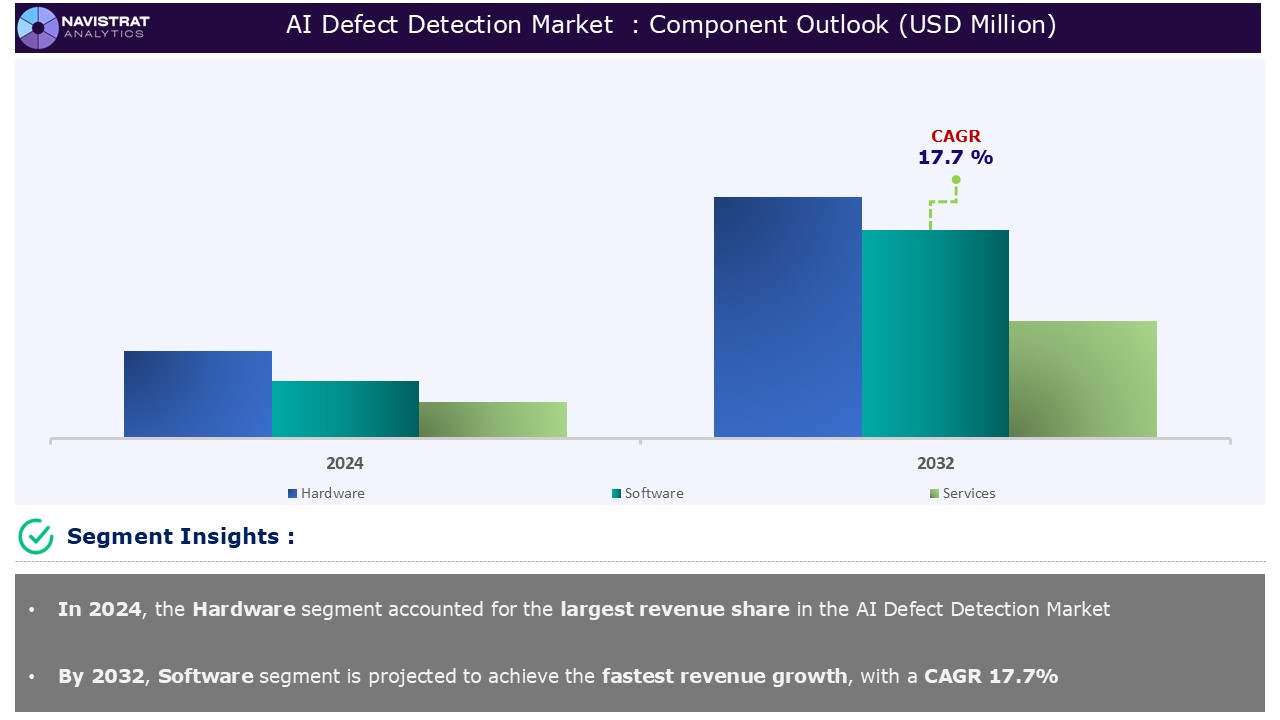
Based on the Component, the AI Defect Detection Market is segmented into Hardware, Software, and Services.
The software segment is expected to register the fastest revenue growth of 17.7% by 2032. The software segment will be further segmented into the revenue share by On-Premise and Cloud deployment. AI-powered defect detection software is increasingly being adopted in industries to perform real-time analysis and precise identification of anomalies through advanced computer vision (CV) and machine learning (ML) algorithms.
AI-enabled systems are highly capable of continuous learning, by allowing them to adapt to any production conditions and detect subtle, complex defects that the human eye might miss. Cloud-based AI defect detection solutions are projected to generate significant market revenue share owing to rapid adoption in industries such as the automotive, electronics, and pharmaceuticals, where precision and quality checks are highly required.
Application Segment Insights and Analysis:
Based on the Application, the AI Defect Detection Market is segmented into visual inspection, quality control, ultrasonic inspection, X-ray/CT inspection, thermal inspection, predictive maintenance, and others.
The visual inspection segment accounts for a significant revenue share in 2024. Rapid advancements in sensor integration, imaging technologies, and intelligent software are driving the growth of the market. AI-powered visual inspection systems are becoming essential across industries for operational efficiency, cost reduction, and zero-defect production.
The fusion of high-resolution cameras, precision sensors, and AI algorithms enables real-time monitoring and analysis of products on assembly lines. AI visual inspection systems are highly efficient in pattern recognition tasks such as crack detection, object classification, weld flaw analysis, and non-destructive testing (NDT) by leveraging deep learning techniques such as conventional neural networks (CNN) and recurrent neural networks (RNN).
Industry Vertical Segment Insights and Analysis:
Based on the industry vertical, the AI Defect Detection Market is segmented into Manufacturing, Aerospace & Defense, Energy & Utilities, Agriculture, Healthcare, Construction and Others.
The manufacturing segment accounts for the highest revenue share in 2024. Increasing deployment of AI defect detection in electronics & semiconductors significantly contributed to a significant revenue share. Globally, electronics OEMs, system integrators, and semiconductor foundries are increasingly adopting AI-enabled Automated Optical Inspection (AOI) solutions to detect critical defects in various electronics components, including printed circuit boards (PCBs), integrated circuits (ICs), resistors, capacitors, inductors, diodes, and transistors with micron-level accuracy.
For instance, on 7th October 2024, LG Innotek deployed an AI-powered inspection system for incoming raw materials to identify defects at the point of receipt and ensure only high-quality materials enter the production process. This system integrates advanced AI image recognition with material data analytics to enhance defect detection accuracy.
Geographical Outlook:
The AI Defect Detection Market is strategically segmented by geography to provide a comprehensive understanding of regional market dynamics. Discover demand analysis, emerging trends, and growth opportunities shaping market performance across different regions and countries.
North America AI Defect Detection Market:
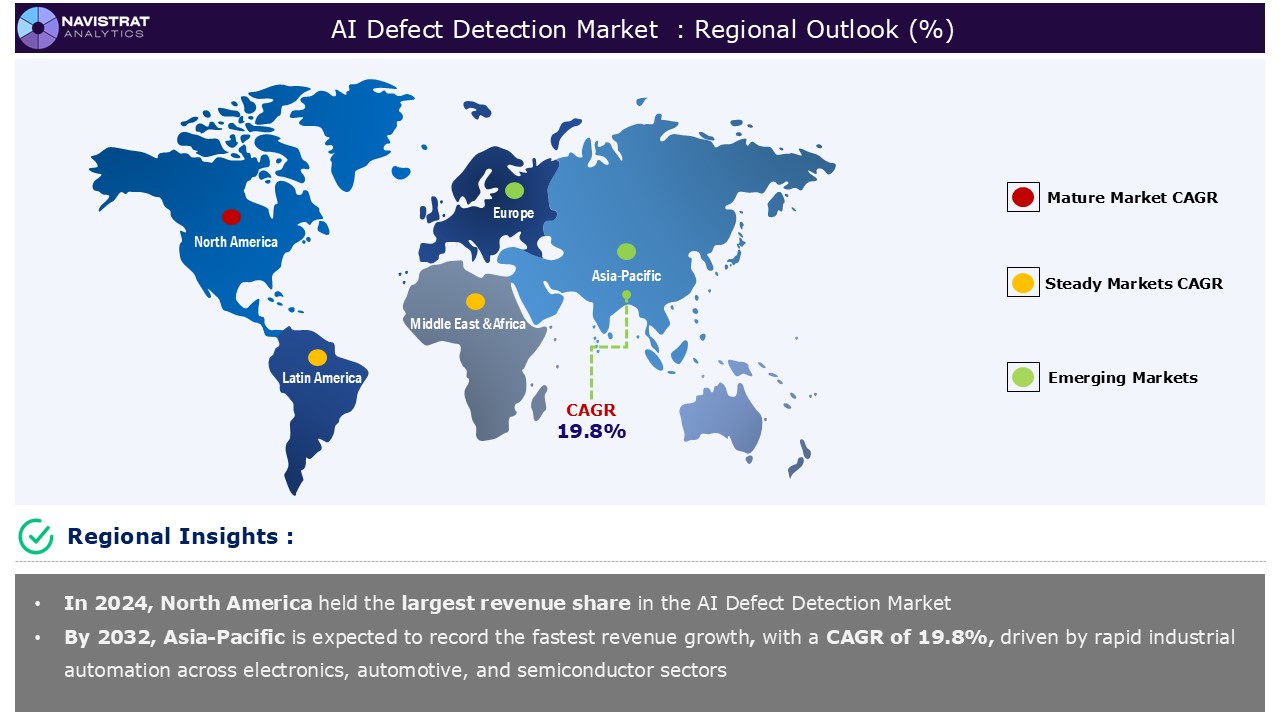
North America registered the highest market share in the AI Defect Detection Market. Increasing adoption of AI defect detection systems in manufacturing quality assurance contributed revenue share in 2024. The United States enforces strict compliance regulations across the pharmaceutical, consumer goods, defense, and aerospace industries. For instance, the U.S. FDA’s Quality System Regulation (QSR) under 21 CFR Part 820 mandates rigorous controls, including visual inspection testing in the pharmaceutical and medical device manufacturing sector.
In the food and beverage industry, the Food Safety Modernization Act (FSMA) requires AI visual inspection and quality checks to meet the packaging compliance and hazard prevention. Also, in the aerospace and defense industry, the Federal Aviation Administration (FAA) sets stringent standards for component reliability, including mandatory visual inspection procedures to detect defects and ensure operational safety.
Moreover, rapid deployment of AI defect detection in electronics and semiconductor manufacturing is further propelling growth of the market in this region. Electronics OEM players are significantly incorporating AI-enabled solutions for defect and object detection, and automated optical inspection. On 18th November 2025, Foxconn deployed NVIDIA AI Models in semiconductor production assembly lines in the U.S. and Mexico.
Asia Pacific AI Defect Detection Market:
Asia Pacific is expected to register the fastest revenue growth of 19.8% by 2032. The demand for AI defect detection across various industry verticals is expected to grow exponentially in Asia-Pacific. Several key players in this region are collaborating with global AI and automation companies to meet the growing demand for AI defect detection.
For instance, on 22nd January 2024, Japan-based Mitsubishi Electric Corporation collaborated with Hacarus Corporation to advance the development of AI-powered visual inspection solutions for the manufacturing sector. In addition, on 18th March 2025, Omron Corporation showcased a CT X-ray automated inspection machine. This new system is jointly developed by NVIDIA Omniverse.
Rising demand for smart factories and industrial automation is anticipated to contribute a significant revenue share by 2032. Major large-scale industries in this region are scaling production processes with the help of Industry 4.0 technologies, these advancements further accelerate the deployment of AI defect detection solutions. Several companies are working on the development of high-speed, AI-driven inspection systems as a strategic move to increase market share and capitalize on growing demand within the supply side of the value chain.
For instance, on 15th May 2025, Taiwan-based Techman Robot introduced the Flying Trigger collaborative-robot-based inspection solution, enabled with intelligent vision capabilities. The AI collaborative robot performs real-time defect detection even as the workpiece continues to move along the production line.
Moreover, the rising integration of AI defect detection in food safety and agricultural applications further enhances revenue growth in Taiwan. On 12th June 2025, the Food and Drug Administration of Taiwan adopted an AI-driven Border Prediction Intelligent System for screening defective fruits.
Countries Asia is a major hub for manufacturing and export and electronics and semiconductor products. Several consumer electronics OEM companies are manufacturing and export electrical and semiconductor products across major global economies owing to low labor costs and government subsidies. For instance, China exported approximately 44.01 million laptops, reflecting a 9.6% year-over-year increase. Mobile phone exports also rose, reaching 241 million units with an annual growth of 4.6%.
Europe AI Defect Detection Market:
Europe registered a substantial market share in the AI Defect Detection Market. Government support for investments in cutting-edge digital technologies and research is propelling revenue expansion in this region. On 16th May 2025, the European Union (EU) committed USD 200.92 million to advance breakthrough digital technologies under the Horizon Europe Programme.
Moreover, the rapid investments in the AI-based inspection technology contributed substantially to revenue growth. For instance, on 14th February 2025, Zurich-based EthonAI secured around USD 6.76 million in funding to develop a platform designed to enhance manufacturing quality across large-scale operations.
In addition, on 17th April 2025, London‑based IA startup Hammer Missions secured USD 1.14 Million to develop drone-based AI software which are widely deployed in the construction industry for applications such as roof & facade investigations, defect detection, and thermal forensics.
Competition Analysis:
The AI Defect Detection Market is characterized by numerous players, with major players competing across segments and regions. The list of major players included in the AI Defect Detection Market report are:
- Carl Zeiss AG (Germany)
- Cognex Corporation (U.S.)
- Keyence Corporation (Japan)
- Teledyne Digital Imaging Inc (U.S.)
- Sick AG (Germany)
- Basler AG (Germany)
- Zebra Technologies Corporation (U.S.)
- Toshiba Corporation (Japan)
- Hitachi High-Tech Corporation (Japan)
- Datalogic S.p.A. (Italy)
- Advantech Co., Ltd. (Taiwan)
- Mitutoyo America Corporation (U.S.)
- Validata Group (U.K.)
- NVIDIA Corporation (U.S.)
- Faststream Technologies (U.S.)
- Kili Technology (France)
- Omron Corporation (Japan)
- Straive (Singapore)
- Averroes.ai Inc. (U.S.)
- Viso.ai AG (Switzerland)
- Hexagon AB (Sweden)
Strategic Developments in the AI Defect Detection Market:
- On 3rd June 2025, Vuzix Corporation announced a strategic partnership with Wyr.ai Private Limited to introduce a next-generation, AI-powered quality assurance inspection platform built on the Vuzix M400 smart glasses. Wyr.ai offers a visual quality assurance platform powered by artificial intelligence and extended reality algorithms. Its technology automates quality control operations, enhancing the efficiency of product testing and inspection across multiple industries.
- On 12th December 2024, Advantech introduced its newest AI acceleration modules EAI-1200 and EAI-3300 featuring Hailo-8 AI processors. These modules deliver up to 52 TOPS of AI computing power while offering over 12 times greater power efficiency compared to standard AI modules and GPU-based solutions. Fully compatible with Advantech’s boards and systems, the modules are well-suited for high-performance applications such as medical image processing, traffic surveillance, and automated defect detection.
- On 2nd April 2024, Cognex Corporation launched of In-Sight L38 3D Vision System. This advanced solution integrates artificial intelligence with both 2D and 3D vision technologies to address a wide range of inspection and measurement tasks. The system generates specialized projection images that translate 3D data into an easily labelable 2D format, streamlining the training process and highlighting features typically missed by conventional 2D imaging.
Key Advantages for Stakeholders:
Navistrat Analytics’ industry report provides an in-depth quantitative analysis of various market segments, historical and current trends, market forecasts, and dynamics within the global market. The historical years covered in this report are 2022 to 2023, with 2024 serving as the base year for market size calculations. The forecast period extends from 2025 to 2032.
The report includes an executive summary and a comprehensive overview of market drivers, restraints, opportunities, and challenges (DROC), along with insights into regulatory standards. It features detailed analyses such as PORTER’s Five Forces, SWOT, and PESTLE, as well as assessments of technological trends and the competitive landscape.
PORTER’s Five Forces analysis helps stakeholders evaluate the impact of new entrants, competitive rivalry, supplier power, buyer power, and substitution threats, enabling them to assess the level of competition and the attractiveness of the global market. The competitive landscape provides stakeholders with a clear understanding of the current market positions of key players, offering valuable insights into their competitive environment.
Scope And Key Highlights of The AI Defect Detection Market Report:
| Report Features | Details |
| Market Size in 2024 | USD 2,630 Million |
| Market Growth Rate in CAGR (2025–2032) | 15.6% |
| Market Revenue Forecast to 2032 | USD 8,202.8 Million |
| Base Year | 2024 |
| Historical Year | 2022–2023 |
| Forecast Period | 2025–2032 |
| Report Pages | 450 |
| Segments Covered |
|
| Regional Scope |
|
| Country Scope |
|
| Key Market Players |
|
| Delivery Format | Reports are delivered in PDF format via email. |
| Customization Scope | Request for Customization |
The AI Defect Detection Market report offers a detailed analysis of market size, including historical revenue (in USD Million) data for 2022-2023 and revenue forecasts for 2025-2032 across the following segments:
- Integration Outlook (Revenue, USD Million; 2022-2032)
- Standalone
- Integrated
- Component Outlook (Revenue, USD Million; 2022-2032)
- Hardware
- Cameras
- 2D
- 3D
- Sensors
- Processing Units
- Networking and Connectivity
- Cameras
- Software
- On-Premise
- Cloud
- Public
- Private
- Hybrid
- Services
- Installation & Integration
- Support & Maintenance
- Hardware
- Technology Outlook (Revenue, USD Million; 2022-2032)
- Computer Vision (CV)
- Machine Learning (ML)
- Deep Learning (DL)
- Natural Language Processing (NLP)
- Others
- Application Outlook (Revenue, USD Million; 2022-2032)
- Visual Inspection
- Quality Control
- Ultrasonic Inspection
- X-ray/CT Inspection
- Thermal Inspection
- Predictive Maintenance
- Others
- Enterprise Size Outlook (Revenue, USD Million; 2022-2032)
- Large Enterprises
- Small and Medium-sized Enterprises (SMEs)
- Industry Vertical Outlook (Revenue, USD Million; 2022-2032)
- Manufacturing
- Automotive
- Electronics & Semiconductors
- Pharmaceutical
- Food & Beverage
- Textiles
- Chemicals & Materials
- Others
- Aerospace & Defense
- Energy & Utilities
- Agriculture
- Healthcare
- Construction
- Others
- Manufacturing
- Regional Outlook (Revenue, USD Million; 2022-2032)
- North America
- U.S.
- Canada
- Mexico
- Europe
- Germany
- France
- U.K.
- Italy
- Spain
- Benelux
- Nordic Countries
- Rest of Europe
- Asia Pacific
- China
- India
- Japan
- South Korea
- Taiwan
- Oceania
- ASEAN Countries
- Rest of APAC
- Latin America
- Brazil
- Rest of LATAM
- Middle East & Africa
- GCC Countries
- South Africa
- Israel
- Turkey
- Rest of MEA
- North America
Frequently Asked Questions (FAQ) About the AI Defect Detection Market Report
The market size of the AI Defect Detection Market was USD 2,630 million in 2024.
The growth of the AI Defect Detection Market is expected to register a compound annual growth rate (CAGR) of 15.6% over the forecast period.
Growing adoption of AI defect detection for quality inspection is a major factor driving the revenue growth.
Concern regarding data privacy and security is a major restraint of the AI Defect Detection Market.
Asia-Pacific accounts for the fastest revenue growth of 19.8%.
Hardware is the leading segment of the AI defect detection market in terms of component.
- Market Definition
- Research Objective
- Research Methodology
- Research Design
- Data Collection Methods
- Primary
- Secondary
- Market Size Estimation
- Top-down method
- Bottom-up method
- Forecasting Methodology
- Tools and Models Used
- Market Overview, Trends and Future Outlook
- Market Size and Forecast
- Industry Ecosystem Analysis
- Market Driver, Restraints, Opportunity, and Challenges (DROC) Analysis
- Market Drivers
- Growing adoption of Industry 4.0 and smart manufacturing
- Rising demand for quality compliance standards and audit requirements
- Rapid demand for cost reduction through scrap minimization and predictive defect analytics
- Market Restraints
- Data privacy concerns in cloud-based defect detection solutions
- Integration complexities with existing legacy manufacturing systems and IT infrastructure
- Market Opportunities
- Growth of edge AI hardware enabling localized defect analysis
- Increased adoption in regulated industries
- Market Challenges
- Limited AI training datasets for niche or custom defect types
- Skilled workforce shortage for AI model training and tuning
- Regulatory, Trade, and Tariff Landscape
- Overview of Global Regulatory Framework
- Country-Specific Regulatory, Trade, and Tariff Policies
- North America (U.S., Canada, Mexico)
- Europe (Germany, U.K., France)
- Asia-Pacific (China, Japan, South Korea, India)
- Middle East & Africa (UAE, Saudi Arabia, South Africa)
- Latin America (Brazil)
- Strategic Insights
- Porter’s Five Forces Analysis
- PESTLE Analysis
- Price Trend Analysis
- Technological and Emerging Trends
- Adoption of Generative AI (GenAI) model in
- 3D Vision and Multi-Sensor Fusion for Accurate Surface & Structural Inspection in productivity, quality, and efficiency improvement
- Low-Code/No-Code AI Model Development Interfaces
- Automated Annotation and Data Labeling Tools for Vision Data
- Explainable AI (XAI) for Transparent Defect Decision-Making
- 3D Vision and Multi-Sensor Fusion for Accurate Surface & Structural Inspection
- Cloud-Native AI Inspection Platforms for Scalable Deployment
- Synthetic Data Generation to Address Defect Data Scarcity
- Recent Developments
- Funding and Investments
- Merger and Acquisition
- Expansion
- Partnership and Collaboration
- Product/ Service Launch
- Technological developments
- Integration Market Revenue Estimates and Forecasts, 2022-2032
- Standalone
- Integrated
- Component Market Revenue Estimates and Forecasts, 2022-2032
- Hardware
- Cameras
- 2D
- 3D
- Sensors
- Processing Units
- Networking and Connectivity
- Cameras
- Software
- On-Premise
- Cloud
- Public
- Private
- Hybrid
- Services
- Installation & Integration
- Support & Maintenance
- Hardware
- Technology Market Revenue Estimates and Forecasts, 2022-2032
- Computer Vision (CV)
- Machine Learning (ML)
- Deep Learning (DL)
- Natural Language Processing (NLP)
- Others
- Application Market Revenue Estimates and Forecasts, 2022-2032
- Visual Inspection
- Quality Control
- Ultrasonic Inspection
- X-ray/CT Inspection
- Thermal Inspection
- Predictive Maintenance
- Others
- Enterprise Size Market Revenue Estimates and Forecasts, 2022-2032
- Large Enterprises
- Small and Medium-sized Enterprises (SMEs)
- Industry Vertical Market Revenue Estimates and Forecasts, 2022-2032
- Manufacturing
- Automotive
- Electronics & Semiconductors
- Pharmaceutical
- Food & Beverage
- Textiles
- Chemicals & Materials
- Others
- Aerospace & Defense
- Energy & Utilities
- Agriculture
- Healthcare
- Construction
- Others
- Manufacturing
- AI Defect Detection Market Revenue Estimates and Forecasts by Region, 2022-2032, USD Million
- North America
- North America AI Defect Detection Market By Integration, Market Revenue Estimates and Forecasts, 2022-2032, USD Million
- Standalone
- Integrated
- North America AI Defect Detection Market By Component, Market Revenue Estimates and Forecasts, 2022-2032, USD Million
- Hardware
- Cameras
- 2D
- 3D
- Sensors
- Processing Units
- Networking and Connectivity
- Cameras
- Software
- On-Premise
- Cloud
- Public
- Private
- Hybrid
- Services
- Installation & Integration
- Support & Maintenance
- Hardware
- North America AI Defect Detection Market By Technology Market Revenue Estimates and Forecasts, 2022-2032, USD Million
- Computer Vision (CV)
- Machine Learning (ML)
- Deep Learning (DL)
- Natural Language Processing (NLP)
- Others
- North America AI Defect Detection Market By Application, Market Revenue Estimates and Forecasts, 2022-2032, USD Million
- Visual Inspection
- Quality Control
- Ultrasonic Inspection
- X-ray/CT Inspection
- Thermal Inspection
- Predictive Maintenance
- Others
- North America AI Defect Detection Market By Enterprise Size, Market Revenue Estimates and Forecasts, 2022-2032, USD Million
- Large Enterprises
- Small and Medium-sized Enterprises (SMEs)
- North America AI Defect Detection Market By Industry Vertical, Market Revenue Estimates and Forecasts, 2022-2032, USD Million
- Manufacturing
- Automotive
- Electronics & Semiconductors
- Pharmaceutical
- Food & Beverage
- Textiles
- Chemicals & Materials
- Others
- Aerospace & Defense
- Energy & Utilities
- Agriculture
- Healthcare
- Construction
- Others
- Manufacturing
- North America AI Defect Detection Market Revenue Estimates and Forecasts by Country, 2022-2032, USD Million
- United States
- Canada
- Mexico
- North America AI Defect Detection Market By Integration, Market Revenue Estimates and Forecasts, 2022-2032, USD Million
- Europe
- Europe AI Defect Detection Market By Integration, Market Revenue Estimates and Forecasts, 2022-2032, USD Million
- Standalone
- Integrated
- Europe AI Defect Detection Market By Component, Market Revenue Estimates and Forecasts, 2022-2032, USD Million
- Hardware
- Cameras
- 2D
- 3D
- Sensors
- Processing Units
- Networking and Connectivity
- Cameras
- Software
- On-Premise
- Cloud
- Public
- Private
- Hybrid
- Services
- Installation & Integration
- Support & Maintenance
- Hardware
- Europe AI Defect Detection Market By Technology Market Revenue Estimates and Forecasts, 2022-2032, USD Million
- Computer Vision (CV)
- Machine Learning (ML)
- Deep Learning (DL)
- Natural Language Processing (NLP)
- Others
- Europe AI Defect Detection Market By Application, Market Revenue Estimates and Forecasts, 2022-2032, USD Million
- Visual Inspection
- Quality Control
- Ultrasonic Inspection
- X-ray/CT Inspection
- Thermal Inspection
- Predictive Maintenance
- Others
- Europe AI Defect Detection Market By Enterprise Size, Market Revenue Estimates and Forecasts, 2022-2032, USD Million
- Large Enterprises
- Small and Medium-sized Enterprises (SMEs)
- Europe AI Defect Detection Market By Industry Vertical, Market Revenue Estimates and Forecasts, 2022-2032, USD Million
- Manufacturing
- Automotive
- Electronics & Semiconductors
- Pharmaceutical
- Food & Beverage
- Textiles
- Chemicals & Materials
- Others
- Aerospace & Defense
- Energy & Utilities
- Agriculture
- Healthcare
- Construction
- Others
- Manufacturing
- Europe AI Defect Detection Market Revenue Estimates and Forecasts by Country, 2022-2032, USD Million
- Germany
- United Kingdom
- France
- Italy
- Spain
- Benelux
- Nordic Countries
- Rest of Europe
- Europe AI Defect Detection Market By Integration, Market Revenue Estimates and Forecasts, 2022-2032, USD Million
- Asia-Pacific
- Asia-Pacific AI Defect Detection Market By Integration, Market Revenue Estimates and Forecasts, 2022-2032, USD Million
- Standalone
- Integrated
- Asia-Pacific AI Defect Detection Market By Component, Market Revenue Estimates and Forecasts, 2022-2032, USD Million
- Hardware
- Cameras
- 2D
- 3D
- Sensors
- Processing Units
- Networking and Connectivity
- Cameras
- Software
- On-Premise
- Cloud
- Public
- Private
- Hybrid
- Services
- Installation & Integration
- Support & Maintenance
- Hardware
- Asia-Pacific AI Defect Detection Market By Technology Market Revenue Estimates and Forecasts, 2022-2032, USD Million
- Computer Vision (CV)
- Machine Learning (ML)
- Deep Learning (DL)
- Natural Language Processing (NLP)
- Others
- Asia-Pacific AI Defect Detection Market By Application, Market Revenue Estimates and Forecasts, 2022-2032, USD Million
- Visual Inspection
- Quality Control
- Ultrasonic Inspection
- X-ray/CT Inspection
- Thermal Inspection
- Predictive Maintenance
- Others
- Asia-Pacific AI Defect Detection Market By Enterprise Size, Market Revenue Estimates and Forecasts, 2022-2032, USD Million
- Large Enterprises
- Small and Medium-sized Enterprises (SMEs)
- Asia-Pacific AI Defect Detection Market By Industry Vertical, Market Revenue Estimates and Forecasts, 2022-2032, USD Million
- Manufacturing
- Automotive
- Electronics & Semiconductors
- Pharmaceutical
- Food & Beverage
- Textiles
- Chemicals & Materials
- Others
- Aerospace & Defense
- Energy & Utilities
- Agriculture
- Healthcare
- Construction
- Others
- Manufacturing
- Asia-Pacific AI Defect Detection Market Revenue Estimates and Forecasts by Country, 2022-2032, USD Million
- China
- India
- Japan
- South Korea
- Taiwan
- Oceania
- ASEAN Countries
- Asia-Pacific AI Defect Detection Market By Integration, Market Revenue Estimates and Forecasts, 2022-2032, USD Million
- Latin America
- Latin America AI Defect Detection Market By Integration, Market Revenue Estimates and Forecasts, 2022-2032, USD Million
- Standalone
- Integrated
- Latin America AI Defect Detection Market By Component, Market Revenue Estimates and Forecasts, 2022-2032, USD Million
- Hardware
- Cameras
- 2D
- 3D
- Sensors
- Processing Units
- Networking and Connectivity
- Cameras
- Software
- On-Premise
- Cloud
- Public
- Private
- Hybrid
- Services
- Installation & Integration
- Support & Maintenance
- Hardware
- Latin America AI Defect Detection Market By Technology Market Revenue Estimates and Forecasts, 2022-2032, USD Million
- Computer Vision (CV)
- Machine Learning (ML)
- Deep Learning (DL)
- Natural Language Processing (NLP)
- Others
- Latin America AI Defect Detection Market By Application, Market Revenue Estimates and Forecasts, 2022-2032, USD Million
- Visual Inspection
- Quality Control
- Ultrasonic Inspection
- X-ray/CT Inspection
- Thermal Inspection
- Predictive Maintenance
- Others
- Latin America AI Defect Detection Market By Enterprise Size, Market Revenue Estimates and Forecasts, 2022-2032, USD Million
- Large Enterprises
- Small and Medium-sized Enterprises (SMEs)
- Latin America AI Defect Detection Market By Industry Vertical, Market Revenue Estimates and Forecasts, 2022-2032, USD Million
- Manufacturing
- Automotive
- Electronics & Semiconductors
- Pharmaceutical
- Food & Beverage
- Textiles
- Chemicals & Materials
- Others
- Aerospace & Defense
- Energy & Utilities
- Agriculture
- Healthcare
- Construction
- Others
- Manufacturing
- Latin America AI Defect Detection Market Revenue Estimates and Forecasts by Country, 2022-2032, USD Million
- Brazil
- Rest of LATAM
- Latin America AI Defect Detection Market By Integration, Market Revenue Estimates and Forecasts, 2022-2032, USD Million
- Middle East & Africa
- Middle East & Africa AI Defect Detection Market By Integration, Market Revenue Estimates and Forecasts, 2022-2032, USD Million
- Standalone
- Integrated
- Middle East & Africa AI Defect Detection Market By Component, Market Revenue Estimates and Forecasts, 2022-2032, USD Million
- Hardware
- Cameras
- 2D
- 3D
- Sensors
- Processing Units
- Networking and Connectivity
- Cameras
- Software
- On-Premise
- Cloud
- Public
- Private
- Hybrid
- Services
- Installation & Integration
- Support & Maintenance
- Hardware
- Middle East & Africa AI Defect Detection Market By Technology Market Revenue Estimates and Forecasts, 2022-2032, USD Million
- Computer Vision (CV)
- Machine Learning (ML)
- Deep Learning (DL)
- Natural Language Processing (NLP)
- Others
- Middle East & Africa AI Defect Detection Market By Application, Market Revenue Estimates and Forecasts, 2022-2032, USD Million
- Visual Inspection
- Quality Control
- Ultrasonic Inspection
- X-ray/CT Inspection
- Thermal Inspection
- Predictive Maintenance
- Others
- Middle East & Africa AI Defect Detection Market By Enterprise Size, Market Revenue Estimates and Forecasts, 2022-2032, USD Million
- Large Enterprises
- Small and Medium-sized Enterprises (SMEs)
- Middle East & Africa AI Defect Detection Market By Industry Vertical, Market Revenue Estimates and Forecasts, 2022-2032, USD Million
- Manufacturing
- Automotive
- Electronics & Semiconductors
- Pharmaceutical
- Food & Beverage
- Textiles
- Chemicals & Materials
- Others
- Aerospace & Defense
- Energy & Utilities
- Agriculture
- Healthcare
- Construction
- Others
- Manufacturing
- Middle East & Africa AI Defect Detection Market Revenue Estimates and Forecasts by Country, 2022-2032, USD Million
- GCC Countries
- South Africa
- Israel
- Turkey
- Middle East & Africa AI Defect Detection Market By Integration, Market Revenue Estimates and Forecasts, 2022-2032, USD Million
- North America
- Market Share Analysis
- Revenue Market Share by Key Players (2023-2024)
- Analysis of Top Players by Market Presence
- Competitive Matrix
- Competitive Strategies
- Mergers and Acquisitions
- Partnerships and Collaboration
- Investment and Fundings
- Agreement
- Expansion
- New Product/ Services Launches
- Technological Innovations
- Carl Zeiss AG
- Company Overview
- Financial Insights
- Product/ Services Offerings
- Strategic Developments
- SWOT Analysis
- Cognex Corporation
- Company Overview
- Financial Insights
- Product/ Services Offerings
- Strategic Developments
- SWOT Analysis
- Keyence Corporation
- Company Overview
- Financial Insights
- Product/ Services Offerings
- Strategic Developments
- SWOT Analysis
- Teledyne Digital Imaging Inc
- Company Overview
- Financial Insights
- Product/ Services Offerings
- Strategic Developments
- SWOT Analysis
- Sick AG
- Company Overview
- Financial Insights
- Product/ Services Offerings
- Strategic Developments
- SWOT Analysis
- Basler AG
- Company Overview
- Financial Insights
- Product/ Services Offerings
- Strategic Developments
- SWOT Analysis
- Zebra Technologies Corporation
- Company Overview
- Financial Insights
- Product/ Services Offerings
- Strategic Developments
- SWOT Analysis
- Toshiba Corporation
- Company Overview
- Financial Insights
- Product/ Services Offerings
- Strategic Developments
- SWOT Analysis
- Hitachi High-Tech Corporation
- Company Overview
- Financial Insights
- Product/ Services Offerings
- Strategic Developments
- SWOT Analysis
- Datalogic S.p.A.
- Company Overview
- Financial Insights
- Product/ Services Offerings
- Strategic Developments
- Advantech Co., Ltd.
- Company Overview
- Financial Insights
- Product/ Services Offerings
- Strategic Developments
- Mitutoyo America Corporation
- Company Overview
- Financial Insights
- Product/ Services Offerings
- Strategic Developments
- Validata Group
- Company Overview
- Financial Insights
- Product/ Services Offerings
- Strategic Developments
- NVIDIA Corporation
- Company Overview
- Financial Insights
- Product/ Services Offerings
- Strategic Developments
- Faststream Technologies
- Company Overview
- Financial Insights
- Product/ Services Offerings
- Strategic Developments
- Kili Technology
- Company Overview
- Financial Insights
- Product/ Services Offerings
- Strategic Developments
- Omron Corporation
- Company Overview
- Financial Insights
- Product/ Services Offerings
- Strategic Developments
- Straive
- Company Overview
- Financial Insights
- Product/ Services Offerings
- Strategic Developments
- Averroes.ai Inc.
- Company Overview
- Financial Insights
- Product/ Services Offerings
- Strategic Developments
- Visio.ai AG
- Company Overview
- Financial Insights
- Product/ Services Offerings
- Strategic Developments
- Hexagon AB (Sweden)
- Company Overview
- Financial Insights
- Product/ Services Offerings
- Strategic Developments