

Top Virtual Influencers Changing Social Media: How AI Personalities Are Redefining Digital Influence
Discover the top virtual influencers transforming social media, including Lil Miquela, Imma, Shudu, Kyra, Radhika Subramaniam, and India’s emerging AI influencer Shibani Roy. Learn how AI-powered creators are reshaping digital marketing, brand engagement, and the future of influencer marketing.
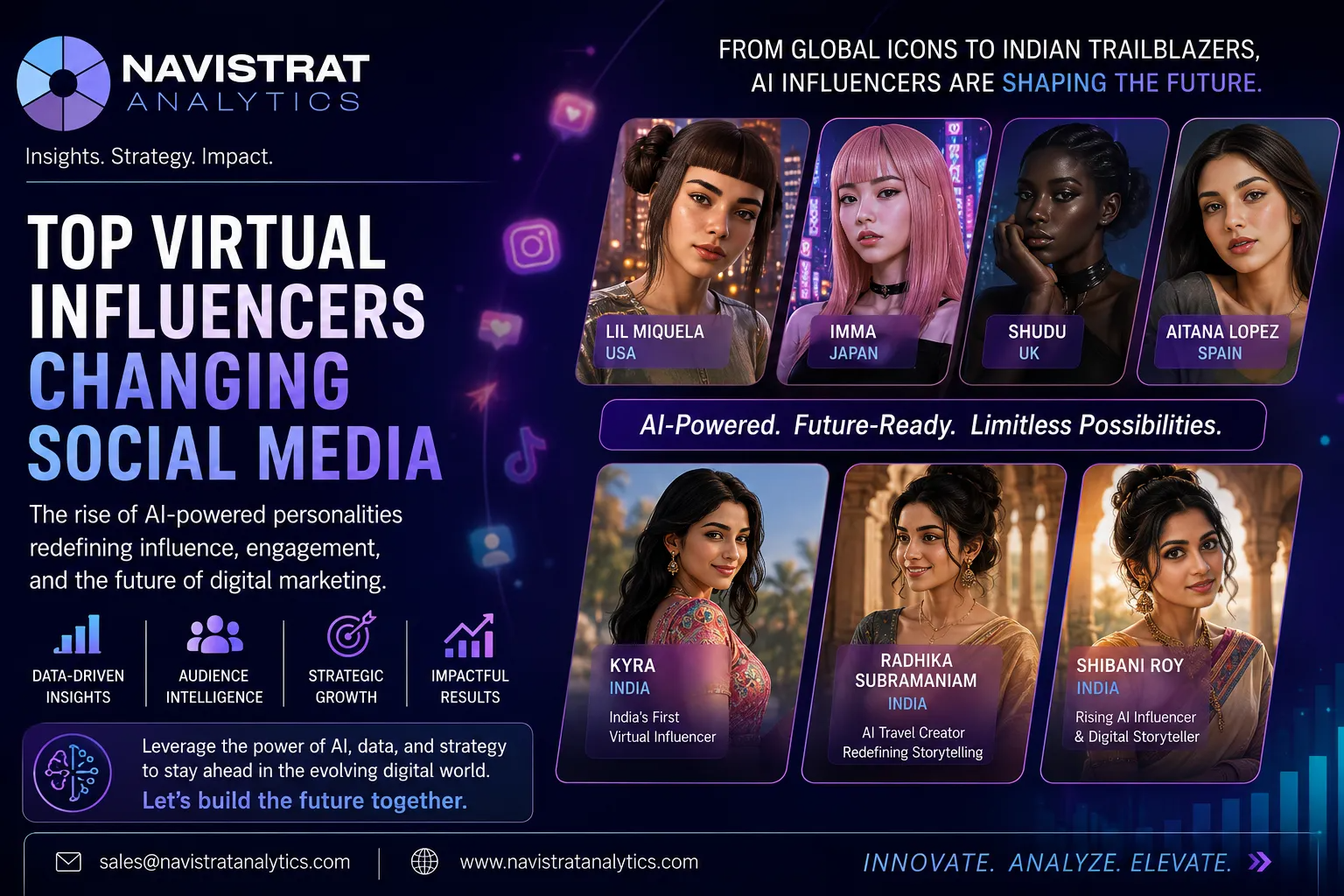
Imagine scrolling through Instagram and discovering a fashion model with flawless style, a growing fan base, and partnerships with major brands. Now imagine finding out she doesn’t actually exist.
Welcome to the world of virtual influencers.
Once considered a futuristic experiment, AI-powered influencers have become one of the most disruptive forces in digital marketing. These computer-generated personalities are attracting millions of followers, collaborating with global brands, and reshaping how audiences engage with content.
From Lil Miquela in the United States to Kyra in India, virtual influencers are proving that influence is no longer limited to humans. They are becoming powerful storytellers, brand ambassadors, and digital celebrities in their own right. The question is no longer whether virtual influencers will become mainstream. The question is how much they will transform the future of social media.
According to Navistrat Analytics The global Virtual Influencer market reached USD 10.18 billion in 2025 and is expected to register a revenue CAGR of 42.7% during the forecast period. Growing demand for authentic and personalized digital engagement, rapid advancements in artificial intelligence and generative AI, increasing adoption of social media platforms, rising investment in metaverse and digital ecosystems, and growth of E-commerce and social commerce are expected to drive revenue growth of the market.
The Rise of the Virtual Influencers Economy
Social media has gone through several transformations.
The first era belonged to celebrities.
The second era belonged to content creators.
The third era belongs to influencers.
Now, a new era is emerging—one powered by artificial intelligence.
Virtual influencers combine AI, CGI, digital design, and storytelling to create online personalities that can interact with audiences, promote brands, and build communities. Their popularity continues to grow because they offer something unique: the ability to blend creativity, technology, and scalability.
Brands are taking notice.
Virtual influencers can appear anywhere, wear anything, and participate in campaigns without many of the logistical challenges associated with traditional content production. They offer consistency, creative flexibility, and global reach.
More importantly, they appeal to younger audiences who are increasingly comfortable engaging with digital-first experiences.
Why Virtual Influencers Are Capturing Attention
The success of virtual influencers is not just about technology.
People don’t follow influencers because they are human.
People follow influencers because they tell stories.
The most successful AI influencers have distinct personalities, unique visual identities, and compelling narratives. They create emotional connections that encourage followers to engage, comment, and share.
Research has also shown that trust plays a major role in virtual influencer effectiveness. Content that feels more human and relatable often generates stronger audience responses and engagement.
This is why leading virtual influencers focus on lifestyle, fashion, travel, music, and personal storytelling rather than simply showcasing technology.
The Global Virtual Influencers Leading the Industry
Lil Miquela (United States)
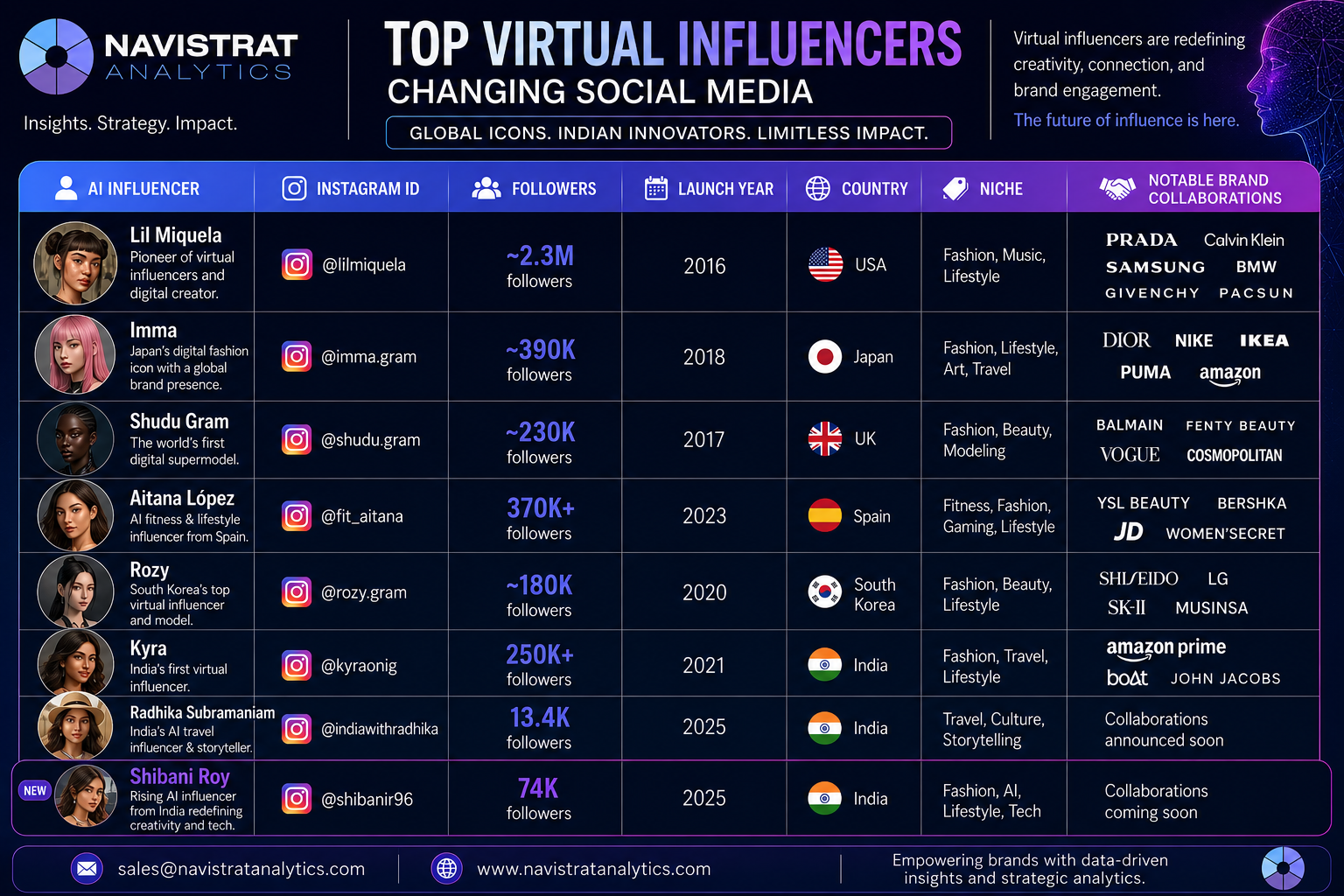
If there is one virtual influencer who changed the industry forever, it is Lil Miquela. Created in 2016 by Brud, Lil Miquela is widely regarded as the world’s most influential virtual influencer. Today, she has millions of followers across social platforms and has collaborated with major brands including Prada, Calvin Klein, Samsung, Givenchy, and BMW. Recent industry analyses estimate her audience at more than three million followers across Instagram and TikTok.
Lil Miquela proved that audiences care more about storytelling and personality than whether an influencer is physically real. She helped establish the foundation for today’s virtual influencer industry and remains a benchmark for digital creator success.
Imma (Japan)
If Lil Miquela pioneered the industry, Imma helped legitimize it within the fashion world. Created by Aww Inc., Imma is instantly recognizable thanks to her signature pink bob hairstyle. Since her launch, she has become one of Asia’s most successful virtual influencers and has collaborated with brands including Dior, Nike, IKEA, Amazon, Porsche Japan, Puma, Calvin Klein, and Valentino.
Unlike many virtual influencers who focus heavily on futuristic narratives, Imma’s content feels surprisingly relatable. She posts fashion, lifestyle, travel, and behind-the-scenes content similar to that of human creators. Recent industry analyses continue to identify Imma as one of the most influential virtual personalities in the global fashion industry.
Shudu (United Kingdom)
Created by photographer Cameron-James Wilson, Shudu is often described as the world’s first digital supermodel. When Shudu first appeared online, many people assumed she was a real fashion model. Her photorealistic appearance sparked widespread discussions about beauty standards, representation, and the future of modeling.
Over the years, Shudu has appeared in campaigns for luxury and fashion brands and has become one of the most recognized digital models globally. Shudu pushed the boundaries of what digital humans could achieve. Her success demonstrated that AI-generated personalities could compete visually with traditional models and become part of high-fashion campaigns.
Aitana Lopez (Spain)
Aitana Lopez represents the next evolution of virtual influencers. Created in Spain, Aitana gained attention because of her highly realistic appearance and lifestyle-focused content. Unlike earlier CGI influencers, Aitana emerged during the generative AI boom, benefiting from advances in AI image generation and content creation technologies.
Her rapid rise attracted international media attention and highlighted the growing commercial potential of AI-generated creators. Recent industry discussions frequently cite Aitana as one of the most successful examples of modern AI influencer marketing. Aitana demonstrates how advances in generative AI are making virtual influencers more accessible, scalable, and difficult to distinguish from human creators.
The Rise of Indian Virtual Influencers
India’s creator economy is among the fastest-growing in the world. It was only a matter of time before AI influencers entered the conversation.
Kyra
Kyra is widely recognized as India’s first virtual influencer and one of the pioneers of AI-powered content creation in the country. Her content focuses on fashion, travel, lifestyle, and luxury experiences. Since her introduction, she has collaborated with multiple brands and helped introduce Indian audiences to the concept of virtual influencers.
At a time when many Indian consumers were unfamiliar with AI-generated personalities, Kyra demonstrated that digital creators could build meaningful engagement within India’s rapidly growing creator economy. Kyra laid the foundation for India’s virtual influencer ecosystem and opened the door for future AI-powered creators.
Radhika Subramaniam
One of the most notable developments in India’s AI influencer landscape occurred in June 2025 when Collective Artists Network launched Radhika Subramaniam, India’s first AI-generated travel influencer. Designed as a Tamil-English speaking Gen Z traveler, Radhika focuses on culturally rooted storytelling and local experiences. Her launch attracted significant media attention and highlighted how AI influencers can connect with audiences through identity-driven narratives rather than simply visual appeal.
Shibani Roy
Among India’s emerging AI influencers, Shibani Roy is building a distinctive presence by combining fashion, lifestyle, technology, and digital storytelling. Rather than focusing solely on visual content, Shibani Roy aims to create meaningful conversations around creativity, artificial intelligence, and the future of digital influence.
Her journey reflects a broader shift in the influencer landscape. Audiences increasingly seek personalities that inspire curiosity, offer unique perspectives, and explore new forms of storytelling. As India’s AI creator ecosystem expands, Shibani Roy represents a new generation of digital creators who are using artificial intelligence not just as a tool, but as a platform for imagination and innovation.
Latest Trends Shaping the Future of AI Influencers (2026)
Hyper-Realistic AI Personalities
Recent reports suggest that AI influencers are becoming increasingly difficult to distinguish from human creators. Advances in generative AI, image generation, voice synthesis, and video creation are accelerating this trend.
AI Influencers Beyond Fashion
The first wave of virtual influencers focused primarily on fashion and lifestyle.
The next wave is expanding into:
- Travel
- Education
- Gaming
- Healthcare awareness
- Technology
- Finance
What This Means for Brands
For marketers, virtual influencers represent more than a trend.
They offer:
- Consistent brand representation
- Unlimited creative possibilities
- Scalable content production
- Greater control over campaigns
- Access to technology-focused audiences
At the same time, authenticity remains essential.
The future is unlikely to be a competition between AI influencers and human influencers. Instead, the most successful campaigns will combine the creativity of AI with the trust and emotional depth that human creators provide.
The Future of Social Media Is Hybrid
Virtual influencers are no longer experimental projects. They are becoming a permanent part of the creator economy. Advances in generative AI, conversational AI, digital humans, and real-time content generation are making virtual personalities increasingly realistic and interactive. As these technologies mature, audiences will see more AI-powered creators across fashion, entertainment, travel, gaming, and marketing.
The future of social media will not be defined by humans or machines alone. It will be defined by creators who can tell compelling stories, build meaningful communities, and adapt to an increasingly digital world.
Final Thoughts
- The rise of virtual influencers marks one of the most significant shifts in the history of social media.
- From global icons such as Lil Miquela, Imma, Shudu, and Aitana Lopez to Indian pioneers like Kyra, Radhika Subramaniam, and the emerging Shibani Roy, AI-powered creators are reshaping how influence is created and consumed.
- For brands, marketers, and content creators, the message is clear: The future of influence has already arrived.
- It’s more digital, more creative, and more intelligent than ever before.