Category: Information and Communication Technology (ICT)

  • Top Virtual Influencers Changing Social Media: How AI Personalities Are Redefining Digital Influence

    Top Virtual Influencers Changing Social Media: How AI Personalities Are Redefining Digital Influence

    Discover the top virtual influencers transforming social media, including Lil Miquela, Imma, Shudu, Kyra, Radhika Subramaniam, and India’s emerging AI influencer Shibani Roy. Learn how AI-powered creators are reshaping digital marketing, brand engagement, and the future of influencer marketing.
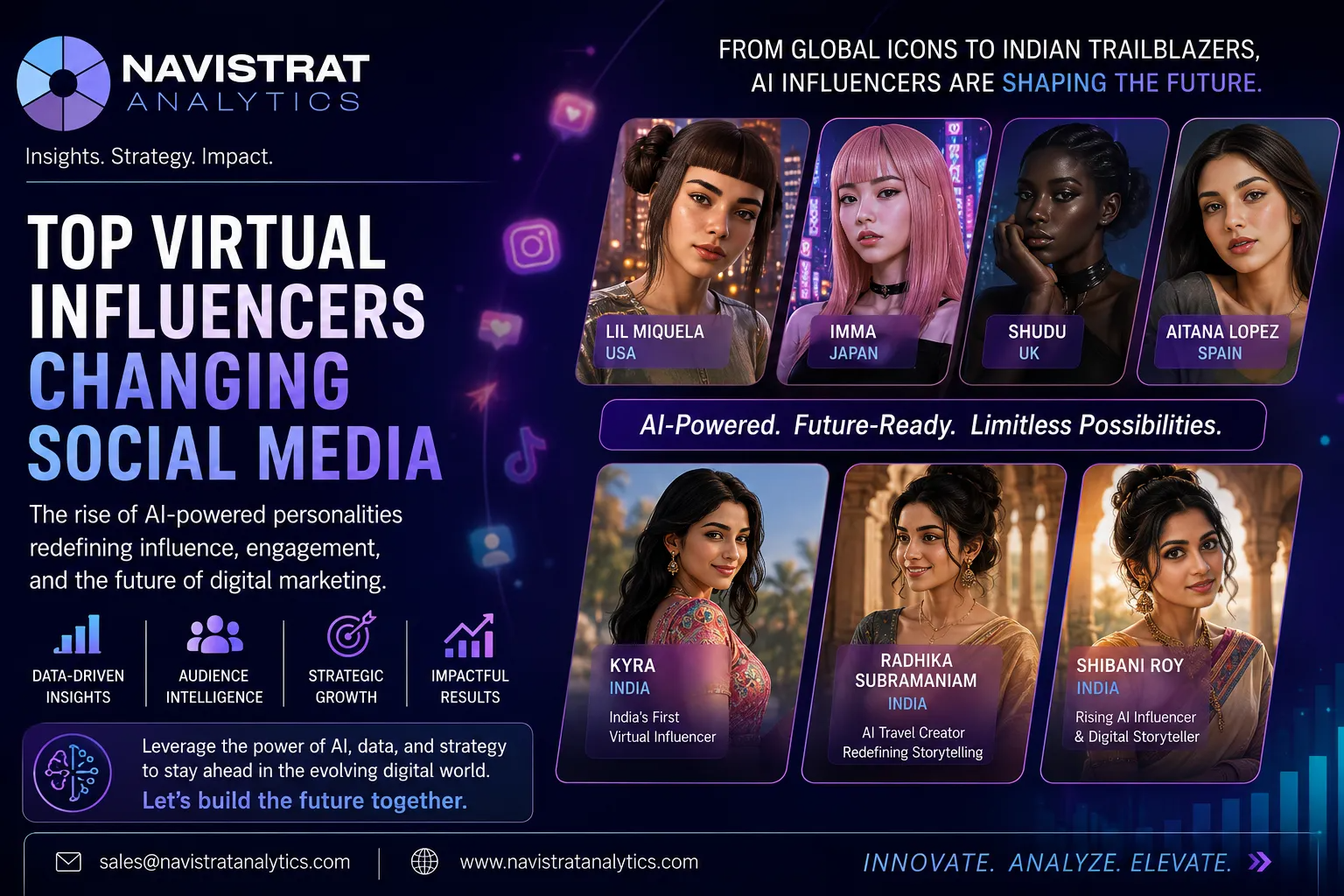
    Top Virtual Influencers Changing Social Media

    Imagine scrolling through Instagram and discovering a fashion model with flawless style, a growing fan base, and partnerships with major brands. Now imagine finding out she doesn’t actually exist.

    Welcome to the world of virtual influencers.

    Once considered a futuristic experiment, AI-powered influencers have become one of the most disruptive forces in digital marketing. These computer-generated personalities are attracting millions of followers, collaborating with global brands, and reshaping how audiences engage with content.

    From Lil Miquela in the United States to Kyra in India, virtual influencers are proving that influence is no longer limited to humans. They are becoming powerful storytellers, brand ambassadors, and digital celebrities in their own right. The question is no longer whether virtual influencers will become mainstream. The question is how much they will transform the future of social media.

    The Rise of the Virtual Influencers Economy

    Social media has gone through several transformations.

    The first era belonged to celebrities.

    The second era belonged to content creators.

    The third era belongs to influencers.

    Now, a new era is emerging—one powered by artificial intelligence.

    Virtual influencers combine AI, CGI, digital design, and storytelling to create online personalities that can interact with audiences, promote brands, and build communities. Their popularity continues to grow because they offer something unique: the ability to blend creativity, technology, and scalability.

    Brands are taking notice.

    Virtual influencers can appear anywhere, wear anything, and participate in campaigns without many of the logistical challenges associated with traditional content production. They offer consistency, creative flexibility, and global reach.

    More importantly, they appeal to younger audiences who are increasingly comfortable engaging with digital-first experiences.

    Why Virtual Influencers Are Capturing Attention

    The success of virtual influencers is not just about technology.

    People don’t follow influencers because they are human.

    People follow influencers because they tell stories.

    The most successful AI influencers have distinct personalities, unique visual identities, and compelling narratives. They create emotional connections that encourage followers to engage, comment, and share.

    Research has also shown that trust plays a major role in virtual influencer effectiveness. Content that feels more human and relatable often generates stronger audience responses and engagement.

    This is why leading virtual influencers focus on lifestyle, fashion, travel, music, and personal storytelling rather than simply showcasing technology.

    The Global Virtual Influencers Leading the Industry

    Lil Miquela (United States)

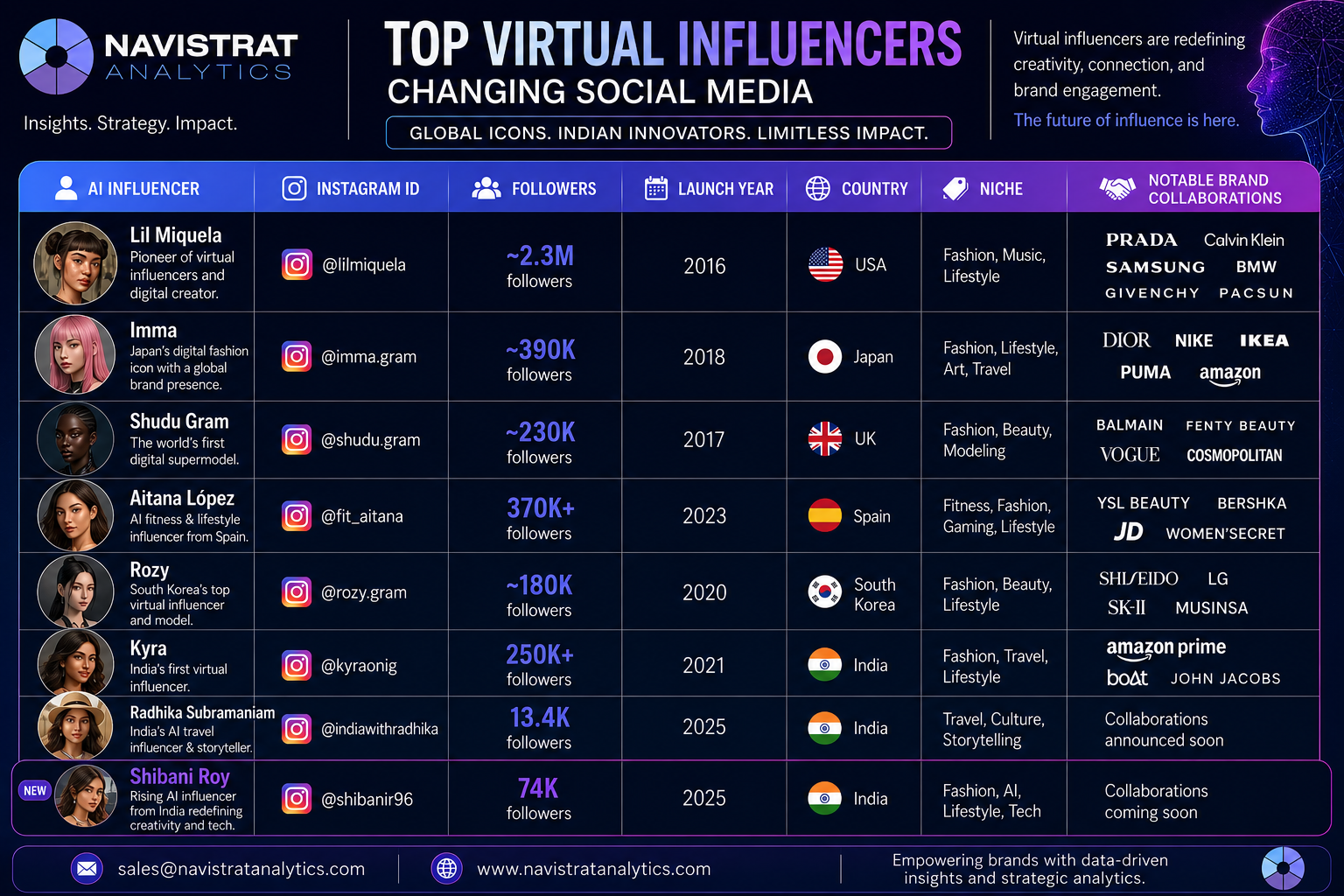
    If there is one virtual influencer who changed the industry forever, it is Lil Miquela. Created in 2016 by Brud, Lil Miquela is widely regarded as the world’s most influential virtual influencer. Today, she has millions of followers across social platforms and has collaborated with major brands including Prada, Calvin Klein, Samsung, Givenchy, and BMW. Recent industry analyses estimate her audience at more than three million followers across Instagram and TikTok.

     Lil Miquela proved that audiences care more about storytelling and personality than whether an influencer is physically real. She helped establish the foundation for today’s virtual influencer industry and remains a benchmark for digital creator success.

    Imma (Japan)

    If Lil Miquela pioneered the industry, Imma helped legitimize it within the fashion world. Created by Aww Inc., Imma is instantly recognizable thanks to her signature pink bob hairstyle. Since her launch, she has become one of Asia’s most successful virtual influencers and has collaborated with brands including Dior, Nike, IKEA, Amazon, Porsche Japan, Puma, Calvin Klein, and Valentino.

    Unlike many virtual influencers who focus heavily on futuristic narratives, Imma’s content feels surprisingly relatable. She posts fashion, lifestyle, travel, and behind-the-scenes content similar to that of human creators. Recent industry analyses continue to identify Imma as one of the most influential virtual personalities in the global fashion industry.

    Shudu (United Kingdom)

    Created by photographer Cameron-James Wilson, Shudu is often described as the world’s first digital supermodel. When Shudu first appeared online, many people assumed she was a real fashion model. Her photorealistic appearance sparked widespread discussions about beauty standards, representation, and the future of modeling.

    Over the years, Shudu has appeared in campaigns for luxury and fashion brands and has become one of the most recognized digital models globally. Shudu pushed the boundaries of what digital humans could achieve. Her success demonstrated that AI-generated personalities could compete visually with traditional models and become part of high-fashion campaigns.

    Aitana Lopez (Spain)

    Aitana Lopez represents the next evolution of virtual influencers. Created in Spain, Aitana gained attention because of her highly realistic appearance and lifestyle-focused content. Unlike earlier CGI influencers, Aitana emerged during the generative AI boom, benefiting from advances in AI image generation and content creation technologies.

    Her rapid rise attracted international media attention and highlighted the growing commercial potential of AI-generated creators. Recent industry discussions frequently cite Aitana as one of the most successful examples of modern AI influencer marketing. Aitana demonstrates how advances in generative AI are making virtual influencers more accessible, scalable, and difficult to distinguish from human creators.

    The Rise of Indian Virtual Influencers

    India’s creator economy is among the fastest-growing in the world. It was only a matter of time before AI influencers entered the conversation.

    Kyra

    Kyra is widely recognized as India’s first virtual influencer and one of the pioneers of AI-powered content creation in the country. Her content focuses on fashion, travel, lifestyle, and luxury experiences. Since her introduction, she has collaborated with multiple brands and helped introduce Indian audiences to the concept of virtual influencers.

    At a time when many Indian consumers were unfamiliar with AI-generated personalities, Kyra demonstrated that digital creators could build meaningful engagement within India’s rapidly growing creator economy. Kyra laid the foundation for India’s virtual influencer ecosystem and opened the door for future AI-powered creators.

    Radhika Subramaniam

    One of the most notable developments in India’s AI influencer landscape occurred in June 2025 when Collective Artists Network launched Radhika Subramaniam, India’s first AI-generated travel influencer. Designed as a Tamil-English speaking Gen Z traveler, Radhika focuses on culturally rooted storytelling and local experiences. Her launch attracted significant media attention and highlighted how AI influencers can connect with audiences through identity-driven narratives rather than simply visual appeal.

    Shibani Roy

    Among India’s emerging AI influencers, Shibani Roy is building a distinctive presence by combining fashion, lifestyle, technology, and digital storytelling. Rather than focusing solely on visual content, Shibani Roy aims to create meaningful conversations around creativity, artificial intelligence, and the future of digital influence.

    Her journey reflects a broader shift in the influencer landscape. Audiences increasingly seek personalities that inspire curiosity, offer unique perspectives, and explore new forms of storytelling. As India’s AI creator ecosystem expands, Shibani Roy represents a new generation of digital creators who are using artificial intelligence not just as a tool, but as a platform for imagination and innovation.
    Latest Trends Shaping the Future of AI Influencers (2026)

    Hyper-Realistic AI Personalities

    Recent reports suggest that AI influencers are becoming increasingly difficult to distinguish from human creators. Advances in generative AI, image generation, voice synthesis, and video creation are accelerating this trend.

    AI Influencers Beyond Fashion

    The first wave of virtual influencers focused primarily on fashion and lifestyle.

    The next wave is expanding into:

    • Travel
    • Education
    • Gaming
    • Healthcare awareness
    • Technology
    • Finance

    What This Means for Brands

    For marketers, virtual influencers represent more than a trend.

    They offer:

    • Consistent brand representation
    • Unlimited creative possibilities
    • Scalable content production
    • Greater control over campaigns
    • Access to technology-focused audiences

    At the same time, authenticity remains essential.

    The future is unlikely to be a competition between AI influencers and human influencers. Instead, the most successful campaigns will combine the creativity of AI with the trust and emotional depth that human creators provide.

    The Future of Social Media Is Hybrid

    Virtual influencers are no longer experimental projects. They are becoming a permanent part of the creator economy. Advances in generative AI, conversational AI, digital humans, and real-time content generation are making virtual personalities increasingly realistic and interactive. As these technologies mature, audiences will see more AI-powered creators across fashion, entertainment, travel, gaming, and marketing.

    The future of social media will not be defined by humans or machines alone. It will be defined by creators who can tell compelling stories, build meaningful communities, and adapt to an increasingly digital world.

    Final Thoughts

    • The rise of virtual influencers marks one of the most significant shifts in the history of social media.
    • From global icons such as Lil Miquela, Imma, Shudu, and Aitana Lopez to Indian pioneers like Kyra, Radhika Subramaniam, and the emerging Shibani Roy, AI-powered creators are reshaping how influence is created and consumed.
    • For brands, marketers, and content creators, the message is clear: The future of influence has already arrived.
    • It’s more digital, more creative, and more intelligent than ever before.
  • Emotion AI: How AI is Revolutionizing Human-Computer Interaction

    Emotion AI: How AI is Revolutionizing Human-Computer Interaction

    Discover how Emotion AI is transforming industries by analyzing human emotions using AI. Learn about its applications, benefits, and future trends.

    How AI is revolutionizing human-computer interaction

    Introduction:

    Imagine a world in which technology cannot respond merely to our words but also to the feelings inside us. Whether it is a virtual assistant tuning into our frustration, a car assessing the driver for fatigue, or an AI chatbot adapting to our moods, such scenarios are no longer science fiction—it’s the reality for now. Emotion AI is also known as affective computing. It is an advanced technology that gives machines the capability to recognize, interpret, and act upon human emotions. This technology processes facial gestures, tone of voice, and physiological signals to determine an individual’s emotional state. Emotion AI uses machine learning, deep learning, natural language processing (NLP), and computer vision to analyze human emotions.

    Why is Emotion AI Gaining Popularity?

    The global demand for personalized emotionally intelligent AI solutions is on the rise across industries. Healthcare providers, automakers, retailers, educators and other businesses are exploring how Emotion AI can enhance customer experience, mental health support, driver safety, and even e-learning engagement.  Research in consumer psychology indicates that decision-making is predominantly guided by intuition and emotions rather than purely logical reasoning. Emotional factors influence nearly 95% of buying decisions, thereby shaping the experiences and expectations of consumers. Therefore, businesses are adopting Emotion AI technologies to gauge human emotion through the study of facial expression, voice tone, and other behavioral patterns.

    According to Navistrat Analytics, the global emotion AI market reached USD 2,548.7 million in 2024 and is expected to register a revenue CAGR of 22.3% during the forecast period. Major technology companies such as Google, Microsoft, IBM, and Affectiva have invested heavily into this field to bring more advanced solutions to the market. In September 2023, for instance, Swedish company Affectiva (a subsidiary of Smart Eye) introduced a new attention metric into its cloud platform for Emotion AI. This innovation marks a significant step forward in measuring viewer attention for brands, advertisers, entertainment companies, and market researchers.

    How Does Emotion AI Work?

    Emotion AI, operates at the intersection of artificial intelligence, psychology, and neuroscience. It allows machines to analyze human emotions by interpreting facial expressions, voice tones, physiological signals, and behavioral patterns. Let’s break down the three core technologies behind it.

    • Facial Expression Analysis: Our face is a powerful communicator of emotions, and Emotion AI can detect micro-expressions that reveal happiness, anger, sadness, surprise, or frustration. For example, Apple’s Face ID doesn’t just unlock phones—it can read our expressions to create Animojis that mimic your mood in real-time.
    • Voice Emotion Recognition: Our tone, pitch, speed, and intensity convey emotions just as much as our words. Emotion AI listens beyond spoken language to detect joy, stress, excitement, or irritation. For example: Call center AI assistants use this technology to detect customer frustration and escalate issues to human agents before complaints.
    • Physiological & Behavioral Analysis: Our bodies react to emotions in subtle ways, such as heart rate changes, pupil dilation, or body posture shifts. Emotion AI analyze these physiological signals to assess stress, confidence, or nervousness. For example: Smartwatches like Fitbit and Apple Watch monitor stress levels based on heart rate and skin response.
    Applications of Emotion AI Across Industries

    Emotion AI is transforming industries by providing machines to understand and respond to human emotions. From automotive safety to personalized marketing, businesses are adopting this technology to enhance user experiences and decision-making. Let’s explore its real-world applications across various sectors.

    • Automotive: Emotion AI, powered by eye-tracking and facial recognition, monitors driver fatigue, alertness, and emotional state. If drowsiness or distraction is detected, the system triggers alerts, reducing accident risks.
    • Healthcare: AI chatbots analyze voice tone and speech patterns to detect signs of stress, anxiety, or depression, providing early intervention. In addition, Wearable devices track heart rate variability and facial expressions to assess pain levels, improving patient care.
    • Retail & E-Commerce: AI analyzes facial expressions and eye movements to suggest products that match the customer’s emotional response. Various brands are currently using AI-powered sentiment analysis to test ad effectiveness and optimize campaigns.
    • Customer Service: AI-powered chatbots detect frustration in a customer’s voice and adjust responses accordingly to provide a better experience. Call centers analyze customer emotions in real time to escalate urgent issues to human agents when needed.
    • Education: AI detects student engagement levels through facial expressions and adapts teaching methods to keep learners focused. AI tutors adjust difficulty levels based on students’ frustration or confidence.
    • Entertainment & Media: AI evaluates facial reactions while watching content to measure engagement and fine-tune entertainment strategies. Emotion AI enhances voice synthesis, making AI-generated voices sound more natural and expressive.
    • Finance & Banking: AI detects suspicious behavior by analyzing voice stress levels and facial cues during transactions. AI chatbots offer tailored financial advice based on a customer’s emotional state and concerns.
    • Gaming: AI-powered non-playable characters (NPCs) react dynamically to a player’s emotions, making games more immersive. Games can adjust difficulty based on the player’s frustration or excitement levels.

    Applications of Emotion AI

    The Future of Emotion AI: What’s Next?

    Emotion AI is rapidly evolving, with significant advancements from tech giants like Google, Apple, and Microsoft. These developments are shaping the future of human-computer interactions, making them more intuitive and emotionally responsive. In April 2024, for instance, Microsoft has submitted a patent application for “intentional virtual user expressiveness,” a technology designed to recognize a user’s emotional state and represent it through animated facial expressions. The system analyzes various data points to assess the user’s emotions and their intensity. This information is then processed by a facial animation model, which generates a dynamic, emotion-based rendering of the user, updating in real-time or near-real-time for a more natural and expressive virtual interaction.

    The year 2025 marks the beginning of a new chapter in mental health care. Emotion AI will be instrumental in evaluating emotional well-being, delivering personalized interventions, and offering real-time assistance. In March 2024, the U.K.’s National Health Service introduced a chatbot called Wysa to help adults and teenagers manage stress, anxiety, and depression. This initiative is revolutionizing mental health care by enhancing accessibility. It enables early detection, and improving the effectiveness of interventions. It is also fueling innovation within the market.

    Top Five Companies in Emotion AI Market

    Various companies are leading the development and application of Emotion AI technologies. Here are top five companies in this field:

    • IBM: IBM has been a pioneer in AI research and development. Its Emotion AI solutions are integrated into various applications. This includes customer service and healthcare, to analyze and respond to human emotions. IBM Watson, the key product of the company offers a range of AI services, including natural language processing and emotion analysis, playing a crucial role in the global Emotion AI market.
    • Microsoft: Microsoft embeds its Emotion AI capabilities in the Azure platform, providing developers with tools to build applications. It can recognize and respond to human emotions through facial expressions and voice analysis. Significant accomplishments of the company include its AI research investments and collaborations with organizations such as OpenAI.
    • Google: Google has been investing in Emotion AI to enhance user interactions across its products. Its technologies are used to improve user experience by understanding and responding to emotional cues. Key accomplishments include groundbreaking advancements in artificial intelligence, notably through Google AI and the TensorFlow platform, which enable emotion AI applications via tools like the Natural Language API and Vision AI.
    • Amazon Web Services (AWS): Amazon Web Services (AWS) utilizes Emotion AI to enhance customer interactions, particularly through its voice assistant, Alexa, which can detect and respond to users’ emotional states. In addition, AWS provides tools like Amazon Rekognition for facial expression analysis, Amazon Comprehend for sentiment detection in text, and Amazon Lex for emotionally aware chatbots and voice assistants.
    • Affectiva (Smart Eye): Affectiva originally an MIT Media Lab spin-off, is a pioneer in Emotion AI. It was acquired by Smart Eye in 2021. The company specializes in multimodal emotion recognition by analyzing facial expressions, voice tone, and physiological signals to interpret human emotions. Automotive companies widely use Affectiva’s technology in driver monitoring systems (DMS) to assess driver drowsiness, distraction, and emotional states, enhancing road safety.
    Conclusion

    The Emotion AI market is rapidly expanding, driven by technological advancements that allows machines to understand and respond to human emotions in increasingly sophisticated ways. From personalized customer experiences to revolutionizing mental health care, the applications of this technology are transforming various industries and reshaping the way we interact with technology. In addition, the rise of Agentic AI is significantly driving the expansion of Emotion AI by enhancing its adaptability, responsiveness, and real-world applications.

    As we enter 2025, Emotion AI is set to transform our lives by enabling technology to understand and respond to our emotions. Advancements in personalized devices and improved mental health support will significantly enhance our daily experiences. By embracing this emotionally intelligent future, we will create a more connected, compassionate, and fulfilling human experience.

    Is your business ready to harness the power of Emotion AI? Stay ahead of the curve and explore its endless potential today.

    Get a preview of the complete research study

    Request a free sample copy of this report

    Request customization in the report

    Follow Us in LinkedIn

    For inquiries, contact us at sales@navistratanalytics.com

error: Content is protected !!